Feeds:
Posts
Comments

Posts Tagged ‘cliff’

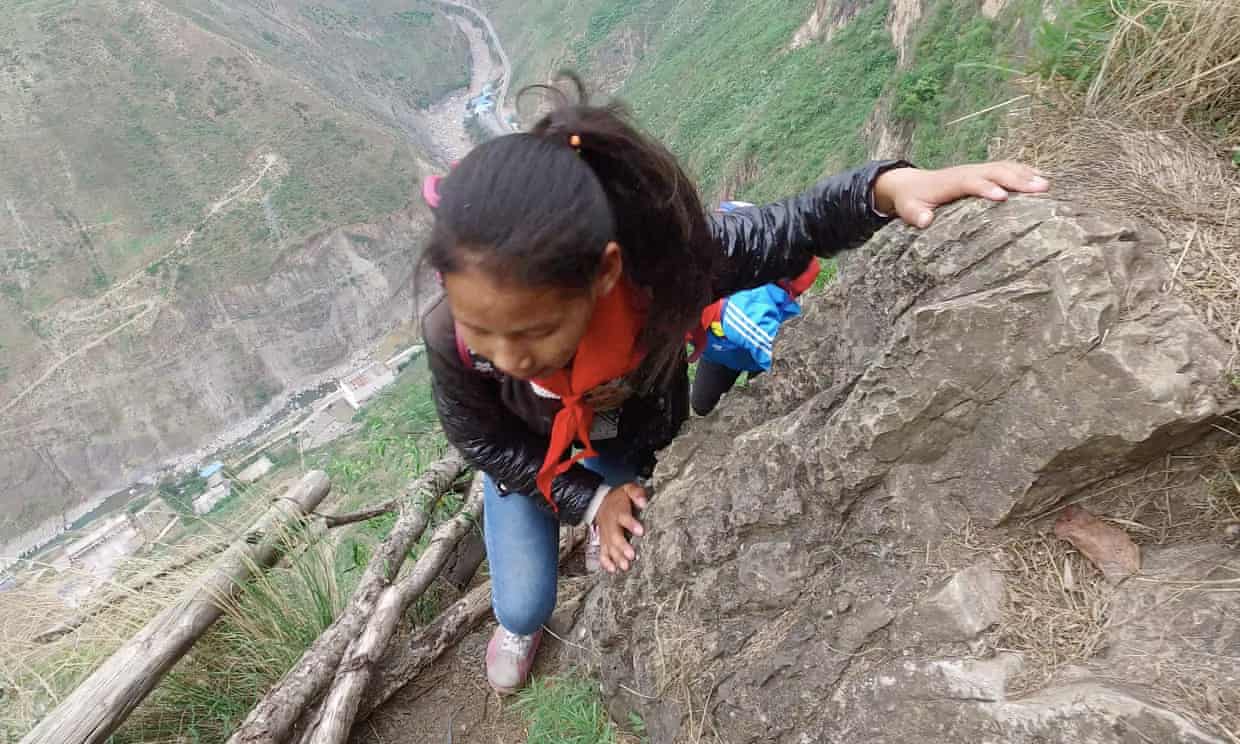
Photo: Feature China/Barcroft Images.
“There are 17 vine ladders on the 800-metre-high way home, but the most dangerous part is a path on the cliff without a vine ladder.In 2016, the Guardian reported this story on children as young as six going to school from Atuler village in Sichuan.

In one of the online English classes where I volunteer, the teacher likes to provide unusual news stories for our adult students to practice their reading on. Recently she gave the class an article from 2016 that astounded us all. After class, I searched online for a follow-up.

In 2016, Tom Phillips wrote at the Guardian, “To attend class, backpack-carrying pupils from Atuler village in Sichuan province must take on an 800-metre rock face, scrambling down rickety ladders and clawing their way over bare rocks as they go.

“Images of their terrifying and potentially deadly 90-minute descent went viral on the Chinese internet [after] they were published in a Beijing newspaper. The photographs were taken by Chen Jie, an award-winning Beijing News photographer. …

“Chen used his WeChat account to describe the moment he first witnessed the village’s 15 school children, aged between six and 15, scaling the cliff. ‘There is no doubt I was shocked.’ … Chen, who spent three days visiting the impoverished community, said the perilous trek, which he undertook three times, was not for the faint of heart.

‘It is very dangerous. You have to be 100% careful,’ he told the Guardian. ‘If you have any kind of accident, you will fall straight into the abyss.’

“So steep was the climb that Zhang Li, a reporter from China’s state broadcaster CCTV who was also dispatched to the mountain, burst into tears as she attempted to reach Atuler village. ‘Do we have to go this way?’ the journalist said as her team edged its way up the cliff face. ‘I don’t want to go.’

“Api Jiti, the head of the 72-family farming community which produces peppers and walnuts, told Beijing News there had been insufficient room to build a school for local children on the mountaintop.

“But the perils were evident. The villager chief told the Beijing News that ‘seven or eight’ villagers had [died] after losing their grip during the climb while many more had been injured. He had once nearly fallen from the mountain himself.

“The trek to school is now considered so grueling that the children have been forced to board, only returning to their mountaintop homes to see their families twice a month.

“Villager Chen Jigu told reporters the wooden ladders used to move up and down the mountain were, like the village, hundreds of years old. ‘We replace a ladder with a new one when we find one of them is rotten,’ he said.”

In the Insider follow-up story, we learn that the government came to the rescue, although not everyone agreed to move. Michelle Mark wrote, “The Chinese government has resettled 84 households who once lived in a remote village at the top of a 2,624-foot cliff.

“The village made international headlines in 2016, after harrowing photos showed young children climbing down the cliff to go to school, descending rickety ladders made of vines and scaling narrow paths without any guardrails or safety devices.

“The villagers have since been moved into apartment buildings near the town center of Zhaojue County in the province of Sichuan, according to the state-run broadcaster CGTN.

“The broadcaster quoted one villager who said Atule’er residents drew lots for their new homes — [the villager] said he was allowed a 1,076-square-foot dwelling because there are five people in his family, and that he was looking forward to accessing services in the new area that were previously unavailable to him. …

“The resettlement of the Atule’er villagers is reportedly part of a broader campaign to house impoverished families in remote villages. The Zhaojue County site is expected to soon house more than 18,000 residents from 4,057 households, according to CGTN.

“Despite the efforts, not all Atule’er villagers were willing to leave their homes. CNN reported that 30 households intended to stay in their clifftop homes, partly due to a newfound tourist economy. Roughly 100,000 people visited Atule’er in 2019, creating some $140,000 in revenue for the village”!

More at the Guardian, here, and at Insider, here.

Read Full Post »

There are a few websites that are always reliable for blog topics: Brain Pickings, Studio 360, Only a Game, On the Media, Eco RI News, Arts Journal, and until recently, AndrewSullivan.com (Andrew retired).

Another website I like a lot is the one for the radio show Living on Earth. Here Living on Earth‘s Steve Curwood touches base with writer Mark Seth Lender to learn about lambs that teach themselves to climb  (kind of like the kids in the wild playgrounds we’ve noted).

“Rocky Mountain bighorn sheep are born with all the climbing gear they need: feet evolved to grab and hold on near-vertical rock, and an uncanny sense of balance. Writer Mark Seth Lender came across a herd of the sheep near Alberta’s Jasper National Park late last summer and discovered that for the lambs, having the equipment is not enough. They still have to learn how to use it.”

Lender explains, “They are working it out. The lambs, by themselves. Where the mountain tapers smooth and hard off the ridgeline. The rest of the herd, already picking their way among the crags and cracks is heading down. But the lambs upon this unfamiliar terrain, hold back. The ewe by her stance and where she looks has led them here. To the edge. But will not show them how. Down they will learn on their own.

“She stands aside, and waits. …

“They are not full of play. They stand on the high point and look, long, toward the river and the sweet grass far …  far … below. They look. And look: To left to right slowly turning their heads. They plan: each move, each angle polished into an extended curve. A calculus: For every way point, every stopping place, the risk of a dead end. …

“Sometimes the only down is up: they scramble against the vertical, grappling with their cloven feet, the ledge where the gamble led too narrow for a bird. Sometimes, what looks easy is impossible: the gradual slope, which ends in a sheer and impassible cliff. Sometimes the granite cleaved along the head grain is the only path and the only safety a headlong run, the living rock inclined too steep for caution.

“The hooves of rocky mountain bighorn sheep are broad as a puck, gray as the living rock (as if the color gives them grip). They hold, like India rubber pads, where purchase seems untenable, a magician’s trick, inertia where there should be none. Up where the trees are far and few and the dead wood outnumbers the living.” More here.

Photo: Mark Seth Lender
The ewe leads them to the edge, but will not show them how to climb down.

Read Full Post »

Photo: Julie Van Stappen, National Park Service
Apostle Islands sea caves

Winter seems to be hanging on, so it’s not too late to blog about the Apostle Islands and the sea caves in winter.

My husband and I visited the Apostle Islands 16 years ago, almost to the day. We stayed in a pleasant B&B that had a waitress who, my husband recalls, acted like one’s sojourn there “was the experience you had been waiting for your whole life.” We drove around and tried to keep warm. I’m looking at a pottery pitcher with an apple on it that we bought in a little shop.

At the New Yorker, Siobhan Bohnacker introduces a slide show on the sea caves, calling them “Cathedrals of Ice.”

“This past February, thanks to an unusually cold winter, the sea caves along the Apostle Islands National Lakeshore, in northern Wisconsin, were accessible by foot for the first time in five years. Visitors were able to walk two miles over the thick ice of Lake Superior to see the ice formations that run up the coastline. Erin Brethauer, a photographer living in North Carolina, visited …

“Describing the trek to the caves, Brethauer told me, ‘A steady stream of people cut a colorful line on the horizon. More than a hundred and thirty-eight thousand people visited the ice caves this winter, up from twelve thousand seven hundred in 2009.’ …

“The shorelines along the Apostle Islands have been slowly shaped by the movement of the water of Lake Superior, and by its annual freezing and thawing. Sea caves, which resemble honeycombs, are sculpted in the course of centuries by waves breaking onto cliffs. This impact creates what are called reëntrants, or angular cavities that tunnel into cliffs. When reëntrants join behind the cliff face, sea caves result. When water is trapped in the caves and cavities, and freezes, dramatic ice formations occur.

“Brethauer said, ‘We were struck by the size and coloring of the ice along the coastline. Some ice was a pale blue, while other formations were yellow or reddish, depending on the sediment the water collected when it was freezing. … I loved watching how people interacted with the caves and ice, climbing or taking pictures. They provided such scale and added to your feeling of wonder. And then, stepping inside one of the caves, looking up, and listening to the silence or the ricochet of sound, it felt like being in a cathedral.’ ”

Check out the slide show at the New Yorker, here.

Read Full Post »