Feeds:
Posts
Comments

Posts Tagged ‘club’

Photo: Brooke Holder/The Christian Science Monitor.
Eddie Lorah performs at Barber’s Den in Somerville, Massachusetts, Sept. 14, 2024. Every Don’t Tell Comedy show is located at an unconventional venue. 

People often say, “I have to laugh so I don’t cry.” And goodness knows, we all need laughter. In fact, a doctor I met when I was working for Minnesota Physician actually taught people how to make themselves laugh. Because it boosts endorphins that are good for you. He called himself the Laugh Doctor.

Now I’m learning that there’s such a thirst for comedy these days that live clubs are popping up everywhere. Including in barbershops.

Stephen Humphries writes at the Christian Science Monitor, “Of all the options for a night out in Boston, an immigration lawyer’s office probably doesn’t rank high on many lists. Yet that’s where Hayley Licata and Renee Tracy found themselves last fall. The two recent college grads had such a blast that they’ve opted to repeat the experience.

“Tonight, they’ve arrived at a barbershop. This location was a secret – just as the law office had been. A man at the door checks that they’re on the guest list. Then he welcomes them to Don’t Tell Comedy.

“Every weekend, in over 200 cities around the world, Don’t Tell Comedy hosts secret shows by stand-up comedians. Venues range from boxing gyms to boats. For one night only, this dimly lit salon in Somerville, Massachusetts, has been transformed into a pop-up comedy club. In one corner, a microphone stand basks in the flat halo of a spotlight. Forty folding chairs have been set up between work stations sporting arrays of electric razors. …

“Founded in 2017, Don’t Tell Comedy has had a success that reflects the remarkable boom of live comedy since the pandemic. In large part, the demand for stand-up has been fueled by filmed specials on streaming platforms and funny clips on TikTok and YouTube. But, paradoxically, it’s also a reaction to those media. Events such as Don’t Tell Comedy are inspiring people to get off their couches, because online entertainment is no substitute for participating in intimate, in-person events.

“ ‘It feels a little bit like magic,’ says Brendan Eyre, the headliner among the five performers at the barbershop. … ‘You’re sharing an experience with strangers. You’re laughing at the same thing. They’re laughing at the same thing, which brings people together. You feel a sense of community.’ …

“In an era when many people can’t seem to watch television without constantly checking their phones, the audiences for both sets at the barbershop are fully unplugged for more than 70 minutes. Attendees may even become part of the show. For instance, one comedian cracked a joke about first-timers Gilbert Paredes and Kelly Emmons.

“ ‘If you sit at the front, they might give you attention,’ says Ms. Emmons. ‘But that’s part of the fun. If you wanted something that was one-way, you would stay at home and watch your TV.’ …

“For her, part of the appeal of the inexpensive Don’t Tell Comedy event is discovering talents she hasn’t heard of before. The lineups are a secret prior to each show. (Very occasionally, big-name acts such as Jeff Garlin and Michael Che will drop by to road test new material.)

“Tonight, audiences are especially enamored with comic Janet McNamara. She tells the audience about her audition for Season 9 of ‘American Idol.’

“ ‘You know how they have “bad people”? I was one of the bad people,’ Ms. McNamara tells the room, which erupts with laughter. ‘I went on as, like, a goof to make my friends laugh. But then it didn’t occur to me that it would be on TV.’

“Ms. McNamara, who mercifully didn’t sing during her set, performed at the first-ever Don’t Tell Comedy show. It was staged in a backyard in Los Angeles in 2017. She says fringe stand-up venues aren’t a novel concept – shows in laundromats predate Don’t Tell Comedy – but what the company does especially well is showcase fast-rising stars on its YouTube channel.

Case in point: Susan Rice, a septuagenarian comic from Portland, Oregon.

“ ‘Her set really just did well,’ says Don’t Tell Comedy’s chief operating officer, Brett Kushner. ‘It’s over a million [viewers] now. She’s now taping her special down in LA from that momentum.’ “

More at the Monitor, here. No firewall.

Read Full Post »

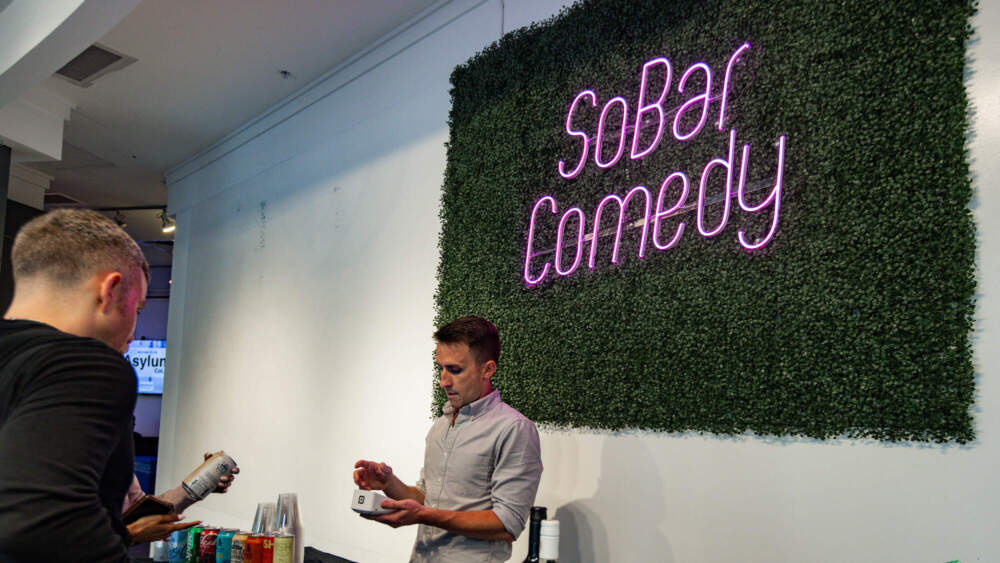
Photo: SoBar Comedy.
SoBar Comedy worked in collaboration with Dray Drinks, Boston’s first non-alcoholic bottle shop to assemble its lineup of non-alcoholic beers, wines and mocktails.

We’ve featured articles about watering holes that ban cellphones (here, for instance) so people can socialize without distractions. Turns out, there are also people who hate all the alcohol that flows at comedy clubs, people who would really like to enjoy the comedy. Enter, Boston’s SoBar.

WBUR Radio’s Elijah Nicholson-Messmer reports, “When John Tobin started working as a door person at a local comedy club in the early ‘90s, his boss asked him how he liked the work.

“ ‘I love being in the comedy business,’ Tobin said.

“But his boss Dick Doherty, a legend in the city’s comedy scene who drank and drugged his way through the ‘60s, ‘70s, and early ‘80s, was quick to correct him.

” ‘You’re not in the comedy business,’ Tobin recalled Doherty saying. ‘You’re in the alcohol business.’

“Over three decades later, that business has started to change. Younger adults are drinking less than they did 10 or 20 years ago and show producers like Tobin and his business partner Norm Laviolette are taking notice.

[In June] they launched SoBar Comedy, the country’s first sober-curious comedy club [to host] bi-weekly improv and stand-up shows, located in Faneuil Hall.

“Tobin and Laviolette own and operate some of the biggest comedy clubs across New England, including Laugh Boston and Improv Asylum. Laviolette said they started noticing the trend at their other comedy clubs, where food and beverage sales form a cornerstone of the business model. The pattern soon became clear — younger audience members were increasingly forgoing beers and cocktails when going out.

“ ‘As we started to watch we’re like, “Well, geez, maybe there’s an opportunity . . . to do something that speaks directly to that mindful drinking, sober-curious [mindset],” ‘ Laviolette said. …

“On opening night at SoBar, some folks were excited to sample the non-alcoholic beers and mocktails on offer, crafted in collaboration with Dray Drinks, Boston’s first non-alcoholic bottle shop. …

“Performing comedy for an all-sober audience is a daunting task for some comedians, but for Corey Manning, who headlined and hosted SoBar’s inaugural show, having an alcohol-free night of comedy comes with plenty of upside.

“ ‘One of the things that’s different about a sober show than the regular comedy show is that I didn’t have to deal with a drunk audience member, which is always a good thing not to have to do,’ Manning said.

“This December, Manning will celebrate 30 years of sobriety from drugs and alcohol. Now, he helps others as a substance misuse counselor. But in the early years of his sobriety, performing in comedy clubs across the country made that journey challenging. …

“Crowds and performers expect alcohol at comedy clubs like they expect popcorn at a movie theater, Manning said. But for audiences and comedians who want a fun night out without the drinking, that relationship can be far from ideal. Over the years, Manning’s sobriety has helped other comedians as well.

“ ‘Because I have been consistently the person that didn’t drink at comedy shows, it actually has inspired other comedians who are having difficulties with drinking and stuff like that to not drink,’ Manning said. ‘And one of the things that I also started trying to do is work that material into my set, because sometimes I hit home with someone in the audience.’

“Other comedians like Mary Spadaro, who performed at SoBar’s opening night, make an asset of their sobriety, flipping what could easily be a heavy subject into fresh comedy material.

“Decades after Tobin got his start as a comedy club door person, his old boss’s words still ring true for much of the industry today. Many comedy clubs across the country are still very much in the alcohol business. But for Tobin and Laviolette, it’s all about putting the comedy first.”

Uh-oh. I found that the club is on hold until “early 2025.” I hope it succeeds long term. With two successful clubs under their belts, I think the owners know what they’re doing. Maybe summer was just not the best time to launch in Boston. Do you think a sober comedy club could thrive where you live?

More at WBUR, here.

Read Full Post »

Photo: Ryan Lenora Brown/The Christian Science Monitor.
Juliet Mzibeli (front) is 12 and has been kayaking with the Soweto Canoe and Recreation Club (SCARC) since she was nine.

Every story I share here comes bundled with Covid-era caveats. You know: are the people still doing on Saturday what was reported on Friday? I’m counting on the thought that Omicron having peaked in South Africa, the kids in this article are back to enjoying their sport.

Ryan Lenora Brown reported from Soweto for the Christian Science Monitor, “As a kid growing up in South Africa, Nkosi Mzolo and his friends had a front-row seat each summer to Africa’s largest river kayak race, a 75-mile endurance paddle over bone-rattling rapids.

“But as he sat on the banks of the Msunduzi River near Durban watching the paddlers stream by in a rainbow of bright spandex, he couldn’t imagine being in their shoes. ‘I thought that was a sport for white people,’ he says.

“But Mr. Mzolo happened to grow up straddling a revolution. When he was born, in 1988, Black South Africans like Mr. Mzolo couldn’t vote or live in most parts of the country, let alone play sports with white people. By the time he was 12, though, paddling was changing in post-apartheid South Africa.

“A local Black kayaker invited Mr. Mzolo to learn the sport. … Now Mr. Mzolo runs a canoe club that trains Black paddlers, opening up a world to them, just as it opened to him.

“ ‘Canoeing pulled my life off the course it was on and put me on a different one,’ he says.

“Today, he coaches more than 75 young, Black kayakers in Soweto, near Johannesburg, hoping the sport, known to South Africans as canoeing, might do the same for them. ‘I want to give them something in their lives to look forward to,’ he says.

“In a sports-mad country still wrestling with the legacies of segregation and colonialism, integration in sports is a deeply political issue. During apartheid, South Africa was banned from international competitions like the Olympics for refusing to send racially mixed teams. Today, there are controversial racial quotas for the national teams in most major sports. But Mr. Mzolo’s paddlers are part of a generation that grew up thinking they could play whichever sport they chose.

“The club Mr. Mzolo now leads, the Soweto Canoe and Recreation Club (SCARC), was started in 2003 by Brad Fisher, the advertising executive and paddler who sponsored Mr. Mzolo’s education. He later hired Mr. Mzolo, who was working as a gardener in Johannesburg, as one of the club’s early coaching recruits.

“Since then, the club has trained some of the country’s top Black paddlers. Mr. Mzolo himself has gone on to finish the Dusi Canoe Marathon, the long-haul race he watched as a boy, 17 times. But more importantly for coaches like Mr. Mzolo, the club has given thousands of kids a passion they might never have otherwise found.

“ ‘My talent is in the water,’ says Chwayita Fanteni, who is 16 and has been paddling for three years. ‘I like the energy I get from winning.’ … 

“ ‘My goal is to go to Russia. For the Olympics,’ says Nhlamulo Mahwayi, who is 12 and has been training with SCARC since he was nine. So far, he’s only been as far as Cape Town, which he rates as ‘so fun and so clean. I saw people surfing.’

“Like many of the young paddlers here, when Mr. Mahwayi joined the club in 2018, he didn’t know how to swim.

“ ‘Ninety-five percent of these kids, I would say, they come here not knowing how to swim at all,’ says Mr. Mzolo. That too is a legacy of apartheid, which barred Black South Africans from most pools and beaches. Today, many parents never teach their kids how to swim because they themselves don’t know how to.

“New recruits to SCARC, then, often spend months in a nearby public pool before they ever dip a paddle in the water. …

“Mr. Mzolo comes here when he can, when he isn’t working a night shift as a firefighter and paramedic, or sleeping one off. … It’s exhausting, he says, but nowhere near the worry he felt last year when the club was closed for five months during South Africa’s coronavirus lockdown.

“During those months, he spent his days rushing COVID-19 patients to hospitals, and his nights wondering how his athletes were doing, many attempting to do homeschooling with no internet, computers, or even sometimes electricity. Some lived in informal settlements with no reliable water or power. Many of their parents had lost their jobs.

“With public facilities like parks and dams closed, the club couldn’t train. Mr. Mzolo went door to door visiting his athletes and bringing food parcels to their families – just as he often did before the pandemic. … On a recent afternoon, the coaches arrived in a minibus loaded with heavy bags of cornmeal, rice, tinned beans, and oil, enough for every athlete to take home a share.

“ ‘Looking at myself, I started where these kids are,’ he says. ‘Now I’m trying to be part of their journey.’ ”

More at the Monitor, here.

Read Full Post »

2019-11-14-verona-balcony

Credit: Frank Bienewald/LightRocket via Getty Images
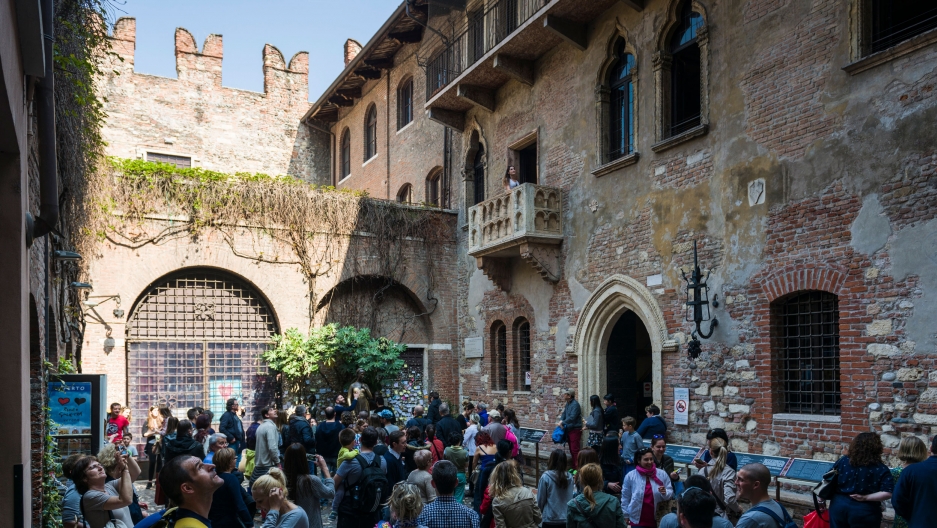
To see the famous balcony, tourists crowd the backyard of the building in Verona said to be Juliet’s house.

Having read recently that there are tens of thousands of people writing PostcardsToVoters these days, I was intrigued to learn about a letter-writing club with quite a different purpose. The letter writers in today’s post are making sure that anyone who writes to Shakespeare’s Juliet gets a personalized response.

Bianca Hillier reports at Public Radio International’s The World, “Verona, Italy, is filled with references to Romeo and Juliet, the city’s most famous literary residents. Tourists can pretend to be Juliet by standing on the balcony at what is said to be her 14th-century house.

“They can also write Juliet a letter. Each year, tens of thousands of people do, asking for advice on life and love.  They may be surprised to learn Juliet writes back.

“The personalized responses come from volunteers with the Juliet Club. Their work began decades ago as a group of friends answering letters to Juliet. … The letters have grown into a worldwide phenomenon.

“ ‘The letters started arriving in Verona maybe 100 years ago. So it’s a long tradition that belongs to the story of the city,’ said Giovanna Tamassia, manager of the Juliet Club. Giovanna’s father, Giulio Tamassia, founded the club in 1972.

“People can send letters by traditional mail, email, or by dropping a letter in Juliet’s mailbox at her house in Verona.

‘If you think, “Who writes to Juliet? Who takes the pen and writes to someone they don’t know?” It can sound crazy,’ Tamassia said. ‘But if you read the letters, you discover it’s not crazy. It has a meaning.’ …

“When the letters finally make it to the club’s modest office in Verona, they are sorted by language. Tamassia said some people write in looking for advice on love, while some simply want to express their emotions.

“ ‘We can see in these letters that [this opportunity] is a really unique thing. It’s not like writing to a doctor or a psychologist or someone you know,’ Tamassia said. ‘They don’t know who will read the letter [or] who will answer. It’s like writing to yourself, in a way. Writing is a therapy.’

“Juliet’s secretaries, as they’re called, respond to letters every day during the club’s limited hours of operation. A few remote secretaries in the United States, England, and Moscow reply to the email messages, but most letters are answered from Romeo and Juliet’s home city of Verona.

“An influx of Americans began volunteering as secretaries after a 2010 movie starring Amanda Seyfried called ‘Letters to Juliet’ popularized the club. …

“ ‘When people come to reply, it’s very heartfelt. They feel like [they are] in a mission of love. In the name of Juliet,’ Tamassia said. … ‘It’s like seeing in the hearts of many people. [We] try to give help or support or friendship. But we also receive a lot when we have the chance to read others’ lives, others’ experiences. It opens your mind to different kinds of love.’

“There are no standard replies to the letters Juliet receives, Tamassia said, and it takes secretaries 30 to 60 minutes to craft each thoughtful response.

“Only one aspect of the letters is standardized: they’re all signed, ‘All my love, Juliet.’ ” …

“As the Juliet Club nears its 50th anniversary, Tamassia said there is no plan to close the doors anytime soon.

“ ‘It’s a job I have because I love it,’ she said. ‘It started as a passion but maybe, now, I can’t stop because the letters continue and continue to arrive.’

“The doors also remain open, in part, due to donations. A local bank pays for the office space and the city of Verona pays for the stamps.

“ ‘The letters are really like a treasure. So many love stories in all languages from every corner of the world,’ Tamassia said. ‘There isn’t anything else that can be compared.’

“Instructions for writing a letter to Juliet can be found on the Juliet Club’s website.” More at PRI, here.

You know what really impressed me? That the people in the club take 30 to 60 minutes to craft a response. That’s longer than I would have thought. This is not like writing to Santa and getting no response.

Hat Tip: Twitter

Photo: David Simchi-Levi MIT

psp_4321

Read Full Post »