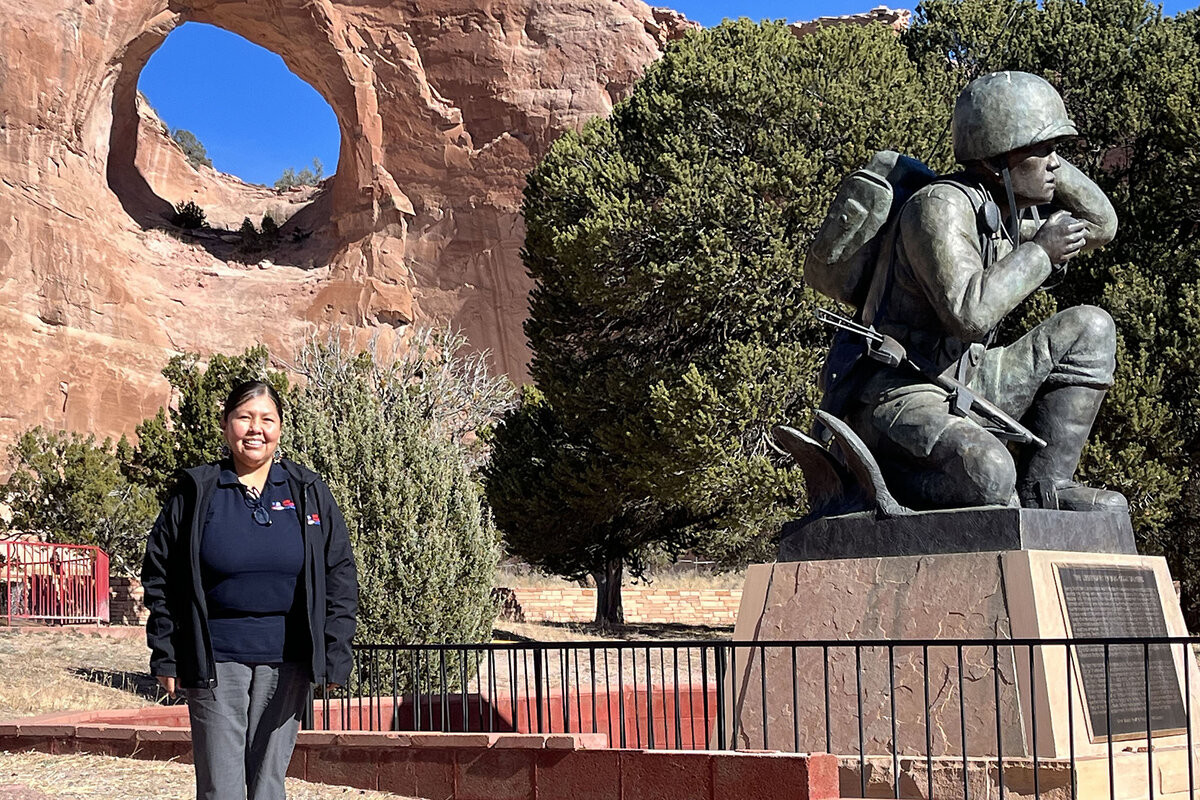
Photo: Anna Mulrine Grobe/The Christian Science Monitor.
US veteran Bernadine Tyler stands at a memorial to Navajo code talkers on the Navajo Nation, in Window Rock, Arizona.
On this Memorial Day, let’s take a look at the indigenous people who have served in our military.
Anna Mulrine Grobe writes at the Christian Science Monitor, “In her work with U.S. military veterans here on the Navajo Nation, Bernadine Tyler routinely logs 1,200 miles a month driving across an area the size of West Virginia, over high windswept plains dotted with rust-red mesas.
“Roughly one-third of homes here on America’s largest reservation don’t have electricity or running water, so Ms. Tyler, herself a member of the Navajo Nation and an Army veteran, brings services directly to her fellow vets, most of whom are over the age of 65.
“She points out the occasional gas station and folks walking on the dusty shoulders of pot-holed roads. There’s a bus, ‘but it’s very unreliable and only runs one route,’ says Ms. Tyler, program lead for the Diné Naazbaa Partnership (DNP), which serves the Navajo Nation and receives funding from the U.S. Department of Veterans Affairs. …
“For vets without transport or refrigerators, she carries bags of ice to fill the convenience store coolers that many use to chill their food and medications. She enlists volunteers, including her sons, to help haul water and chop wood for warmth in the winter.
“The particular challenges of accessing this care came to light during the COVID-19 pandemic, when Native American veterans living in small multigenerational homes without running water on closed tribal lands died at significantly higher rates than other former service members. The VA subsequently pledged to better serve America’s Native American community.
“In 2020, the VA created the first advisory committee for Native American veterans. It held its first meeting in 2022 and began issuing its recommendations last year. Though they aren’t binding, the suggestions of some committees have an acceptance rate of 90%, according to the agency. …
“With this year’s 2024 defense spending bill, lawmakers also granted the Native American Indian Veterans a congressional charter, making it the first-ever group dedicated to the interests of Indigenous people in the U.S. to get the status. It is a development that took the NAIV nearly 20 years of lobbying to achieve. With the charter, NAIV can testify before Congress and, ideally, more easily help the VA process benefits claims.
“The hope is that these developments will not only improve care, but also foment faith that, even after decades of neglect, change is possible – particularly among the 57% of Native American veterans who say their top reason for joining the military was a desire to serve their country.
“Native American veterans are among America’s most patriotic, says Adam Pritchard, a researcher at Syracuse University’s Institute for Veterans and Military Families. ‘It’s a very important step in the right direction to acknowledge their history of the service and their ongoing needs.’
“ ‘Our history has much mistrust,’ Ms. Tyler says. Good-faith efforts to fix a long-broken system and build it up, she adds, can help heal old wounds, too.
“In 1943, Thomas Begay joined the U.S. Marines. He was 16 or 17 years old – he’s not sure which. … He wanted to be an aerial gunner, Mr. Begay told the recruiter. [The recruiter sent him] to become a code talker. While he and his fellow troops practiced the top-secret tribal language with a twist, their basic training was more ad hoc than the Marine norm.
“ ‘They got us a rubber boat, and they just dumped us way out in the ocean and said … “Learn how to get to shore,” ‘ he recalled in a 2013 discussion cataloged by the National Archives.
“Months later, after landing at Iwo Jima in February 1945, Mr. Begay and his fellow code talkers were hailed as instrumental in taking the island – and later with helping to win the war. Their code was never broken. …
“Today, Mr. Begay is living in a house where bad plumbing has damaged the floors and ceiling. ‘It’s not safe for him,’ says Karen Shirley, community coordinator for DNP, which is helping him apply for VA grants to fix up his home, or get Mr. Begay a new one.
“ ‘How can we not support this great warrior who helped save this country, and just get him the housing he needs?’ Ms. Tyler says.”
More at the Monitor, here. No paywall. Subscriptions are reasonable.

 Suzanne's Mom's Blog