Feeds:
Posts
Comments

Posts Tagged ‘colonial’

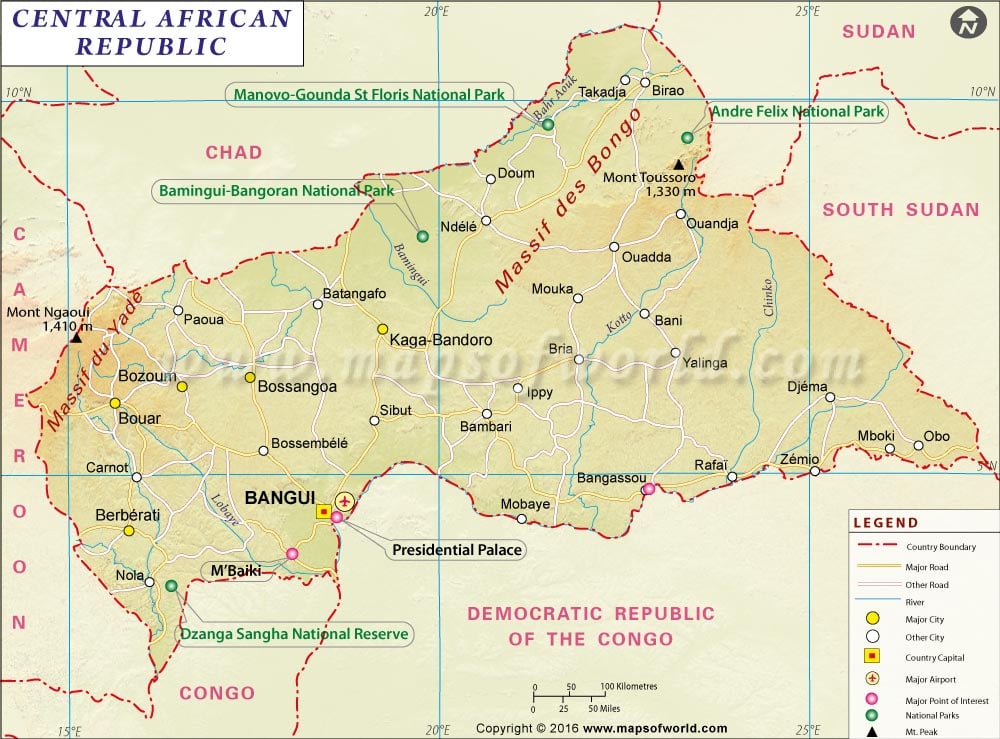
Map: Maps of the World.
The National Ballet in the Central African Republic brings to life traditional dance forms from different ethnic groups across the country. 

In parts of Africa where colonialism glommed together disparate tribes with ancestral enmities, wars have continued off and on for decades. But the Central African Republic (CAR) is setting a different example, with the help of its national ballet company. The idea is to give all the CAR groups a moment in the sun by highlighting the dance traditions of each. The effort also brings people together in new ways.

In the following article, we learn about a number of ethnic dance groups, including the National Artistic Ensemble that performed recently at the Africa Day of School Feeding (ADSF) in Bouboui. [See the African Union site for an explanation of ADSF. Interesting.]

France24 reports: “The dancers shake their hips, kicking their feet to the beat of the age-old ‘dance of the caterpillars,’ typically performed in the south where the insects are gathered for food.

“Three times a week the National Ballet rehearses traditional dances of the many ethnic groups making up the Central African Republic.

” ‘The creations they ask of us are based on the particularities of each ethnicity. I’m Banda and I have to suggest dance steps from the Banda ethnic group,’ Sidoane Kolema, 43, said.

“They aim to preserve the heritage of the CAR, a mosaic of ethnic groups that is scarred by decades of conflict and instability and is among the world’s poorest countries.

“From behind the scenes, 26-year-old Intelligentsia Oualou began singing in Gbanu, the language of her native southwestern Ombella-M’poko region.

“To the jingle of bells and rhythmic thud of the drum and xylophone-like balafon, the spinning silhouettes of the other dancers soon appeared across the dilapidated stage, set up on waste ground in the capital Bangui.

” ‘All my relatives are artists and I’ve dreamed of being an artist too,’ said Oualou. She is one of 62 dancers in the National Artistic Ensemble, created by CAR President Faustin Archange Touadera in 2021.

” ‘Promoting our cultures means going to the hinterlands to find the different dance steps of the Central African Republic in order to create a show that is diverse,’ National Ballet choreographer Ludovic Mboumolomako, 55, said. He spent three weeks living among the Pygmies in their ancestral forests in the south in order to enrich his choreography with their dances, songs and ways of living. …

“The company is often called upon to perform the ancestral dances in public at political gatherings, inaugurations and official ceremonies. In front of officials or at festivals, they dance in costumes of raffia skirts topped with pearl belts and patterned wax-print fabrics.

” ‘We need to raise awareness among young people … by dancing the different dances of our different ethnic groups in front of everyone. Tomorrow, if we are no longer here, it will be up to them to take over,’ Kolema said.

“The dancers were even recently integrated into the civil service, just like the actors and musicians who also belong to the National Artistic Ensemble.

“One of the upsides is that the dancers ‘have not a subsidy, but a salary’ [Culture Minister Ngola Ramadan] said. …

“Kevin Bemon, 44, said he had been able to put his former ‘difficult’ life dancing at neighborhood wakes behind him, thanks to the monthly salary of [$124] – just over twice the minimum wage in the CAR. …

“For a decade until 2013, the CAR was wracked by civil wars and intercommunal conflict, and although the violence has lost intensity since 2018, tensions persist.

” ‘Traditional dance has brought us together. After the recent wars, different ethnic groups were divided. Thanks to dance, we’ve become children of the same family,’ Oualou said.”

Check out the great photos at France 24, here. No paywall.

Read Full Post »

Photo: Katie Orlinsky.
“On Long Island [in New York state] a group of Shinnecock women are nursing a bay back to health and, in the process, reclaiming traditions,” writes the magazine Nature.

A couple nonprofits and a few indigenous women are putting into practice one of my favorite principles: “Two and two and 50 make a million.” They are saving their small piece of the ocean from pollution and helping to bring back a better world.

Claudia Geib writes at Nature, “Danielle Hopson Begun stands waist-deep in the waveless expanse of Long Island’s Shinnecock Bay. She reaches into the water and lifts out a heavy rope, which drips with the amber and butterscotch-colored fronds of a marine plant called sugar kelp. It’s early June, and over the past eight months this kelp, anchored here, has grown from millimeter-long seedlings into foot-long golden ribbons, absorbing nitrogen and carbon from the water in the process.

“Tended by Hopson Begun and four other women from the Shinnecock Indian Nation, these lines are part of the first Indigenous-owned kelp farm on the U.S. East Coast. The kelp is harvested each year and sold locally as a natural fertilizer. But for these women, who have formed a nonprofit organization called Shinnecock Kelp Farmers, it has become something more than a crop: It is one piece of a multifront effort to reassert ancestral ties to the lands and waters their community has stewarded for thousands of years.

“Today, though, Shinnecock Bay is drastically different from the waters their ancestors once harvested wild kelp from. It’s more polluted, and the waters have grown warmer and more acidic. And almost every year since starting the farm in 2020, Hopson Begun and her partners have found their lines coated in an alga that suffocates and kills baby kelp. It significantly reduced part of their harvests — until now.

“To combat the algae, the kelp farmers have turned to cutting-edge science and technological solutions — supported by a grant from The Nature Conservancy and industry expertise from aquaculture nonprofit GreenWave — to supplement their long connection to the bay.

“ ‘There is this traditional knowledge that we have — of how the seaweed grows in the bay, and how to nurture it and prepare it for the work that it has to do,’ says Tela Troge, one of the group’s founders. If the Shinnecock Kelp Farmers can successfully grow kelp in the bay — weaving this ancestral understanding with modern science — the plant stands to help restore an ancient link to a cultural practice, while perhaps helping stem the rising tide of pollution that has invaded these waters since the arrival of colonialism.

“Among the challenges of farming kelp is simply finding the time. The kelp farmers and their friends and families — mothers, lawyers, counselors, activists — live and work in the communities of the greater Long Island and New York City area. Today about half of the nearly 1,600 enrolled members of the Shinnecock Indian Nation live on a 900-acre property on the eastern edge of Shinnecock Bay — a property surrounded by wealthy Hamptons enclaves and just a barrier island away from the Atlantic Ocean.

“Life here has always been intertwined with water. For at least 10,000 years, the ‘People of the Stony Shore’ gathered fish, mussels, scallops and clams, and cultivated oyster gardens along a vast stretch of land and waters on and around what is now called Long Island. Skilled seafarers, they relied on the Shinnecock and Peconic Bays — both local inlets — as well as the open sea. They hunted whales and exchanged white and purple wampumpeag beads they carved from the shells of hard clams, or quahog. These beads, known as wampum, remain an important touchstone for the Shinnecock, who continue to carve them as jewelry and cultural symbols.

“When Europeans arrived in the Northeast in the 1600s, they brought diseases that decimated the Shinnecock and their neighbors, razed forests to sow farms and claimed burial grounds to build towns. Over time the Shinnecock Indian Nation lost access to most of their historic hunting and fishing grounds, retaining a territory of about 1,000 acres, including the 900-acre reservation. With the spread of new people, the waters the Shinnecock relied on changed, too.

“Shinnecock Bay, in particular, suffered. The bay spans 9,000 acres, separated from the Atlantic Ocean to the south by a narrow barrier island. Warm and shallow, with an average depth of only about 6 feet, the bay’s connection to the sea has shifted over the centuries as storms alternately carved and filled in cuts through the island. A powerful 1938 hurricane created Shinnecock Inlet, a permanent opening to the Atlantic. Yet, still largely landlocked, the bay’s waters concentrated high levels of nitrogen, which seeped through the ground from cesspools and septic systems as homes and towns sprung up along its shores.

“By the 1980s, annual nitrogen-fed algal blooms turned the water ‘brown like a cup of coffee,’ says Stony Brook University researcher Ellen Pikitch, one of the co-founders of the university’s Shinnecock Bay Restoration Program. These ‘brown tides’ clouded the water, blocking sunlight from reaching eelgrass, killing fish and destroying shellfish habitat. …

“By the mid-2000s the marine life that the Shinnecock people had once relied on was nearly gone. Oyster reefs vanished. Between the 1970s and 2011, the commercial fishery for quahogs, the clams used for Shinnecock wampum and food, collapsed by more than 99%.

“At the same time, members of the Shinnecock Indian Nation had been fighting to assert their ancestral land and water claims. In 2019, an ocean-farming nonprofit called GreenWave reached out to members of the Nation. Inspired by a PBS documentary about the Shinnecock people’s long battle against Southampton’s development, one of the group’s staffers wanted to know if members of the Nation would consider working with GreenWave on a kelp farm.

“The proposal captured the interest of the future Shinnecock Kelp Farmers for multiple reasons. They knew that, historically, the Shinnecock harvested seaweed for home insulation, food and medicine, and that kelp could absorb nitrogen and carbon into its tissues. When harvested and dried for garden fertilizer and used in place of traditional fertilizers, kelp offered a way to pull excess nutrients from the bay. …

“The Sisters of St. Joseph, a Catholic religious order, joined the collaboration by providing water access from their community center along Shinnecock Bay. In 2020, five Shinnecock women — Danielle Hopson Begun, Donna Collins-Smith, Rebecca Genia, Tela Troge and her mother, Darlene Troge — took up waders and began the work of nursing kelp to life.”

There’s a lot more at Nature, here. No paywall. Great photos.

Read Full Post »

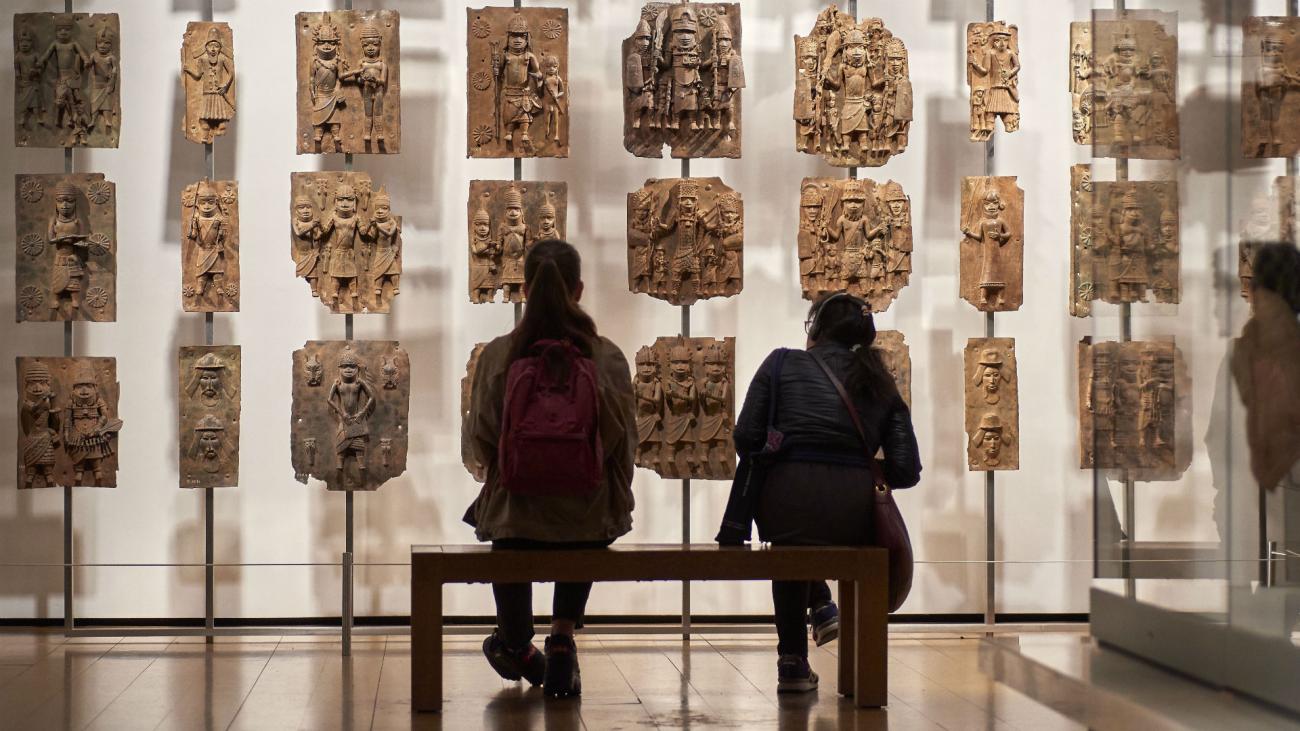
Photo: British Museum.
Benin bronzes.

Around the world, looted national treasures are beginning to return home. Among the most famous are the bronze plaques made in Benin, Africa. Now that country is building museums to protect its returning bronzes — and all its art.

Chinma Johnson-Nwosu writes at the Arts Newspaper, “The Republic of Benin, which is making its debut appearance at the Venice Biennale this year, is turning to culture as part of a strategy to spur economic growth. Its government is building four new museums in a range of locations and a cultural quarter in the largest city, Cotonou, in addition to boosting investment in arts education.

“A museum in the coastal city of Ouidah, from where the last recorded shipment of slaves to the US departed in 1860, will explore the history of slavery. It is scheduled to be completed at the end of this year, the first of the four new museums slated to open over the next five years in Benin. Maison de la Mémoire et de l’Esclavage aims to tell the history of slavery from African, American and Caribbean and European perspectives, says Alain Godonou, the director of museums for the national agency of heritage and tourism.

“Between 2016 and 2026, the Benin government plans to invest €250m [more than $5 million], with the goal of making culture the economy’s second pillar after agriculture. In addition to building museums, the government’s focus is on preserving non-material heritage, increasing cultural tourism and offering financial incentives to private investors.

“Promoting the arts goes beyond fostering a sense of national identity, says Babalola Jean-Michel Abimbola, the country’s minister of culture. ‘It’s a fight against poverty, allowing us to create jobs and build a better economy.’

“Construction began last year on a new cultural quarter in the centre of Cotonou [Le Quartier Culturel et Créatif] which is to host a contemporary art museum, a sculpture garden, a Franco-Beninese cultural institute, a concert arena, commercial galleries and a crafts village showing local crafts and heritage. …

“Further plans include the Musée des Rois et des Amazones du Danhomè in Abomey, where visitors will in future be able to explore the 300-year history of the kingdom of Dahomey. Musée International du Vodun, located in the capital, Porto-Novo, aims to rehabilitate the image of a much-maligned and globally poorly understood Indigenous religion, also known as Voodoo.

“The government hopes that the new museums will build on the success of a 2022 exhibition, where 26 recently repatriated royal artefacts went on display in the presidential office. These were shown alongside the contemporary exhibition, Art of Benin From Yesterday and Today: From Restitution to Revelation.

“The show drew more than 230,000 visitors in the three months it ran, 90% of whom were citizens of Benin, Godonou says. … While he concedes it may be too ambitious to expect to replicate the 2022 success annually, he believes a target of 100,000 would be sustainable.

“Last year, the government launched an Agency for the Development of Art and Culture. The ministries of tourism and finance are also seeking to introduce tax relief policies for the cultural industries.

“The kind of publicly funded, government-led major museum projects Benin is undertaking have little precedent in Africa. … The Benin government’s plan does, however, envisage involving the private sector. By showing entrepreneurs that people in the country are interested in art, Abimbola hopes to spark business interest. In some parts of Cotonou that is already happening. Septième Gallery, which already had a space in Paris, launched in Cotonou in 2022. …

“Investment in arts education and professional training is also increasing. Sèmè City, a government-backed development project, has revealed plans for a new Africa Design School campus located in Ouidah. The school launched in Cotonou in 2019 in partnership with L’École de Design Nantes Atlantique and has since added a masters programme and an exchange programme, in which 11 French students participated in 2023. …

“Last year, the École du Patrimoine Africain, which trains heritage professionals, celebrated its 25th anniversary. When it began, only 5% of the people working in Beninese museums were trained in heritage preservation. Now the figure is 80%.”

More at the Art Newspaper, here. Can you guess what country was the colonizer? Consider the names of the museums.

Read Full Post »

Photo: Annabel Lankai.
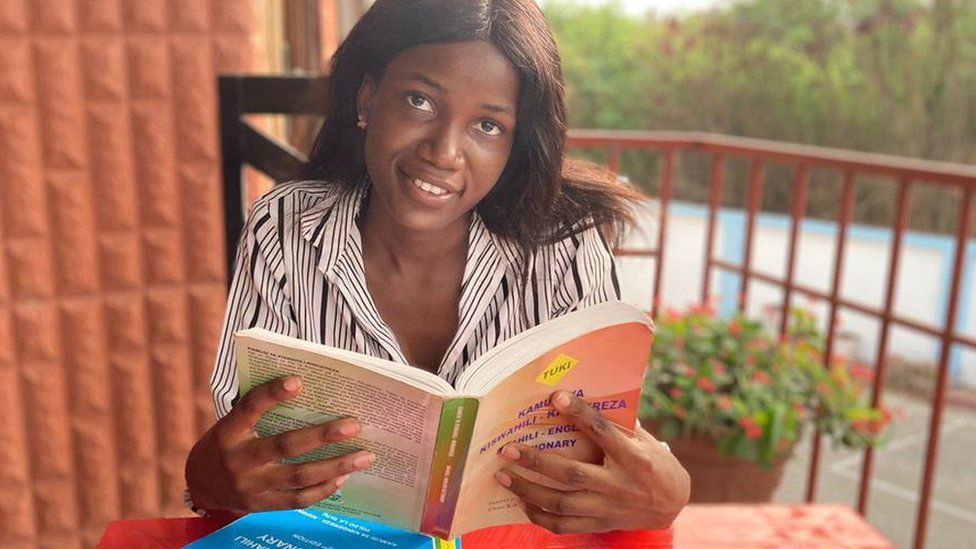
Ghanaian Swahili student Annabel Naa Odarley Lankai is advocating to make Swahili the lingua franca of Africa.

The BBC reports on renewed efforts to make Swahili the Esperanto of Africa, the universal language on the continent.

“With more than 200 million speakers, Swahili, which originated in East Africa, is one of the world’s 10 most widely spoken languages and, as Priya Sippy writes, there is a renewed push for it to become the continent’s lingua franca.

” ‘It’s high time we move from the colonizer’s language.’

“This is not part of a rousing speech by a pan-African idealist but rather the sentence is uttered quietly and calmly by Ghanaian Swahili student Annabel Naa Odarley Lankai. … Africa should ‘have something that is of us and for us,’ the 23-year-old adds.

“In its heartland, Swahili and its dialects stretch from parts of Somalia down to Mozambique and across to the western parts of the Democratic Republic of Congo. But Ms Lankai’s classroom at the University of Ghana in the capital, Accra, is some 4,500km (2,800 miles) west of Swahili’s birthplace – coastal Kenya and Tanzania. The distance could be seen as a measure of the spread of the language and its growing appeal. …

“Swahili, which takes around 40% of its vocabulary directly from Arabic, was initially spread by Arab traders along East Africa’s coast. It was then formalized under the German and British colonial regimes in the region in the late 19th and early 20th Centuries, as a language of administration and education. …

“At its recent heads of state meeting, the African Union (AU) adopted Swahili as an official working language. It is also the official language of the East African Community (EAC), which DR Congo is poised to join.

“In 2019, Swahili became the only African language to be recognized by the Southern African Development Community (SADC). Shortly after, it was introduced in classrooms across South Africa and Botswana. Most recently, Ethiopia’s Addis Ababa University announced it would start teaching Swahili. …

“Tom Jelpke, a researcher of Swahili at London’s School of Oriental and African Studies, argues that as connections grow across the continent, people will want a common way to communicate. He believes that its closeness to other languages in east and central Africa will cement its position there. But beyond those regions there may also be an ideological element. …

“Says Ally Khalfan, a lecturer at the State University of Zanzibar … ‘It is about our property and our identity as Africans.’ …

“Currently, English is the official or second language in 27 out of the 54 countries in Africa, and French is the official language in 21 of them.

” ‘English is still the language of power,’ says Chege Githiora, a linguistics professor in Kenya, in recognition of the political and economic reality. He advocates what he calls ‘fluent multilingualism,’ where people are comfortable speaking more than one trans-national language. …

“But whereas Swahili has an appeal in east, central and southern Africa, it has more competition in the west and the north. Arabic is dominant in the north, but in the west there are African languages – such as Hausa, Igbo and Yoruba – which could vie for the status of lingua franca.

“If Swahili is to become truly pan-African it will take political will, an economic imperative and financial investment to reach all regions.”

More at the BBC, here. No firewall.

Read Full Post »

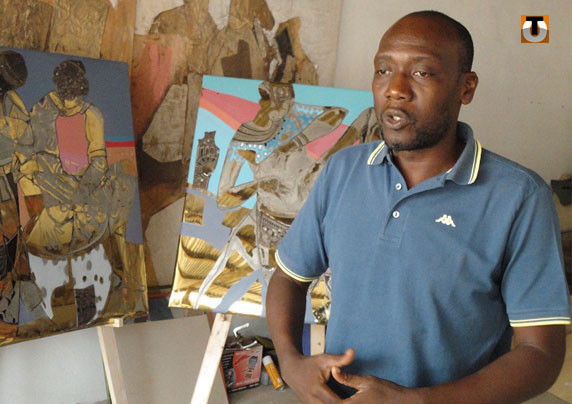
183726-emmanuel-sogbadji-sur-les-traces-de-paul-ahyi_ng_image_full

Photo: Cité Internationale des Arts
Emmanuel Sogbadji is one of the African artists whose work is shown at the new Togo museum, Palais de Lomé.        

Sometimes when I’ve been volunteering in ESL classes, I’ve caught the echo of African colonialism from languages that students try out on me because I don’t understand their native tongue. Somali and Eritrean students may know a little Italian, countries like Uganda and Zimbabwe speak English, people from such countries as Mali, Togo, and Congo know French.

Although multilingualism can be helpful in refugee language classes, I can’t help thinking the students wouldn’t have had to be refugees in the first place if the colonial powers hadn’t plundered Africa. I suppose that down the road, when the US starts welcoming refugees again, we’ll be getting people from Burkina Faso who know a little Chinese.

Anyway, because I had an English student from Togo who spoke French, I was not surprised to learn from today’s feature that Togo’s new national museum has French connections and a French name, Palais de Lomé.

Rebecca Anne Proctor writes at Frieze, “Festive scenes unfolded in Lomé’s botanical park in late November [2019], as drummers and colourfully clad moko jumbies, or stilt walkers, entertained guests – including President Faure Essozimna Gnassingbé and artist Kehinde Wiley – at the inauguration of the Palais de Lomé, Togo’s first major contemporary art museum and the only entirely state-funded arts institution in Africa.

“This is a remarkable achievement for one of the world’s poorest countries, where almost 70 percent of the rural population lives below the global poverty line, according to a 2015 World Bank report. The new museum is also an unexpected signal of cultural openness by the historically repressive Togolese government. …

“The museum is housed in the colonial Governor’s Palace, constructed in 1905, which served as a base for the Togolese state after the country gained its independence from France in 1960. For the past 20 years, however, it sat empty, until an extensive restoration project – costing [$3.6 million] – was completed in November 2019.

“Occupying the palace’s stately banquet halls and residential quarters, the new institution is large enough to accommodate five simultaneous exhibitions and abuts an 11-hectare garden, displaying works by Togolese sculptors such as Amouzou Amouzou-Glikpa and Sadikou Oukpedjo – another first in West Africa.

” ‘Three Borders’, the most contemporary of these shows, delves openly into the turbulent history of the region. In Togolese artist Emmanuel Sogbadji’s painting ‘The Intercessor’ (2006), a tall, semi-abstract figure holds a long knife. Flanked by two men, he appears defiant in the face of an interrogation. …

“As Claude Grunitzky, a New York-based Togolese editor, told me: ‘Many creatives and artists have begun to return to Togo as “repats”, […] leading interesting projects and ventures in the creative industries.’

” ‘The Palais de Lomé is a newborn child, one we have been awaiting in Togo for so long,’ added Clay Apenouvon, one of the country’s most prominent artists, who protested against the junta in his youth before relocating to Paris in 1992. Apenouvon is setting up a second studio in Lomé, where he now spends several months of the year. Not all are so optimistic, however: a Togolese artist, who wished to remain anonymous out of fear for his safety, told me that the Palais ‘will just be for the state. It won’t help the people.’ …

“The museum’s current comprehensive public funding model distinguishes it from comparable institutions on the continent. … Half of the Palais de Lomé’s government funding is set to expire at the end of its first year, however, so [Sonia Lawson, the Palais de Lomé’s inaugural director, a former luxury goods executive for L’Oréal and LVMH,] intends to form a board of donors of African descent, who she hopes will acquire new works from the continent and its diaspora for the museum’s collection.

“As a state-backed initiative, the Palais de Lomé resembles public arts institutions in the Gulf region – such as the National Museum of Qatar, opened in 2019, and the soon-to-be-completed Zayed National Museum in Abu Dhabi – which aim to boost cultural capital and foster local arts communities while improving the public image of governments viewed as repressive.

“It remains to be seen whether Lomé’s newest museum will spur substantive change or merely serve a propagandistic function, but the signs thus far seem promising. With ‘Three Borders’, Togo is not only looking outwards – to its neighbours and the international art world – but reflecting inwards on its own difficult history. ”

More here.

Read Full Post »

The uncle of my co-worker from Ghana is a very fine photographer who chronicled much of the last days of colonialism and the beginning of independence in his native land.

Another colleague was reading an article about the uncle’s new book in the Washington Post and thought, “Could they be related?” They are.

Nicole Crowder wrote at the Post, “In 1957, after over a century of colonization, Ghana gained independence from Britain. Just 30 years prior, in 1929, photographer James Barnor was born in the country’s capital Accra — then the Gold Coast colony — and over the course of a career that spanned more than six decades would become one of Ghana’s leading and most well-known photographers.

“Throughout the 1950s and 1960s, Barnor created a definitive portfolio of street and studio portraiture depicting societies in transition: images of a burgeoning sub-Saharan African nation moving toward independence, and a European capital city becoming a multicultural metropolis.

“Ghana in the 1950s was experiencing a radiance of post-colonization as well as its ‘heyday of Highlife,’ a fusion of traditional African rhythms, Latin calypso and jazz influences that would soon spread across Ghana’s borders to West Africa and beyond. … Barnor captured all of this energy, playing at once artist, director, photographer and technician, by offering a well-rounded portrait of Ghanian life from many walks of life.

“On Oct. 8, Autograph ABP and the gallery Clementine de la Feronniere [released] the book ‘Ever Young‘ showcasing Barnor’s extensive archive, followed by a corresponding photo exhibition in Paris through Nov. 21.”

More at the Washington Post.

Photo: James Barnor/Autograph, ABP
Nigerian Superman, Old Polo Ground, Accra, 1957–58.

Read Full Post »

Three cheers for quirky causes that, at a minimum, don’t do any harm and, at best, make a contribution to the world.

Simon Romero recently covered one such cause in the New York Times: “Shigeru Nakayama, the guardian of this ghost city in the Amazon rain forest, gazes at the Rio Negro, a vast blackwater tributary. From some angles, it looks less like a river than a sea, spurring him to remember Japan.

“ ‘Fukuoka got kind of cold during winter,’ said Mr. Nakayama, 66, who left the island of Kyushu in southern Japan with his parents and three brothers in the mid-1960s for a new life in Brazil. ‘We were farming people, trying to get ahead. Japan was reduced to ashes after the war. Life was still tough.’

“ ‘But Brazil was the land of our dreams,’ said Mr. Nakayama, squinting under the punishing midday sun as he leaned his wiry frame against one of the crumbling stone buildings of Airão Velho — a town so overgrown and forlorn it is now held in a labyrinthine embrace of tree roots and vines.”

He has made it his life’s work to “to care for the abandoned outpost. …

“ ‘I’m glad there’s someone taking care of Airão Velho,’ said Victor Leonardi, a historian of Amazonia at the University of Brasília who explored the ruins here in the 1990s. “It smelled of jaguar urine back then, but it was obviously a place of riches at one point, where people dined on porcelain from England and consumed Cognac from France.’ …

“ ‘Japan has turned into a new kind of prosperous country, and I guess that’s good for the people there,’ Mr. Nakayama said. ‘But that kind of life was never in the cards for me.’

“Mr. Nakayama acknowledged that shielding Airão Velho from the encroachment of the jungle was an uphill struggle. A glance around suggests that the strangler figs have the scales tipped in their favor. Amid the ruins, wasps hover; fire ants march; cicadas sing. …

“Nakayama feels the need to clean the graveyard, hacking away at the growth that threatens to devour the site once and for all. ‘For centuries, people lived and died in Airão Velho,’ he said. ‘They were the true pioneers, and I have to honor their memory by preserving this place. It is a matter of respect.’ ”

More here.

Photo: Mauricio Lima for The New York Times
Shigeru Nakayama has made it his life’s work to care for an abandoned outpost in the Amazon jungle.

Read Full Post »