Feeds:
Posts
Comments

Posts Tagged ‘columbia’

Photo: Connatural Archive.
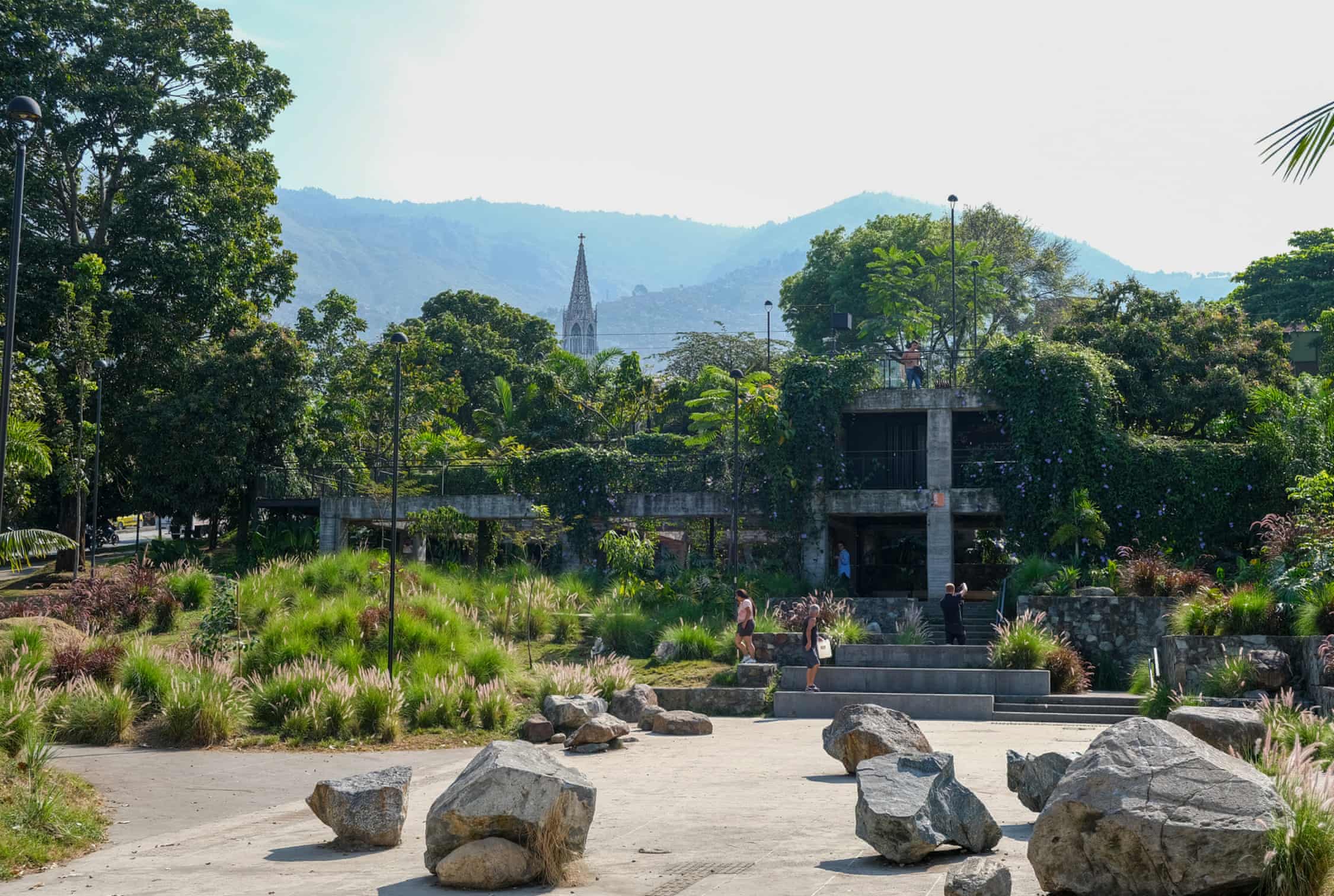
Surrounded by hills: Colombia’s Parque Prado, no longer abandoned to illegal activity.

What is your first reaction to the words Medellín and Colombia? If you have kept up on the news for a few decades, your associations may include both drug wars and change.

Oliver Wainwright at the Guardian focuses on the change.

“Lilac-flowering creepers engulf an abandoned house on a street corner in Medellín, Colombia, spilling from the roof and smothering most of the upstairs windows. A giant fan palm is visible through one opening, while a knotty tangle of aerial roots cascades down to the pavement from another. Step through the doorway of this overgrown ruin, and you find not a scene of desolation and decay but a sleek steel frame holding up the crumbling facade, which forms an unusual entrance to an enchanting new public park.

“ ‘We behaved more like archaeologists than landscape architects,’ says Edgar Mazo of Connatural, the firm behind the Parque Prado, in the working-class neighborhood of Aranjuez. He leads me through a series of planted terraces; fountain grasses and trumpet trees sprout from where a derelict car park and abandoned homes once stood. ‘You dig up the concrete, water gets into the ground, vegetation grows up, and the people come back,’ he adds, speaking through a translator. ‘That’s natural regeneration.’

“In recent decades, Medellín has been widely celebrated for its astonishing urban transformation. In the 2000s, it went from being one of the most dangerous cities on the planet, riven by murderous drug cartels, to a case study in the miraculous peace-bringing powers of architecture and landscape. Sergio Fajardo, the son of an architect who served as Medellín’s charismatic mayor from 2004 to 2008, was hailed for sprinkling the city’s poorest neighborhoods with dazzling new libraries, stadiums and swimming pools.

“These determinedly ‘iconic’ projects were enthusiastically feted on the pages of glossy design magazines, and their stories recounted in keynotes at international conferences. Impoverished hillsides were connected to a new metro system with an elegant web of cable cars and outdoor escalators, while parks dotted with expressive architect-designed canopies sprang up across the city. The dramatic fall in crime during Fajardo’s term was largely credited to this vision of ‘social urbanism,’ and the increase in the amount of public space per citizen.

“But the Medellín miracle has since lost some of its sparkle. Take the Biblioteca España, one of the flagship projects, designed by Colombian star architect Giancarlo Mazzanti. It stands as a striking cluster of chiseled concrete boulders, rising from the hillside in the formerly no-go barrio of Santo Domingo. But it has been shuttered since 2015, due to structural defects. …

“Mazo’s work takes a markedly different approach from the 00s penchant for spectacle. When he was asked to look at the sloping half-hectare site in Aranjuez, which was home to a rundown car park and six boarded-up houses, abandoned for more than a decade, there was an existing plan to raze everything and replace it with a park traversed by a big zigzagging ramp. It looked like a hangover from the earlier lust for shape-making, something that might photograph well from a helicopter.

“Instead, Mazo and his team decided to keep most of what was already there. Almost 70% of the material on-site remains, albeit in a new form. Walls and floor slabs were chiseled from the two-storey parking structure, and the rubble used to fill the basements of the houses, with soil packed on top. The buildings’ roof timbers were reclaimed and used to make benches, while the landscape was shaped in such a way that rainwater is retained, meaning that no artificial irrigation is needed. The team even collected seeds from the plants that had sprung up on the plot, so they could be scattered around the new park after the project’s construction – allowing the natural colonizers back in.

“The project was built during the pandemic for a cost of just [$1.5m] and the lockdowns allowed time for the plants to establish, without the threat of being trampled by visitors. Five years on, the planting has reached a level of maturity that makes this urban oasis seem like it’s always been there. …

“The former car park’s concrete frame makes for an imposing armature at the centre of the park, supporting a raised steel walkway and framing a series of semi-enclosed spaces beneath it. Reclaimed bricks and stacked roof tiles serve as retaining walls, creating a rugged backdrop to lush clumps of grasses and palms. Gabion cages filled with rocks and rubble line water retention ponds, and provide platforms for seating. A sandy clearing down below makes space for ballgames and events, while park-goers can watch the action from the terraced decks above, and enjoy a grandstand view across the sprawling city and its seven hills.

“ ‘When people first colonized this valley,’ says Mazo, ‘they used to climb up to the top of the hills to communicate with each other. The park now becomes part of that system, giving people an elevated view to connect with others.’ …

“Crucially, there’s a space for everyone here – from elevated walkways, to quiet shrub-lined reading areas, to seating tucked away from prying eyes. The sense of fragmentation, as well as the level changes, allow different social groups to coexist.” 

Read more about this and other pilot projects at the Guardian, here. No paywall, but anything you can donate helps to keep factual news accessible to all.
Read Full Post »

Photo: José Hevia.
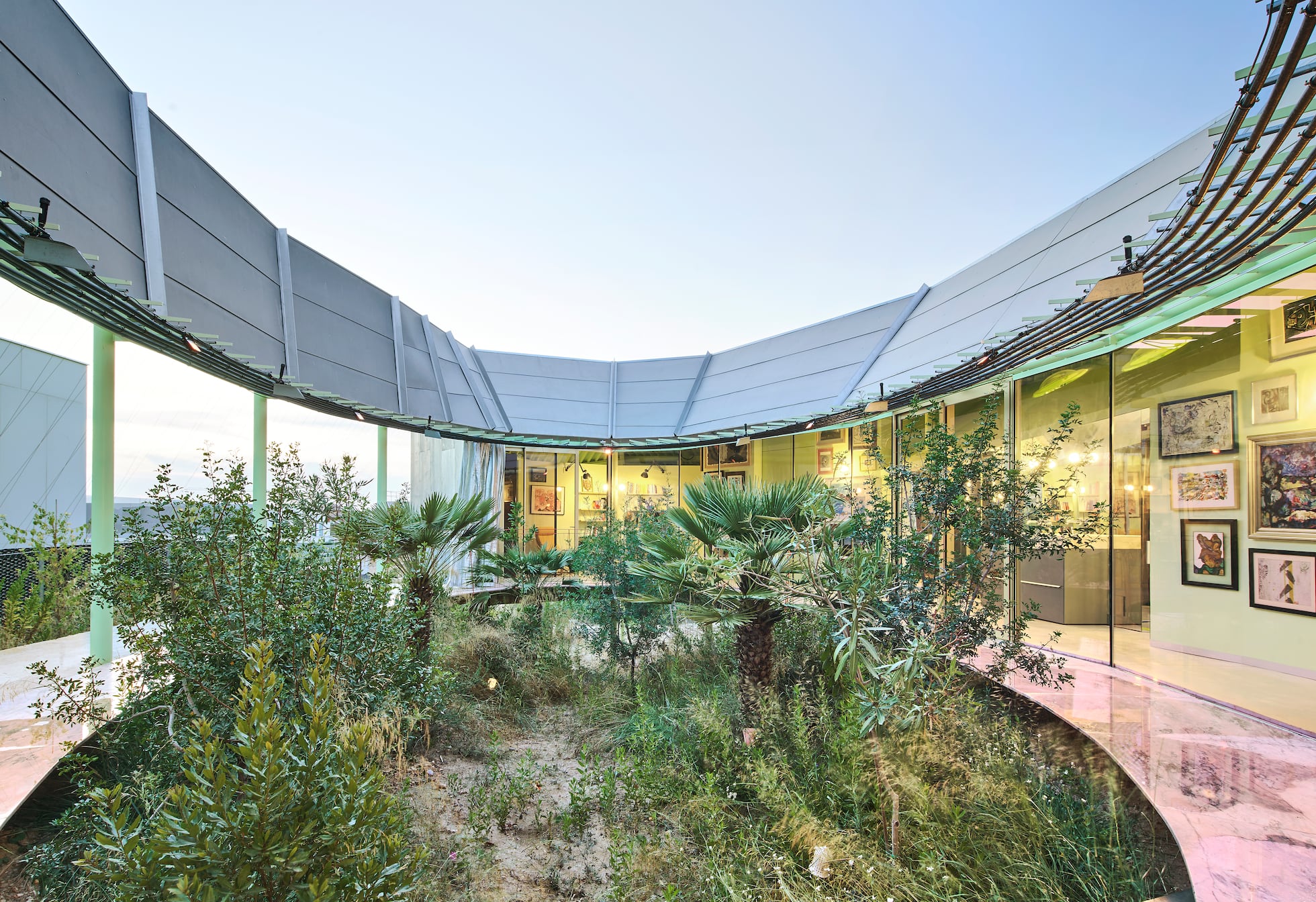
Rambla Climate-House by architect Andrés Jaque in Molina de Segura, Spain.

Today’s article addresses how architecture can and should repair our ecological system. How in cities, for example, a comprehensive vision would extend beyond beautifying downtown to embracing the understanding that we are not the only species on the planet.

At El País, Miguel Ángel Medina interviews architect Andrés Jaque about buildings that can be good for the environment.

“For three years,” he says, “Andrés Jaque, 53, has been dean of the Graduate School of Architecture at Columbia University, one of the most cutting-edge centers in architectural innovation. The Madrid-born architect is spending his time at the university rethinking how buildings and cities should face climate change. He believes that we must commit to an ‘interspecies alliance’ and that buildings, beyond just being sustainable, should also contribute to repairing our ecology.

“Jaque has proposed several projects with this concept in mind, such as the Reggio School in Madrid — designed to create life within its walls and attract insects and animals. …

Andrés Jaque
“Architecture is the discipline that has most clearly assumed the responsibility of responding to the climate crisis. In the last 15 years, there’s been a radical transformation [in the field]: materials have gone from being sustainable to [repairing the ecology]. And [the architectural field] has revised its own mission, which is no longer to just build new buildings, but to manage the built environment. Additionally, it has brought about an intersectional vision: understanding that the material, the social, the ecological and the political are inseparable and that climate action has to coordinate these fronts of transformation. This has placed architecture at the center of environmental action.

Miguel Ángel Medina
“Do architects share this interpretation?

Jaque
There’s a part [of the field] that’s anchored in a heroic vision of modernity and another that’s commercial… but there’s another that has a political commitment to the planet. And [those who adhere to this] understand that architecture must respond not only to the most immediate circumstances of a commission, but also to action for the planet. …

“There are two systems: a material world of extractivism — which is a mix of carbonization, colonialism, anthropocentrism, heteropatriarchy and racialization — that’s currently collapsing. And, in the cracks of this system, another kind of architecture is emerging, which seeks alliances between species based on symmetry, which pursues a global regime of solidarity and which advances along a line of decarbonization that marks the esthetics, the materialities [and] the types of relationships that constitute contemporary culture. This is gaining undeniable strength. In the future, we’ll see a change that’s as important as the one that modernity once represented.

Medina
“What do we do with urban planning, given so many extreme phenomena?

Jaque
“We’ve been pioneers in proposing a change of focus, from an emphasis on the city as a kind of stain on the territory, to a trans-scalar approach. This is a way of understanding [the physical structure that is] an urban block of apartments, the microbial relationships that occur in the bodies of those who live on that block, as well as the large networks of resource extraction that make life on that block possible.

“The city has lost the capacity to contain all realities, [which is necessary] in order to think in a climatic and ecosystemic way. And we need a new model that allows us to understand that what happens on a molecular scale has implications on the scale of bodies, buildings, streets, neighborhoods, the planet and the climate. Designing [cities] in a trans-scalar way requires changes in the methodologies of architecture, which we’re exploring. …

“Cities are going through a period of great transformation. A transformation in which the city has to be understood as something physically porous, which allows for the circularity of water, which contributes to multiplying life… a transformation of materiality that promotes a flow of materials that also contributes to the health of bodies. [We require] a very different way of urbanizing the air – in such a way that it’s understood that there’s a direct relationship between our lungs and the climate – and a commitment to the generation of diverse and empowered living environments. The main difficulty is how to do this quickly, so as to mitigate the impact of the climate and environmental crises.

Medina
“What’s this new ‘interspecies diplomacy’ that you advocate in favor of?

Jaque
“Humans are just one of many forms of life. And the idea that humans can decide to sacrifice the rest of the species to serve their own interests has been shown to be harmful. Understanding that we’re dependent on many other species — and that we’re actually inseparable from them — is more realistic. We depend on the quality of the soil, on the ecosystems. An interspecies alliance based on protecting the living conditions of diverse species is beneficial for all life on the planet.”

More at El País, here.

Read Full Post »

Photo: Jorge Gardner via Unsplash.
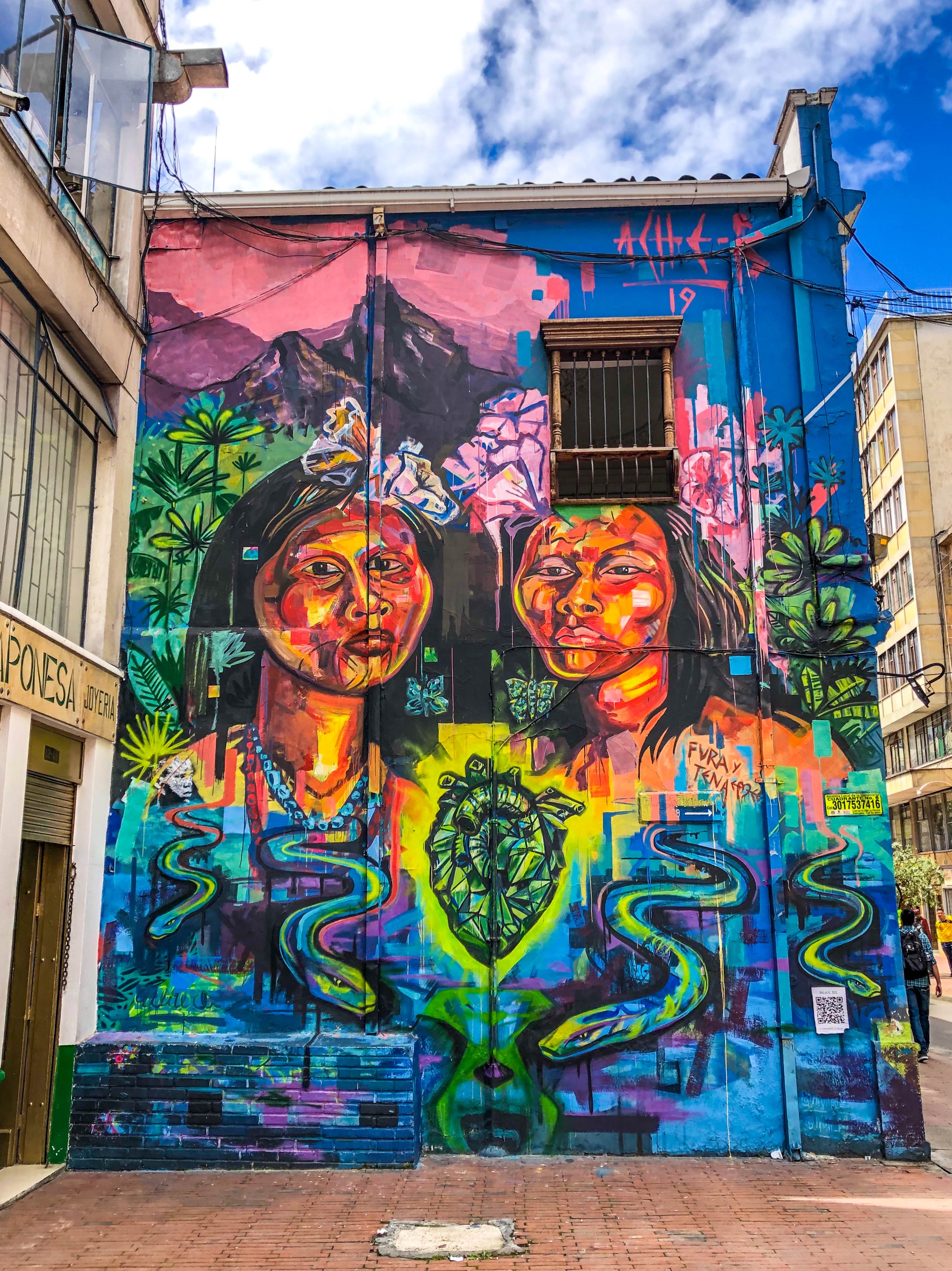
Street art in Bogotá, Columbia.

We who have so much reason to be thankful at Thanksgiving can spare a thought today for those who have little — and are grateful for that little. An experiment in Bogotá is offering hope to some of the poorest women in Columbia.

In an opinion piece at the Washington Post, Bina Venkataraman writes, “One day in the distant future, caregiving could be as celebrated as carrying a football into an end zone. Rather than toil in the shadows, people who juggle children and aging parents might be applauded for their skills — or stopped on the street by admirers. Family caregivers could get paid for the hours they put in minding the young, the sick, the disabled and the old. Men would be as proud as women to care for their children. Governments would fund more services to relieve at-home caregiving, recognizing its physical and psychological toll. …

“For now, consider a small experiment hatched in Ciudad Bolívar, the second-poorest district of Colombia’s capital city, where settlements of makeshift houses sprawl up a steep mountainside, emblazoned with colorful street murals. This district has long been a hotbed of political resistance, home to diverse Indigenous peoples as well as Venezuelan refugees. …

“Since 2020, it has become the site of Bogotá’s first manzana delcuidado, or ‘care block,’ in a city where caregivers — mostly women, mostly poor — ordinarily labor in obscurity without compensation or formal recognition. More than 30 percent of Bogotá’s female population, some 1.2 million women, provide unpaid care full time, some for as much as 10 hours a day.

“Most lack formal education beyond some years of high school, and the city estimates that 1 of every 5 of these women has a diagnosed illness, ranging from arthritis from long hours spent hand-washing clothes to sexually transmitted diseases and untreated cancers. And many of them, says Nathalia Poveda, who manages the Manitas care block in Ciudad Bolívar, don’t recognize that when their husbands hit them, it is domestic abuse.

“A care block is a modest attempt to shift the way caregivers are viewed and supported, and the way they view themselves. It’s a community-scale solution — something that’s needed if poor women are to benefit from global progress in gender equality.

“In Ciudad Bolívar, women can drop off dirty clothes and bedding each week to a city-funded laundromat. Demand is so high in the district, and given only four washing machines and dryers, the women have to rotate out of using the program every three months.

“A community center offers free courses to help women earn high school diplomas and practice yoga while city employees mind the children, elderly or people with disabilities in their care. Caregivers and their spouses can learn to use a computer or cellphone and get STD testing, psychological counseling and legal aid — all under one roof. In the same building, a child can get a strep test and his mom can get a Pap smear, rather than having to shuffle to clinics around the city.

‘It gives me a breath, a break,’ said Lisbeth Diaz.

“This isn’t rocket science, but it is innovation. ‘We need to care for the people who care for us,’ says Diana Rodríguez Franco, Bogotá’s secretary for women’s affairs, who came up with the idea. The city now has 20 care blocks, as well as a program to send relief caregivers directly to people’s homes. The city funds the program with an annual budget of $800,000, and it has attracted grants from global organizations for pilot projects such as caregiving classes for men.

“I spoke with several women using services at various care blocks in the city. ‘It gives me a breath, a break,’ said Lisbeth Diaz, who was taking a class that would certify her skills as a caregiver at the Manitas care block in Ciudad Bolívar. The idea behind certification, said Poveda, is to help women recognize that the work they do in the home is valuable.

“ ‘You have to take care of yourself to take care of everyone else,’ said Sandra Quevedo, who was glad to learn yoga, lifting her chin and chest with pride as she spoke. At a care block within a high-altitude ecological park called Entrenubes, a group of middle-aged women in a program called Las Mujeres Que Reverdecen — ‘the women who regreen’ — giggled and flexed their muscles when I asked what it was like to get paid to learn to plant trees and care for city parks part time. …

“The manzanas are one of several initiatives that Bogotá’s first female and openly gay mayor, Claudia López, has launched to try to shift the balance of power between men and women. … The López government also brought in an all-electric fleet of city buses, called La Rolita, and has been hiring and training women to drive and maintain them.

“ ‘There’s been huge pushback,’ says Rodríguez Franco, noting that the city was sued in 2021 by a man who objected to the care blocks’ focus on women. (La Rolita also inspired a lawsuit.) But Rodríguez Franco is heartened to see some men now coming to the care blocks with their female partners to finish high school or to learn to use computers. …

“International development experts have long argued that, along with fostering social progress, educating girls and women and putting more income in their hands can break cycles of intergenerational poverty and moderate population growth. Helping caregivers finish school and find jobs has been an often overlooked but critical piece of this puzzle.

“In recent decades, Colombia has made strides toward recognizing the rights of women — especially caregivers. In 2010, it became the first country to require that women’s contributions to the care economy be documented. …

“Much change is needed to lift the burden on caregivers worldwide and to give women greater access to education and jobs. As political leaders in rich nations debate policies that can put more women into the halls of power, Bogotá’s efforts are a reminder that the world’s poorest caregivers also need innovative measures — if we are one day to inhabit a world in which the average woman’s economic and political power is equal to that of the average man.”

More at the Post, here.

Read Full Post »

Photo: Mie Hoejris Dahl.
An indigenous leader and indigenous
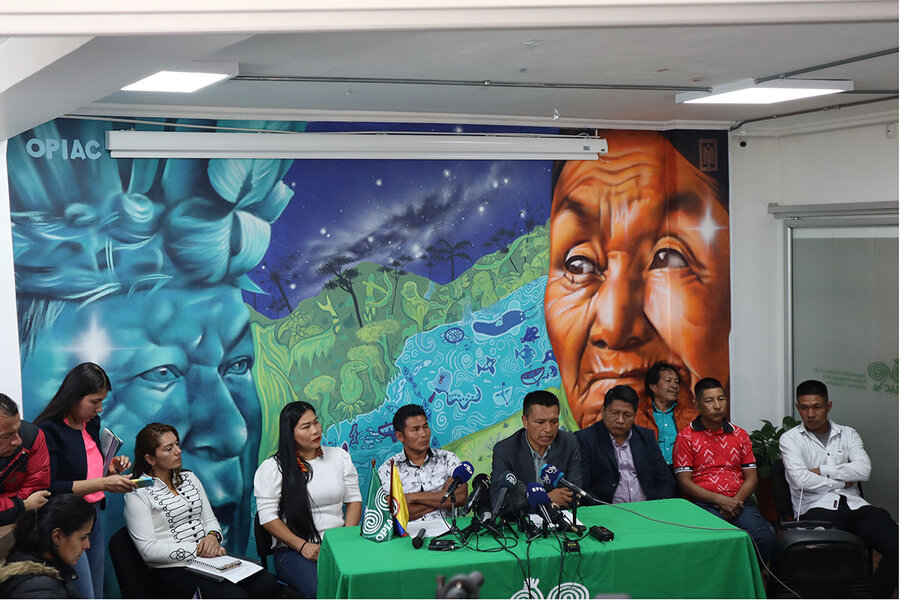
guards and family members of four lost children meet at the office of the National Organization of Indigenous People of the Colombian Amazon, in Bogotá, Colombia, June 15, 2023.

You may have heard about the kids who were in a plane crash in the jungle and survived largely because of their indigenous skills. Today I share a story about how an unusual collaboration among searchers led to their being found.

Mie Hoejris Dahl reports at the Christian Science Monitor, “Few things have united the Colombian population like the recent successful rescue of four young Indigenous children following a deadly plane crash – and their ability to survive alone in the jungle for 40 days.

“The story of Lesly Jacobombaire Mucutuy, Soleiny Jacobombaire Mucutuy, Tien Ranoque Mucutuy, and Cristin Ranoque Mucutuy, who ranged in age from 11 months to 13 years at the time of the crash, grabbed hearts and headlines [recently] for their incredible resilience. The plane wreck killed all three adults on board, but against great odds, the children survived alone in the jungle by tapping into ancestral education about the animals, edible plants, and survival tactics in the wild jungle.

“Their survival is an inspiration, but the saga also put a spotlight on challenges faced by Colombia’s Indigenous populations, who fight to preserve their culture amid historical marginalization. …

“A promising thread has emerged in the days since the children’s discovery, which is the unparalleled, collaborative search efforts by the Colombian military and Indigenous guards that led to their rescue in the first place.

“It has many here looking to what the future of respect and partnership might look like between the government and Indigenous communities.

“ ‘This was a lesson … to look for commonalities’ between the government and Indigenous groups, says Rufina Román, a leader in the National Organization of Indigenous People of the Colombian Amazon, a nongovernmental organization. ‘We are going to need to rely on joint action for many other issues … like climate change’ and environmental protection. …

“On May 15, two weeks after an engine failure caused a flight carrying three adults and the four children to crash in the dense Amazon jungle, rescuers found the front part of the plane stuck between trees in the southern Colombian state of Caquetá. The pilot, an Indigenous leader, and the children’s mother were found dead.

“Although the search team saw signs of life – a baby bottle, half-eaten fruit, and dirty diapers – the children were nowhere to be found.

“The Colombian government deployed search-and-rescue planes and helicopters, as well as land and river teams to the crash site. They scoured for the kids in an area of about 1,650 miles and used sound systems to play a recording of the children’s grandmother speaking in their native language, Huitoto, telling them that people were looking for them and that they should stay in one place.

“The children kept moving, some close to them speculate out of fear of who exactly was looking for them. Armed dissident guerrilla groups are a threat for many Indigenous communities in the jungle.

“But even so, the search was challenging from the start.

“ ‘It’s a very remote zone that requires special capacity,’ says Pedro Sánchez, the general who led the government search operation. Some 16 hours of rain a day, humidity, dense vegetation, and dangerous animals make the terrain hard to penetrate even for the country’s best-trained soldiers. It’s hopeless trying to see anything from the air due to tree coverage, and it’s hard from the ground, too. …

“Eventually, General Sánchez authorized Indigenous volunteers from across the country to participate in the operation: a decision that almost certainly saved the children’s lives.

“ ‘Without them, we still wouldn’t have found the kids,’ he says of the approximately 80 Indigenous volunteers.

“Working with the guard helped multiply eyes and ears on the ground, but also contributed important, deep-seated knowledge about the jungle. Spiritual knowledge, too, General Sánchez says.

“He describes the collaboration as ‘very fluid,’ which stands in contrast to the historical mistrust between Indigenous people and the government’s armed forces. Indigenous communities are often stigmatized as uneducated, violent, and out of touch with modern society. And the absence of the state in many of these remote communities, lack of public services like roads and running water or electricity, and few security measures in a region overrun by armed groups mean that many mistrust and feel abandoned by the state. …

“There’s hope that the unprecedented collaboration that took place between the armed forces and the Indigenous guard in Operation Hope, as the rescue mission was dubbed, can blaze a new path for relations between the government and Indigenous groups here.

“When the soldiers and Indigenous guards were deep in the jungle, on several occasions their technology, like GPS satellites and compasses, stopped working. ‘What do you say?’ General Sánchez asked the Indigenous guards.

“That simple question was ‘something spectacular,’ says Janer Quina, regional coordinator of the Indigenous guard in Cauca … who participated in the search. It contrasts with his experience with non-Indigenous Colombians in the past. Historical knowledge around nature, for example, is often met with skepticism from outsiders, he says. …

“In the long, emotional search, the soldiers and Indigenous guards shared food, personal questions, and survival techniques. Indigenous guards shared ancestral knowledge, like medicinal plants, while soldiers taught them to use their high-tech equipment. … What was perhaps even more surprising was the kids’ ability to survive in such precarious conditions.

“ ‘We taught them how to survive in the Amazon jungle,’ says Eliecer Muñoz, one of the Indigenous rescuers, of the education that children in many remote Indigenous communities are brought up with about plants, animals, and how to construct a shelter. …

“Thus, ‘Lesly [the 13-year-old] knew what to do,’ says Ms. Román, including which plants or insects were edible and how to care for a baby without any of the tools many Westerners rely on, like formula or a crib.’ “

More at the Monitor, here. No firewall.

Read Full Post »

There are always new things to discover. We’ll never stop needing scientists to discover treatments and cures for emerging illnesses or new kinds of energy to replace fossil fuels. We’ll never stop needing diplomats and non-diplomats to discover ways to make peace or artists to lead us to new frontiers of imagination.

And what about archaeologists? New discoveries of ancient artifacts continue to teach us so much about both our history and our future.

Hakim Bishara writes at Hyperallergic, “In a remarkable discovery, archaeologists have found one of the world’s largest collections of prehistoric rock art in the Amazonian rainforest. Tens of thousands of paintings of animals and humans, made up to 12,600 years ago, were found on an eight-mile rock surface along the Guayabero River in the Colombian Amazon.

“Called ‘the Sistine Chapel of the ancients,’ the collection includes drawings of large mammals, birds, fish, lizards, handprints, and masked figures of dancing humans. The ancient paintings also record interactions between humans and extinct species of giant Ice Age mammals like mastodons.

“The discovery belongs to a joint team of Colombian-British researchers, led by Jose Iriarte, a professor of archaeology at Exeter University in the United Kingdom. The archeologists conducted the main bulk of excavations in the area between 2017-2018 with the intent of revealing their findings in the [British] documentary series Jungle Mystery: Lost Kingdoms of the Amazon. … The documentary’s presenter is Ella Al-Shamahi, an archaeologist and explorer. The findings are also outlined in an article in the journal Quaternary International.

“In an email to Hyperallergic, the researchers wrote: ‘The excavations, in the deep soil around the shelters, have revealed one of the earliest secure dates for the occupation of the Colombian Amazon and clues about people’s diet at this time, as well as the remains of small tools and scraped ochre used to extract pigments to make the paintings.’

“The team has also found realistic drawings of deer, tapirs, alligators, bats, monkeys, turtles, serpents, and porcupines. There are also depictions of creatures resembling a giant sloth, camelids, horses, and three-toe ungulates with trunks.

‘These native animals all became extinct, probably because of a combination of climate change, the loss of their habitat and hunting by humans,’ the researchers wrote.

“According to the researchers, communities that lived in the area at the time of the drawings were hunter-gatherers who fished in the nearby river. Remains of bones and plants found during the excavations shed information about their diets, which included palm and tree fruits, piranha, alligators, snakes, frogs, rodents such as paca, capybara, and armadillos. …

“The archaeologists wrote, ‘At the time the drawings were made temperatures were rising, starting the transformation of the area from a mosaic landscape of patchy savannahs, thorny scrub, gallery forests and tropical forest with montane elements into the broadleaf tropical Amazon forest of today.’ “

More pictures at Hyperallergic, here. That list of animals is reminding me of Suzanne at age 5, when she was a huge fan of the capybara. We saw a few at Disney World that year.

Read Full Post »

In a delightful post at BookRiot.com, blogger David Attig offers some of his research on bookmobiles and libraries in out-of-the-way places.

In one example, he writes about “a delightful twist on the Pack Horse Library. Since 1990, teacher-turned-mobile-librarian Luis Soriano has brought books to thousands of children in rural Colombia, all from the back of a donkey. The biblioburro, as Soriano calls it, helps poor children have access to more books and thus a chance at a better education. ‘That’s how a community changes and the child becomes a good citizen and a useful person,’ Soriano told CNN. ‘Literature is how we connect them with the world.’ Soriano and his biblioburro are the subject of a children’s book by Monica Brown and John Parra, proceeds from the sale of which go to support Soriano’s work.”

“Derek Attig writes and teaches about book culture, technology, and history,” says BookRiot. “In addition to writing a book about bookmobiles in American life, he blogs at Bookmobility.org.”

Read the whole post at BookRiot, where you will find a Works Progress Administration bookmobile visiting Bayou De Large, Louisiana, pack horse librarians posing in Hindman, Kentucky, a booketeria in a Nashville supermarket, a vending machine library at a Bay Area school, a library at Amsterdam Schiphol Airport, and more.

Photo: Luis Soriano

Read Full Post »

I find lots of great links at Andrew Sullivan’s blog. Besides having an excellent staff, he seems to have half the world forwarding cool stuff to him. Otherwise, I probably would never have stumbled on Feature Shoot, which showcases work from up-and-coming and established photographers.

In one article, Amanda Gorence writes, “Photographer Fernando Decillis traveled to Pasto, Colombia for the elaborate Carnaval de Negros y Blancos, a five day festival celebrating the Epiphany that has been a tradition since 1912. …

“El Desfile Magno [the great parade] is a mind-blowing display of immaculately crafted floats made by incredibly talented artists. The artists are usually honored with this task through family ties and only after years of studying the traditional craft. … Decillis gives us a front row spot to the festivities, the artists and the giant masterpieces of Pasto’s celebrated tradition.

“Decillis was born in Montevideo, Uruguay. He is based in Atlanta mixing it up with a variety of advertising, editorial and conceptual work.” More, here.

Photograph: Fernando Decillis

Read Full Post »