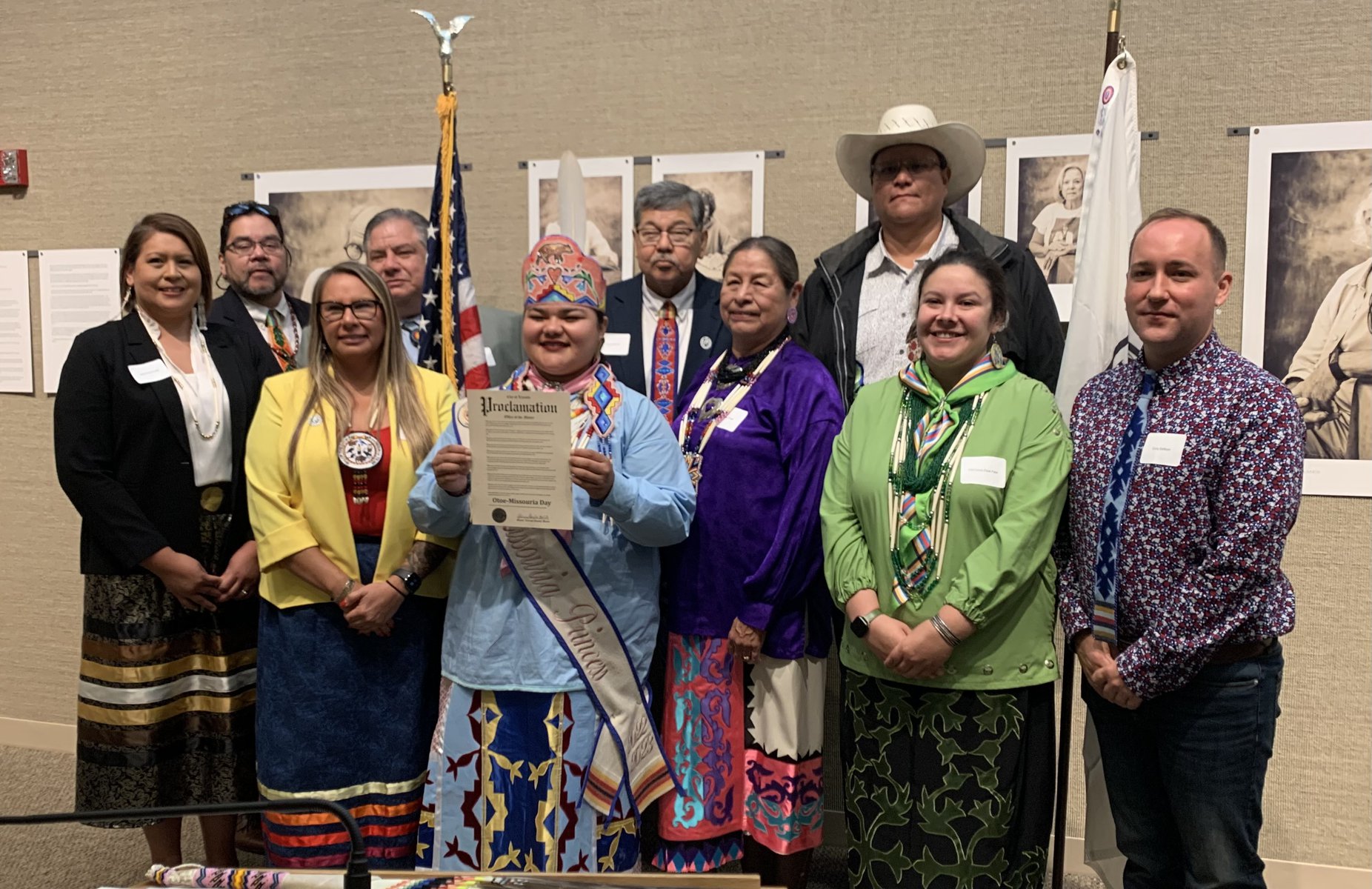
Photo: Nebraska Public Media.
Members of the Otoe-Missouria tribe pose with the proclamation that designates September 21 as “Otoe-Missouria Day” in Nebraska.
However we celebrate Monday, it’s a good idea to think it through. What is loyalty to Columbus about? What is loyalty to the original inhabitants about? What can we learn?
In a 2021 National Public Radio (NPR) story, Dylan Baca, a 19-year-old Arizonan who was instrumental in helping broker the proclamation recognizing Indigenous Peoples’ Day, said, “I still don’t think I’ve fully absorbed what that has meant. This is a profound thing the president has done, and it’s going to mean a lot to so many people.”
But he acknowledges that Italian Americans also deserve to be celebrated because Columbus Day was founded as a way to appreciate the mistreatment of Italian Americans. “Italian American culture is important, and I think there are other times and places to recognize that. But I think it’s also important to also recognize the history of Columbus Day itself. Should we recognize a man whose labors [decimated] the Native American population here? I don’t think that is something that we want to be honored.”
I know now that the traditions I learned in elementary school are mostly based on fairy tales. So I appreciate the opportunity to gain information based on facts. Here, for example, is an interesting article about a tribe indigenous to Nebraska.
Jackie Ourada at Nebraska Public Media reports, “The last time Otoe-Missouria families walked together on Nebraska prairie, they were headed south to hot, dry reservation land in Oklahoma. They wouldn’t be officially welcomed back to their ancestral home for nearly 200 years.
“This is where Christina Faw Faw’s relatives hunted elk and bison, where they kept their corn and wild plants, where they held celebrations and ceremonies, and eventually, where they had to leave. Though, Faw Faw says her ancestors’ presence remains.
“ ‘As soon as we got out of the car and started walking down this road, I could feel it,’ she said.
“Oregon marked its first statewide recognition of Indigenous Peoples’ Day, in place of Columbus Day, in 2021 after its legislature passed a bill brought by its Indigenous lawmakers. Rep. Tawna Sanchez, one of those lawmakers, said the movement to recognize the day is an ideal time to capitalize on the momentum of political recognition.
” ‘I don’t know that we’ll ever get to a place where people have their land back or have the recognition of who they are, to the degree that we that we need to or should. But the fact that people are paying attention at this very moment — that’s important, because we will have a greater opportunity to educate people and help them understand why we are where we are right now,’ she told NPR in 2021. …
“Her tribe’s land stretched across southeastern Nebraska, from Yutan to the Salt Creek in Lincoln. They were forced out in 1833 to make way for white settlements, some of which became the concrete city blocks of Lincoln and the University of Nebraska. Both are now officially recognizing the damage done to Native people.
“[Faw Faw] made the trip to Lincoln, as the city’s mayor signed a proclamation designating September 21 as Otoe-Missouria Day. It’s the latest step in a growing movement, in Nebraska and across the world, to recognize the harm white settlers inflicted on Indigenous people and to reconcile relations. …
“Nebraska State Historical Society excavations show the Otoe-Missouria tribe built several round earth lodges across this southeastern land they called nyi brathge, or ‘flat water,’ which later gave Nebraska its name. They had separate storage areas for their corn and wild plants, dedicated areas for their fishing and hunting utensils, and large gathering spaces for tribal ceremonies. …
‘Dozens of families from the 3,200-member tribe traveled from their reservation in northern Oklahoma for the ceremony. While the trip back to their former tribal land sparked feelings of gratitude and healing, Vernon Harragarra said there’s still pain that may never fully mend.
“ ‘Today is just one step forward in gaining what we lost,’ Harragarra said. His elders have long spoken of the culture white settlers erased when they pushed tribes to reservations.
“ ‘We used to share the pipe with the Omaha people and the Winnebagos – our neighbors,’ Harragarra said. ‘When we left, a lot of our ceremonial and ancient ways were gone.’
“The first arrival of white settlers and the diseases they carried nearly decimated the Missouria tribe. It’s what eventually brought the two groups together. At one point, the Missouria tribe dwindled to just one hundred relatives – forcing them to join the Otoes to survive.
“And when they were forced south to Oklahoma, Harragarra said his bloodline almost didn’t survive. His ancestors made the long trek as soldiers pushed other tribes along the Trail of Tears, the infamous and deadly 5,000-mile route that displaced Indigenous populations to reservations.
“Harragarra thought about that history when he and his family drove up from Oklahoma. Getting away from the reservation with his children felt like he was restoring lost traditions – such as his tribe’s sacred buffalo hunts, where families would take their growing children to gather food for the first time.
“ ‘When I took my daughter out of school, it reminded me of those stories,’ Harragarra said. ‘I wanted my kids to be here to witness this historic day. I kept telling them that on the way up here.’
“Harragerra said he expects his children to also keep traditions alive despite pressure to assimilate. ‘They’re not done yet. You know, in the future, I’m not gonna be here forever,’ Harragarra told his three children. ‘You guys got to carry on what we’re trying to get back.’ “
More at NPR, here, and at Nebraska Public Media, here. No firewalls.


 Suzanne's Mom's Blog