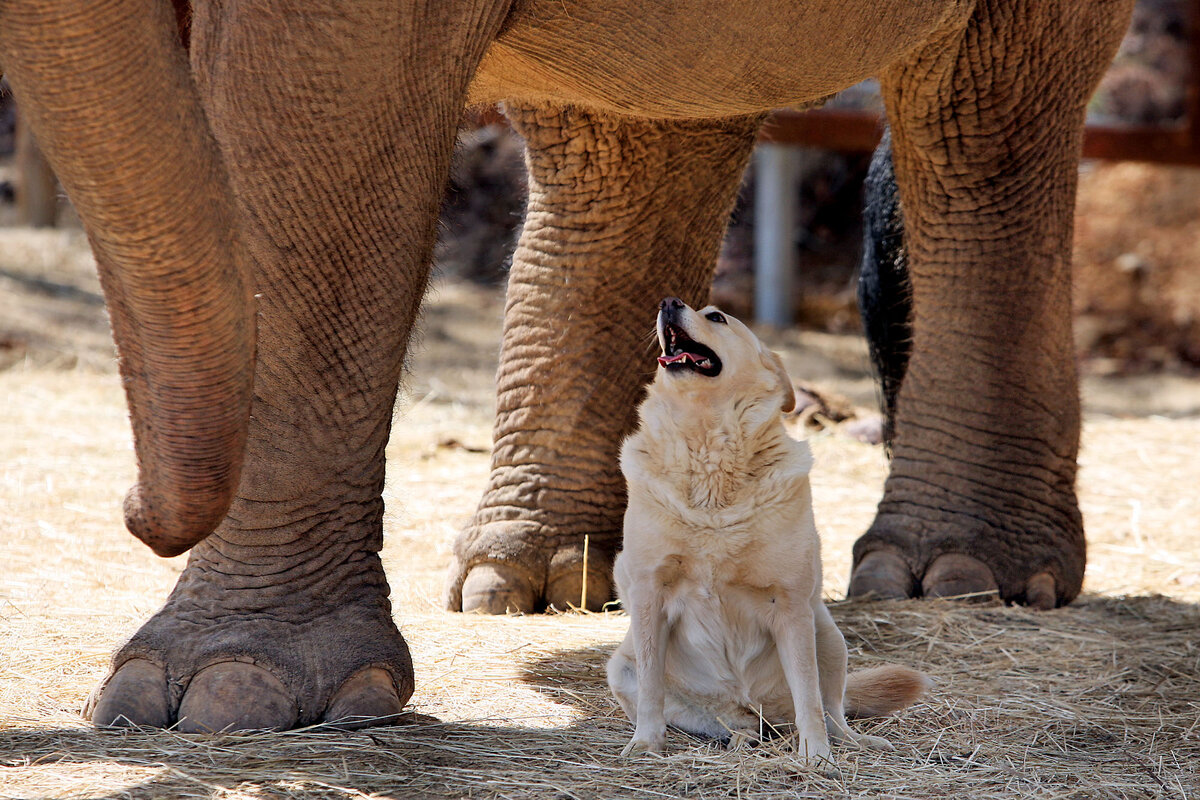
Photo: Melanie Stetson Freeman/CSM.
The friendship between Bella, a stray dog, and Tarra, a resident of the Elephant Sanctuary in Tennessee, exemplifies feelings that are not unusual in the animal kingdom.
If you have ever heard Sy Montgomery on Boston Public Radio or read any of her wonderful books about animals, you will know that there is at least one scientist who believes critters have feelings. (FYI: with the exception of the Bobbitt worm, Sy Montgomery loves them all.)
Other scientists also have noticed that animals have feelings. At the Christian Science Monitor, Stephanie Hanes reports on research showing that many “animals exhibit signs of experiencing emotions and being self-aware.”
“This past April,” she writes, “a group of biologists and philosophers unveiled the New York Declaration on Animal Consciousness at a conference at New York University in Manhattan. The statement declared that there is ‘strong scientific support for attributions of conscious experience to other mammals and to birds.’ It also said that empirical evidence points to ‘at least a realistic possibility of conscious experience’ in all vertebrates and many invertebrates, including crustaceans and insects.
“Researchers have found myriads of indications of perception, emotion, and self-awareness in animals. The bumblebee plays. Cuttlefish remember how they experienced past events. Crows can be trained to report what they see.
“Given these findings, many believe there should be a fundamental shift in the way that humans interact with other species. Rather than people assuming that animals lack consciousness until evidence proves otherwise, researchers say, isn’t it far more ethical to make decisions with the assumption that they are sentient beings with feelings?
“ ‘All of these animals have a realistic chance of being conscious, so we should aspire to treat them compassionately,’ says Jeff Sebo, director of the Center for Mind, Ethics, and Policy at New York University. ‘But you can accept that much and then disagree about how to flesh that out and how to translate it into policies.’
“Sasha Prasad-Shreckengast is trying to get into the mind of a chicken. This is not the easiest of feats, even here at Farm Sanctuary in Watkins Glen, a scenic hamlet in the rolling Finger Lakes region of upstate New York. For decades the sanctuary has housed, and observed the behavior of, farm animals – like the laying hens Ms. Prasad-Shreckengast is hoping to tempt into her study.
“Chickens, it turns out, have moods. Some might be eager and willing to waddle into a puzzle box to demonstrate innovative problem-solving abilities. But other chickens might just not feel like it.
“Ms. Prasad-Shreckengast also knows from her research, published this fall in the Journal of Applied Animal Welfare Science, that some chickens are just more optimistic than others – although pessimistic birds seem to become more upbeat the more they learn tasks.
“ ‘We just really want to know what chickens are capable of and what chickens are motivated by when they are outside of an industrial setting,’ Ms. Prasad-Shreckengast says. ‘They have a lot more agency and autonomy.’ …
“In other words, how do chickens really think? And how do they feel? And, to get big picture about it, what does all of that say about chicken consciousness?
“In some ways, these are questions that are impossible to answer. There is no way for humans, with their own specific ways of perceiving and being in the world, to fully understand the perspective of a chicken – a dinosaur descendant that can see ultraviolet light and has a 300-degree field of vision.
“Yet increasingly, scientists like Ms. Prasad-Shreckengast are trying to find answers. What they are discovering, whether in farm animals, bumblebees, dogs, or octopuses, is a complexity beyond anything acknowledged in the past. …
“Researchers have found myriads of indications of perception, emotion, and self-awareness in animals. The bumblebee plays. Cuttlefish remember how they experienced past events. Crows can be trained to report what they see. …
“Ms. Prasad-Shreckengast’s study takes place in the wide hallway of Farm Sanctuary’s breezy chicken house. Unlike in pretty much any other chicken facility, the birds here come and go as they please from spacious pens.
“Following up on her previous research, she has designed a challenge that she hopes will appeal to most of her moody chickens. It is a ground-level puzzle box, with a push option, a pull option, and a swipe option. Birds are rewarded with a blueberry when they solve a challenge. …
“The idea of consent – which is a basic, foundational principle in the study of human behavior – is also a hallmark of animal studies here at Farm Sanctuary. To the uninitiated, this might sound absurd, with images of chickens signing above the dotted line. But it is not actually all that rare. Studies of dogs, dolphins, and primates all depend on the animals agreeing, in their own way, to participate. …
“Spearheaded by Kristin Andrews, professor of philosophy and the research chair in animal minds at York University in Canada, the idea emerged from conversations she had with two colleagues, Jonathan Birch, a philosopher at the London School of Economics and Political Science, and Jeff Sebo, director of the Center for Mind, Ethics, and Policy at New York University. …
“ ‘People were dimly aware that new studies were identifying new evidence for consciousness – not only in birds, but also reptiles, amphibians, fishes, and then a lot of invertebrates, too,’ says Dr. Sebo. ‘But there was no central, authoritative place people could look for evidence that the views of mainstream scientists were shifting.’ …
“For instance, trees communicate, and fungal networks send messages throughout a forest. Species such as sea turtles and bats use electromagnetic fields, a force we cannot even perceive, to guide their movements and migrations. Snakes see infrared light, birds and reindeer see ultraviolet light, and dolphins use sound waves to navigate underwater. …
“For generations, the dominant perspective has been that the human perspective is the best view in the house, with the most complex and complete picture of reality.
“But there hasn’t been a species studied over the past 20 years that hasn’t turned out to exhibit pain. There hasn’t been a species that hasn’t turned out to be more internally complicated than people expected, Dr. Andrews says. …
“ ‘That word, “consciousness,” is the problem,’ Dr. Andrews says. ‘The thing that everybody in the field agrees on is that consciousness refers to feeling – ability to feel things. … But then if you start asking people to give a real, concrete definition of consciousness, they’re not able to do it.’ …
“For the purposes of the declaration, researchers said, they focused on what is called ‘phenomenal consciousness.’ This is the idea that ‘There is something that it’s like to be a particular organism,’ explains Christopher Krupenye, professor of psychological and brain sciences at Johns Hopkins University. … Basically means that an animal experiences the world not as a machine, but as a being. Phenomenal consciousness is what you are experiencing right now in your body with the sight of words on a page as you read this article.”
There are numerous species described in the article at the Monitor, here. Don’t miss the playful bees.
No firewall. Subscriptions solicited.



 Suzanne's Mom's Blog