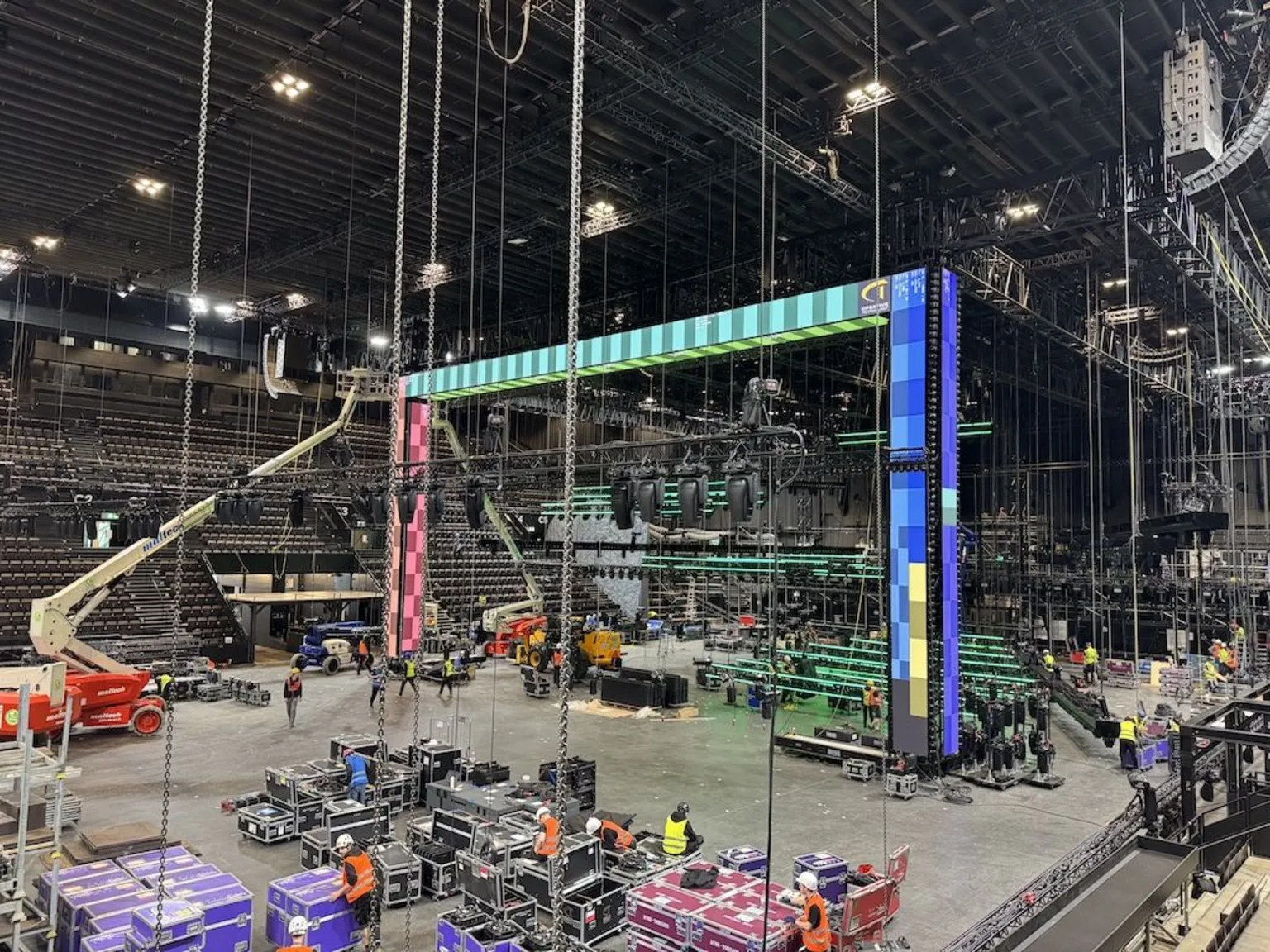
Photo: SRG/SSR.
Construction of this year’s Eurovision stage began in early April, three weeks before rehearsals kicked off.
You have to admire the ambition that goes into producing an extravaganza. Just envisioning it seems beyond the imagination of normal mortals. Today’s story describes the behind-the-scenes magic of the 2025 European song competition known as Eurovision, in which fans root for their own countries.
Mark Savage reports at the BBC, “Thirty-five seconds. That’s all the time you get to change the set at Eurovision. Thirty-five seconds to get one set of performers off the stage and put the next ones in the right place. Thirty-five seconds to make sure everyone has the right microphones and earpieces. Thirty-five seconds to make sure the props are in place and tightly secured. …
” ‘We call it the Formula 1 tire change,’ says Richard van Rouwendaal, the affable Dutch stage manager who makes it all work. ‘Each person in the crew can only do one thing. You run on stage with one light bulb or one prop. You always walk on the same line. If you go off course, you will hit somebody.’
“The stage crew start rehearsing their ‘F1 tire change’ weeks before the contestants even arrive. Every country sends detailed plans of their staging, and Eurovision hires stand-ins to play the acts. …
“As soon as a song finishes, the team are ready to roll. As well as the stagehands, there are people responsible for positioning lights and setting pyrotechnics; and 10 cleaners who sweep the stage with mops and vacuum cleaners between every performance. …
“The attention to detail is clinical. Backstage, every performer has their own microphone stand, set to the correct height and angle, to make sure every performance is camera perfect.
” ‘Sometimes the delegation will say the artist wants to wear a different shoe for the grand final,’ says Van Rouwendaal. ‘But if that happens, the mic stand is at the wrong height, so we’ve got a problem!’ …
” ‘It’s a big logistics effort, actually, to get all the props organized,’ says Damaris Reist, deputy head of production for this year’s contest. ‘It’s all organized in a kind of a circle. The [props] come onto the stage from the left, and then get taken off to the right. Backstage, the props that have been used are pushed back to the back of the queue.’ …
“What if it all goes wrong?
“There are certain tricks the audience will never notice, Van Rouwendaal reveals. If he announces ‘stage not clear’ into his headset, the director can buy time by showing an extended shot of the audience. …
” ‘There’s actually lots of measures that are being taken to make sure that every act can be shown in the best way,’ says Reist. …
“It’s no surprise to learn that staging a live three-hour broadcast with thousands of moving parts is incredibly stressful. …
“The shifts are so long that, back in 2008, Eurovision production legend Ola Melzig built a bunker under the stage, complete with a sofa … and two (yes, two) espresso machines.
” ‘I don’t have hidden luxuries like Ola. I’m not at that level yet!’ laughs Van Rouwendaal ‘But backstage, I’ve got a spot with my crew. We’ve got stroopwafels there and, last week, it was King’s Day in Holland, so I baked pancakes for everyone.’ “
More at the BBC, here.
This year the winner was Austria’s Johannes Pietsch, or JJ, and the song was “Wasted Love.”


 Suzanne's Mom's Blog