Feeds:
Posts
Comments

Posts Tagged ‘country music’

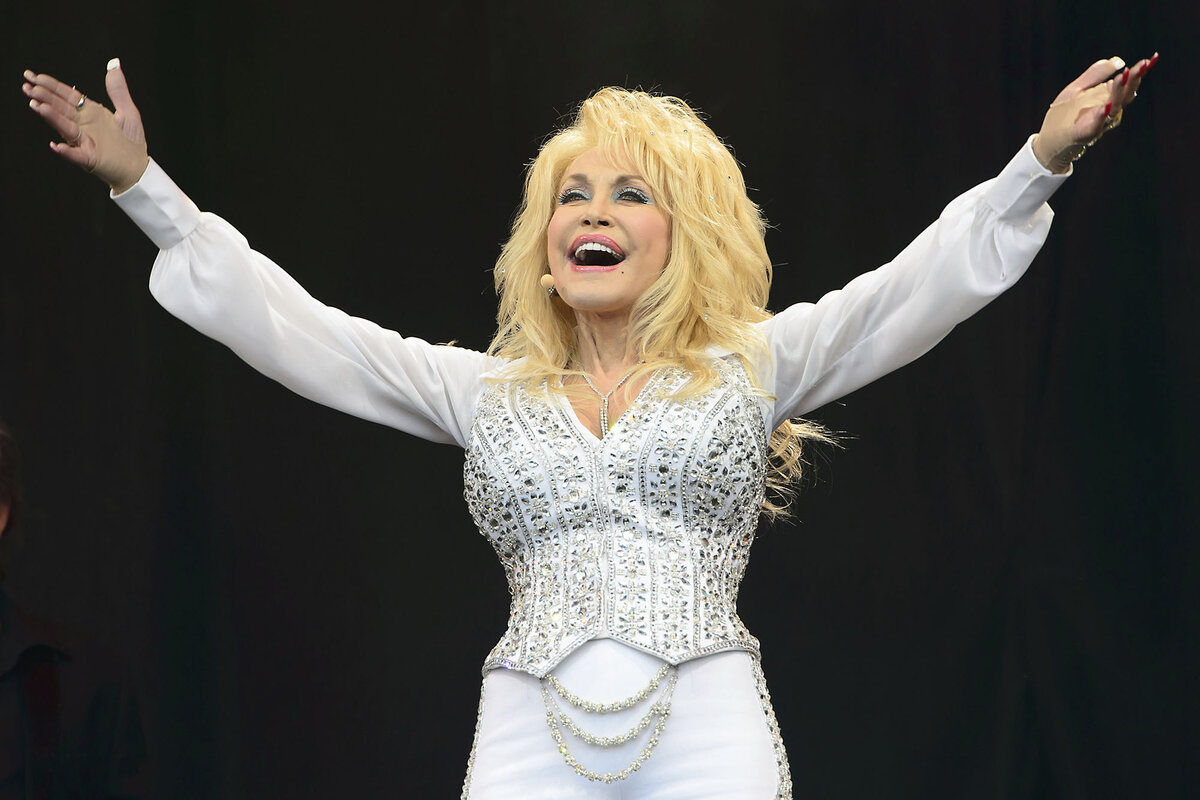
Photo: Jonathan Short/Invision/AP/File.
Dolly Parton performs at the Glastonbury music festival, in Somerset, England, June 29, 2014. Considering that she died on in August at age 80, she must have been 68 in that lovely AP photo.

I’m only a part-time country music fan, but I’ve read enough about the late Dolly Parton to feel that she deserves all the admiration she has received.

Harry Bruinius, Victoria Hoffmann, and Patrik Jonsson contributed to the following Christian Science Monitor article about Parton.

” ‘A Few Old Memories’ wasn’t one of her numerous self-written songs, but the performance on a 1999 album is pure Dolly Parton. She sings of old love letters and a faded photograph – relics of a relationship supposedly put away long ago.

“The arrangement is spare; her voice rises above fiddle, banjo, and dobro with a sadness that feels less performed than remembered. Just a few old love letters / with the edges all brown / and an old faded picture / I keep turned upside down.’

“ ‘It’s so heartfelt,’ says Maureen Loughran, director and curator of Smithsonian Folkways Recordings in Washington. ‘It’s really expressing a personal experience that can be shared across age, across location, across any kind of experience.’ …

“Dolly Rebecca Parton, who died [in August] at 80, spent some seven decades performing that way. She took things that were intensely particular – the music of the Tennessee mountains, a childhood in poverty, a woman’s fear of losing a lover, the indignities of work, as well as her own flamboyantly constructed femininity – and made millions of strangers recognize themselves in them.

“From the 1973 crossover ballad ‘Jolene’ to her ‘I Will Always Love You’ (later recorded by Whitney Houston) to the Grammy-winning ‘9 to 5,’ a working woman’s anthem, Ms. Parton’s accessible melodies and lyrics – by her own estimate, she wrote more than 3,000 songs – conveyed her authentic experience with grief and struggle, but also her drive to spark hope, humor, or resilience in others. That might help explain an achievement harder to measure than record sales, awards, or the ability to play multiple instruments by ear. … Ms. Parton somehow came to belong to almost everybody.

“She was loved by good ol’ boys and drag queens, evangelical Christians and gay men, country traditionalists and feminists. She was a daughter of poor rural Appalachia who became fabulously wealthy without seeming to repudiate her roots.

“ ‘She was absolutely what you thought she was, and more,’ says Lori Moore, chief executive of the American Eagle Foundation, which worked with Ms. Parton on eagle conservation at Dollywood, the singer’s theme park in Pigeon Forge, Tennessee. ‘She was an amazingly smart business lady, and she had this incredible persona, and just anyone that got around her felt the energy that seeped out of her – she was this magnet.’

“Ms. Parton was a devout Christian who became an LGBTQ+ icon; an extravagantly feminine woman who fiercely guarded ownership of her songs and built a business empire around them and her other passions: childhood literacy, her Appalachian heritage, and community care. She could look almost comically artificial – the wigs, rhinestones, and exaggerated curves were part of the joke, and she was always in on it – while leaving people with the conviction that the person underneath was unusually genuine.

“Her broad appeal was not, however, the result of avoiding convictions. She generally avoided partisan politics, but she spoke plainly about race, women, poverty, and LGBTQ+ people.

“That self traveled remarkably far. Ms. Parton moved from country into pop and movies, then later back toward the bluegrass and old-time music of her childhood. In 2023, at 77, she made a rock album. …

“Ms. Edwards describes a career spent building ‘an immersive storytelling world out of her own life’ – through songs, films, books, Dollywood, and even the Imagination Library, her literacy program for children.

“But songwriting remained the center of it.

“ ‘What Dolly brought is this deeper-rooted knowledge and love of the music from where she came from,’ says Ms. Loughran. Instead of simply reproducing that tradition, she says, Ms. Parton turned it toward the experiences of people living modern lives. Her gift was observation: seeing how the world acted upon ordinary people and putting that into songs ‘so that all of us can be engaged in understanding each other.’

“That formulation might also describe the larger Parton phenomenon. She did not resolve America’s contradictions so much as make room for them. Her version of belonging did not require people to become less particular, or one group’s dignity to depend on another’s humiliation. She remained unmistakably herself and somehow gave very different people permission to do the same. …

“As both a country music icon and American pop cultural force, Ms. Parton was also relentlessly optimistic and rarely without a smile – and she often said as much.

“ ‘If you see someone without a smile today, give ’em yours,’ she once said. … ‘I make a point to appreciate all the little things in my life. I go out and smell the air after a good, hard rain. These small actions help remind me that there are so many great, glorious pieces of good in the world.’ ”

For my 2017 story about Parton’s inspiring Imagination Library, click here. There’s also at the Monitor, here.
Read Full Post »

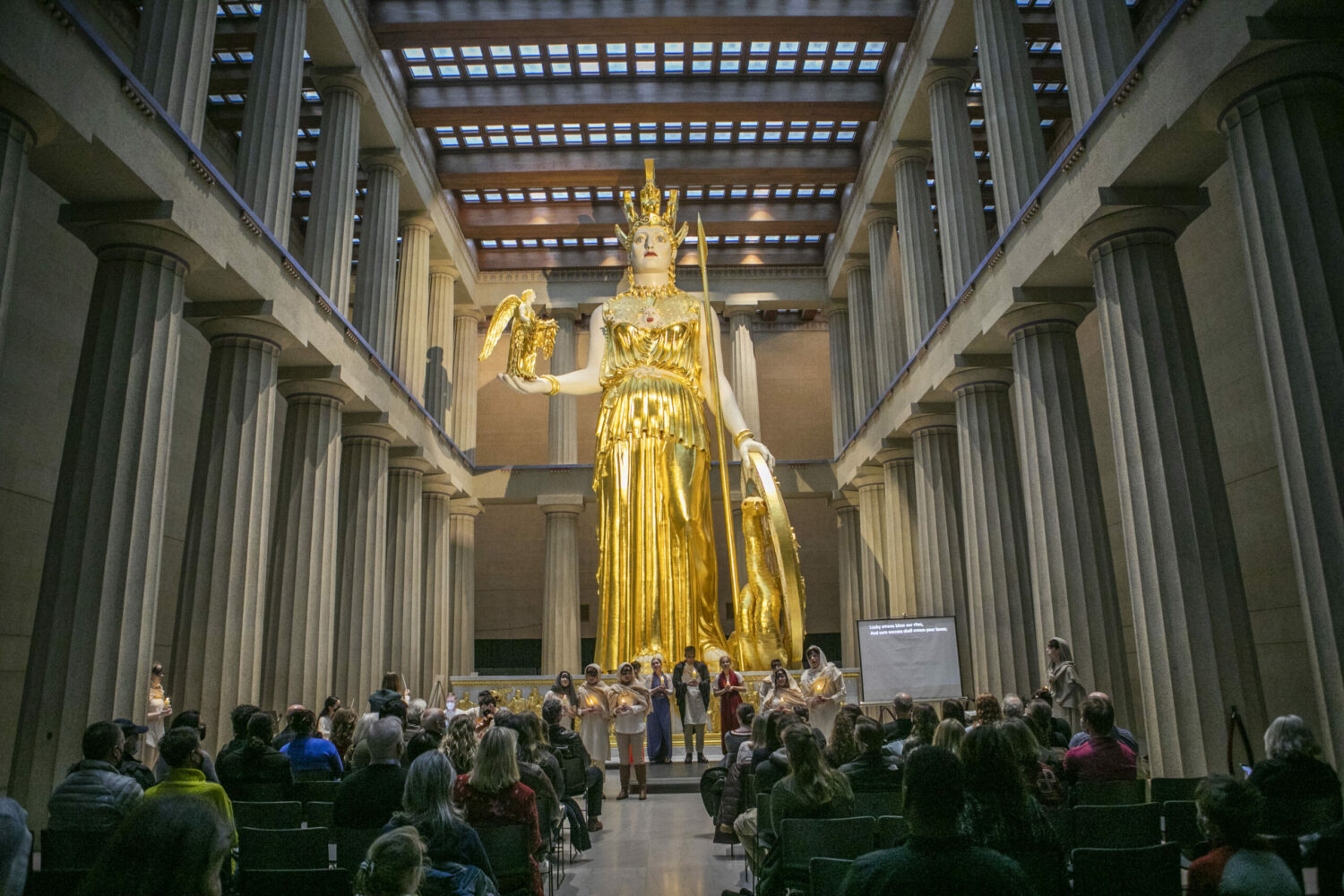
Photo: Anne Rayner.
Athena watches over a production of ‘Semele’ at the Parthenon in Nashville, a city better known for Country & Western than Early Music.

Well, this is fun. Just goes to show that blanket assumptions about places (about groups of people, too) tare always wrong.

John Pitcher writes at Early Music America, about a recent Vanderbilt Opera Theatre production of George Frideric Handel’s 1744 opera-oratorio hybrid Semele.

“The production, featuring a small student string ensemble and singers expertly coached in Baroque performance practice, ran two consecutive nights inside Nashville’s Parthenon. ….

“Vanderbilt’s historical performance (HP) program is just one part of an early-music scene that’s been ebbing, flowing, and growing in Nashville for nearly 20 years. The city is home to two HP ensembles, Music City Baroque and Early Music City. Each can boast of distinguished pedigrees. There are also a couple of churches, St. George’s Episcopal and First Lutheran, that serve as regular venues for early-music performances, along with an assortment of choral groups that routinely perform Renaissance and Baroque music.

“Nashville’s period-instrument musicians can play Bach’s B-minor Mass with the best of them. But these musicians are influenced just as much by their close association with Music City as they are by their familiarity with valveless horns and viola da gambas. Nashville has a music infrastructure that is second to none, with over 180 recording studios, 130 music publishers, 100 live music clubs, and 80 record labels. …

“It’s not uncommon for Nashville classical musicians to perform Mahler with the Nashville Symphony, record a pop song with Miley Cyrus, premiere a 21st-century piece with one of Nashville’s several contemporary-music ensembles, and give a period-instrument performance of a Bach Brandenburg Concerto — all in a few weeks.

“Chris Stenstrom, a long-time cellist with the Nashville Symphony who also performs regularly with Nashville’s contemporary group Alias Chamber Ensemble as well as Music City Baroque, is typical of this kind of musician. Indeed, he keeps a spare cello in his closet, strung with sheep gut and tuned to A415. ‘I like to have one instrument that’s settled in and ready to play Baroque music,’ Stenstrom says.

“The versatility of Nashville’s historically informed musicians has made them flexible, even delightfully heretical, in their approach to performing early music. … Many of Nashville’s historically informed players are open to performances using modern instruments, and most are utterly expansive in their definitions of what constitutes early music.

“Although Bach, Handel, and Telemann are often performed, one also encounters programs devoted to Baroque women composers, along with music from Nashville’s early history, which includes Negro spirituals, hymns, and fiddle music. ‘Nashville musicians have never felt the need to be completely orthodox in their approach to early music,’ says Jessica Dunnavant, a long-time flutist with Music City Baroque who teaches modern and Baroque flute at both Vanderbilt and Lipscomb universities. ‘Rhinestone and twang are welcome at our concerts.’ …

“Things didn’t get started until 2003, when George Riordan, an oboist and scholar steeped in Baroque performance practice, left his post as an assistant dean at Florida State University College of Music to become director of the School of Music at Middle Tennessee State University.

“That summer, Riordan’s wife, Karen Clarke, a noted period violinist who had performed with the Atlanta Baroque Orchestra and Smithsonian Chamber Orchestra, among others, noticed an item in an Early Music America newsletter that caught her eye. Murray Forbes Somerville just announced he was leaving his position as Harvard University’s University Organist and Choirmaster to take up a post in, of all places, Nashville. …

“Nashville’s classical-music scene was, at that moment, on the cusp of its golden age. Kenneth Schermerhorn, then music director of the Nashville Symphony Orchestra, had already established a partnership with Naxos Records to record for its American Classics series. This arrangement would soon turn the Nashville Symphony into a Grammy Award juggernaut. Martha Ingram, a Nashville billionaire benefactor, was meanwhile dispensing funds to her favorite performing-arts groups with unprecedented largesse. This culminated with the 2006 opening of the Schermerhorn Symphony Center, modeled after Vienna’s Musikverein.

“The city, moreover, had plenty of choristers who knew their way around Handel’s Messiah, and a growing number of classical musicians who had at least some training in historically informed performance. This was fertile ground for the right maestro to plow.

“Not long after Somerville moved to Nashville, Riordan connected with a phone call. ‘I invited Murray out to MTSU for an early music jam session,’ Riordan recalls. ‘We played that first session, and Murray declared that we needed to put on a show.’ “

Be sure to read the part about finding similarities with Appalachian musical traditions at Early Music America, here. No firewall.

Read Full Post »

Travel Trip 5 Free Things Nashville

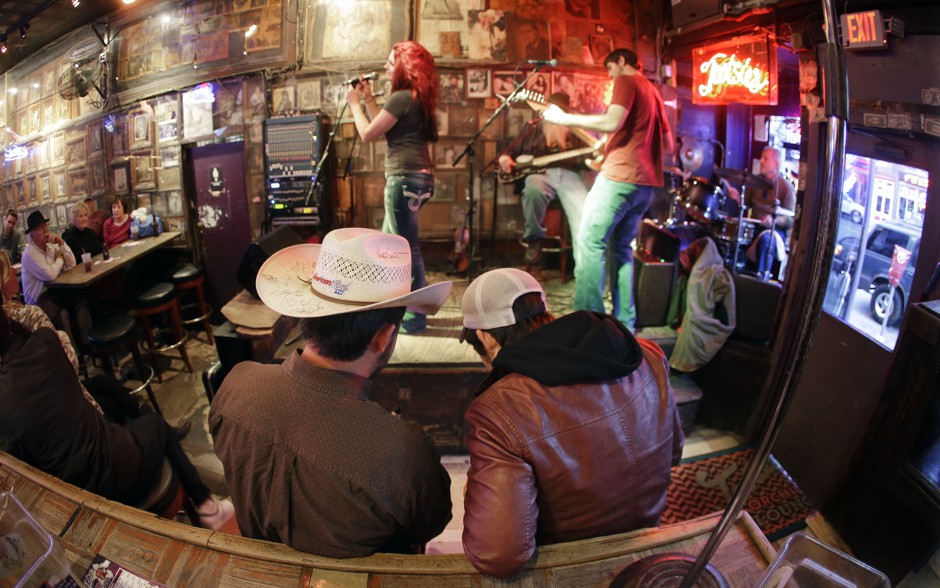
Photo: Mark Humphrey/AP
“More than 15 million visitors came to Nashville last year, and country music is a big reason why,” says
CityLab.

I have never been to Nashville, but when John visited, he was impressed. He told us that music and signs of music were on very street corner. A recent article added other angles to Nashville’s music story.

Lee Gardner at CityLab writes, “Thanks to a surging economy and an onrushing hot-city rep, the Music City has been gaining about 100 new residents a day. … But as the skyscrapers and rents have risen, many of the hallowed offices and studios of Music Row, the industrial heart of the country, have come under threat from the wrecking ball.

“Country music has survived a lot worse, according to Don Cusic. He’s is a Nashville-based historian of the genre who served as a consultant for Country Music, the massive new 16-hour PBS documentary series from filmmaker Ken Burns that charts the genre’s trans-Atlantic influences and tracks its nearly 100-year rise from disrespected ‘hillbilly music’ to the vox populi of the white working class, and a multi-billion-dollar business in the streaming age.

“Cusic spoke with CityLab about why Nashville became synonymous with country [and about] what’s next for the city. …

“Gardner: Why do you think Nashville became synonymous with country?

“Cusic: Actually it was Chicago and country music that were synonymous until about World War II, and after that Nashville. It starts becoming synonymous because of the radio stations. In Chicago it was WLS, in Nashville WSM — the National Barn Dance in Chicago, the Grand Ole Opry in Nashville. But the Chicago show lost its sponsor, which was Alka-Seltzer, and the Grand Ole Opry didn’t. It was sponsored by Prince Albert Tobacco.

“The other basis for the Opry’s stability was that it was owned by the National Life and Accident Insurance Company. The company used the Grand Ole Opry as a ‘door opener.’ Salesman would knock on doors with a brochure about the Opry, and that would lead into sales of insurance policies. When rock ‘n’ roll hit in the late 1950s, a number of radio stations switched to rock, [but] the Grand Ole Opry kept going because it could sell insurance. …

“Gardner: What is it about Nashville other than the Opry that allowed things like Music Row to take root?

“Cusic: It’s the people behind the scenes that made a difference. … You had a lot of these key figures who were executives who said, ‘If we’re going to have a show, it’s going to be top-notch show.’ I think that’s a lot to do with it right there.

“Gardner: People now talk about Music Row … as a forerunner of the ‘innovation district’ concept. Do you think that having this tight concentration of companies and creatives had an effect on the rise of country, and of Nashville?

“Cusic: Absolutely. Nashville attracted … a creative community, and that creative community feeds off of itself. I teach at Belmont College, and my students are always saying, ‘Where I come from, I’m the only person that writes songs; I’m the only person that plays the guitar. I get here and everybody writes songs and everybody plays the guitar.’ …

The other thing was the Nashville musicians’ union. Here, musicians could make a living playing, and when the studios developed, you had top-notch musicians here.

“Gardner: Country music — and perhaps Nashville, too — get stereotyped as being extremely white. … I gather the series explores some of those stereotypes. …

“Cusic: They did a survey not long ago, where about a third of the people in this country didn’t like country music, and not because of the music, not because of the artists, not because of the songs, but because of the image they had of it. They didn’t want that to be their self-image, and the image they had was we were backwards, we were hicks and hillbillies, we were racist. … I think this documentary takes that down quite a bit. …

“Gardner: Nashville has seen a lot of economic changes. … How is that affecting the city’s country music identity?

“Cusic: I wrote a book called Nashville Sound, and it really should have been Nashville Sounds. The public perception of Nashville is not accurate, totally, with music, because there’s a thriving jazz scene here. Contemporary Christian music has a huge presence here. You’ve got pop and rock acts here. …

“Gardner: I imagine, though, that many of the people now moving to Nashville don’t really care much about music. Do you think that the city’s musical identity has been watered down?

“Cusic: One of the things that comes through in Ken’s documentary — you can’t kill it. You can hold it underwater, but you just can’t kill it. It’s like a rubber ball that keeps bouncing back. That’s kind of frustrated the Chamber of Commerce at times, because they still want Nashville to be the Athens of the South. [But] it comes back to country music over and over again. That’s what stuck in people’s minds. Believe me, the business establishment and social establishment have tried to change that. They can’t do it.”

More at CityLab, here.

Read Full Post »