Feeds:
Posts
Comments

Posts Tagged ‘covid-19’

gjw6gssc7jtv42liwz2xxprp6i

Photo: Craig F. Walker/Boston Globe
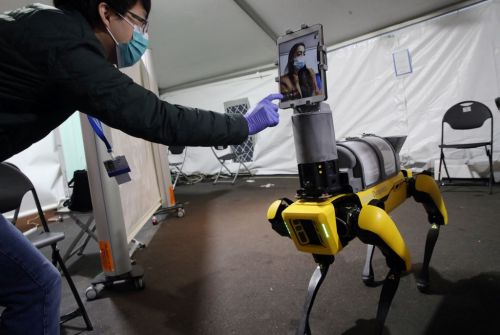
Research scientist Hen-Wei Huang talked about Spot the robot during a demonstration at Brigham and Women’s Hospital in Boston.

When Boston Dynamics first launched its robot dog, people regarded it more as a toy with fancy tricks than as a serious partner in the working world.

Then came coronavirus.

As Hiawatha Bray reports at the Boston Globe, the robot’s remarkable agility is one reason it has become useful for screening potential Covid-19 victims safely.

Bray writes, “At Brigham and Women’s Hospital, the first encounter a potentially infected person might have is not with a doctor or nurse swathed in protective gear, but with a talking, animal-like robot that looks like it might have wandered off the set of ‘Star Wars.’

“Spot, the agile walking robot from Waltham-based Boston Dynamics, gained Internet notoriety for showing off its dance moves on YouTube. But now it’s going to work in the real world, striding into the danger zone, armed only with an iPad. The robot is posted just outside the hospital, not so much as a sentinel, but as an intake worker that will help doctors safely interview people who fear they may have been infected with the coronavirus. …

“The yellow-and-black Spot robot, which resembles a large dog, is positioned inside a big white tent set up in front of the hospital’s main entrance as a triage area for potential COVID-19 cases. It is fitted with an iPad that displays a physician located safely inside the hospital who can use the device’s camera to see the patient’s physical condition. The doctor can talk to the patient through the built-in microphone and a mounted speaker, asking standard diagnostic questions.

“The physician is also able to remotely control Spot, directing the machine to move around for a better perspective of the patient. …

‘Most people have been very excited to be interacting with this robot and mostly see it as something that is cool and fun,’ [said emergency room doctor Farah Dadabhoy].

“Michael Perry, Boston Dynamics’ vice president of business development, said that as early as February the company began receiving inquiries from hospitals worldwide. Was it possible, they asked, to use a Spot robot to conduct triage interviews? …

“Many had set up their COVID triage areas outdoors, on lawns or in parking lots. On such uneven surfaces, ‘traditional robotics doesn’t make sense,’ he said. ‘We need something that can handle this difficult terrain.’ …

“Doctors at the Brigham had also been looking into automated triage. In cooperation with engineers at the Massachusetts Institute of Technology, they worked on remote diagnostic sensors, but they needed a robot to carry them. So in March they reached out to Boston Dynamics.

“The result was a specially modified Spot, featuring the iPad and a little carrying pouch mounted near the robot’s ‘tail.’

“There’s nothing flashy about the pouch, but it’s quite practical. It allows Spot to deliver small items such as bottled water to infected patients, without the need to send in a nurse. Personnel can’t approach a COVID-infected patient, even for something as simple as giving him a bottle of water, without putting on safety gear. … With the medical version of Spot, health care workers can just put the bottle in the pouch and have it marched over to the patient. And the moisture-resistant robot is designed to be sanitized easily.

“The current version of Spot is only good for conducting interviews. But the Brigham will soon deploy an upgraded model with cameras that can measure a patient’s respiration rate and body temperature, with no need to make physical contact. …

The company said it is giving its medical hardware and software designs at no charge to any robotics company that cares to use them. Perry said Boston Dynamics has already had talks with a Canadian maker of wheeled robots.

Read more at the Globe, here.

Spot the Robot Dog in an earlier career as a YouTube dancing sensation.
Read Full Post »

merlin_171325053_7e964ad6-9a5e-4fbb-a992-81804bd3bb07-superjumbo

Photo: Lauren Justice for the New York Times
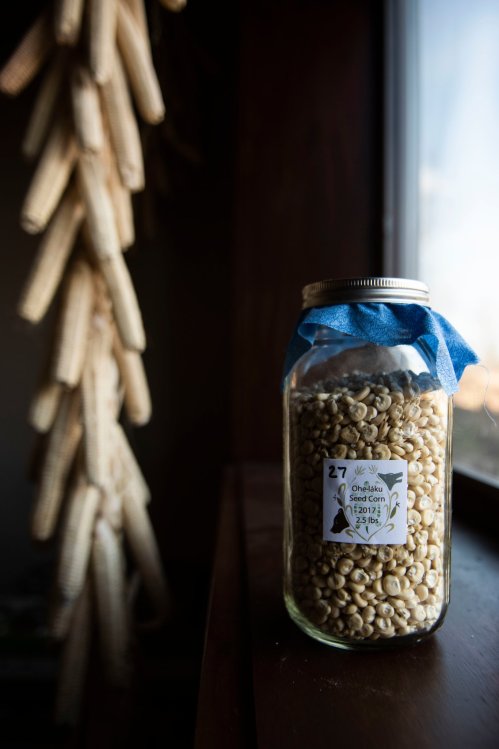
“Faced with grocery shortages,” reports the
New York Times, “many Native Americans have started collecting seeds to plant in their gardens at home.” Among members of the Oneida Nation, white corn, above, is prized for its versatility and nutrient density. 

As many of us non-gardeners start to wonder if we could grow tomatoes and lettuce in the kitchen window, we look with envy at people who can feed themselves without grocery stores.

Recently I read an article in the New York Times by Priya Krishna about indigenous Americans who, although suffering in the pandemic like the rest of us, at least have ancient wisdom they can dust off to help them survive.

“For the roughly 20,000 members of the Oglala Sioux Tribe living on the Pine Ridge Indian Reservation — a vast, two million-acre expanse in southern South Dakota — social distancing is certainly feasible. Putting food on the table? Less so.

“Getting to food has long been a challenge for Pine Ridge residents. For a lot of people, the nearest grocery store is a two-hour drive away. Many rely on food stamps or the Food Distribution Program on Indian Reservations, a federal initiative that provides boxes of food (historically lacking in healthy options) to low-income families. Diabetes rates run very high.

“The coronavirus crisis [has] only made access to food harder, as shelves of the few groceries empty out, shipments of food boxes are delayed because of supply chain disruptions, and hunting and gathering are restricted by government regulations and environmental conditions.

“But the Oglala Sioux, like many other Native Americans across the country, are relying on the practices — seed saving, canning, dehydrating — that their forebears developed to survive harsh conditions with limited supplies. …

“Big-box stores and processed foods have eroded some of the old customs. But now, faced with a disrupted food system, many Native Americans are looking to those traditions for answers.

“Milo Yellow Hair, who lives in Wounded Knee, S.D., on the Pine Ridge Reservation, is hard at work preparing 8,000 seedlings of local varieties of squash and corn — hearty crops with a short growing time — to plant in people’s yards. …

‘Here on the reservation it is a day-by-day existence,’ said Mr. Yellow Hair, 70, who works for the nonprofit Slim Buttes Agricultural Development Program. ‘If this thing goes crazy and the external food services stop, the food we grow locally is going to be paramount to meet this need.’ …

“The coronavirus emergency is dire on the Navajo Nation in Arizona, Utah and New Mexico, which as of [April 13] had 698 cases and 24 deaths. …

“The Turtle Mountain Band of Chippewa has a strong tradition of canning local crops like beets, cucumbers and carrots, and some families are known for their expertise. Many are now donating their stockpiles to those on the reservation in need.

“ ‘You don’t think twice about it,’ said [Jamie Azure, the tribal chairman of the Turtle Mountain Band of Chippewa, in Belcourt, N.D. ]. ‘And then when the Covid-19 threat comes through, you realize how important all of this is.’

“In Alaska, the Athabaskan peoples have long dealt with brutal, protracted winters by preserving produce and freezing meats. Cynthia Erickson, who is Athabaskan and an owner of the only grocery store in her village, Tanana, has a freezer full of moose, caribou and whitefish. But she has been struggling to get her usual wholesale suppliers to fill orders. The tribe may ask Gov. Mike Dunleavy to open moose hunting season (which normally begins in August or September) early if the food supply runs low, she said. …

“After much of his work dried up, Brian Yazzie, a private chef in St. Paul who is Navajo, decided to volunteer at the Gatherings Café in Minneapolis, which is feeding Native American seniors. He is cooking almost exclusively with traditional Native ingredients, making stew out of tepary beans from Ramona Farms in Sacaton, Ariz., and cooking elderberries into a sauce for barbecue chicken.

‘Indigenous peoples survived colonization, and so has our food and ingredients,’ said Mr. Yazzie, 33. ‘Practicing our foodways is a sign of resiliency.’ …

” ‘As this pandemic continues to grow,’ [says Chelsey Luger, who co-founded an indigenous wellness program with her husband], ‘I can tell you that I feel safer on the reservation than anywhere else.’ ”

More at the New York Times. here.

Read Full Post »

andyandersen_st.fauci_-1080x1080-1

Art: Andy Andersen via Hyperallergic
Andy Andersen’s depiction of Dr. Anthony Fauci, of the National Institute of Allergy and Infectious Diseases, as Saint Pantaleon the Healer. Andersen, a Los Angeles area illustrator, is one of many artists reimagining the doctor as pandemic cultural icon.

Don’t you love how creative people always find ways to have fun with current events, no matter how dire? Consider this charming story by Hakim Bishara at Hyperallergic, where we learn about the art community’s take on the doctor at the center of federal Covid-19 communications, the doctor that people trust.

“Dr. Anthony Fauci, head of the National Institute of Allergy and Infectious Diseases and a member of the White House coronavirus task force, is by all accounts the man of the hour [and] being showered with praise and admiration, sometimes uncomfortably, as he became the most recognized voice in the United States on the coronavirus pandemic.

“On social media, Fauci is being celebrated with thousands of artistic tributes, from admiring portraits and cartoons to tattoos, sock puppets, and saint icons bearing his image.

“One of the most intricate tributes to Fauci belongs to Andy Andersen, an illustrator based outside of Los Angeles. His illustration depicts the famed doctor as the late-medieval Saint Pantaleon the healer. ‘Saint Fauci’ holds a box of medicine, flanked by angels of death and spikey coronaviruses.

“ ‘I based it on some of the classic saint iconography that exists,’ Andersen explained to Hyperallergic in an email. ‘The pose, the composition, the elements all reference those iconic images, but updated with references to the virus.’

“ ‘To me, Fauci is the calming, reassuring voice during this confusing and unpredictable time,’ Andersen wrote. ‘He reminds me of a grandfather who assures you that everything will be ok. It will be hard, it will most likely suck, and sh#!t will happen, but in the end, everything will be ok. The silver lining is that humanity has such a competent, intellectual powerhouse on its side.’

“Several other fans also elevated Fauci to saintdom. One of them created a ‘Saint Fauci’ votive candle with the caption: ‘Not all heroes wear capes! 🙏🙏🙏🙏’ [See @taintedsaint_ on Instagram.]

“One of the most famous public images of Fauci captures him facepalming … during a coronavirus briefing at the White House. For many Americans, the image highlighted Fauci as a voice of reason …

“Brad Albright, an artist and an illustrator based in Texas, decided to perpetuate Fauci’s facepalm with a sticker. ‘Somebody get this man some (more) medals, honors and awards!!! Seriously. He’s a saint,’ he wrote in the caption.

“In addition, there are myriad admiring portraits of Fauci online, from pencil sketches to paintings and GIFs. One such artwork, titled ‘The Explainer in Chief,’ captures Fauci explaining the disease to the press cameras. The artist, Phil Bateman, writes in the caption: ‘Who else but Anthony Fauci could tell you terrifying things and yet whose terrifying explanations made you feel better because you believed only him.’ …

“How does this intense level of attention affect Fauci himself? When asked in an interview with CBS’s Gayle King if he feels personal pressure he calmly answered, ‘It’s my job. This is the life I’ve chosen and I’m doing it.’ ”

Read Hyperallergic here. And for more on the curious manifestations of Fauci fandom, check out the Verge.

By the way, did you ever see the documentary How to Survive a Plague, about the AIDS crisis?  Dr. Fauci was in government back then, too, and in the the early 1980s, before his hair turned gray, he was definitely not considered a hero by terrified AIDS victims. Clearly, he has learned a lot. Which proves that there really are second chances in life.

Photo: Donut Crazy via the Hartford Courant
Donut Crazy has honored infectious disease expert Dr. Anthony Fauci with special doughnuts bearing his image.

oiwoz6yjrnbpjpvre2mrkujbhu

Read Full Post »

psa

Image: Youtube

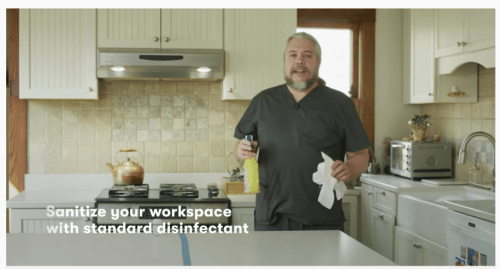
Because our age puts my husband and me in a high-risk category for Covid-19 and because I know the pandemic won’t last forever, I’m going to try the doctor’s grocery-disinfecting techniques from the 13-minute video below. It’s a lot of work and most people will think it’s nuts. But there are some good tips here. And you know, unless you are a health-care worker or suddenly homeschooling, you do have time.

Among the easier tips: leaving nonperishables in the garage or on the porch for the three days it takes for the contagion to dissipate; buy only hot takeout and reheat it in the microwave or stove; toss the outer cereal box and just keep the inner liner; dump bread into a container you can seal and throw out the bread bag.

Most people could manage that, I think.

Meanwhile, I confess that I am washing bananas now, but I’m not yet at the doctor’s 20-second requirement. At first my husband said, “Wash bananas? They have their own skin and you throw it out.” But then he realized we weren’t talking about washing because you are going to eat the banana but because the outside of anything that unknown people have touched can spread germs around your house.

But he still wasn’t really on board. Then he read a New York Times article by infectious disease expert Michael T. Osterholm, here, called “It’s Too Late to Avoid Disaster, But There Are Still Things We Can Do” (!) and decided maybe we do have to up our game. We’re on our own. Watch the video, and let me know what you think.

On a more cheerful note, whenever I can get technology to work, it’s been a pretty great boon. We had a four-way chat with our kids on FaceTime yesterday that was fun and funny, and today I go online with What’s App or Skype to help an Afghan asylum seeker with her grad school application.

Hang in, Folks. This won’t last forever.

Read Full Post »

divnwdsdyfaeznt7mcrsbjugam

Photo: Tom Gralish / Inquirer Staff Photographer
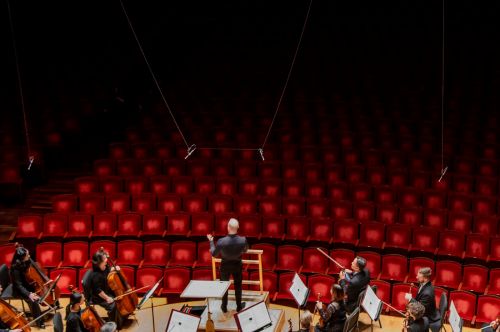
A friend wrote on Facebook about listening to a Covid-19 Philadelphia Orchestra concert March 12.

At first when I read her Facebook post, I thought a friend I’ve known since I was in nursery school had gotten inside the hall to hear this concert. But I see the staff kicked almost everyone out. I guess she listened on the radio.

Hannah posted: “I was touched by the Philadelphia Orchestra playing a concert to an empty hall on Thursday. They did Beethoven’s 6th, a good choice for this strange time in our history. The acoustic was different, of course, and lent a crispness to the sound. It was their last performance until whenever. Available for streaming on WRTI. Thanks, orchestra!”

Looking up more info, I found an article by David Patrick Stearns at the Inquirer.

“The Philadelphia Orchestra was never meant for an audience of one — or few. That’s why the Philadelphia Orchestra’s audience-less Thursday concert felt like a parallel universe.

“You had the familiar orchestra musicians in full concert dress, music director Yannick Nézet-Séguin, and the beloved Beethoven Symphonies Nos. 5 and 6. Except different. On Thursday afternoon, the Philadelphia Orchestra canceled all of its events through March 23. ….

“The concert’s Plan B, which fell into place that same day, had the performance going forward to a nearly empty house, streamed on the orchestra’s website (though a snafu put it in Facebook Live) and recorded for WRTI radio broadcasts. …

“For those who were there, it was confounding to have the orchestra standing to receive phantom applause that wasn’t there. This was not a dress rehearsal, but the real deal. And it was also a reminder of the gravity of the situation.

“The atmosphere, though, was hardly grave. … For all of its magisterial image, the Philadelphia Orchestra isn’t easily unnerved, thanks to history of foreign touring under highly changeable circumstances. …

“Of all the composers, it’s Beethoven who has been there for the public through centuries of hardship, Nézet-Séguin said in a spoken introduction to the concert: ‘And we’re still inspired.’

“ ‘We rehearsed the program … we were gearing up to play it,’ first associate concertmaster Juliette Kang told me at intermission after playing Beethoven’s 5th.
‘We had to play it. It was an artistic imperative from the inside,’ Kang said. ‘The emotional whirlwind everybody’s in, it came through in the piece. It did for me. I could feel that struggle in the Beethoven.’

‘Though the hall was empty, I could feel trembling inside of me,’ said concertmaster David Kim. …

“Internet chatter praised the orchestra for maintaining its presence — along with criticisms that the musicians were at risk just from being together. There’s an edge of covert panic out there, and you can almost feel the struggle between people’s sense of hope and fear.

“On the hope front … On Twitter, pianist Igor Levit (@igorpianist) vowed to stream performance videos from his home every day at 7 p.m. Central European Time. The Berlin Philharmonic played a streamed concert from an audience-less hall on Thursday afternoon, including Berio’s Sinfonia, whose choral contingent embeds the words ‘Martin Luther King’ into the orchestral texture. …

“In Philadelphia [Beethoven’s Fifth] was not the kind of end-of-the-world Beethoven heard from European radio archives when empires were crumbling during World War II. Nor was there the hopelessness felt at the Philadelphia Orchestra’s post 9/11 concert at the Mann Center in 2001.

“The current adversary is an invisible virus, not a fallen hero or an act of war. Thursday’s concert had exceptional momentum, as if to say, ‘We will get through this.’

“Beethoven’s usually genial Symphony No. 6 (‘Pastoral’) had higher peaks of tension and release than usual, with an aggression in the third-movement peasant dances that led more logically than usual into the storm scene that followed — as if Nézet-Séguin conducted it as an opera without words.” More from the Inquirer critic here.

Read Full Post »

rtx79fmi-e1584114422319

Photo: Reuters/Guglielmo Mangiapane
Italy formally recognizes that newspapers are essential services.

The demise of newsprint has been exaggerated. Newspapers are still needed. Not only did one in Australia — partly as a joke — print some blank pages with dotted lines for making your own toilet paper, but in Italy newspapers have now been characterized as “essential” services.

Luiz Romero reports at Quartz: “As it became increasingly clear earlier this week that the Italian government would announce even more stringent measures to combat coronavirus, in a country that already faces extraordinary restrictions, a debate began to brew over what should be left open and what should be forced to closed. Places that sell food and medicine would have to keep functioning, but what about the edicole—the small shops that sell newspapers and magazines, and that still exist in the thousands in Italy?

“On Wednesday (March 11), Carlo Verdelli, the director of Repubblica, one of the two largest newspapers in the country, alongside Corriere, published a note arguing that newsstands should be added to the list of essential services that was being prepared by the government. …

“Here, like everywhere else, newsstands are disappearing. They went from 18,400 to 14,300 during the 2010s—a number that  includes those that also sell souvenirs for tourists. Excluding them, the real number of newsstands in Italy is estimated to be around 5,000. Still, Italians like to read newspapers. Almost a third of the population gets its daily news in print. …

“After some debate, and as the number of cases continued to spike, the government finally took a decision. Everything had to close except what it deemed essential services—food stores, pharmacies, hardware stores, and factories. … Newsstands were also allowed to keep going. …

“In Milan, newspaper vendors are proud of what they do. Rosi Varezza, who operates a small but busy newsstand, explained that papers are essential for elderly readers, who are most at risk from the outbreak. Clients buy newspapers for habit, but also to get information they deem more trustworthy; to go deep into subjects they consider important; and to hear the news delivered from specific voices—columnists that have informed them for decades. …

“Newsstands are even registering a small bump in sales. That was clear in Milan. In a busier newsstand, near a major shopping street here, I had to wait to pay for the newspaper. And when my turn came, I had to ask my questions quickly. The newsagent was impatient, answering with short sentences, and insistently looking over my shoulder. A line was forming.” More at Quartz, here.

In my own case, I have always read articles more deeply if they are in print. And in my semi-isolation, I look forward to the paper delivery every day and read more sections than usual. You?

Read Full Post »

coronavirus-comic-1460-7-1080x802-1

Art: Wei Man Kow

While many of us feel crushed under the weight of stories about Covid-19, cartoonists have been addressing the coronavirus in their own way, mostly trying to be helpful.

Jason Li writes at Hyperallergic, “No corner of the globe experiences the epidemic in quite the same way. … Cartoonists and illustrators have taken to the public squares of social media to express statements of solidarity, share experiences (and grievances), and laugh a little. [We’ve] collected our favorite works from around the world — taking care to include as many perspectives and geographies as we could, while still centering those in China, who remain most impacted by the virus. …

“[One] viral illustration by momo shows that Wuhan, ground zero of the epidemic, carries the support of everyone else in China. Wuhan is represented by a caricature of its famous food, hot dry noodle, while those cheering them on are drawn as foods from other regions of China.

“On a gentler note, the 3×3 comic [by] Wang XX is a fantastic encapsulation of the tenderness and care that people in China are feeling for one another during this calamitous period. In it, a seal, octopus, walrus and mouse help each other don their face masks and then hug it out. …

“[Another] comic about the shortages in Hong Kong by Ah To shows a person keeping toilet paper them in their safe along with their gold bars and surgical masks. …

“Many in and outside of China criticize its authorities for handling the crisis poorly and for muffling early warnings from medical experts. [A] mini-comic by A ee mi in Taiwan weaves a fantastical yet blunt critique of China’s healthcare system. In it, a coronavirus carrier is sent home without proper treatment, spreading the virus to their friends and community.

“While many airlines have suspended flights to China, the authorities in Hong Kong, which shares both land and sea borders with Mainland China, have staunchly refused to close off its borders. This has left its citizens incredibly anxious and angry. [Toballkidrawing] aptly depicts how the issue is viewed in Hong Kong — that the government is handing out a free pass for the virus to move in. …

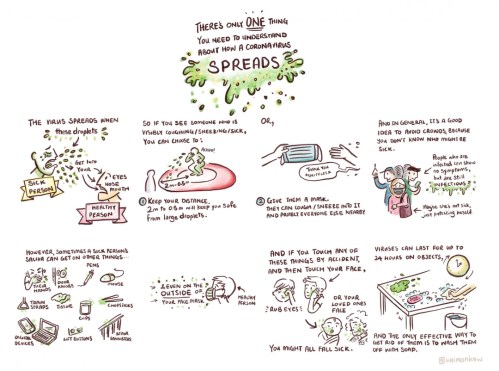
“One genre of responses that’s been common across the globe is illustrated health advice. Some are comedic, some pithy, but the most popular are detailed and instructional. The above example by Wei Man Kow in Singapore was an unexpected hit and was subsequently translated into seven different languages by various strangers on the internet. (The artist has also made the instructional available for free download, including coloring book versions in Chinese and English.) Meanwhile, veteran cartoonist Sonny Liew (also in Singapore) teamed up with local doctors to put out [a] calming, animal-themed strip combating paranoia and disinformation.

“The breadth of these illustrated responses mirrors the myriad lived realities of the coronavirus. While none will argue that the virus is not a global epidemic or phenomenon, few agree on how serious the problem is, and people around the world are experiencing and interpreting its impact in vastly different ways. ”

Check out all these comics and more at Hyperallergic, here. If you have seen other good cartoons on this topic, please link to them in comments.

Read Full Post »

« Newer Posts