Feeds:
Posts
Comments

Posts Tagged ‘cow’

Photo: Melanie Stetson Freeman/CSM.
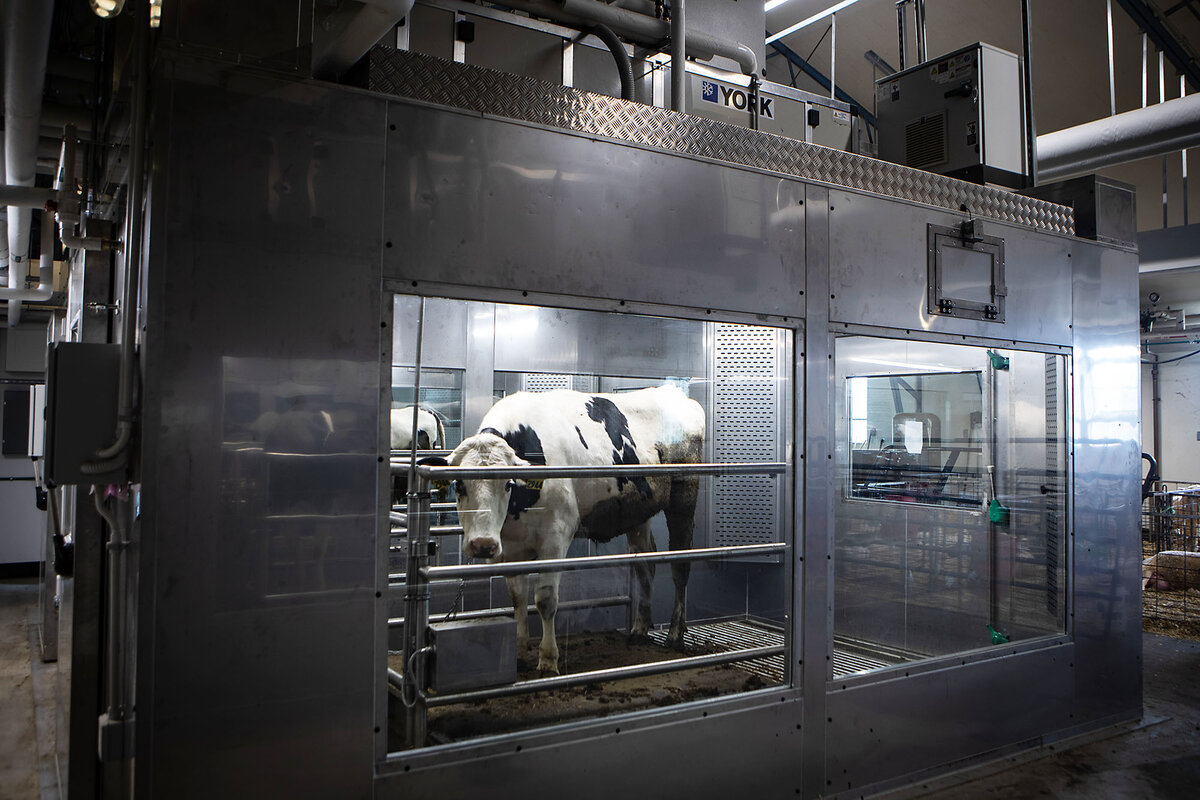
A heifer stands inside a methane chamber at Cornell University, June 7, 2024, in Ithaca, New York. Researchers are studying how to reduce methane emissions from dairy cows.

When he was only 11, one of my grandsons gave up eating beef after learning in school about the effects of cows’ methane emissions on global warming.

I guess it’s fortunate that there are people researching ways to make cows “less gassy.” But some of the research sounds like it’s not much fun for the cow.

Stephanie Hanes of the Christian Science Monitor reported recently on work at Cornell.

“On the campus of Cornell University, within an intricately monitored and carefully sealed chamber, there is a cow. Scientists carefully record what this cow eats and what she drinks. They open the chamber only once a day, so as to limit disturbances to her environment. Every breath she takes – or more crucially, exhales – is also measured to its molecular level. There is hydrogen. There is carbon, recorded down to its isotopic composition. There is oxygen. And, most important to this state-of-the-art study, there is methane.

“Methane is a naturally occurring gas that comes from a variety of biological and industrial sources, from oil- and gas-well leaks to decomposing garbage to, well, cow burps. It is also one of the world’s most potent greenhouse gases – far more heat-trapping than carbon dioxide. …

“ ‘There is growing awareness amongst environmental advocates, policymakers, that reducing methane emissions is the fastest way to reduce warming,’ says Dan Blaustein-Rejto, director of food and agriculture at the nonprofit Breakthrough Institute. …

“Although exact percentages are difficult to determine, researchers estimate that cows are responsible for around 30% of U.S. methane emissions. This is largely because cattle, like goats or sheep, are ruminants: animals with four-chambered stomachs that ferment grass and other vegetation into consumable food. And a natural by-product of rumination is methane. …

“According to the U.S. Department of Agriculture, there are 28.2 million beef cattle in the U.S., along with 9.36 million dairy cows and 33.6 million calves. And those numbers pale in comparison to countries such as India, which has an estimated 61 million milk cows, or Brazil, with around 234 million beef cattle. 

“With growing pressures from policymakers and climate advocates, then, agribusiness and scientists are trying to figure out how to make individual dairy cows more productive, which could lead to smaller herds, while at the same time trying to find ways to make cow burps — the body function that produces the most methane — less gassy.

“The first step to doing that, says Cornell associate professor Joseph McFadden, is to get good measurements of bovine methane in the first place. …

“ ‘The challenge comes in capturing the methane,’ says Joe Rudek, lead senior scientist at the Environmental Defense Fund. ‘Cows are breathing out this methane. You’ve got them walking around in a pasture, how do you capture that methane that’s coming out of the cows’ mouth and nostrils?’

“So instead of individually measuring each cow, scientists are trying to build up a robust sample size of measurements that would let them statistically predict methane emissions, both broadly and specifically. One contraption they use now is called the GreenFeed – basically a high-tech box with cow treats. When the cow puts her head into it to eat, the box measures methane and other gases. These instruments are portable, so theoretically farmers can use them in different locations.

“But, Dr. McFadden says, those measurements are not always exact. That’s why his respiration chambers are important. Because the pods are highly accurate, closed systems, they can calibrate other machines. … The chambers can help him monitor other inputs and outputs that can give clues about animal health and well-being, and about how the animal uses energy – as well as about other greenhouse gases, such as nitrous oxide. …

“Across the country, at the University of California, Davis, professor Ermias Kebreab is also working with dairy cows, and has his eye on some solutions. In addition to feed additives, he is measuring what happens when cows eat local agricultural by-products, such as the grape residue from winemaking. GreenFeed measurements are finding some promising initial results, he says.   

“ ‘We found a 10% to 12% reduction in emissions,’ he says. ‘Animals were happy to eat it … and it avoids the emissions from putting it into a landfill.’ Not only that, he says, but grape pomace — the fruit’s leftover skin, seeds, or stems — seems to improve milk quality. 

“ ‘It’s a win-win kind of situation,’ he says.”

More at the Monitor, here.

Read Full Post »

Photo: Ann Clark Cookie Cutters.
Cow cookie cutters are among the many unusual shapes at this Rutland, Vermont, company.

When I started downsizing to move to the new place, I passed along or weeded out all sorts of possessions. Although I wanted to try making Christmas cookies in the new, tiny kitchen, I decided I didn’t need two Christmas trees, two snowmen, two stars. But today’s story makes me want to add shapes like cows, pigs, sharks, and ice cream cones.

Jordan Barry writes at Seven Days Vermont, “For many holiday bakers, the first step in the festive process is a trip into the depths of a forgotten cupboard. Behind lidless Tupperware and single-use appliances, they’ll find a jumble of gingerbread people, stars and trees. And, if those cookie cutters are good ones, there’s a high likelihood they were made in Vermont.

“Inconspicuously tucked into the warehouse land of Rutland’s Quality Lane, Ann Clark is the United States’ largest producer of cookie cutters, selling 4 to 5 million per year. Founded in 1989 by the artist for whom it is named and now led by her son, Ben Clark, the company sits behind only Chinese mega-manufacturers on the global cookie cutter scale. And as it continues to grow, the family-owned operation is expanding into all aspects of the baking biz, from food coloring to cake mixes.

“Cookie cutters are just one of the items that Ann’s art inspired, Ben told Seven Days on a tour of the facility in early November. … The convivial CEO described a folksy drawing of a pig that his mother and his business-consultant father had made into cutting boards, Christmas tree ornaments, coasters and cookie cutters to sell at trade shows. The cookie cutter, with a handmade recipe card tied to it, was the runaway hit.

“Soon, that pig was joined by a cow and a sheep. In those days, the family focused on selling their cookie cutters to gift stores and making custom promotional ones for businesses such as McDonald’s and Under Armour. Now, Ann Clark has an arsenal of roughly 3,500 shapes — around 700 of which are currently available — that range from simple numbers to holiday staples to a ‘fashion doll head,’ which surged in sales this summer around the release of Barbie.

“New shapes can be made in a day, inspired by trends, pop culture moments, competitors’ products, and creative ideas from employees and bakers around the country. There’s a cookie cutter for each of the year’s ’26 events,’ Ben said — a list that includes Christmas, Valentine’s Day, Halloween and Discovery Channel’s Shark Week.

“Of all 3,500, Ann’s favorite shape is the watering can. It became Ben’s sentimental favorite, too, after they realized it was the company’s worst seller. Any shape that does worse is immediately cut. …

“The company works with many of the top cookiers in the world, who test new shapes and send their elaborately decorated samples to Ann Clark HQ. Digital content manager Annora McGarry catalogs them in a ‘cookie library’ and stores the physical cookies in an office closet for use in photo shoots.

“Ann Clark cookie cutters’ high-profile fans include the team at King Arthur Baking in Norwich. The companies have worked together ‘for many years, and they are a wonderful partner,’ said Nathalie Morin, associate product manager at King Arthur.

“Cookie cutter designs should have enough detail to be easy to decipher, without small, pointy elements that will make dough stick or overbake, she explained. Metal cutters make the crispest cut, and rolled edges make pressing down more comfortable. …

“The cutters’ American-made status is a selling point for many, Ben said, but not always for the most obvious reason. … ‘It’s really about lead time.’

“When a shape runs out at the Ann Clark factory, it takes the production team just about nine minutes to change the die — a heavy metal block in the shape of a cutter’s final form — and start a replacement run. The new cutters are packaged and shipped by the following morning, whereas it could take months to import replacements from China, Ben said. During the busiest times of year, 12 to 15 employees across two shifts change dies 50 times a day, producing up to 500 cookie cutters per run. …

“When the business started, a company called Creative Products made the cookie cutters in Pennsylvania. Ann Clark slowly brought manufacturing in-house over the course of seven years, eventually acquiring Creative Products — and its accounts with stores such as Sur la Table, Williams Sonoma, Bed Bath & Beyond and Crate & Barrel.

” ‘We realized we’d been trying to convince gift stores that a cookie cutter is a great gift,’ Ben said. ‘Every kitchen store already knows what a cookie cutter is and why it’s great. We could barely keep up.’ …

“The team tested a host of private-label products, including food coloring, sprinkles, icing mix and meringue powder. The food coloring, like the pig design that launched a cookie cutter empire, was the clear winner. It kept selling out, and the manufacturer couldn’t keep up. With the help of food scientists, the Ann Clark team developed its own recipe and built a separate, food-safe facility down the road.

“That facility now produces 3,000 tubes of food coloring a day, along with products such as royal icing and fondant.

” ‘The food coloring is amazing,’ said Paulina Thompson, who launched her Essex Junction home-based biz, Paulina’s Sweets, in February 2021. ‘You can achieve the colors really fast, especially for that Christmas red that everybody wants.’ “

More at SevenDays, here.

Read Full Post »

John’s web surfing has been turning up topics he knows I’d like, too, and he takes the time to send a link. An article he sent from Modern Farmer describes why scientists are studying cows’ hairstyles.

Anne O’Brien writes, “While a bovine couldn’t care less about a hair whorl gone awry, it may be prudent for the farmer to take note. Turns out there is some serious science behind hair whorl behavior and brain development.”

Hair whorls on cows’ foreheads, O’Brien reports, “may be more than an aesthetic quirk. About two decades ago, animal behaviorists began to notice a connection between crazy hair whorls and crazy animals.

“Dr. Temple Grandin, professor of animal science at Colorado State University and author of the best-selling book Animals in Translation, first noticed a connection between the location of a bull’s hair whorl and whether the animal was excitable when handled by humans. Studies showed that location — meaning above, between, or below the eyes — as well as shape of the whorl could be, to some extent, a predictor of excitable behavior in cattle. …

“How, then, are hair growth patterns and temperament related? It all has to do with brain development, says Dr. Amar Klar, head of the Developmental Genetics Section within the National Cancer Institute in Frederick, Maryland.

“ ‘Our skin and the nervous system come from the same layer of cells in embryonic development, the ectoderm,’ Klar says.

“As embryonic cells migrate to form a developing fetus, skin and brain cells are closely intertwined, particularly at the scalp. …

” ‘When we were looking at brain laterality and the location of internal organs, hair whorls also came up,’ Klar says. His research has shown that within the human population, the majority is right-handed and demonstrates a clockwise hair whorl.

“Livestock seem to mimic this handedness. A study from the University of Limerick in Ireland in 2008 demonstrated that horses with clockwise hair whorls were significantly more likely to move toward the right, or begin a gait with the right-sided hooves — in essence, these horses were right-handed.” More here.

Photo: Temple Grandin
Scientists have been exploring the connection between the cow’s hair whorl and its behavior.

Read Full Post »

Vermonters care a lot about their farms. So when a dairy farm in South Woodstock was threatened with development, the neighbors bought it.

“Perched on a hill overlooking a valley,” writes Ann Trieger Kurland at the Boston Globe, “Farmstead Cheese Co. began as a neighborly plan to preserve a dairy farm.

“The bucolic 18-acre site was a former water buffalo farm and creamery that produced mozzarella and yogurt. When its owners moved to Canada and put the land up for sale, locals worried about the loss of jobs and the disappearance of another bit of the Green Mountain State’s rich heritage. They feared that the pastoral landscape might be grabbed by a developer.

“So 14 neighbors banded together to buy the farm and decided cheese making might safeguard its future. Within the year, they rebuilt the creamery, brought in a mixed breed herd — Holstein, Jersey, Ayrshire, and Swiss Brown — to blend milks and make farmstead cheese. They started the first community-owned dairy farm in the state. In two years, the company has won dozens of awards for its cheddar, a harvarti-style tilsit, Edam, and English and French-style cheeses.

“The new owners are not novices. They include seasoned farmers and food industry executives who hired experienced staff. The top cheese maker, Rick Woods, 46, has been plying his craft for 19 years. ‘We’re a new company, but it’s not the first time around the block for these people,’ says Sharon Huntley, who is in charge of marketing.” Read more about the community-owned farm and where you can buy the cheeses.

Photo: Vermont Farmstead Cheese Co.
At the community-owned in South Woodstock, Vt., there are 135 cows.

Read Full Post »

My Neighbor’s Cow

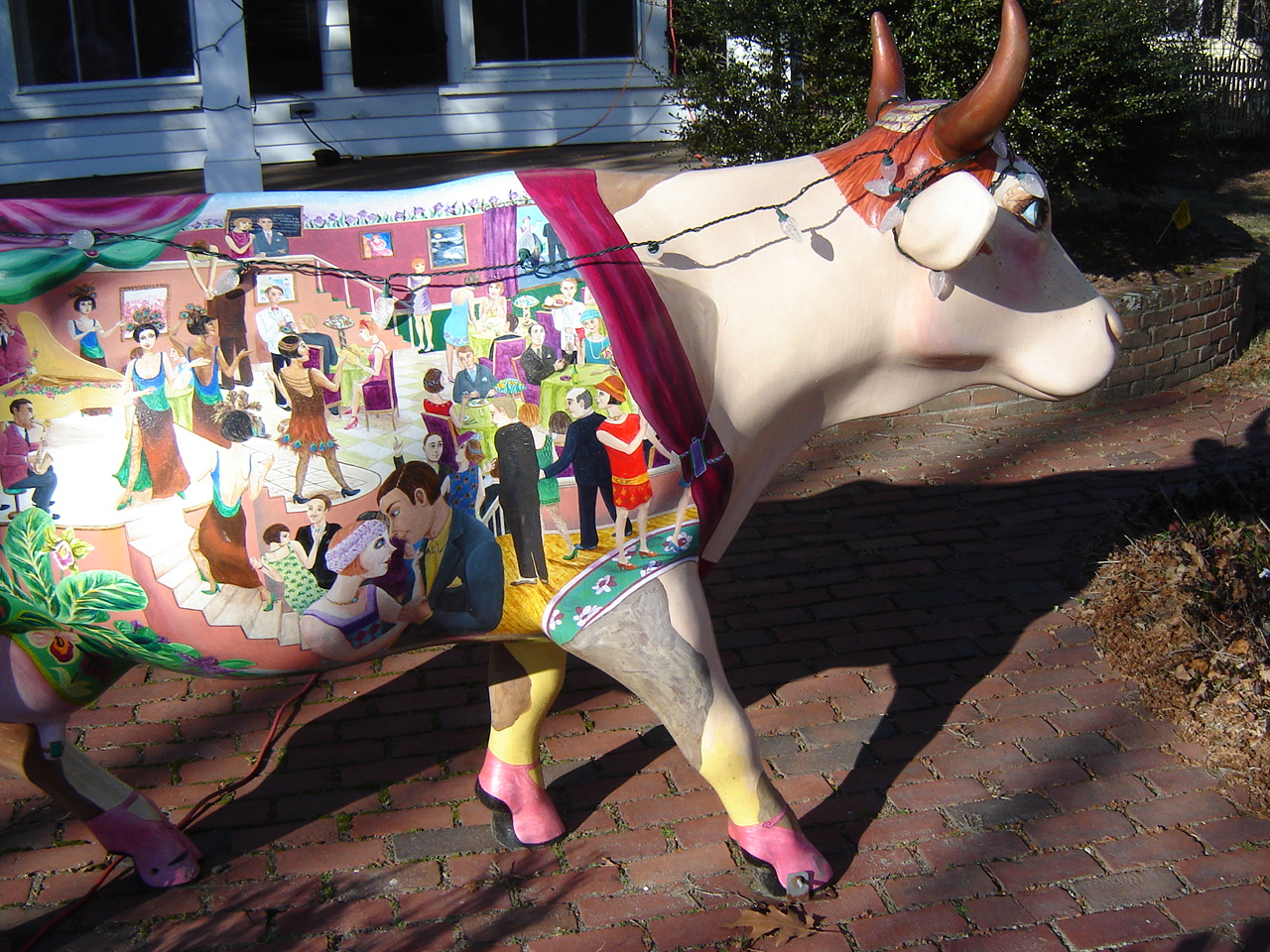
My neighbor’s cow is still sporting Christmas lights in mid-January. I like the subjects that interest her deeply (in her gut, really), and I love her high-heeled shoes and pink socks. I also appreciate that she is very calm and unlikely to kick over a a lamp and start the Chicago Fire.

My neighbor’s cow is detached and steady and, other than donning Christmas lights, never changes.

Read Full Post »