Feeds:
Posts
Comments

Posts Tagged ‘Cultural Revolution’

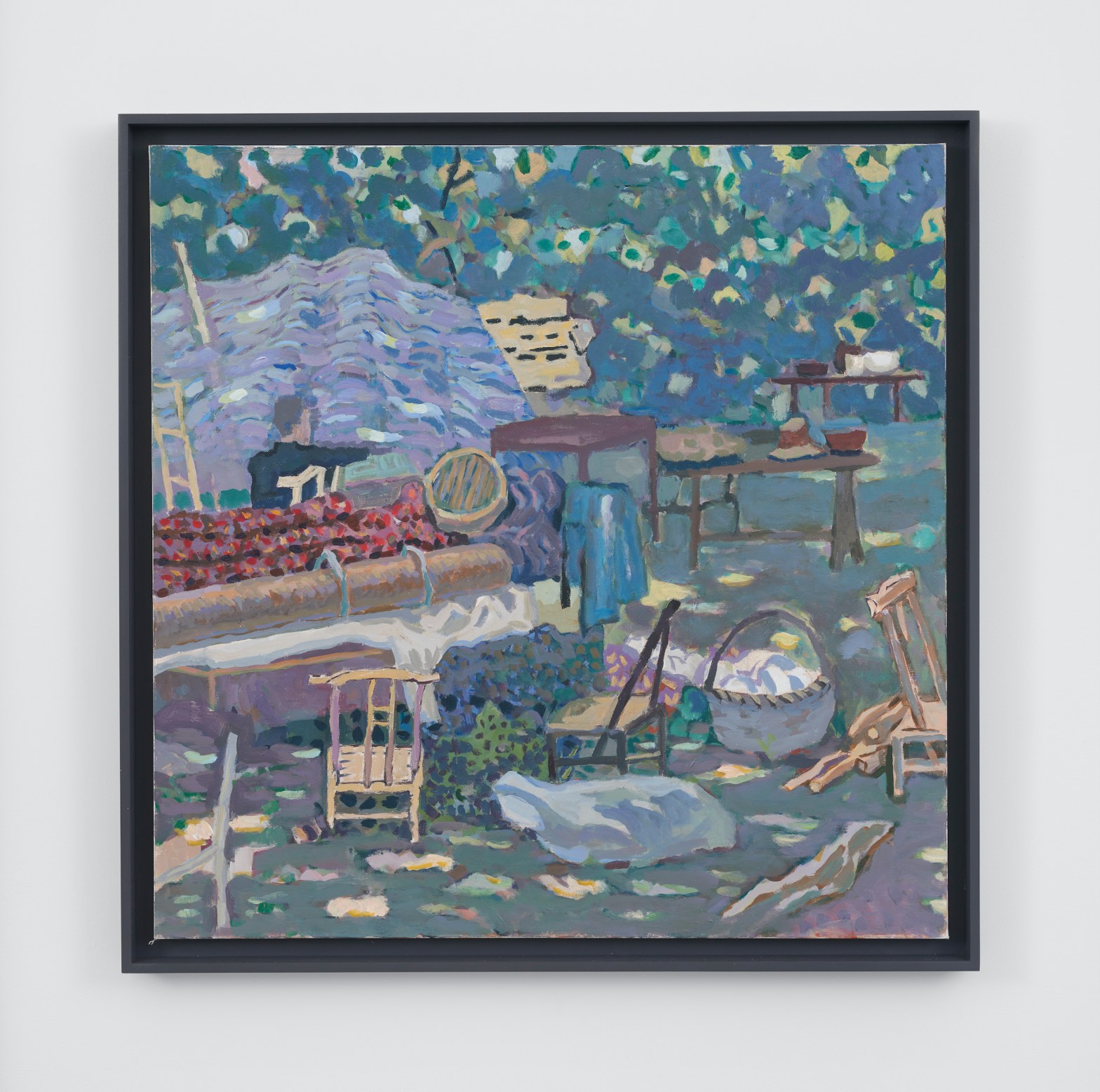
Art: Yun-Fei Ji via James Cohan Gallery.
Yun-Fei Ji, “Everything Moved Outside” (2022), acrylic on canvas.

The daughter of my mother’s college friend visited us in about 1980. Her family had been deeply traumatized by the anti-intellectual fervor of the Cultural Revolution in China. She couldn’t speak much English at the time, but I understood constant repetitions of “very painful, very painful.”

When I read today’s article about an artist who evolved from the Socialist Realism he was taught at the time, I thought of Ching and the way she grew, never completely shedding the deep hurt of totalitarian madness turned against friends and neighbors.

John Yau writes at Hyperallergic about Yun-Fei Ji, a Chinese painter who learned the state-sanctioned style of Socialist Realism “and then elected to unlearn it in order to reinvent himself.

“Yun-Fei Ji was born in Beijing in 1963, three years before the start of the Cultural Revolution (1966–76). Launched by the demagogue Mao Zedong, who distrusted intellectuals, the Cultural Revolution was an attempt to turn China into a utopian paradise run by and for workers. … 

“Ji belongs to the generation that studied at the Central Academy of Fine Art (CAFA) in Beijing in the first years after it reopened. Like the other painters in this group, he learned the state-sanctioned style of Socialist Realism and then elected to unlearn what he had absorbed in order to reinvent himself. … He secretly studied calligraphy — which was considered intellectual, bourgeois. …

“He opened it up and used it to respond to current events, such as post-revolutionary China’s massive Three Gorges Dam Project and the consequent displacement of more than 1.5 million people. …  

“As long as Ji continued to work in the tradition of Chinese landscape painting, Western audiences may have seen his views of displacement and protest, wayfarers carrying all their possessions, and melancholic ghosts as foreign to their experience. 

“This is why Ji’s change is radical. He decided to take on the Western tradition of painting in order to suggest that his subject matter is global, rather than local to China. … While the traumatic social upheaval caused by the Three Gorges Dam Project is still very much on Ji’s mind, as evidenced by painting titles such as ‘Migrant Worker’s Tent,’ ‘Satellite Dish on a Bed,’ and ‘Everything Moved Outside,’ new things are happening in his work.

“Three paintings signal a departure for Ji: two depictions of flowers (‘Sunflower Turned Its Back’ and ‘Early Spring Bloom 2020’) and a three-quarter-length view of a standing man — and my favorite work — ‘The Man with Glasses.’ … 

“Against a mottled brown, violet, and gray-blue abstract ground Ji has depicted an elderly man in blue pants and a long blue jacket over a pale blue shirt. The man is looking down, his hands in his pockets, and we cannot see his eyes. His head seems too large for his body, a deliberate choice by the artist. The shirt becomes a series of dry brushstrokes near the bottom and the gray-blue pants are largely unpainted. The jacket’s color reminds me of the blue surgical scrubs worn by doctors, which folds another level of feeling into the painting. The fact that the portrait resists a reductive reading is important to the change in Ji’s work and thinking. 

“The premier coup approach is in keeping with ink painting, which cannot be revised or layered, but in his use of paint he works differently, as seen in the mottled background and single dry brushstroke used to separate the front pockets of the shirt. The incompleteness of the man set against a dark, fully painted abstract ground seems both a formal and emotional decision. The man is ephemeral, while the dark, inanimate ground is permanent. The evocation of change and transience is also inherent to Ji’s paintings of sunflowers and blossoming branches. In these works, he meditates on the relationship between forced change and inescapable transformation.”

More paintings at Hyperallergic, here. No firewall. Subscriptions welcomed.

It was interesting to me that “Everything Moved Outside” (2022) makes this reviewer think of the migrant life. For me “everything moved outside” means Covid. Would love to hear more reactions to the paintings shown at Hyperallergic.
Read Full Post »

Yu Hua in Jia Zhangke’s Swimming Out Till the Sea Turns Blue. The film documents life in rural Chinese villages over the past seven decades.

There’s a new documentary covering 70 years of life in China. In an interview at Hyperallergic, Jia Zhangke, director of Swimming Out Till the Sea Turns Blue, tells Jorden Cronk about some of the challenges of extracting personal memories from elderly people raised with a group mindset.

“Moving fluidly between fiction and documentary, the work of Chinese director Jia Zhangke assumes many forms, often within the same film. His latest, Swimming Out Till the Sea Turns Blue, is a documentary portrait of rural China, told through the lives and words of four authors — Ma Feng, Jia Pingwa, Yu Hua, and Liang Hong — whose work collectively spans from the 1949 communist revolution to the present day. Combining reflections on each era’s politics with memories of the authors’ rural upbringings, Jia charts the cultural evolution of China in intimate strokes. … Jia and I connected on Zoom to discuss hidden histories and the generation gap separating today’s Chinese youth from their rural roots.

Hyperallergic: I’ve heard you refer to the new film as the third in your ‘Artists Trilogy.’ At what point did you begin to conceive of the film as such?

Jia Zhangke: I shot the first two films in the trilogy back-to-back. In 2006 I made Dong, about the painter Liu Xiaodong, and in 2007 I made Useless, about the fashion designer Ma Ke. Immediately after I thought I would make the third part, about artists who are either architects or city planners. … I had found quite a few architects and city planners that would be perfect for the project, but they didn’t seem to want to share on camera the things I wanted to capture, so we postponed the project.

“It wasn’t until recently that I started to think again about the third installment. For the past few years, I’ve been going back and forth between Beijing and Jia Family Village [Note: no relation to the director], and while I was there, I noticed that they are facing many issues — and not uniquely Chinese issues, but global issues in terms of the younger generations leaving rural areas for urban settings. Nowadays in these rural areas, you tend to see mostly older people; younger people don’t stay in these areas for long. So now when these younger generations have children, they will have no connection or memories or understanding of their rural or agricultural roots. …

They’re very old. … We had to spend a lot of time during post-production finding a coherent logic and structure in what they were saying, to properly distill their memories.

H: How did you come to the four main subjects of the film? Do they have certain characteristics or writing styles that you felt were particularly suitable to the story you were trying to tell?

JZ: As I was thinking about who I could call on to tell these rural histories, one particular element in Jia Family Village stood out: a literary tradition with very strong connections with the first writer depicted in the film, Ma Feng. He was born and raised in Jia Family Village, and he often wrote about the region. I thought I could use writers born in similar areas who have been writing about these regions as a way to make this documentary come alive. …

“Ma Feng, he was born in the ’20s and most prolific in the ’50s and ’60s, while Jia Pingwa mostly wrote in the ’70s and ’80s, Yu Hua about the ’80s and ’90s, and Liang Hong about anything from the ’90s until now. So it made sense for me to put these authors together as a kind of relay to talk about their formative years, and even though they have some overlap, the most important eras for each of them represent specific moments in time. …

“But more interesting for me was that I could capture each author’s unique way of storytelling and their worldview through the way they talk through their memories, lives, and history, as well as how they depict their characters. … In addition to learning about the last 70 years of rural history, you’re witnessing the evolution of Chinese literature.

H: Ma Feng is the only writer who’s no longer alive. How did you decide to have his daughter speak for him?

JZ: For me, to put together a comprehensive understanding of these rural areas during Ma Feng’s time, it wasn’t sufficient to rely only on his daughter, because I really needed that firsthand account. That’s the reason why, in addition to the daughter, I included two village elders, both in their 90s. These elders had direct experiences and interactions with Ma Feng that I relied on to offer eyewitness testimony to what happened during this period. All three of them talk about the collectivization of society that occurred during Ma Feng’s time. When we look back and rethink the ideas from that era, we might now have different assessments, viewpoints, or understandings of these concepts, but what I want to articulate with the film is that we have to admit that this happened, no matter how we interpret what happened. Through these three people, I wanted to capture the social and historical contexts for these things.

“However, this also posed a couple of problems with regards to interviewing them. They’re very old, of course, but they also come from a society that focused on collectivism rather than individualism, which means that it is very difficult for them to talk from a first-person, or ‘I,’ perspective. It was a challenge to interview them in such a way that they would open up in front of the camera and share their private and subjective memories. And since they are old, they tend to not talk in chronological order, and instead jump around, skip ahead, and flash back in a way that isn’t always coherent. We had to spend a lot of time during post-production finding a coherent logic and structure in what they were saying, to properly distill their memories.

H: Is this hesitancy to talk from a first-person perspective one reason you chose to shoot the interviews from multiple angles and from what seems like a quite a distance?

JZ: For me, the compositions evolve in a natural way within the film’s structure. For the first interviews, I wanted to things to be impressionistic, so we started with images of old people eating, and through that group concept slowly but surely segue into individual memories. In other words, I wanted to locate a visual concept that would take us from the collectivist to individualist way of viewing memories.

H: Much of the film is about the official record of Chinese history and the personal experiences of each author, and how those are quite different. In general, what is the public’s understanding of these events?

JZ: In terms of the grand narrative, the ‘official’ version of history is pretty much the same for everyone, at least in terms of how people understand the big historical junctures. However … everything is stated in such an abstract or statistical way. That’s why I think films like this are very much needed. You can’t feel abstract or statistical histories. There’s no impact — it’s meaningless. What’s missing are visceral connections with history. Of course, there are many ways you can hide certain parts of history. But what’s more important to realize is that what’s often hidden is not necessarily what happened, but how things happened.”

More at Hyperallergic.

Read Full Post »

7lml4w4k6rdejczc77tdfn7enq

Photo: Hanjun
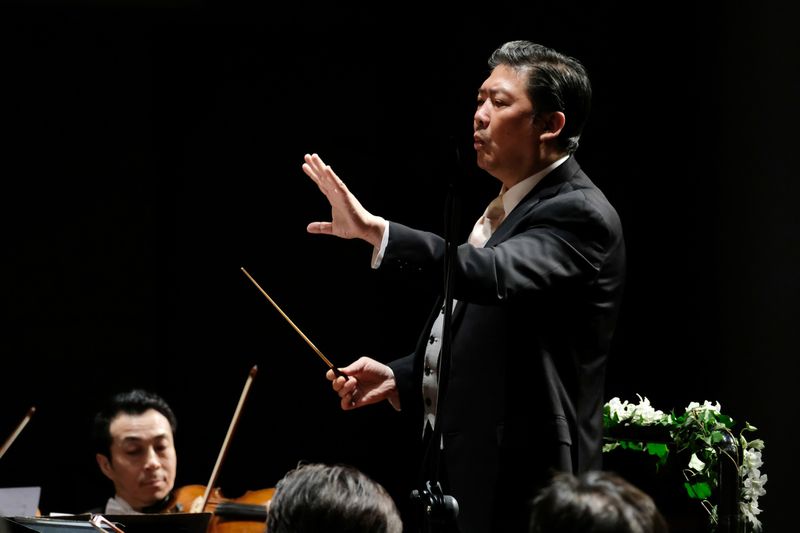
Music director Long Yu with the Shanghai Symphony  This orchestra carried on straight through World War I and World War II. During the Cultural Revolution, they had to play folk songs and songs of revolution. But they played.

This past August the Shanghai Symphony came to Chicago. And thanks to coverage of the visit, I learned something new about a Chinese city I visited in 2007.

Howard Reich interviewed the symphony’s conductor at the Chicago Tribune. “When the Shanghai Symphony Orchestra makes its Chicago-area debut Aug. 16 at the Ravinia Festival, no one will be prouder of the occasion than its music director, Long Yu.

“For to him, the Shanghai ensemble will be more than just a visitor from the other side of the world – it will be bringing with it a legacy stretching back to 1879, when it was established under a previous name.

“ ‘This is the first orchestra not only in China, but in the Far East,’ says Yu, speaking by phone from Hong Kong. …

“In effect, adds Yu, this orchestra ‘introduced most of the classical music to China and to Asia.’ …

“ ‘There is something wrong about how the Western world – I don’t speak about the United States only – the Western world is taking for granted our culture,’ [Chicago Symphony Orchestra music director Riccardo Muti] said. ‘In China, where we performed in this big (arts) center – where they have theater, concert halls and drama – that is so modern and fantastic, they told me that they are building a new hall!’ …

“Few could have envisioned such an embrace of Western classical music when the Shanghai ensemble was founded. But equally remarkable is the fact that it has survived through so many political, social and cultural upheavals.

“ ‘You can see this orchestra for 140 years, you can find all the programs through the First (World) War, Second (World) War, Cultural Revolution and till today – they have not stopped playing concerts,’ says Yu.

‘Especially during the Cultural Revolution, they still played! They did function in the Cultural Revolution – Chinese folk songs, but they still played. …

“ ‘Today it sounds like a very crazy idea. But during the years of the Cultural Revolution in China, it was fashionable to punish people for learning too much Beethoven, Bach and Mozart. I graduated from high school (in 1970) having been trained as a pianist, but my studies were interrupted, and I was sent to the rice fields for four years of physical labor. The government felt they needed to purify my soul, and they believed physical labor was the best way.’

“Musicians who nurtured Western culture suffered severely. Yang Bingsun, the Central Philharmonic Orchestra of China’s concertmaster, spent ‘nine years and four months in prison, my fingers constantly being injured because I was forced to work in cement,’ he told me in 1987. …

“What a difference a few decades make: In May, the First China International Music Competition launched in Beijing with an unprecedented first prize: $150,000 plus professional career management for three years (second and third prizes were $75,000 and $30,000). … Why have the Chinese put so much muscle behind classical music?

“ ‘To be placed on the international music map in a very serious way,’ Richard Rodzinski, the contest’s general director, told me earlier this year.

“Which helps explain why conductor Yu and the Shanghai Symphony Orchestra are bringing their wares here. …

“For his Ravinia program, he’ll feature cellist Alisa Weilerstein in Dvorak’s Cello Concerto, Rachmaninoff’s Symphonic Dances and Qigang Chen’s ‘Wu Xing (The Five Elements),’ a kind of East-meets-West program. But unlike some observers, Yu sees fewer distinctions between music-making in the two hemispheres.

“ ‘I don’t like to put Western music or Eastern music, Western culture or Eastern culture’ in categories, he says. ‘People ask me what is the difference between Chinese orchestras and Western orchestras? Basically, no difference. Eastern and Western orchestras do the same things, we teach every orchestra the same way, we rehearse the same way, we do the same programs.’ ”

More at the Chicago Tribune, here.

Read Full Post »