Feeds:
Posts
Comments

Posts Tagged ‘calligraphy’

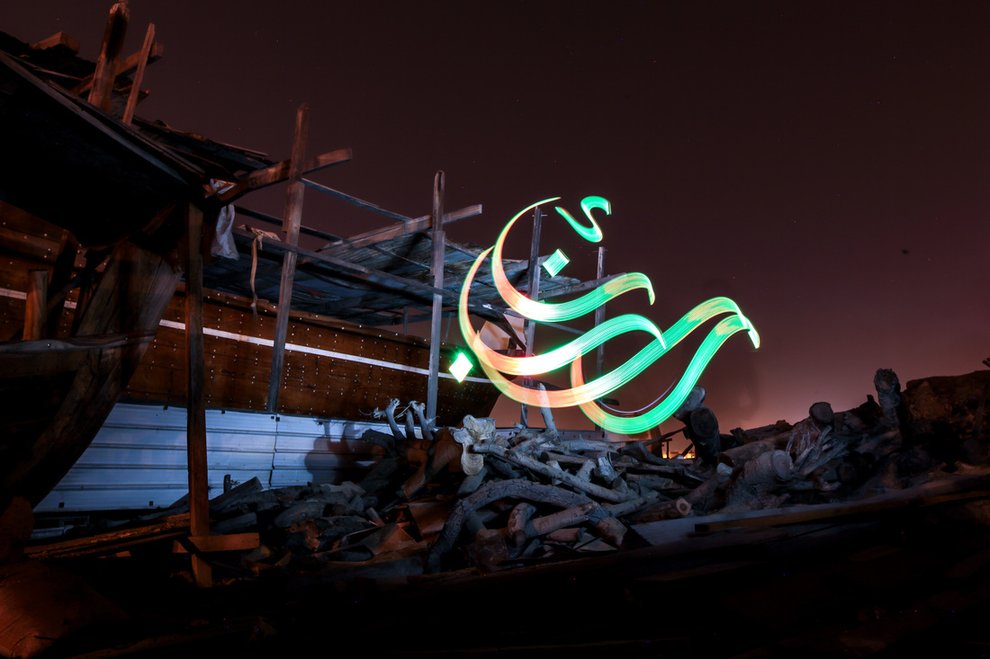
Photo: Karim Jabbari.
Karim Jabbari uses long-exposure photography to capture words written with handheld lights. 

There’s an amazing kind of calligraphy that involves writing with light. For Karim Jabbari, it started as a way to connect with his heritage.

Alissa Greenberg reports at the Nova Newsletter (PBS), “Karim Jabbari still remembers how painful it was to walk down the street with his family as a child and see his neighbors turn away. ‘No one was willing to talk to us in public,’ he says. Jabbari’s father was a political prisoner, an activist and ‘public enemy’ of the dictatorship that then ruled Tunisia. …

“Ten-year-old Jabbari, lonely and missing his father, looked for other ways to fill his time. What he found was his father’s trove of 400-year-old religious texts, inherited from an ancestor who had been a renowned scholar of Islam. The books were written in an old form of North African calligraphy known as Maghrebi script. ‘It’s an art form that speaks to your soul, even if you don’t understand the message. … I saw my father, his smile.’

“Before long, he was obsessed, copying what he saw in the books over and over until the arcs and lines settled into his muscles. That obsession only grew once he left his hometown of Kasserine to go to boarding school, and his new skill attracted friends—the one thing he’d never had.

“Today, Jabbari, now 42, is a full-time artist based in Canada and the U.S., using murals, graffiti, and specialized technology to bring traditional Arabic calligraphy to an international audience. He worries that a craft that prizes meditative concentration and lengthy training will be lost in an era so focused on agility and speed. …

“Calligraphy—and calligraphers—have resisted new technologies for centuries. For starters, Arabic and its sibling, Persian, used non-Latin alphabets that made them difficult to adapt for use in printing technology developed in the West, says Behrooz Parhami, an engineer who has studied how Arabic and Persian scripts have evolved alongside technology. Physical typefaces built for Persian and Arabic’s connected letters are more fragile, prone to chipping and cracking. And if they aren’t perfectly made, white spaces appear between letters that shouldn’t be there.

“The scripts also included letters with elements stacked on top of neighboring letters, which was impossible to recreate using the separate blocks of moveable type. And they varied in height and width much more than Latin characters, meaning that the common printing practice of adjusting typefaces to make letters about the same size would render words illegible. …

“It therefore makes sense that in Persia and the Arab world, words simply remained handwritten for centuries longer than in Europe, Parhami says. … Still, Parhami attributes this delay not just to the technical challenges but also to the hallowed role of the written word in these societies. In the Arab world, calligraphy provided an intimate connection to God through handwritten copying of the Quran and other religious texts. …

” ‘You can be a beautiful, amazing, well-known, traditional calligraphy artist, but your art isn’t speaking to the younger generations,’ [Jabbari] says. Refusing to try new things or embrace new technology leaves young people out, he argues, and puts the entire tradition at risk. ‘ “Your art is dying with you,” I said to them. I have nothing but respect for you, but I’m taking calligraphy to the streets.’

“Although Jabbari also paints murals that incorporate written elements, ‘taking calligraphy to the streets’ usually means light painting: a combination of long-exposure photography and perfectly calibrated movements of a handheld light that captures the loops and swirls of Maghrebi Arabic in thin air. In 2011, after Jabbari’s uncle was shot and killed along with 28 other young men during the beginning of the Arab Spring, he returned to Kasserine to do just such a performance piece. ‘I wanted to write his name in light painting, the same place where he died,’ he says. After he finished honoring his uncle, he gave other families in the area the opportunity to do the same, allowing them to write their loved ones’ names in space—a fleeting memorial fixed on film.

“Light calligraphy is a challenging medium. ‘You need to know the limits of the camera, what space it’s covering,’ he says. ‘You have all of that space to explore, so you end up using your body as reference: making a line at chest level, or one at hip level.’ …

“Jabbari has collaborated with dancers and musicians. … He recently hired two software developers to create a program that projects his movements in short near-real-time loops onto skyscrapers, a kind of ephemeral graffiti. …

“Calligraphy has taught him that ‘we are the sum of all the knowledge our ancestors transmitted to one another,’ he says. That’s how the art of calligraphy has been passed down—from master to student, who then becomes the next master—and also what calligraphy was for: recording history and wisdom to be shared with the next generation.

“Jabbari hopes his work will inspire the traditionalists to try out something new and the modernists to remember the value of tradition, reminding them what writing can be: a form of escape, an adventure in memory.”

More at PBS, here. Gorgeous photos.
Read Full Post »

Art: Yun-Fei Ji via James Cohan Gallery.
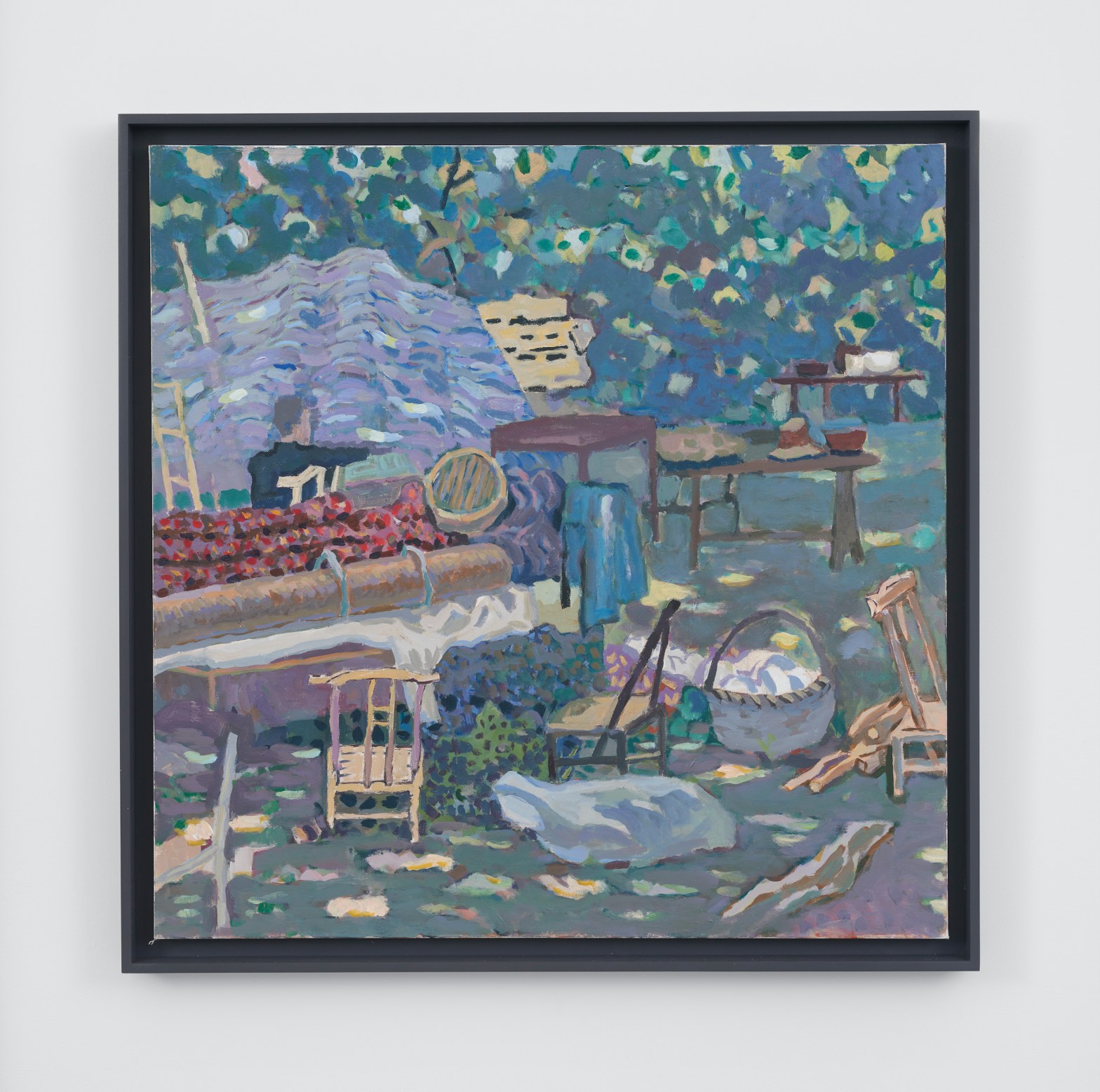
Yun-Fei Ji, “Everything Moved Outside” (2022), acrylic on canvas.

The daughter of my mother’s college friend visited us in about 1980. Her family had been deeply traumatized by the anti-intellectual fervor of the Cultural Revolution in China. She couldn’t speak much English at the time, but I understood constant repetitions of “very painful, very painful.”

When I read today’s article about an artist who evolved from the Socialist Realism he was taught at the time, I thought of Ching and the way she grew, never completely shedding the deep hurt of totalitarian madness turned against friends and neighbors.

John Yau writes at Hyperallergic about Yun-Fei Ji, a Chinese painter who learned the state-sanctioned style of Socialist Realism “and then elected to unlearn it in order to reinvent himself.

“Yun-Fei Ji was born in Beijing in 1963, three years before the start of the Cultural Revolution (1966–76). Launched by the demagogue Mao Zedong, who distrusted intellectuals, the Cultural Revolution was an attempt to turn China into a utopian paradise run by and for workers. … 

“Ji belongs to the generation that studied at the Central Academy of Fine Art (CAFA) in Beijing in the first years after it reopened. Like the other painters in this group, he learned the state-sanctioned style of Socialist Realism and then elected to unlearn what he had absorbed in order to reinvent himself. … He secretly studied calligraphy — which was considered intellectual, bourgeois. …

“He opened it up and used it to respond to current events, such as post-revolutionary China’s massive Three Gorges Dam Project and the consequent displacement of more than 1.5 million people. …  

“As long as Ji continued to work in the tradition of Chinese landscape painting, Western audiences may have seen his views of displacement and protest, wayfarers carrying all their possessions, and melancholic ghosts as foreign to their experience. 

“This is why Ji’s change is radical. He decided to take on the Western tradition of painting in order to suggest that his subject matter is global, rather than local to China. … While the traumatic social upheaval caused by the Three Gorges Dam Project is still very much on Ji’s mind, as evidenced by painting titles such as ‘Migrant Worker’s Tent,’ ‘Satellite Dish on a Bed,’ and ‘Everything Moved Outside,’ new things are happening in his work.

“Three paintings signal a departure for Ji: two depictions of flowers (‘Sunflower Turned Its Back’ and ‘Early Spring Bloom 2020’) and a three-quarter-length view of a standing man — and my favorite work — ‘The Man with Glasses.’ … 

“Against a mottled brown, violet, and gray-blue abstract ground Ji has depicted an elderly man in blue pants and a long blue jacket over a pale blue shirt. The man is looking down, his hands in his pockets, and we cannot see his eyes. His head seems too large for his body, a deliberate choice by the artist. The shirt becomes a series of dry brushstrokes near the bottom and the gray-blue pants are largely unpainted. The jacket’s color reminds me of the blue surgical scrubs worn by doctors, which folds another level of feeling into the painting. The fact that the portrait resists a reductive reading is important to the change in Ji’s work and thinking. 

“The premier coup approach is in keeping with ink painting, which cannot be revised or layered, but in his use of paint he works differently, as seen in the mottled background and single dry brushstroke used to separate the front pockets of the shirt. The incompleteness of the man set against a dark, fully painted abstract ground seems both a formal and emotional decision. The man is ephemeral, while the dark, inanimate ground is permanent. The evocation of change and transience is also inherent to Ji’s paintings of sunflowers and blossoming branches. In these works, he meditates on the relationship between forced change and inescapable transformation.”

More paintings at Hyperallergic, here. No firewall. Subscriptions welcomed.

It was interesting to me that “Everything Moved Outside” (2022) makes this reviewer think of the migrant life. For me “everything moved outside” means Covid. Would love to hear more reactions to the paintings shown at Hyperallergic.

Read Full Post »

In case you missed it, the NY Times had a great story on the discovery of ancient fragments of the Quran (or Koran) in Birmingham, England, of all places, where they had been long overlooked.

Dan Bilefsky writes, “The ancient manuscript, written on sheep or goat skin, sat for nearly a century at a university library, with scholars unaware of its significance.

“That is, until Alba Fedeli, a researcher at the University of Birmingham studying for her doctorate, became captivated by its calligraphy and noticed that two of its pages appeared misbound alongside pages of a similar Quranic manuscript from a later date.

“The scripts did not match. Prodded by her observations, the university sent the pages out for radiocarbon testing.

“[In July], researchers at the University of Birmingham revealed the startling finding that the fragments appeared to be part of what could be the world’s oldest copy of the Quran, and researchers say it may have been transcribed by a contemporary of the Prophet Muhammad.

” ‘We were bowled over, startled indeed,’ said David Thomas, a professor of Christianity and Islam at the University of Birmingham, after he and other researchers learned recently of the manuscript’s provenance.”

The manuscript fragments are estimated to be at least 1,370 years old.

Lots more here.

Video: BBC, by way of Youtube

Read Full Post »