Feeds:
Posts
Comments

Posts Tagged ‘damage’

Photo: Sean Waugh.
NOAA’s National Severe Storm Lab has been looking into the hail problem.

Here’s my periodic reminder that cutting out funding for scientific research can affect your life. The important work of the National Severe Storm Lab of National Oceanic and Atmospheric Administration (NOAA) in Oklahoma is just one example of what may be lost.

Nick Gilmore at public radio WVTF in Virginia reported recently on NOAA’s research into hail.

“Just picture this – it’s a warm afternoon and a thunderstorm starts to roll overhead. You head indoors and hear rain begin to fall. As the cracks of thunder get louder, you peek out the window to see large chunks of ice on the ground. … Rain makes sense to fall from a storm – but large pieces of ice?

“ ‘Hail is one of those things that we don’t really know how it forms,’ says Sean Waugh, a research scientist at NOAA’s Severe Storms Laboratory.

“We do know some of the basics. Strong thunderstorms have strong updrafts – think like a vacuum cleaner that’s able to lift moisture high up into the atmosphere. It’s cold up there, so that water freezes into a small stone. It collects more water, refreezes as it cycles through the storm – more water, refreezes. … Eventually, the hailstone gets too heavy and tumbles to the earth below. Waugh says wind speed, direction and moisture in the air also play a part in hailstorm development.

We also know hail can be expensive.

“ ‘In any given year, it’s 60-80% of the damage that comes from severe thunderstorms,’ says Ian Giammanco – a meteorologist at the Insurance Institute for Business and Home Safety. He says we’re just getting more hailstorms these days.

“ ‘Rewind the clock all the way back to 2008 – every year since then, we’ve had over $10 billion in damage from hail. This has crept up now to a $20-30 billion problem.’

“Giammanco says that’s why research like what Sean Waugh is doing is so important – finding out what hail looks like before it hits the ground. …

“Waugh says, ‘We don’t know what broke when it landed, how much of that mass, or size or shape have we lost between when it fell and when we find it, right? I’ve seen six-inch diameter stones melt before I can get out of the car to pick them up.’ …

“There are other questions, too: how fast does hail fall? Does it fall in a specific orientation? Does the stone melt while it’s falling to the earth below?

” ‘These are all really, really important questions if you’re trying to ascertain what hail looks like to a radar. And that’s a really critical piece of knowledge if you’re trying to warn for hail in real time, which is obviously the goal! Most people want to know if there’s going to be golf balls falling at their house or softballs.’ …

“Waugh and his team have built a complex rig that observes hail in free fall and in real time. They head out from Oklahoma – typically to the Southern Plains – to get the system in front of a storm producing large hail.

“The rig has high speed and high-quality cameras, and Waugh says there’s another key component.

” ‘But we need a lot of light to do that. Otherwise, the image would just be dark,’ he explains. ‘So, the LED array I have on the back of the truck produces about 30% more light than the sun!’ …

“ ‘We can use that knowledge to improve our forecasts of what storms are likely going to produce hail days in advance. By understanding the type of hail that different storms produce, that increases our ability to model it properly and then forecast that in the future,’ Waugh says. ‘And that way people can take appropriate action to protect life and property.’ ”

More at public radio WVTF, here. Cool video of hail in flight.

I don’t get the funding cuts. The jobs that will be lost at the weather center are in Oklahoma, so it’s not just coastal communities that will be hurt. And anyway, don’t hurricanes damage golf courses in Florida sometimes? Weather is something no human can be the boss of, so it’s just common sense to try to understand it.

Please share your hail stories.

From the University of Oklahoma news site, OU Daily.
Read Full Post »

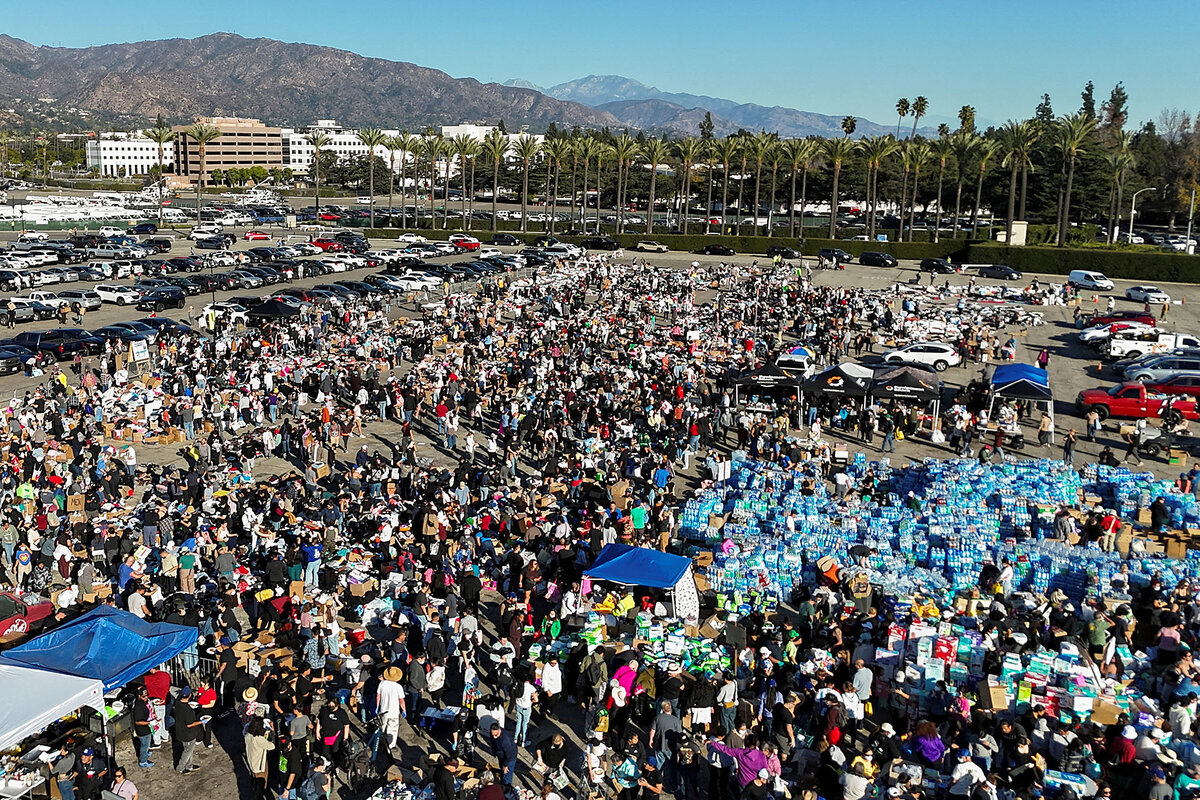
Photo: Alan Devall/Reuters.
A drone view shows volunteers with people affected by the Palisades wildfires, at a donation center in Arcadia, California, Jan. 12, 2025.

If you ever feel like your world is run by people without hearts, do what Mister Rogers’ mother advised when he was a little boy: “Look for the helpers.” As long as there are a few willing helpers, all things are possible.

Consider the volunteers in the recent California wildfires. At the Christian Science Monitor, Ali Martin wrote in January about people stepping up, even those whose lives had also been damaged.

The story started with a family’s pet goat. “Coco the goat is nestled in a soft bed between two cars in the parking lot of El Camino Real Charter High School on the western edge of Los Angeles’ San Fernando Valley. Other wildfire evacuation shelters wouldn’t allow the 10-year-old house goat to stay with her family – the animal shelters board pets on their own, in kennels – but breaking up wasn’t an option for her owner, Maji Anir. …

“She is quietly out of the way, is no bother, and offers a drop of levity in a sea of stress – most people who take notice stop to pet her, spirits lifted. Workers are letting her stay.

“Mr. Anir and his family had just two hours to evacuate as the fire approached their home in Malibu – not enough time to get everything they needed. They pulled away Tuesday evening as the sun was setting. By morning the house was gone, along with all of their neighbors’. …

“Even in this besieged region, ruin is bending toward resilience. And from the staff to random visitors and those sheltering, a common theme is kindness. …

“El Camino is a well-appointed charter school. … Classes for the school’s 3,500 students were scheduled to start back up in mid-January. Now, with the Palisades Fire burning out of control on the other side of a mountain ridge, the campus is a gathering place for those needing refuge – and the people volunteering to help.

“Kate Delos Reyes was supposed to be in a residential program for mental health treatment. The program in Santa Monica was canceled as fires swept through the nearby Pacific Palisades.

“She’s seen fires before, when she worked at a rehab center in another Southern California mountain range. Remembering that stress, she drove to the evacuation center at El Camino to lend whatever help they might need. ‘Kindness is free, you know.’ …

“Eddie Včelíková is fielding a stream of texts from her friends while she scrolls through social media. She is taking in photos of her childhood home in Altadena; St. Mark’s Episcopal Church, which she attended every Sunday; her schools – all of it destroyed.

“Altadena, an unincorporated town in northern LA County, welcomed Black homebuyers in the mid-1900s, when redlining kept them out of other neighborhoods. As the area developed along the southwestern base of the San Gabriel Mountains, so did the diversity of its middle-class bedrock. Last week, the Eaton fire, which is still burning, swept through much of the small community and leveled entire blocks.

“When she saw video of the burned-out park where she played every weekend as a child, Ms. Včelíková says she broke. She found her way to the shelter. ‘I’m just out here volunteering to stay busy because it’s the only thing I think that’ll keep me from going insane.’ …

“She’s tried to get back into her old neighborhood, but National Guard troops are blocking every route – protecting vacant homes from looting. On Sunday, she attended a virtual church service hosted by St. Mark’s. The church may be gone, but its spirit is not. …

“[Soon] not even the shelter itself is safe. The Kenneth Fire has broken out in late afternoon on a ridge overlooking this edge of the San Fernando Valley. … This refuge is shutting down. Most of the evacuees are heading 20 miles east to another shelter at the Westwood Recreation Center.

“Leslie and Megan Walsh are making space in their packed trunk for a small suitcase. They’ve just met a young woman who needs a ride to Westwood, and they’ve offered to take her.

“They’re from San Diego; they know what LA is going through. In 2003, fires swept through parts of their city, and they had to flee. Their neighborhood lost 300 homes. Now, with Megan living in LA, the family wanted to help however they could.

“Leslie and her daughter drove to LA with a car full of animal supplies – pet food and beds, mostly – to donate. But their first stop, a shelter in Agoura Hills, was evacuated, so they came here. Now this one’s evacuating. …

“The Walshes headed back to San Diego with their supplies. Over the next couple of days, Megan ran a donation drive among their San Diego neighbors. She and her parents returned to LA Sunday with a U-Haul truck and two more cars filled with clothing, toiletries, pet food, sleeping bags, air mattresses, and more. …

“Back at El Camino high school on Thursday, in the hours before the Kenneth Fire erupted, first responders had pulled into a corner parking lot to take a break and grab a meal. The shelter was overflowing with food donations, so school administrators redirected the potluck to feed firefighters and police officers.

“Administrative Director Jason Camp says the support for first responders was driven by an outpouring in the community. … He notes the number of people – emergency responders, volunteers, local officials – who are managing their own fears and losses from the widespread devastation. Nobody is untouched.

“Some people who are displaced or lost their homes want to be part of the solution and ‘to help somebody through the pain and maybe together they can get through it,’ he says. ‘It’s refreshing to see that not everything’s in total chaos. The heart is still there.’ ”

More at the Monitor, here.

Read Full Post »

Photo: Ken Ruinard/USA Today.
Asheville, North Carolina, after Hurricane Helene.

Asheville, NC. “I’m safe, but my house is structurally damaged and I’ve just dealt with FEMA and they’re very good and my insurance is being a pain in the neck so … ugh. Anyway, I don’t have power or water and I’m living in a neighbor’s house right now. Thank you for thinking of me. I’m safe and a little stranded feeling. I’ll try and reach out when I’ve got more definite news.”

I got that voicemail on October 7. Hurricane Helene struck my childhood friend’s home September 24. She didn’t answer email. I didn’t have her mobile phone number. But when the US mail delivered my letter to her, we connected.

Patrik Jonsson goes in depth at the Monitor about hurricane-tossed North Carolinians pulling together to help one another.

“Eric Gillespie put his sandals on, walked outside his house, and stood in awe at the sight of Clear Creek – usually a gurgling rivulet – rushing like a dark torrent.

“Then he heard the screams for help. Down a steep bank lay a row of cookie-cutter houses, now up to their eaves in muddy water. Friends and neighbors – some infirm – remained in their homes as nearly 30 feet of water rushed down the French Broad River system, rising in a matter of minutes, trapping a dozen neighbors unable to scramble to higher ground.

“ ‘That’s when things got crazy,’ says the owner of the Wakey Monkey coffee shop in nearby Saluda. ‘There was no way to prepare for what happened.’

“In a rescue scene replicated over 6,000 times across Appalachia as remnants of Hurricane Helene crashed into the steep terrain, neighbors and first responders rushed to action, using everything from sofa cushions and paddleboards to mules and Chinook helicopters in order to ferry friends and strangers to safety. Over 230 people died in the storm, the bulk of them in Appalachia. The toll includes 11 members of one family in the Asheville suburbs.

“ ‘There was both beauty and tragedy in the response,’ says Nathan Smith, a pilot from Charlotte, North Carolina, who surveyed the damage as he flew his 1979 Cessna 180 Skywagon on multiple missions into hard-hit county airports. …

“There were slip-ups and mistakes. But to many on the front lines here, the very worst that nature could conjure was met by the very best America had to give. …

“What promises to be a long recovery is now top of mind for residents of Greater Appalachia, many of them exhausted and still in shock at the discombobulation not only of their lives, but also of the geography of their valleys. …

“In Saluda, North Carolina, a railroad stop that became an adventure destination, the tone of the first meeting of the local business association after the storm was subdued at best.

“The Green River, a world-renowned kayaking destination, could remain impassable for months, if not years, some association members said. With major roads blocked and tourist towns like Bat Cave and Chimney Rock leveled, would anyone show up for leaf-peeping season?

“ ‘What happened was scary,’ says Emily Lamar, co-owner of The Purple Onion restaurant in Saluda. ‘What happens next is scary, too.’

“Access issues for rescue crews tell that story. There is little way to get from South Carolina to Tennessee as parts of Interstate 40 are washed out. The famous Blue Ridge Parkway is undrivable, covered with trees and washouts. Large parts of Asheville’s quirky River Arts District are smashed. {See photo.] Much of what was the iconic village of Chimney Rock is now wreckage situated downstream in Lake Lure. …

“One analogue is the city of New Orleans, which lost more than a quarter of its population [after Hurricane Katrina] 2005 and 2011. But just as New Orleans used that experience to strengthen its levees, many here hope these Carolina communities can build back stronger. Hard-hit Asheville, for one, has long debated better flood controls for its vulnerable River Arts District.

“ ‘This recovery, it’s going to be weeks, months, years, decades, if it’s ever complete,’ says Aaron Clark-Ginsberg, professor of policy analysis at the Pardee Rand Graduate School in Santa Monica, California. ‘Some of this trauma is going to be incorporated into the structure of the community.’ “

More at the Monitor, here. No paywall. Excellent pictures.

Read Full Post »

Photos: Chandra McCormick and Keith Calhoun.
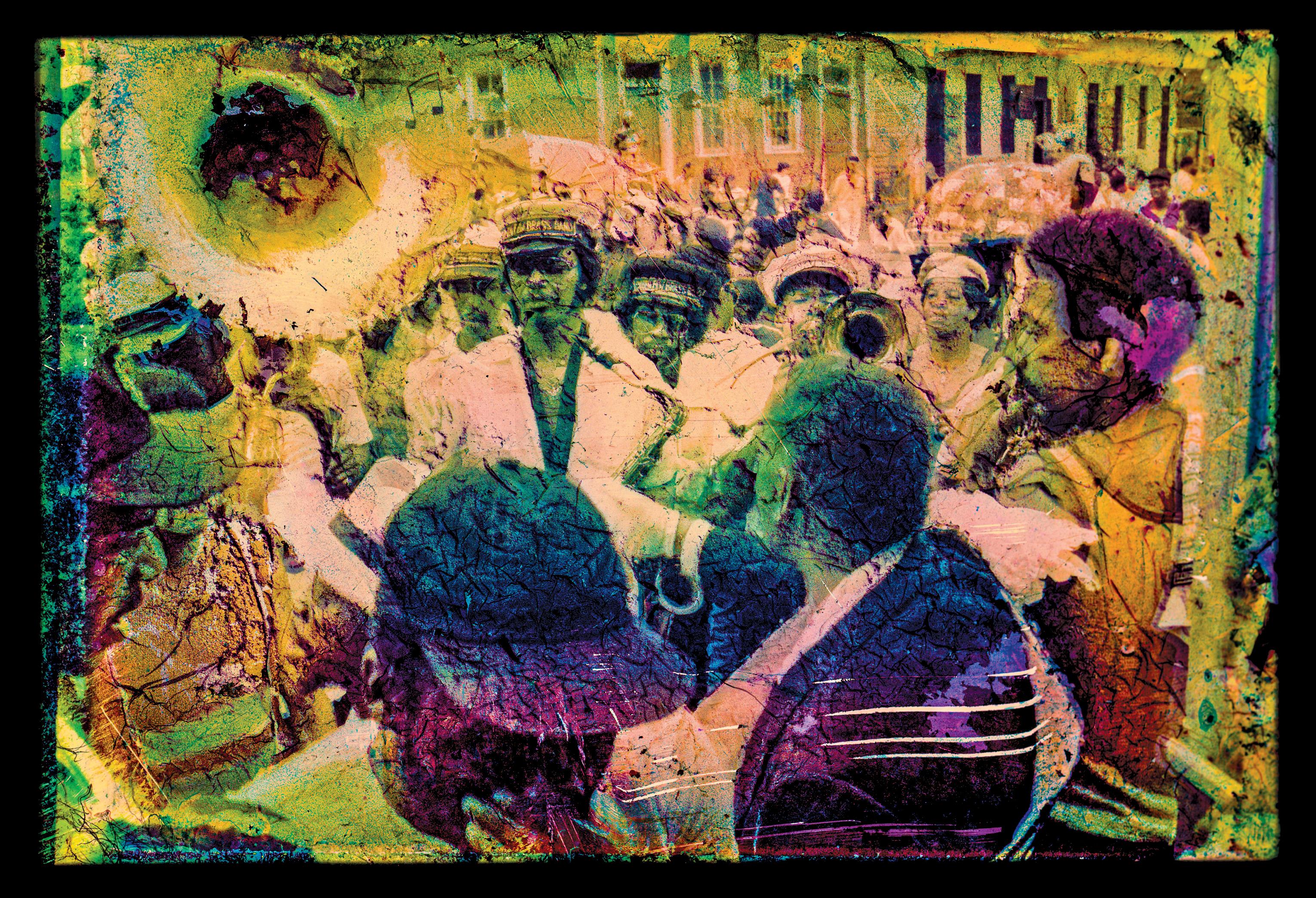
“The Sound of Our Resurrection Is Stronger Than the Silence of Death” is what McCormick and Calhoun call their picture of A Chosen Few Brass Band.

A recent article in Smithsonian magazine about the Louisiana photography duo Chandra McCormick and Keith Calhoun got me interested in learning more about them.

Reporter Amy Crawford focused on something new they were doing with old photographs: working with the Hurricane Katrina water damage to elicit the ghostly spirit of an indomitable city.

Crawford writes that in 2005, “Hurricane Katrina was bearing down on New Orleans, so Chandra McCormick and Keith Calhoun packed their photography archive — thousands of slides, negatives and prints the couple had amassed over three decades documenting African American life in Louisiana. …

“Then they drove to Houston with their two children, planning to be gone for maybe two weeks. Ten weeks later, McCormick and Calhoun returned home to…devastation. ‘All there was, was waterlogged,’ Calhoun says. ‘Imagine the smell — all that stuff had been in that mud and mold.’

“They figured they had lost everything, including the archive, but their teenage son urged them not to throw it away. They put the archive into a freezer, to prevent further deterioration. With an electronic scanner they copied and enlarged the images — at first just searching for anything recognizable. The water, heat and mold had blended colors, creating surreal patterns over ghostly scenes of brass band parades, Mardi Gras celebrations and riverside baptisms.

‘Mother Nature went way beyond my imagination as a photographer,’ Calhoun says of the otherworldly images. McCormick says, ‘We no longer consider them damaged.’

“Today McCormick and Calhoun’s altered photographs are viewed as a metaphor for the city’s resilience. Yet they’re also a memento of a community that is no longer the same. By 2019, New Orleans had lost more than a quarter of its African American population. ‘So much is vanishing now,’ Calhoun says. ‘I think this work serves as a record to validate that we once lived in this city. We were its spiritual backbone.’ ” More at the Smithsonian, here.

From the couple’s website: “Keith Calhoun and Chandra McCormick were born and raised in the lower ninth ward of New Orleans, Louisiana. As husband and wife team, they have been documenting Louisiana and its people for more than 25 years. In New Orleans, they have documented the music culture, which consists of Brass Bands, Jazz Funerals, Social and Pleasure Clubs, Benevolent Societies, and the Black Mardi Gras Indians.

“In addition to documenting New Orleans social and cultural history, Calhoun and McCormick have also covered religious and spiritual ceremonies throughout their community, as well as river baptisms in rural Louisiana. They have created several photographic series, including: Louisiana Laborers; The Dock Worker, Longshoreman, and Freight Handlers on the docks of New Orleans; Sugar Cane Field Scrappers in the river parishes along the Mississippi river; Cotton Gins, and Sweet Potato Workers in East Carrol parish of Lake Providence Louisiana.

“Calhoun and McCormick have documented the soul of New Orleans and a vanishing Louisiana [including] the displacement of African Americans after Katrina … and the cruel conditions of the Louisiana State Penitentiary at Angola, a former slave-breeding plantation named for the African nation from which ‘the most profitable’ slaves, according to slave owners, were kidnapped. …

“[Angola] is an 18,000-acre prison farm where inmates are traded like chattel among wardens of neighboring penitentiaries. Although the 13th Amendment to the United States Constitution abolished slavery in 1865, its prohibition of forced labor does not apply to convicted inmates. … Calhoun and McCormick’s work restores visibility and humanity to a population often forgotten by the public at large.”

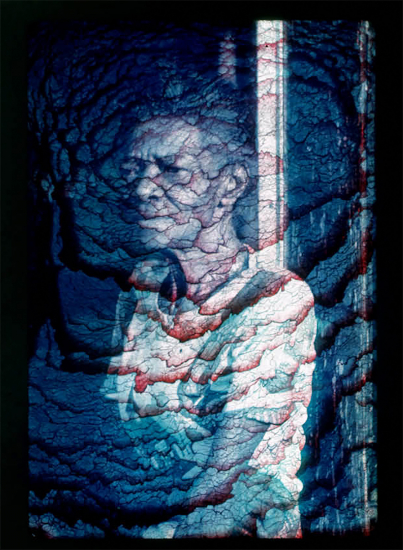
And from the Southbound Project: “The photographic emulsion merging with mold and water sedimentation left interesting patterns and color transformations. … Sometimes the textural quality of the effects even suggests physical markings and scars of trauma. Ida Mae Strickland (1987, ca. 2010), for example, is a portrait of an elderly woman shown from the waist up, seemingly lost in thought with a furrowed brow. She appears contemplative and dignified, as one whose internal strength has carried her through the years. The water damage creates rippling patterns that appear to emanate from her head and evoke wrinkled folds of aged skin. These unintentional effects reinforce qualities of the original image. The photograph, like the original sitter, has quietly weathered the influence of time and nature but still survives.” 

Read Full Post »