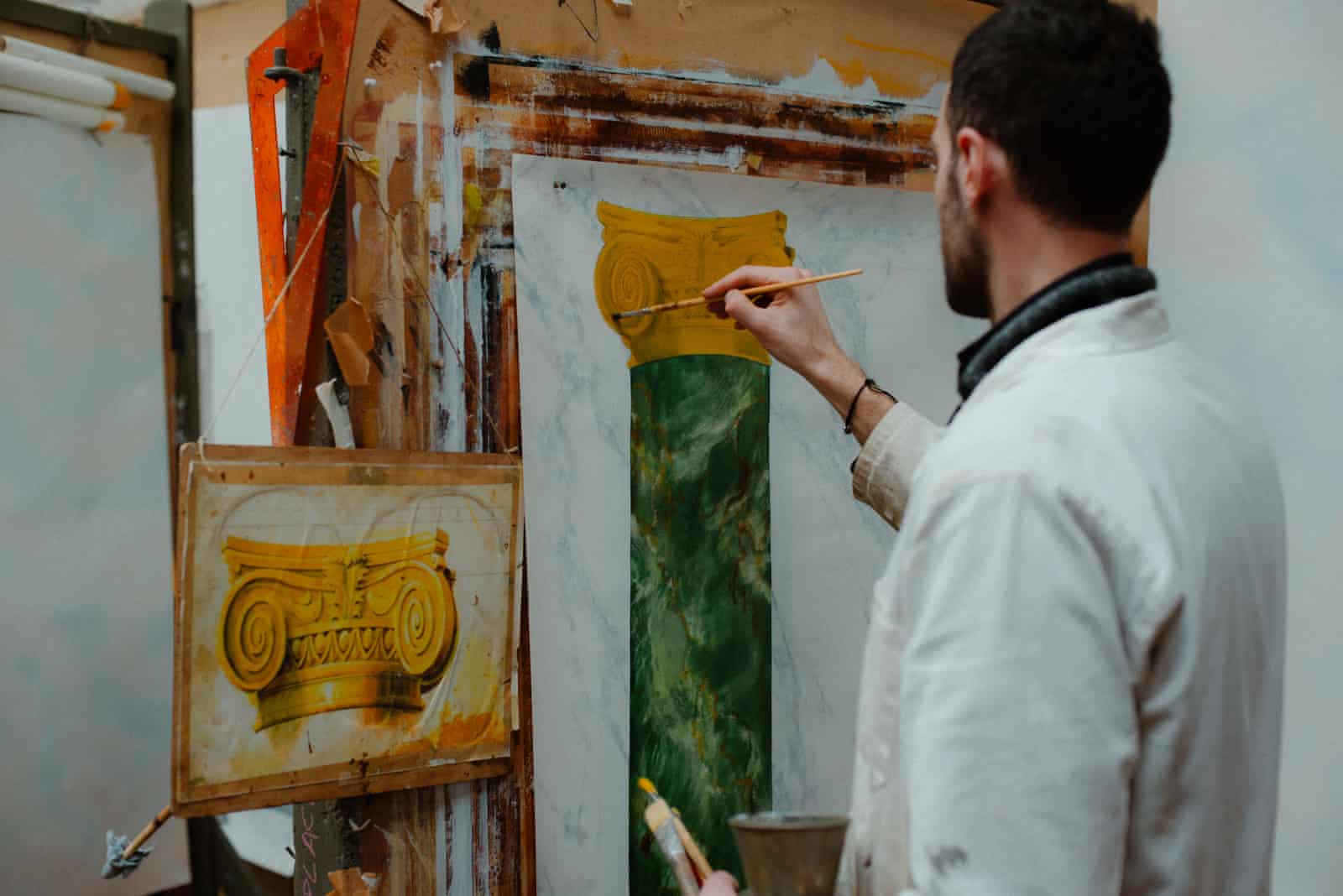
Photo: Felix Bazalgette.
Federico Piccolo at work at the Van der Kelen.
I’ve always been fascinated by trompe l’oeil art (fool the eye) — pillars that aren’t there, window vistas that are solid walls.
Today, I’m learning from Felix Bazalgette at the Guardian that a painting school in Belgium is the place to learn how to do that. But the school is rigorous.
“One morning last February, in a chilly studio in Brussels,” writes Bazalgette, “28 people in white coats gathered to watch Sylvie Van der Kelen paint the sky. ‘The first touch of the brush is generally the best,’ said Van der Kelen as light, pink-tinged clouds began to appear. ‘It is preferable not to make revisions.’
“For a few days this winter I was allowed to sit in on classes at the École Van der Kelen-Logelain, a mythologized painting school in Brussels that is unlike any other arts education institution in the world. Run by the same family since it was founded in 1892, the Van der Kelen course takes place every winter. …
“Students must arrive by 9am, otherwise they will be shut out until lunchtime; they must not bring phones or cameras into the school’s workspace; they must wear white lab coats while they work; and they must work in silence. They also must be able to stand the cold: the studio is ineffectually heated by an ancient single wood-fired stove. …
“If students can tolerate these strictures, by the end of the six-month course they will possess a number of specialized skills, from sign painting and lettering to the application of gold and silver leaf, and manipulation of textural finishes. The core of the course, though – what the school is most famous for – is its trompe l’oeil painting techniques. …
“Trompe l’oeil refers to a genre of illusionistic painting with a history stretching back to the time of the ancient Egyptians, in which artists use textures, shading and tricks of perspective in order to create three-dimensional illusions. At the Van der Kelen, students learn to conjure fake relief sculptures and architectural details out of flat surfaces; create copies, in oil paints, of 28 different types of wood grain and 33 different types of marble; and, like Sylvie, paint a perfect trompe l’oeil sky. …
“The passion for decorative painting among the wealthy upper middle class has evaporated, and fussy-seeming trompe l’oeil has fallen out of style in interior decoration and high art. Student numbers have correspondingly dropped to dangerously low levels.
“And yet, every winter, the family continue to oversee a course that has barely changed since 1892, and students still arrive from across the world to put themselves through a bizarre and sometimes punishing routine (‘There is roughly one breakdown every week,’ a student told me). …
“Everybody is in search for something special here,” Sylvie tells me after her demonstration that morning as the students quietly set to work. “Everyone is here for a reason.”
“This year marks the first time that Sylvie, 52, has taken over the running of the school from her mother Denise – the ‘Coco Chanel of fake marble’ – who herself has been in charge since 1995. …
“Every morning a new technique is demonstrated by one of the Van der Kelens (the school invites outside teachers to teach extra classes, but only members of the family teach the core trompe l’oeil course). The students observe and make notes, before producing an exact copy themselves on a large sheet of paper; this piece of work is known as a ‘panel.’
“No panel, however, can be finished in a single day, because each requires multiple ‘operations’: different stages of work, separated by a day or more to allow the drying of paints and varnishes. As a result, students end up with a dizzying number of panels in progress at any one time, with more added every morning. Even after the workshop closes at 6pm, everyone has homework, sometimes until midnight. ‘It’s brutal,’ one student, a British painter, told me. …
“Why would anyone put themselves through this? Talking to this year’s cohort, I hear a number of reasons. There’s a small but significant contingent of people from various professions – architects, graphic designers, interior designers – who have become dissatisfied with the computer-based nature of their industry and are looking for something more hands-on. After graduating, students might hope to find work as painting assistants for established artists, painting interiors for wealthy clients, working on film or theatre sets, or working for European fashion houses periodically drawn to the trompe l’oeil aesthetic for runway shows and boutiques.
“Every student from an arts background that I speak to, however, cites the work of another painter, Lucy McKenzie, who has arguably done more to revive the school’s fortunes than any other person of late. The young Glaswegian artist was browsing in a secondhand bookshop in Brussels in 2007 when she came across a mention of the school in a book of interiors and – amazed that such a place still existed – immediately enrolled. At that time, McKenzie was almost a decade into an already accomplished arts career, but she signed on because she found the school’s illusionistic techniques fascinating. …
“By the mid-oos, the school was in crisis. … That is until McKenzie used the school’s techniques to create thrilling large-scale paintings, such as the vertigo-inducing Untitled (2010), and, along with a book she published about her time at the school, it is works such as these – exhibited at London’s Tate Britain, Amsterdam’s Stedelijk and the Art Institute of Chicago – that have caused a steadily increasing stream of students to arrive at the Van der Kelen’s imposing wooden doors. ‘Lucy McKenzie has a lot to answer for,’ one student told me cheerfully.”
More at the Guardian, here. No firewall.


