Feeds:
Posts
Comments

Posts Tagged ‘destruction’

Photo: Edward Burtynsky.
“Manufacturing #17, Deda Chicken Processing Plant, Dehui City, Jilin Province” (2005) is one of Burtynsky‘s best-known large-scale photos of China’s industrialization of just about everything.

The International Center of Photography in New York City recently hung an exhibit of Edward Burtynsky, a photographer I’ve admired since I first encountered his massive works in the early 2000s.

Louis Bury at Hyperallergic calls the show “A God’s-Eye-View of Earth’s Destruction.,” which doesn’t sound like fun but is sure to be interesting.

Edward Burtynsky: The Great Acceleration,” writes Bury, “at the International Center of Photography contains the artist’s largest ever print, which is saying something. Across a celebrated 40-plus-year career, Burtynsky has been renowned for his work’s ambition and scalar play. His fantastic images, often taken from aerial vantages, depict landscapes modified by human industry, from a stepped mine resembling an amphitheater … to a salt pan whose multicolored pond rows evoke a painter’s palette. …

“The large formats and supra-human perspectives render the Earth alien, potentially confronting the viewer not only with our species’ collateral ecological harms but also our estrangement from them. 

“Even by that standard, the exhibition’s 28-by-28-foot mural Pivot Irrigation #8, High Plains, Texas Panhandle, USA (2012) stands out. The distant overhead view and subdued color palette transform farmland into an almost abstract composition, in which the pictorial space is divided into textured, geometric browns on one side and alternating vertical stripes of washed out blues and grays on the other. A teensy farmstead occupies the bottom left corner and the roads running parallel to the edges of the picture plane serve as a clever framing device.

“But the two-story-tall print’s physical size produces its most dramatic effects. It dominates the central gallery, dwarfing visitors in a manner akin to the quarry cliffs that sometimes loom over the ant-like human figures in Burtynsky’s other landscapes, such as the miners digging for cobalt, for a couple dollars a day, in ‘Dry Tailings #1, Kolwezi, Democratic Republic of Congo’ (2024).

“Curator David Campany’s approach encapsulates the ‘bigger is better’ ethos. … The scope of the artist’s environmentalist muckraking matches the scope of the iniquities it portrays; for decades, Burtynsky has pursued research leads around the globe to capture yet more examples of civilization’s terraforming. Early in his career, before the term ‘Anthropocene’ became common in academic and artistic circles, such images offered a prescient vision of large-scale anthropogenic changes that were typically out of sight and out of mind.

“But as others have caught up to and even surpassed that vision … its style has remained mostly the same, god’s-eye-view consciousness raising feels more and more like a pretext for aesthetic dazzle.

“Burtynsky’s dazzle serves a psychological rather than a moral function. It can provoke in viewers the uncomfortable recognition that harmful ecological realities nonetheless appear beguiling. But it can also occlude the human-scaled implications of those realities. On the central gallery’s terrace level, Campany has helpfully included examples of Burtynsky’s lesser known work: early 1980s portraits of food plant laborers; studies of marshlands taken during the COVID-19 lockdown. While these series lack the wow factor of the artist’s panoramic work, they evidence his eye for formal patterns and keen details. …

“[The show] continues at the International Center of Photography (84 Ludlow Street, Lower East Side, Manhattan) through September 28.”

Fantastic photos at Hyperallergic, here. No firewall. See also Photographic Journal, here, and the artist’s site, here.
Read Full Post »

gettyimages-184252072_wide-edf142f608a14a15dc359bdb75c9dc5bacda4ae4-s600-c85

Photo: Education Images/Universal Images Group via Getty Images
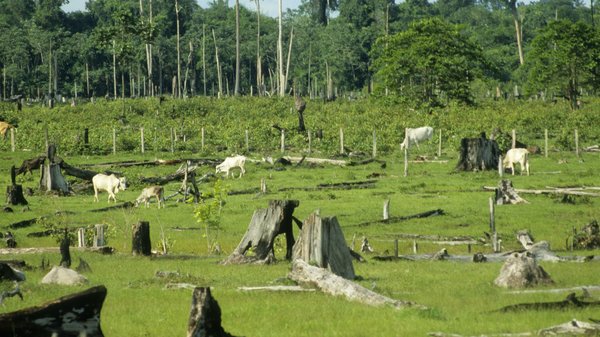
Cattle graze in pasture formed by cleared rainforest land in Pará, Brazil. A new online tool makes it easier for ethical food companies to detect this kind of land-clearing by their suppliers and stop the practice.

Some big food companies have promised not to be a party to the ongoing destruction of the rainforest, often called the lungs of Planet Earth. But how can they see what their distant suppliers may be up to?

Dan Charles at National Public (NPR) describes a promising approach.

“Brazilian scientists are reporting a sharp increase this year in the clearing of forests in the Amazon. That’s bad news for endangered ecosystems, as well as the world’s climate. Deforestation releases large amounts of heat-trapping carbon dioxide.

“It’s also a setback for big food companies that have pledged to preserve those forests — or at least to boycott suppliers that clear forests in order to raise crops or graze cattle.

” ‘Traders such as Cargill, Bunge, or Louis Dreyfus; consumer good manufacturers such as Mondelēz or Procter & Gamble or Unilever; retailers such as Walmart and McDonald’s — all the major brands have made those commitments,’ says Luiz Amaral, director of global solutions for commodities and finance at the World Resources Institute.

“Most of the companies promised to cut all links to deforestation by 2020, but … turns out, it’s really hard for companies to ensure that none of their raw materials came from recently cleared land.

“So Amaral and his colleagues just created a new online tool for companies to use. They call it Global Forest Watch Pro. …

“Amaral pulls up an image of the globe. This particular image shows which areas are covered by trees. … This map is created from data collected by satellites operated by NASA. One satellite scans the entire planet every week, constantly updating this map. So it’s possible to tell whether trees disappear from one week to the next. Another satellite monitors the entire globe for fires.

“Researchers at the University of Maryland created software to filter this flood of data and detect the signals of deforestation. …

” ‘I uploaded 22 cattle farms in Brazil,’ he says. These farms show up as highlighted areas in one region of Brazil. … With a few mouse clicks, we see how much of each farm is covered with trees and how that area has changed.

“He points out one 40,000-acre-farm. Half of it is covered in forests. But we can also see that, 15 years ago, the whole thing was forest. We zoom in closer. We can see exactly where trees disappeared in this part of Brazil. …

“In a similar way, a food company can enter the locations of farms from which it buys raw materials. Global Forest Watch Pro then will send an alert whenever it detects deforestation within that area.

“The company Mondelēz International, which makes Oreo cookies and Triscuit crackers, already is using it.

” ‘I think it’s actually extremely important,’ says Jonathan Horrell, the company’s director of global sustainability. … ‘Forests [are] being cut down in order to produce raw materials that we use in our products,’ he says. Those raw materials include palm oil from plantations in Indonesia, and cocoa farms in West Africa.

“Companies that want to use Global Forest Watch Pro have to figure out exactly where their suppliers are, and that can be difficult. …

“This is easier to do when companies buy food directly from local producers, as is often the case with cocoa and palm oil. In other cases, though, products move through a long chain of intermediary companies. Farmers who raise cattle may sell them to a local slaughterhouse, not directly to McDonald’s.”

But as NPR’s Charles explains, even local slaughterhouses can use the tool. Already WRI has signed up a slaughterhouse in Paraguay for an account. And I expect more will get on board as corporate commitments to cut carbon footprints exert economic pressure.

More here.

Read Full Post »