Feeds:
Posts
Comments

Posts Tagged ‘diesel’

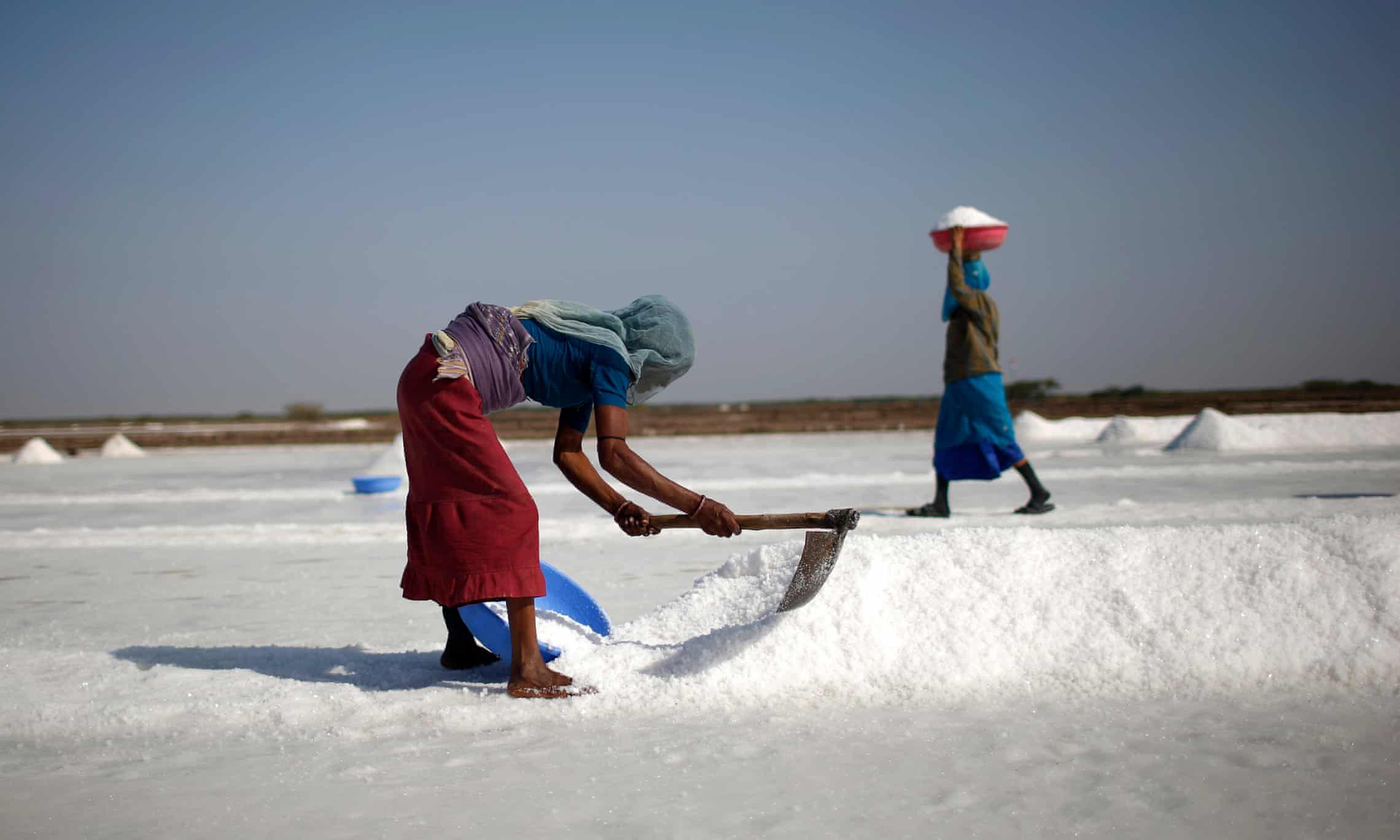
Photo: Ahmad Masood/Reuters.
Working on a salt pan in the western Indian state of Gujarat. The marshes produce 30% of India’s inland salt. 

I’m always up for a little good news from distance places, as I hope you are, too. Today we learn about the benefits of solar energy for one hands-on industry in India.

Suchak Patel writes at the Guardian, “In the expansive salt marshes of the Little Rann of Kutch the bleakness of the sunburnt, treeless landscape is matched only by the drudgery of the salt farmers who toil there for eight months of the year.

“In October, as the monsoon recedes and the flooded salt pans dry out, farmers and their families hop on to trucks and tractors to migrate to the Little Rann of Kutch in Kutch district, Gujarat, where they pitch tarpaulin shelters and begin mining the underground deposits.

“An estimated 10,000 families of farmers, known as agariyas in Gujarati, migrate to the marshes from across the state. They start each season by digging wells to pump out brine using diesel pumps; the brine is then poured into shallow, squarish plots carved on the salt pans and left to evaporate under the sun to produce salt crystals. These marshes produce 30% of India’s inland salt, typically table salt.

“Life in the salt marshes is uniquely challenging. Drinking water comes not from pipes but tankers, children attend schools inside buses not buildings, and the only avenue to healthcare is weekly mobile vans from the health department. Basic amenities such as an electricity grid and toilets are nonexistent.

“ ‘My entire family, including my brother’s two daughters, lives in the desert these eight months, and my nieces attend primary school in a mobile school bus,’ says Bharatbhai Shyamjibhai Mandviya, 45.

“Contracts made with salt traders before each season, where the traders pay an advance to the farmers to buy pumps, diesel, and to meet household expenses mean most farmers start the season in debt, with the harvest income barely enough to cover their costs, let alone allow them to save.

“Diesel constitutes nearly 65% of the input costs in salt farming, and about 1,800 litres [~476 gallons] of the fuel is needed to produce [about] 750 tons of salt, according to Purshottam Sonagra, area manager of nonprofit Vikas Centre for Development that works with salt producers in the region. …

“But the introduction of solar panels to the pans has triggered a significant shift in the lives and lifestyles of the impoverished salt workers. In 2017, the Gujarat government gave solar pumps to salt farmers at nearly 80% subsidy, as part of a larger push to cut emissions and bring down the costs involved in salt production.

“ ‘Solar-powered pumps have reduced the cost of salt farming to one-third of what it was,’ says Sonagra.

“Mandviya has installed three pumps on the salt pan he works on, the savings from which have led to many firsts in his life.

“ ‘We have now built a two-bedroom house with a separate hall and a kitchen in Kharaghoda [his home village],’ says Mandviya. The new home with tiled walls and built-in cupboards which he will share with his brother and family, is a big upgrade from the kuccha [mud and straw] house they lived in before.

“The brothers also bought a motorcycle and a refrigerator from the money they managed to save.

“With more than 5,500 solar-powered pumps now dotting the region, energy costs have fallen [and] the agariyas such as Mandviya are no longer as dependent on the capital from traders, which gives them greater negotiating power over salt prices. …

“Solar pumps and the financial stability they grant have improved access to health, education and mobility, while also offering freedom to salt farmers from an endless work cycle, campaigners say.

“ ‘Steady supply from the solar panels is powering not only pumps but also televisions. Children of salt makers are switching to state-run ‘edutainment’ programs to make up for the loss of education,’ says Bhavna Harchandani, a research scholar at the Indian Institute of Technology Gandhinagar, who has tracked the agariya community as part of her studies. …

“Sonagra says it was difficult to find an office assistant with basic secondary-school education among agariyas until a few years ago.

“ ‘Today, many agariya children attend private schools, complete ITI (vocational) courses, and some manage to go to college. Solar pumps have opened up educational opportunities for the next generation of the community,’ he says.”

More at the Guardian, here.

Read Full Post »

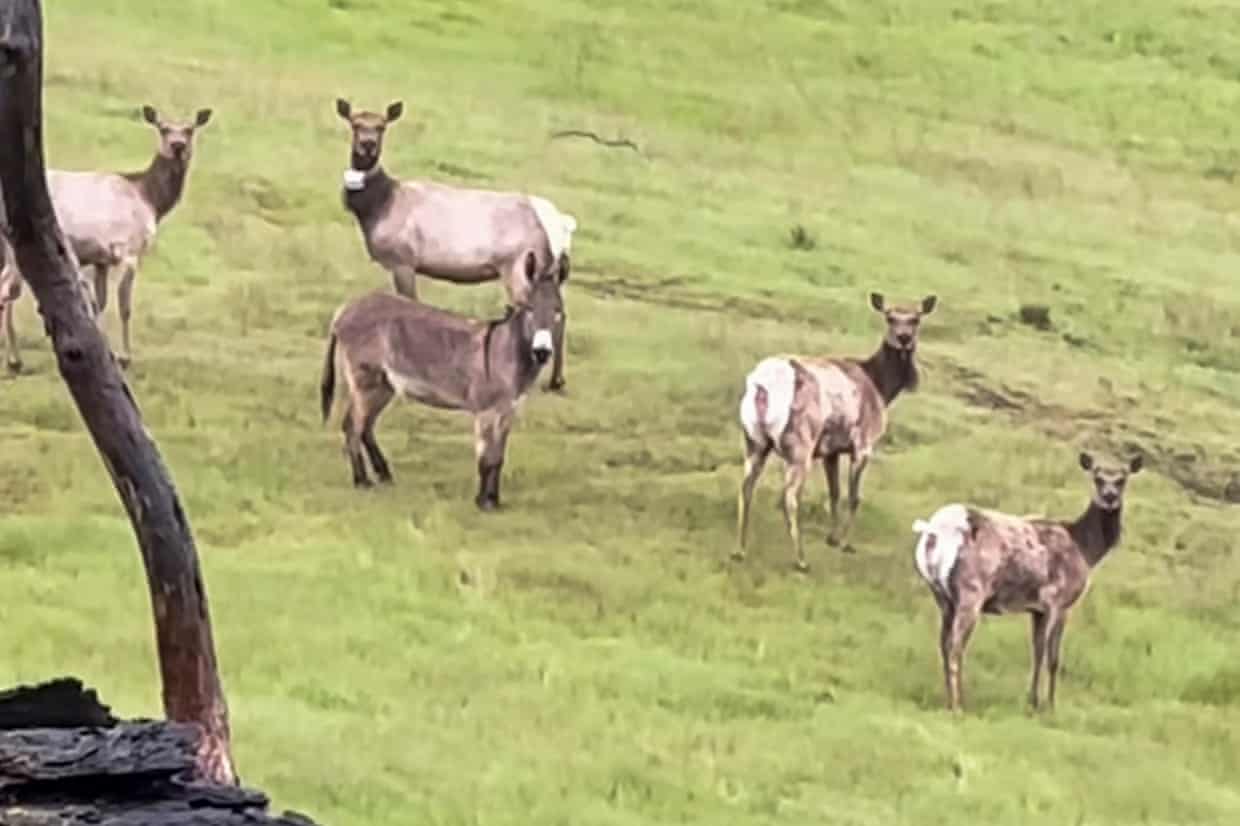
Photo: Instagrammer @maxfennell.
A hunter spotted a donkey living with elks in northern California.

A donkey-owning family in California lost its pet to a wild elk herd — and decided he was better off. What would you have done? Would it depend on how long your pet was missing?

The Guardian reports: “A donkey spotted apparently living with a herd of wild elk in a video that went viral on the internet has been identified as Diesel, a once beloved pet who had apparently run away five years ago.

“The video was taken earlier this year, when Max Fennell, a hunter in northern California, filmed a group of wild elk apparently hanging out with a donkey who appeared to be a member of their herd.

“The short clip of the unusual scene rapidly spread across social media. Now Terrie Drewry and her husband, Dave, have told CBS news that they are convinced the free-roaming burro is their missing pet Diesel, who had scarpered into the wilderness five years earlier. …

“ ‘Finally, we know he’s good. He’s living his best life. He’s happy. He’s healthy, and it was just a relief,’ Drewry told CBS.

“The Drewrys revealed that Diesel had gone missing after getting scared on a trail while on a hiking trip with his human family. They searched for him in vain, though a trail camera spotted him, and hoof prints showed that he was still alive.

“Despite their joy, in seeing Diesel alive and apparently thriving as a want-to-be elk, they have no plans to try to capture him.” More at the Guardian, here.

That got me curious about donkeys that normally live in the wild, and poking around on the web, I ended up at the Young People’s Trust for the Environment (YPTE), which works to inspire “young people to look after our world.”

“There are still several types of donkey living wild in various parts of the world including: the ‘Kiang’ in India and Nepal the ‘Somali’ wild ass in Africa the endangered ‘Onager’ in Mongolia, Turkestan, Iran and Syria. …

“In the wild, donkeys don’t live in such close herds as horses and ponies do, since they occupy marginal desert-lands where food is generally scarce. As a result they have developed very loud ‘voices,’ which can carry just over three kilometres [~2 miles]. This allows them to keep in contact with one another. Their larger ears also allow them to hear the distant calls of their neighbors. Donkeys also use their ears as a form of visual communication and they may help dissipate some of the hot desert heat.

“Donkeys have a very tough digestive system that can break down almost inedible vegetation and at the same time extract and save as much moisture as possible.” More here.

Read Full Post »

Photo: American Diesel Training via Social Finance.
The Social Finance model ensures training programs don’t get paid until students get hired. And students train for free until then.

Because one of the things this blog focuses on is “good works,” I have inevitably put up stories that later turn out to have unexpected downsides. (If I learn about a problem, I do put up a correction.) One story I recall was about an effort in mining country to train out-of-work miners for high-paid tech jobs. I don’t think anyone was trying to rip anyone else off, but there was a Pollyanna aspect to the program, and it didn’t work. Not many people acquired the skills and those that did were unable to find those high-paying jobs.

So that is how we learn. Now there’s a nonprofit called Social Finance that doesn’t pay up on a training program until the trainee has that good job.

Steve Lohr writes at the New York Times, “Bill Barber saw an ad on Facebook last year for American Diesel Training Centers, a school in Ohio that prepares people for careers as diesel mechanics. It came with an unusual pitch: He would pay for the schooling only if it landed him a job, thanks to a nonprofit called Social Finance.

“After making sure it wasn’t a scam, he signed up. After going through the immersive five-week program, he got a job with starting pay of $39,000 a year — about $10,000 more than he made before as a cable TV installer. …

“American Diesel Training is part of a new model of work force training — one that bases pay for training programs partly on whether students get hired. Early results are promising, and experts say the approach makes far more economic sense than the traditional method, in which programs are paid based on how many people enroll. …

Social Finance, founded a decade ago to develop new ways to finance results-focused social programs, is showing how the idea could grow quickly just as the pandemic made job-training programs more important than ever. The coronavirus put millions of people out of work, upended industries and accelerated automation. …

“The Social Finance effort is powered by a fund of more than $40 million raised from philanthropic investors. The money goes toward paying for low-income students, as well as minority candidates and veterans, to enter the training programs. … It has supported four job training programs, including American Diesel Training, in the past year. It has plans to have double that number a year from now. …

“A few nonprofits have a track record of lifting low-income Americans into higher-paying jobs, including Year Up, Per Scholas and Project Quest. Their training is tightly focused on specific skills and occupations, they work closely with employers, and they teach soft skills like communication and teamwork. But there are too few of them, and they struggle for sustainable financing.

“Social Finance is seeking, designing and supporting new programs — for-profit or nonprofit — that follow that training formula but then apply a different funding model.

“ ‘There is emerging evidence that these kinds of programs are a very effective and exciting part of work force development,’ said Lawrence Katz, a labor economist at Harvard. ‘Social Finance is targeting and nurturing new programs, and it brings a financing mechanism that allows them to expand.’

” ‘The goal is to create a tool for impact, to get more people on the economic escalator,’ said Tracy Palandjian, co-founder and chief executive of Social Finance. …

“For Social Finance and its backers, the career impact bonds are not traditional investments. For them, breaking even or a small return would be winning — proof the concept is working, which should attract more public and private money. …

“The Social Finance income-share agreement with students ranges from about 5 percent to 9 percent depending on their earnings — less from $30,000 to $40,000, and generally more above $40,000. The monthly payments last four years. If you lose your job, the payment obligation stops.

“ ‘Our investors aren’t after high returns. They’re primarily after social impact,’ Ms. Palandjian said.

“When screening programs, Social Finance looks for those that offer training for specific skills linked to local demand, and have data to show that its students graduate and get good-paying jobs. … American Diesel Training, based in Columbus, Ohio, met the requirements. The for-profit company’s program is designed as a short, intensive course to train entry-level diesel technicians, mostly for trucking companies and dealerships. …

“Before Social Finance arrived, Tim Spurlock, co-founder and chief executive of American Diesel Training, looked into financing through income-share agreements offered by venture-backed start-ups. The terms, he said, were far less favorable for students.

” ‘Social Finance comes at it from a completely different angle,’ he said. … ‘We’ve completely proven our educational model. The problem was the funding mechanism.’ ”

More at the New York Times, here.

Read Full Post »