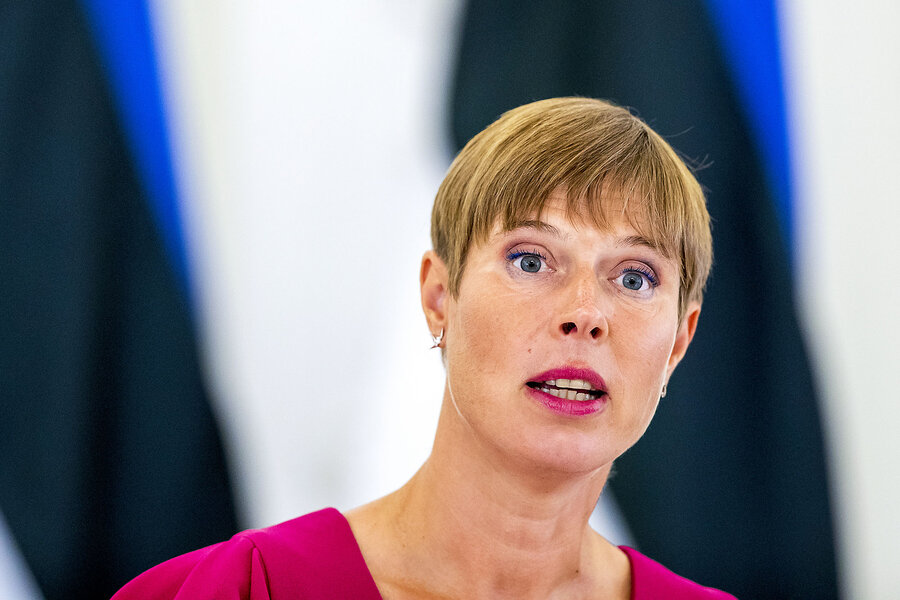
Photo: Mindaugas Kulbis/AP.
Estonian President Kersti Kaljulaid speaks during a news conference in Lithuania, Aug. 14, 2020.
Americans these days do not have much trust in government. It’s unfortunate because government does many good things. But a suspicious attitude has gained hold over the American mindset in the last few years. That’s why I look with envy at an Eastern European country that’s working really well because of a high level of trust — plus the efficient use of technology.
Lenora Chu explains at the Christian Science Monitor.
“Getting married is now one appointment easier in Estonia. The world’s most digitally integrated country launched the sacred union into the e-governance stratosphere last year – where it joined nearly every other government service you can imagine.
“Estonian citizens were already able to file taxes online, vote online, and access digital prescriptions. All of this digital activity hinges upon the Estonian smart identification system – which allows for state-recognized digital signatures – and a public trust in digital governance that’s been hard to replicate in other countries.
“ ‘I actually own my data – I can always track when someone looks at my data,’ says Kristiina Veerde-Toompalu. ‘I trust [my government].’ …
“Ms. Veerde-Toompalu got married in July, and applying online for the certificate saved her and her fiancé a special trip to her hometown’s city registrar. ‘We don’t have to go somewhere and announce our intention to get married,’ she says. …
“To deploy digital services successfully requires Estonians to trust the act of offering up to the cloud everything from birthdate and birthplace to tax information, salary, and medical diagnoses. That public trust took decades to cultivate, and ultimately relies on Estonia’s tight and transparent system of regulation.
“ ‘Paper files are not safer, because you cannot tell who looked at an analog file,’ says Kersti Kaljulaid, who served as president of Estonia from 2016 to 2021. ‘Estonian e-governance is a tightly regulated environment. … The data belongs to citizens, and you have control over who looks at your data, and you can ask them why they did. This is a luxury compared to an analog world, and I believe this is why we have this in-built trust.’
“It takes decades to build up the kind of comfort Estonia has with digitization, says Linnar Viik, a leading Estonian information technology scientist and government adviser since 1995.
‘Trust in digital channels didn’t happen overnight. It was kind of word of mouth and private and personal experience.’ …
“Trust also had to flow from leadership to the tech industry, and it did. ‘That is another layer of trust, whether you as a leader trust the experts on something you don’t understand. The politicians started to listen to the technology people and gave them space,’ says Mr. Viik.
“One such example: In 2000, Mr. Viik was allowed to convert Cabinet meetings from paper-based – at the time, they required knee-high stacks of printouts – to completely digital after one conversation with the prime minister.
“ ‘He asked, “Do we have any other examples around the world of paperless government?” ‘ recounts Mr. Viik. ‘I said, “No.” He said, “Cool, OK, do we have money for that?” ‘
“The Cabinet budget had $85,000 left for printing in that fiscal year, and Mr. Viik spent it on hardware, software, and training for Cabinet ministers and staff. What resulted was the paperless e-Cabinet: a fully wired room that drew global media attention. …
“Now Estonians not only vote and pay taxes online, but also buy property, register cars, sign job and rental contracts, and apply for unemployment benefits digitally. Nearly every service linked with a government office can be done digitally. And for many services, citizens need not even apply, as certain entitlements are automated. That includes parental allowances and child support. Digitization also extends to health care, with every provider required to submit patient information to a centralized digital health authority. …
“ ‘The connotations [around trust] are different in different countries,’ says Mr. Viik. … ‘Other European Union governments – particularly Germany, which has a long history with government surveillance – want to mitigate all risk before digitizing. In Estonia, we would rather say, “Let’s start doing things,” and only then we can find out what are the problems we need to mitigate,’ he says.
“The paradox is that people already offer up enormous amounts of personal data to Google, Facebook, and other companies that are not only foreign but also governed independently, Mr. Viik says. ‘The institution you can control and govern is your own government – but you don’t trust? Why you don’t trust your government who is under your control?’ “
More at the Monitor, here. No firewall.


 Suzanne's Mom's Blog