Feeds:
Posts
Comments

Posts Tagged ‘Diné’

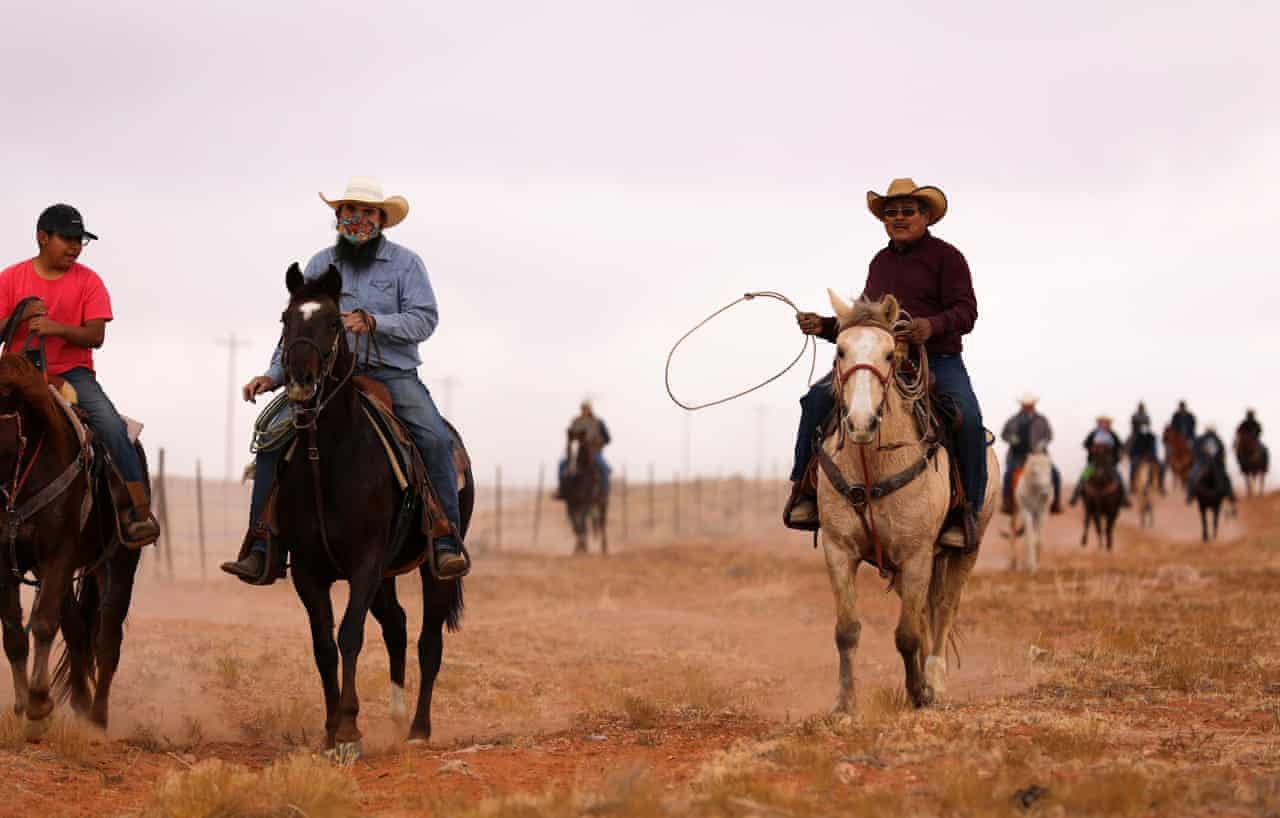
Photo: Larry Price/The Guardian.
Diné voters ride on horseback through the Navajo Nation to the polls in 2020. Allie Young, a Diné grassroots organizer, started the Ride to the Polls campaign.

Elections never stop being important, and next Tuesday, Nov. 4, will be a critical one in many parts of the country as we struggle to shore up democracy. Today we learn about how hard indigenous people sometimes work to get to the polls.

Melissa Hellmann wrote at the Guardian last year about Navajo people’s understanding of voting as an important way to protect the environment.

“In Diné, or Navajo, culture, the horse symbolizes strength and resilience, as well as a connection to the earth. Cowboy culture is so relevant to Native communities, that horseback trail rides are used to draw awareness to issues within the community including suicide prevention, and alcohol and drug use, said Allie Young, a 34-year-old Diné grassroots organizer. This fall, Young has harnessed the trail ride to engage Diné voters for the presidential election: her group’s voter-registration events will culminate with 100 Indigenous voters riding on horseback to a polling station in Arizona on election day. …

“Young, founder of the Indigenous-led civic engagement program Protect the Sacred, told the Guardian. ‘[When] we’re connected with the horse, we’re then reconnected to Mother Earth and reminded of our cultural values and what we’re fighting for, what we’re protecting.’ …

“Political representation that brings needed resources into Native communities is particularly important on tribal lands, where 75% of roads remain unpaved. …

“Young said she hopes that the success of the Ride to the Polls campaign in 2020 and 2022 will encourage ‘the greatest Native turnout ever’ in the upcoming election. This year, the campaign has extended its reach with events such as skateboarding and bull-riding competitions, heavy metal and country music concerts.

“ ‘We’re trying to communicate to our community that we need to protect our tribal sovereignty,’ said Young, ‘and with that, protect our sacred sites, protect our lands, our cultures, our languages, our traditions.’

“Young launched the Ride to the Polls campaign in 2020 in response to the rapid spread of Covid-19 infections in the Navajo Nation, where some counties saw the highest death rates per capita in the nation. She wanted to ensure that her community filled out the US census to receive the funding they deserved and to elect politicians who prioritize the concerns of Native communities.

“ ‘Our nation and many tribal nations across the country were devastated by the onset of Covid-19 because our system is being chronically underfunded,’ said Young, ‘which revealed to the rest of the world what we already know: that the government is not honoring our treaty, which says that we are to receive good healthcare and education.’ She began creating culturally relevant initiatives so that young Diné citizens who felt disenfranchised would see voting as a tool to ‘rebuild our power as a community.’ …

“So far, they have registered 200 new voters and checked or updated the registrations of about 400 people.

“On 12 October, the actor Mark Ruffalo will join Ride to the Polls to help mobilize Native voters and to mark the 100th anniversary of Native Americans being granted the right to vote. …

“ ‘Indigenous people have only been able to fight for their future at the ballot box for 76 years,’ Ruffalo said in a statement. ‘Now we’re seeing a massive movement of young Indigenous folk exercise their power at the polls.’ …

“All Native Americans were finally granted the right to vote under the federal voting rights act of 1965. Still, barriers have remained that make it difficult for Diné to register to vote and cast ballots, including a lack of residential addresses since many people on the Navajo Nation use post office boxes. It also can take up to an hour to drive to a polling location, said Young. And this summer, the US Supreme Court ruled that Arizona can enforce a state law requiring prospective voters to include proof of US citizenship in registration forms, which Young said was a ‘slap in the face to Native Americans, who are the first peoples of this land, to be asked to prove their citizenship.’

“To help address some of those hurdles, Protect the Sacred is partnering with the Indigenous-led voter-engagement non-profit Arizona Native Vote. Indigenous organizers register voters and help residents find their addresses by locating their houses on Google Maps. ‘A key talking point when we talk to voters is letting them know that voting and registering to vote should not be this hard,’ Jaynie Parrish, executive director of Arizona Native Vote, said. …

“During a six-stop trail ride to register Diné citizens throughout the Navajo Nation in mid-September [2024] indigenous organizers discussed with voters the importance of casting ballots in every election. They served citizens stew and frybread while explaining to them that county elections can determine how local government operations are funded. Young said: ‘I believe that we started a movement around the power of the Native vote.’ ”

And so, they voted. We know what happened in 2024, and we know what has been happening to environmental protection since then. But every election counts in moving the needle back toward the people. So, please vote on Tuesday and at every election in the future.

More at the Guardian, here.

Read Full Post »

Photo: Navajo Natural Heritage Program via Natural Resources Defense Council.
Diné Native Plants Program members work to restore a headwater stream impacted by livestock grazing.

The more that the US endangers its wetlands, the more we rely on the work that tribes do to protect them. Perhaps today’s article can help us see what the rest of us can do.

At the website for the Natural Resources Defense Council, or NRDC, Claudia Blanco Nuñez and Giulia CS Good Stefani describe how “Tribal Nations protect and manage millions of acres of wetlands, which help improve water quality, curb the risk of floods, recharge groundwater, and store large amounts of carbon.”

“Two years ago,” they report, “the U.S. Supreme Court slashed federal Clean Water Act protection of wetlands [with] harmful repercussions for droughts, wildfires, flooding, wildlife, and the drinking water supply. 

“In the absence of federal protection, the imperative to defend our shared waters falls increasingly on individuals, states, and Native American Tribal Nations. … Tribal Nations protect and manage millions of acres of wetlands in the United States, and with commitments made by the U.S. government to Tribal co-management and co-stewardship of federal lands, the amount of clean water safeguarded by Tribal Nations is growing.

“NRDC’s Science Office mapped the wetlands found within and intersecting the boundaries of Tribal reservation lands in the contiguous United States. Across the 294 federally recognized Tribal reservations mapped in this analysis, our scientists found that Tribes steward more than 3 million acres of wetlands. Even typically arid regions like the American Southwest have significant wetlands on Indigenous reservations. …

“In addition to the 56.2 million acres that are part of the Tribal reservation system, many Tribes have reserved or treaty rights on lands outside reservation boundaries, and most Tribes and their members maintain ongoing physical, cultural, spiritual, and economic relationships with their ancestral homelands. These reciprocal land and water relationships extend far beyond the political boundary of any designated reservation.

“This analysis is limited to federally recognized Tribes in the Lower 48 due to the complex Tribal governance systems in Alaska and Hawai’i. For example, the Alaska Native Claims Settlement Act of 1971 altered the previous Tribal ownership system to one led by Alaska Native Corporations. This system differs from federally recognized Tribes, which have a government-to-government relationship with the United States that includes eligibility for funding and services from the Bureau of Indian Affairs. That is to say, NRDC’s analysis looked at just a fraction of the total wetlands stewarded by and connected to the lives and well-being of Native peoples today.

“To learn more about Tribal wetland conservation, we spoke with leaders in the wetland management programs of the Navajo Nation and Red Lake Band of Ojibwe. …

“Navajo Nation agency staff are engaged in numerous projects to help restore and protect this essential resource. The Diné Native Plants Program recently submitted a grant application to remove invasive plant species along the Little Colorado’s riverbank. This will make space for native vegetation to grow and help with groundwater recharge for nearby Navajo farmers and families. The Diné Native Plants’ seed program also provides seed mixes for restoration projects that are solely sourced from Navajo plants. 

“Jesse Mike, the Diné Native Plants program coordinator, stepped out of the greenhouse to speak with us. He shared about the history of livestock grazing, trampling, and erosion that have impacted not only the health of the headwater streams on Navajo lands but also the underlying water table. His team is currently working to increase groundwater infiltration and improve the overall ecosystem health of three degraded streams in the Chuska Mountains. …

“The Red Lake Band of Ojibwe’s reservation is in northern Minnesota and has the greatest area of wetlands of any reservation in the contiguous United States. Across the Tribe’s more than 835,000 acres of land — all held in common by the Tribe — the Red Lake Band manages an astonishing 541,000 acres of wetlands. ‘So many wetlands,’ says Tyler Orgon, a biologist and the lead wetland specialist for the Red Lake Band Department of Natural Resources, ‘and we’re very fortunate for that.’ 

“A sizable portion of the Tribe’s wetland acreage north of Upper Red Lake is part of the largest expanse of peatlands in the continental United States. Peatlands cover about 3 percent of the earth and store more carbon than all of the planet’s other types of vegetation, including the world’s forests, combined. 

“One of the most important wetland-dependent plant species for the Red Lake Band — as well as other Anishinaabe and Dakota peoples across the Great Lakes region — is manoomin (Zizania palustris and Z. aquatica), the only wild rice native to Turtle Island. According to an Ojibwe prophecy, their ancestors were instructed to move west to the place where ‘the food floats on water.’

“The University of Minnesota research team We Must First Consider Manoomin (Kawe Gidaa-naanaagadawendaamin Manoomin) works to help protect this essential wetland-dependent plant by combining Western science with Indigenous science and learning from Ojibwe stewardship.

“The scientists have found that an increase in extreme weather conditions (like flooding events and record-breaking snowfall) negatively impact manoomin growth by uprooting the plant or drowning it out in its sensitive early stages. These weather events compound the already present settler-colonial impacts on wetlands in the region, including deforestation and conversion of wetlands into agricultural land use.

“Orgon hopes to restore some of the Red Lake Band’s wetlands that have been impacted by past agriculture.” More at NRDC, here.

Read Full Post »

Photo: Jean Ogden via Wikimedia.
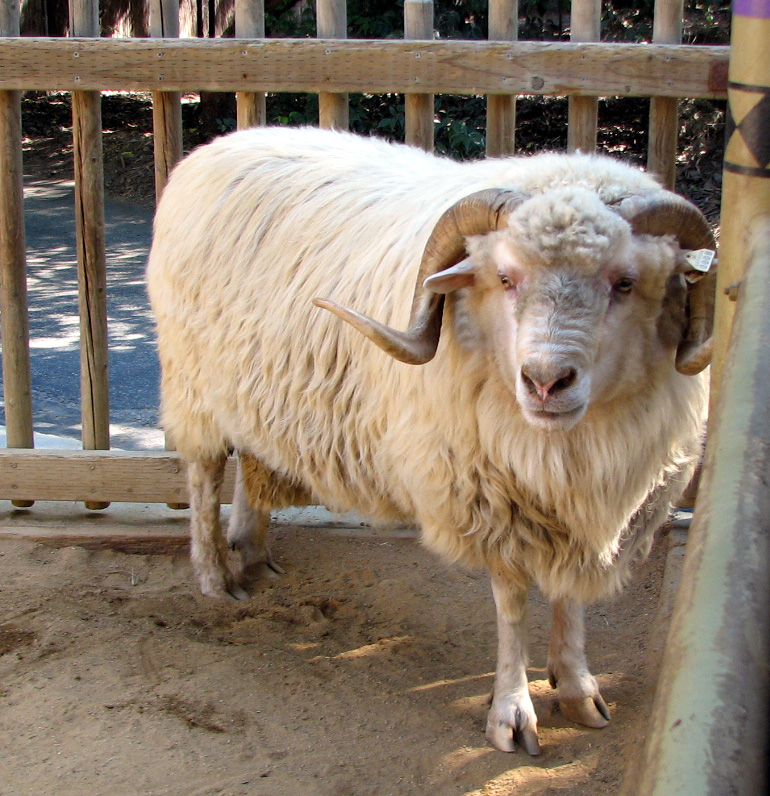
Navajo Churro sheep.

There’s a story at National Public Radio about the special relationship between a kind of sheep and the Navajo people, or Diné. Ayesha Rascoe hosts the NPR program, which you can listen here, if you prefer.

Ayesha Rascoe: For centuries, the lives of Navajo people have been intertwined with livestock — specifically, one particular breed of sheep they’ve relied on for meat and wool. The tribe is well known for weaving the wool of Churro sheep into colorful clothing and tapestries. Those weavings can fetch thousands of dollars from collectors, but they have far more than monetary value. Raising Churro sheep and weaving their wool is an important way Navajo people pass cultural knowledge from generation to generation. KSJD’s Chris Clements visited a Navajo Churro sheep celebration.

Chris Clements: Inside a crowded farmhouse on the edge of the Navajo Nation, weavers are demonstrating how to spin, dye and treat wool from Churro sheep, which they consider sacred.

Roy Kady: Hello. My name is Roy Kady. I am from Goat Springs, Ariz.

Clements: Kady, who’s in his 60s, is standing outside, wearing an ornate turquoise necklace, earrings, bracelets, and a white hat. He’s considered a master weaver, part of centuries of Navajo citizens who’ve carried on traditional beliefs that date back to the 1500s when Churro sheep arrived with early Spanish colonists.

Kady: I’m filling these big shoes that my mother wore as an agropastoralist.

Clements: Tyrrell Tapaha is Kady’s student and his grandson, who’s here at the event. …

“Tyrrell Tapaha: There’s always been weaving in my life, whether it be his work, my grandma’s work, or my great-grandma’s work. ..

“Kady: Tyrrell [says] I want to weave a human form. Do you have any ideas how I could do that? And so I just share with him. …

“Clements: Tapaha has been learning the tricks of the trade since he was very young. When he was only 8, Kady had him teach a class on the art of finger weaving at a nearby chapterhouse. … Tapaha knows that Kady’s teachings will live on with him.

“Tapaha: At least it’ll last my lifetime, you know? And I kind of hear that in how Roy talks about his contribution to the space is like him being an older person now and kind of seeing that handed off.

“Clements: After the morning’s presentations, it’s time for lunch. The weavers roast mutton, a Churro sheep they slaughtered earlier in the day. Participants of the sheep celebration gather around the grill, watching the fire hiss and sputter as the mutton cooks. It’s common for every part of the animal to be used. Nothing, not even its hooves goes to waste.

“In 1863, the U.S. military forced Navajo people to leave their ancestral homelands and relocate to an internment camp. It’s known as the Long Walk. … It almost led to the extinction of the Churro sheep.

“Navajo people were allowed to return home four years later. Some tribal members who’d managed to escape the Long Walk, kept some Churro alive. And today, thousands of Churro sheep live on or near the Navajo Nation.”

Read more about the sheep and the passing along of Diné culture at NPR, here.

Read Full Post »

Photo: Melanie Stetson Freeman/Christian Science Monitor.
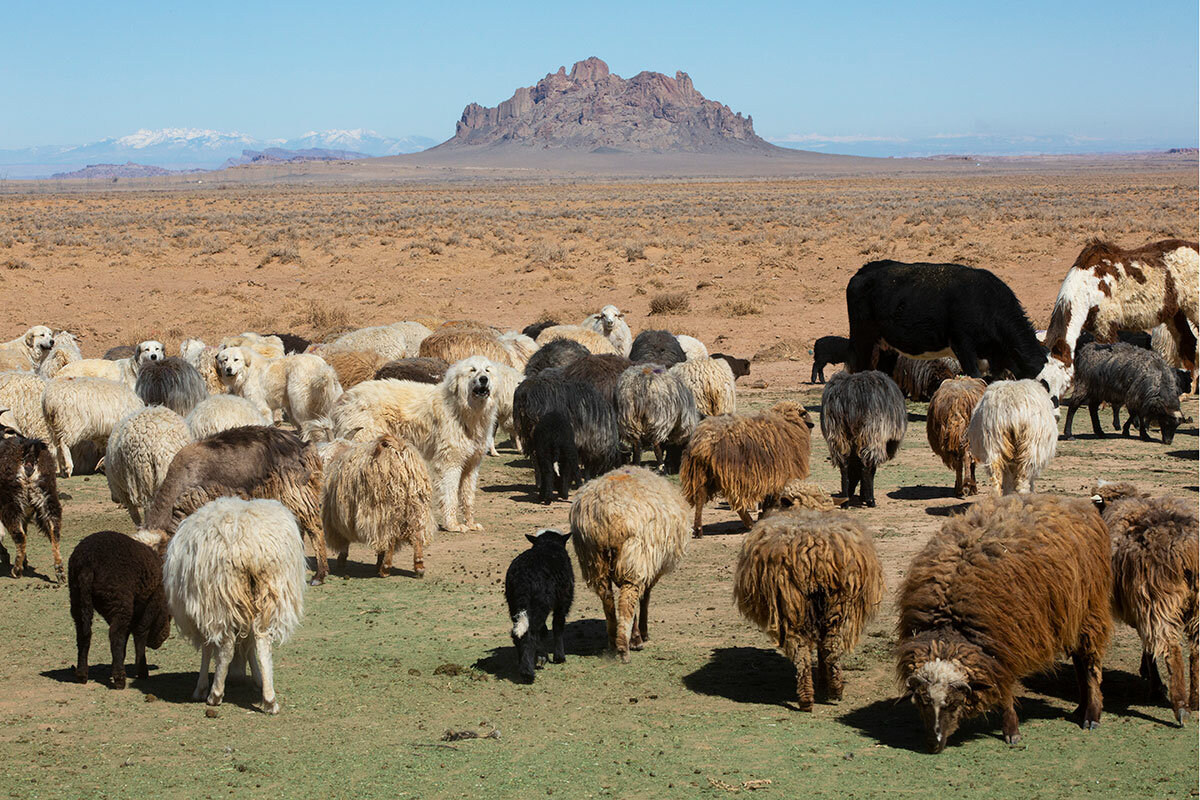
“Great Pyrenees dogs watch over Navajo-Churro sheep … outside Toadlena, New Mexico. … The sheep flourish in the harsh environment,” according to the Monitor.

I like that the Christian Science Monitor has so many stories about the Navajo Nation and other indigenous peoples. Although I’m not a Christian Scientist, I’ve always been impressed by the objective reporting at the Monitor and its steady coverage of underreported topics.

Reporter Henry Gass wrote recently from New Mexico about the resurgence of sheep farming on Navajo land.

“Irene Bennalley steps out into the fierce afternoon sunlight wearing jeans and a maroon sweater, her long gray hair knotted in a braid. Brandishing a long white stick as her crook, she picks her way across her parched desert farm toward the sheep pen. Answering their bleats with firm instructions in Navajo, she shepherds them out onto the dry, dusty range.

“She doesn’t know exactly how many Navajo-Churro sheep she has, but she ballparks it at around 100 head.

It’s bad luck to keep exact counts of your livestock, her father taught her. Don’t boast about your animals, he would say, or they’ll start dropping.

“Out here, ranchers like Ms. Bennalley can’t afford to lose animals. The winters are cold and hard, and the summers are hot and relentless. Water is scarce and feed is expensive. It’s the main reason she has come to love the breed, known colloquially as churros, that she’d grown up only hearing about in stories.

“The Navajo, who refer to themselves as Diné, have long been a pastoral society. Sheep are prominent in their creation myths, and after Spanish colonists first brought the churro sheep to the Southwest, the hardy, adaptable breed became, over centuries, the heart of a self-sufficient economy and vibrant Diné culture.

“But the days of sheep camps and flocks roaming the arid plains and valleys here are long gone. On two separate occasions the churro came close to full extermination. From over 1 million head at one time, by 1977 there were fewer than 500 left in the world.

“Efforts have been gaining momentum in recent years to rebuild the breed and return flocks to the Navajo Nation. Decades of painstaking, sometimes dangerous, work by a handful of committed ranchers and animal scientists have helped restore the population to over 8,000. 

“Now, people on the Navajo Nation are working to bring flocks back to the reservation, to try and fill the economic and cultural void left by their near extinction. 

“ ‘We’re back in a place of reevaluating how we live,’ says Alta Piechowski, whose family has been involved in restoring the Navajo-Churro for decades.

“ ‘When you’re walking the land [with the sheep], there’s a different kind of healing,’ she adds. ‘It heals your heart, and when it heals your heart you’re going to want other people’s hearts to be healed too.’ …

“An ‘unimproved’ breed – meaning one that hasn’t been selectively bred for market – churros are long and lean. … They are resistant to most diseases, and have adapted over the centuries to thrive in the dry, low-forage climate of the Southwest.

“For the Navajo people, the churro were something of a panacea. They provided a healthy and sustainable source of food and income; their many-colored fleece are ideal for weaving iconic Navajo blankets. And culturally, sheep have always been prominent in Navajo spiritual traditions. One of the six sacred mountains that bound the Navajo Nation, Dibé Nitsaa, translates to Big Sheep Mountain.

“But for the best part of a century, Navajo-Churro have been hard to find on the reservation. 

“The official term used by the U.S. government in the 1930s was ‘livestock reduction.’ The Midwest was in the grips of the Dust Bowl, and the Bureau of Indian Affairs, led by commissioner John Collier, concluded that too many livestock were causing land to erode and deteriorate.

“The policy resulted in the slaughter of hundreds of thousands of churros, often on the reservation, and sometimes on the properties of their owners. And it came after the Navajo people had spent over 70 years steadily rebuilding their churro herds. …

“Nearly a century since the stock reduction, the collective memory is still raw. Ms. Bennalley speaks mournfully of what she calls ‘the John Collier days.’ For a long time no one spoke of it at all.

” ‘Some people never really got out of losing their sheep that way,’ says Ms. Bennalley. ‘My family, my dad, nobody really talked about it, because it wasn’t something to be proud of.’ …

“ ‘That connection to the sheep is the connection to the land, which is the connection to the culture, which is the connection to the spirituality of the Diné people,’ says Dr. Piechowski, a career psychologist for reservation schools.

“ ‘If you exterminate the sheep, you’re pretty much eliminating [those] connections,’ she adds. …

“The churro never disappeared from the reservation, but the few that remained stayed hidden in some of the reservation’s most remote corners – so remote that the man who first led efforts to bring the churro from the brink of extinction almost died trying.”

Read more about that at the Monitor, here. Lovely photos. No firewall.

Read Full Post »

Photo: Melanie Stetson Freeman/Staff.
Ida Joe tries out her new sink with running water, which the nonprofit DigDeep installed in her home in Smith Lake, New Mexico. About 30% of those living on the Navajo [Diné] reservation do not have indoor plumbing or running water.

In Navajo Country, water is precious, and running water is sometimes nonexistent. Golly. I shouldn’t complain. Renovations at our house have left us without hot water since May 18, but at least we have cold water and friends with showers. Some Navajos [Diné, as they call themselves] trek periodically to the nearest town and rent a hotel room to take a shower!

Henry Gass, a writer at the Christian Science Monitor, reported the story from Smith Lake, New Mexico. “Ida Joe flinches a little as the tap sputters, then spurts water into the sink. Cautiously, tentatively, she pushes her hand under the faucet. She feels the water soak her skin and run through her fingers – first cold, then hot. After a few seconds, she starts to laugh.

“Outside the one-room house she shares with her two daughters and granddaughter, a cold breeze rolls across the dusty, arid plains of the Navajo Nation. A few hundred yards away, wild horses drink from a small, briny lake.

“Ms. Joe has lived on the Navajo Nation for all of her nearly 50 years. This late February day is her first with running water in her home. Until now, her family would drive to Thoreau, 10 minutes away, or Gallup, 45 minutes away, to buy gallon jugs of water.

They would drive to town to do laundry, and rent a hotel room for the day to use the shower. …

“Water is sacred on the Navajo Nation, and scarce. About 30% of the roughly 173,000 population lack running water, according to a report from the U.S. Water Alliance and DigDeep, an international nonprofit with Navajo employees who have been installing running water systems in homes on the reservation since 2014. The size of the reservation, the large distances between homes, scarce natural water sources, jurisdictional issues, and contamination from industries like uranium mines have all contributed to restricting access to running water here for generations.

“But according to those working to improve water access on the reservation, the COVID-19 pandemic has heralded a bittersweet turning point. … The pandemic drew widespread attention to the fact that many Navajo didn’t have enough water to thoroughly wash their hands, which was core advice of health experts at the time. … New coalitions have formed, funding has increased, and innovations from organizations like DigDeep have helped expand water access here more than ever before.

“ ‘This has been a silver lining for us,’ says Crystal Tulley-Cordova, principal hydrologist for the Navajo Nation Department of Water Resources. …

“A pickup truck, a trailer towing a backhoe, and a gleaming white water truck nicknamed ‘Big Ernie’ make up the DigDeep convoy. …

“The region has been in various forms of drought for over 20 years, and is currently experiencing severe and extreme drought. … There are also problems with water quality. Arsenic and uranium, both left over from a century of mining on the reservation. …

“Meanwhile, piping water onto the reservation is challenging because of how spread out the population is. Some areas are a checkerboard of public and private land, presenting right-of-way issues. On top of that, funding has typically been limited, according to Capt. David Harvey, deputy director of the Division of Sanitation Facilities Construction at the federal government’s Indian Health Service. …

“Through the CARES Act – a pandemic relief funding package passed by Congress in March 2020 – the Navajo Nation received over $5 million specifically for increasing water access on the reservation. …

“The [DigDeep] crew were here 18 months ago to install one of their foremost pandemic-era innovations: a ‘suitcase’ – a 4-cubic-foot box filled with a water pump, heater, filter, expansion tank, and battery installed outside homes to provide tap water from a 1,200-gallon underground tank. …

“During the pandemic, 100 of these suitcase systems have been installed by DigDeep crews on Navajo lands, at no cost to residents.

‘People [were being told], “Wash your hands for at least 20 seconds with soap and water.” But how can they do that if they don’t have running water?’ says Cindy Howe, the project manager for DigDeep’s New Mexico office. …

“Ms. Joe and her family wait in their car while Kenneth Chavez and Brian Johnson assemble the sink and Erving Spencer maneuvers the backhoe. …

“Ms. Joe likes living here, she says. She feels safe, and she wants to raise her kids and grandkids here.

“ ‘It’s one of the most important things that I would probably want to do before I go,’ she says, ‘teaching them the foundation of our culture.’ …

“As they finish their work at Ms. Joe’s house, ‘Big Ernie’ refills the 1,200-gallon tank that now supplies her indoor sink. …

“Lacking water ‘is just normal for a lot of people,’ says Ms. Howe of DigDeep. Her grandparents would melt snow for water. Her parents hauled water throughout her childhood as well – always on Sundays, so she could have a bath before school on Monday.

“ ‘It was really heartbreaking to see,’ she says. ‘Fifty-five years later, it’s still happening. We’re all helping each other [but] there’s still a lot of people that don’t have any water.’ ”

More at the Monitor, here.

Read Full Post »