Feeds:
Posts
Comments

Posts Tagged ‘disabilities’

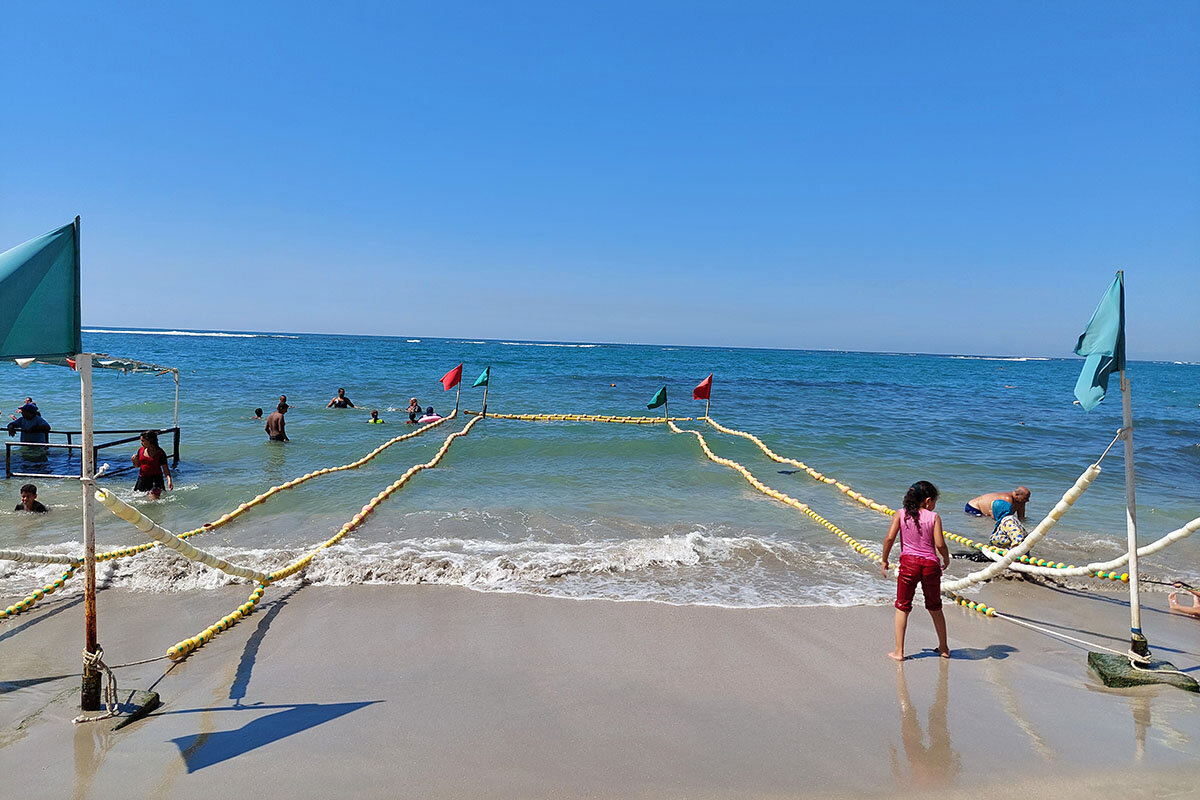
Photo: Mariam Ehab.
View of Mandara Beach in Alexandria, Egypt, where floating ropes help the visually impaired enter and exit the Mediterranean Sea, Aug. 23, 2022.

You may have noticed that I love stories about Sweden and Egypt. That’s because two of my grandchildren are half Swedish and two are half Egyptian. How lucky is that!?

Today’s story comes from Alexandria in Egypt. Miriam Ehab covered it for the Christian Science Monitor.

“In a sunny spot along the bustling shores of Alexandria, Egypt’s second-largest city, a group of beachgoers splash and frolic in the sea. But this is no ordinary beach.

“Holding onto floating barriers and ropes, safe in the knowledge that attentive lifeguards are nearby, almost everyone here is blind or visually impaired. Mandara Beach is the first of its kind in the Arab world’s most populous country, specially fitted so it’s accessible to swimmers with physical disabilities. For many, it’s more than just a day of fun and relaxation – it’s a rare window of empowerment.

“Inaugurated in 2021 for people using wheelchairs, Mandara underwent another renovation last year. When the revamped beach opened again in June, at the height of Egypt’s summer season, thousands of citizens with visual impairments could also safely swim in the calm cerulean Mediterranean waters. …

“ ‘This is the first time I’ve been to the sea,’ Sarah, one beachgoer, says with a beaming smile. ‘I was very happy and did not feel afraid at all when I was swimming.’ … 

“Some 12 million Egyptians live with a disability, roughly 3.5 million of whom face visual challenges. In 2018, President Abdel Fattah al-Sisi declared the ‘year of persons with disabilities.’ … Parliament responded with a slew of laws, including the provision of state-subsidized health care to people with disabilities.

“Other benefits included tax exemptions on the purchase of cars, educational and medical materials, and imported assistive devices. Legal fees, whether for plaintiff or defendant, also were lifted for people with disabilities. And in 2021, Parliament approved tougher penalties for the bullying of people with disabilities.

“ ‘The laws from 2018 are excellent,’ says Hassan Abdel Qader, head of Alexandria’s Blind Association. ‘But the problem is in their implementation.’

“The fact is, say campaigners, that many public spaces and means of transport still lack accessibility, assistive technologies are hard to come by, services for people with disabilities are patchy, and discrimination is not uncommon. Still, change is coming, slowly. 

“Some months ago, Jihad Mohammed Naguib, an employee at the Department of Tourism and Resorts in Alexandria, was inspired by something she heard from the governor of Alexandria, Maj. Gen. Mohamed el-Sherif. He noted that there were never any blind people on the beaches, which are the pride of the coastal city. …

“ ‘The idea ​of ​allocating a part of the beach for the visually impaired … was put forward after we inaugurated the free Mandara Beach for people with motor disabilities and the success that it met,’ Major General Sherif says in an interview. And so, with funding from the Rotary Club of Alexandria Pharos, the work began. 

“Floating ropes with plastic balls were installed on a flat portion of the beach, so that swimmers with visual impairments could enter and leave the water holding these ropes. People in wheelchairs could use a modified ramp, the end of which was fitted with a metal box submerged in the water, ensuring their safety while in the sea. Lifeguards and a first-aid unit were also available – which isn’t always the case on Egypt’s public beaches.

“Those directly affected – and most likely to benefit – were consulted from the beginning. ‘We proposed some things that they have already implemented, and others that they promised would be implemented in the future,’ Mr. Qader says.

“Those suggestions included a whistle for children who feel endangered, and a rope that extends from the entrance of the beach to the water, so that even if a visually impaired person visits on their own they can reach the sea without assistance. …

“The beach is the latest in a recent string of hard-won successes for Egypt’s visually impaired people. The Egyptian Blind Sports Federation already runs several sports teams, including soccer, weightlifting, judo, and showdown – a type of air hockey for blind people.

“But gaps remain.  ‘Most services, and recreational and sports activities for the visually impaired, are concentrated in the Egyptian capital, Cairo, while other Egyptian cities have little capabilities,’ says Moamen Mostafa, the former head of public relations for the Blind Association of Egypt. …

“That makes Mandara Beach all the more poignant for a group who have difficulty accessing recreational and sports activities.  For 52-year-old Mohamed Attia and his 40-year-old wife, Sahar, both wheelchair users, this was the first time they could enjoy the beach together. 

“ ‘I am happy to go into the sea for the first time in my life, after I could only watch it from afar,’ says Ms. Attia. 

“The couple were delighted to find a group of people who helped them move their wheelchairs into the water. … 

“Mr. Attia says … ‘Those who had this idea have a compassionate heart. We really wish this project to continue and spread on all the beaches of Egypt,’ he adds. 

“That wish may come true. Buoyed by the success and widespread acceptance of Mandara Beach, Major General Sherif says there are plans to open a similar facility in Alexandria’s Anfushi Beach. From there, he hopes, the idea will spread through the country.”

More at the Monitor, here.
Read Full Post »

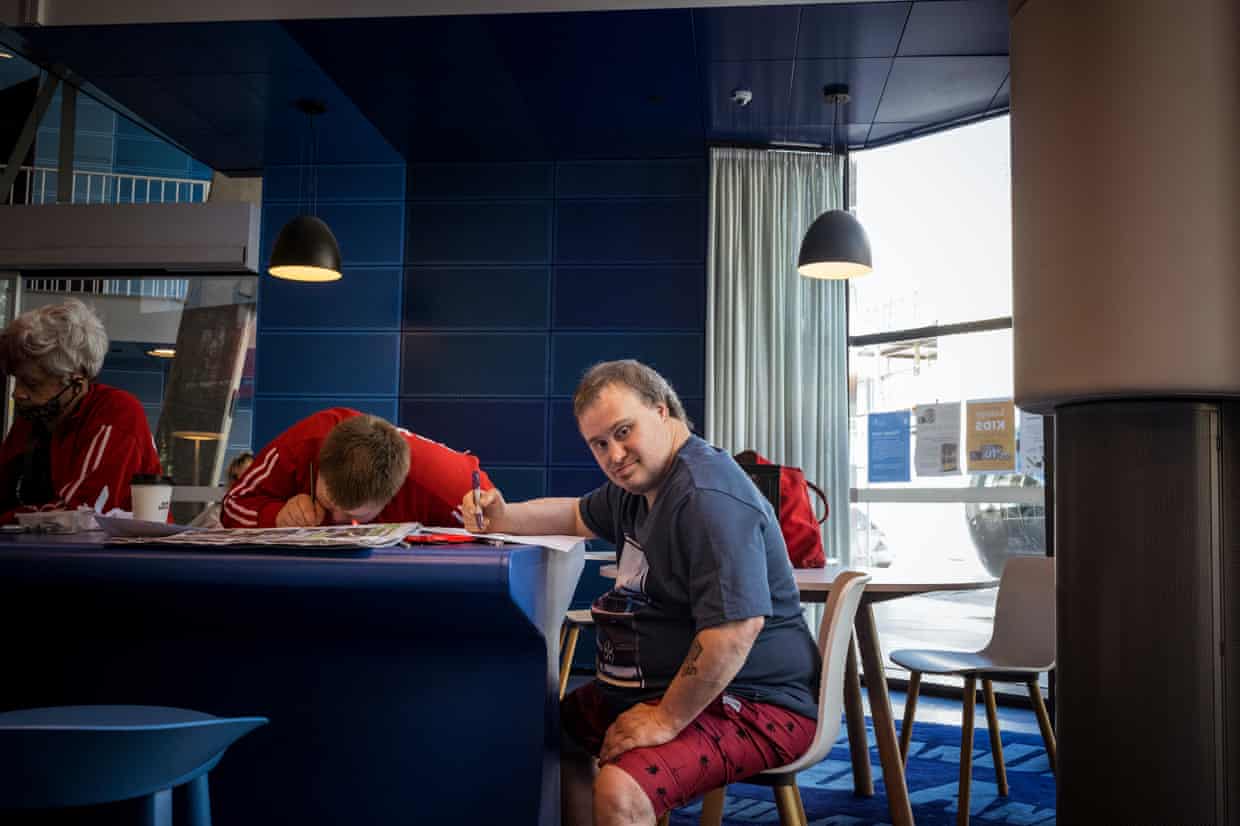
Photo: Christopher Hopkins/The Guardian.
Back To Back acting ensemble member Mark Deans takes part in a weekend workshop at the Geelong Theatre in Australia. The group, which features people with disabilities, just won the “Nobel prize for theater,” says the Guardian.

I imagine there’s nothing like being recognized for great work when you least expect it. When you are just doing what gives you joy. That’s the recent experience of a specialized theater company in Australia.

Lyn Gardner reports at the Guardian, “A small Australian theatre company made up of neurodiverse and disabled actors has won one of the world’s richest theatre prizes, the DK2.5m (~$371,000) Ibsen award.

“Back to Back, which was established in 1987 and is based in Geelong, were announced as the winners of the biennial prize on Sunday night in Norway. The pioneering theatre company is the first Australian recipient of the award, dubbed ‘the Nobel prize for theatre,’ which goes to an individual or company ‘that has brought new artistic dimensions to the world of drama or theatre.’

“Back to Back is renown for their acclaimed and often confronting shows, like 2011’s Ganesh Versus the Third Reich, which sees the cast members interrupt the show to question their right to perform it, about the Hindu deity traveling to Germany to reclaim the swastika from the Nazis. Their other shows include Food Court (2008), Lady Eats Apple (2016) and The Shadow Whose Prey the Hunter Becomes (2019). …

“ ‘It is such an honor for all of us to get that award and to receive it from that panel,’ [ensemble member Sarah] Mainwaring said. … It’s so rewarding for us to know that we can go on, and build our work.’ …

“Back to Back’s artistic director Bruce Gladwin told the Guardian he was ‘shocked’ by the news. When he was first contacted by the Norwegian National Theatre, which takes part in the announcement, he thought they wanted to collaborate. ‘But in that meeting, they announced that we’d won it. None of the ensemble had any idea that they were in contention for it, let alone that they’d won. They were just so moved that their work was acknowledged at that level.

“Awards are strange because you don’t necessarily make the work to receive them. This just came out of the blue. I feel really honored that this group of international theatre practitioners have been watching the company’s work for close to two decades. They’ve acknowledged the ensemble’s insight as social commentators.’ …

“Norway’s ministry of culture made the announcement on Sunday local time, timed to mark the birthday of celebrated Norwegian playwright Henrik Ibsen.

“ ‘We are proud to be able to honor an outstanding and unique theatre company that asks questions of their audience, of society and of each other through groundbreaking productions,’ said chair of the prize committee, Ingrid Lorentzen. … In a letter detailing its decision, the prize panel praised Back to Back’s shows as ‘some of the most memorable productions of 21st century theatre.

“ ‘There is no need for exposition in their theatre, no overreliance on dialogue, no need for a proximity of performer and role. Back to Back create a theatre that doesn’t follow the rules; they take over spaces that have been marginalized, erased or rendered insignificant … this is a theatre that defies a tick box culture. It’s a theatre – both pragmatic and metaphysical – that gravitates around what it means to live in the fullest sense of the word at this precise moment in history.’ “

More at the Guardian, here.

Read Full Post »

Photo: Sam Butler
“Two-year-old Lula-Belle Butler-Wenlock-Simpson, who was born with heart problems and underwent open-heart surgery, poses with a Special Friends doll whose scar mirrors her own,” explains PRI.

At Public Radio International (PRI), a distributor of some of my favorite shows, I recently learned about personalized dolls for children with disabilities and other big challenges. Bianca Hillier reported the story at PRI’s “The World.”

“Dolls have come a long way since the 1950s. One of the first TV commercials for Mattel Inc.’s Barbie doll sang: ‘Barbie’s small and so petite. Her clothes and figure look so neat.’

“While modern-day dolls aren’t confined to quite as rigid looks, the industry still has room to expand its inclusivity — especially for children with disabilities.

“That’s the challenge Victoria Band faced when her son was growing up. He is deaf in both ears and uses hearing aids. When he was younger, she wanted to give him a doll that also used hearing aids to show that he was not alone.

“ ‘When he went to his [medical appointments], he’d say, “Mommy, it’s a scary place at first. You don’t know what’s happening. You don’t know what [the hearing aids] are going to look like,” ‘ Band said. ‘So if [only] there was a doll there and they could say, “Oh, look, this is what you’re going to have in your ears. Look at all the different colors you could have.” ‘ …

“Band, who has always been crafty, started making her own dolls last year. She called the business ‘Special Friends.’

Working from her home in Dewsbury, England, she now makes dolls who have scars, cleft lips, hearing aids, oxygen tanks, or anything else that matches a child’s special needs. Many of the dolls are custom-made. …

“Band’s handmade dolls have since helped hundreds of kids, including a little girl named Lula-Belle who was born with heart problems and had open heart surgery at 14 weeks old. Lula-Belle is 2 years old now and has a scar down the middle of her chest. Her mom, Sam Butler, found out about ‘Special Friends’ on Facebook. …

“ ‘When she got her first doll, she was like, “Mommy, scar! Scar! Scar! Me scar, me scar!” ‘ Butler recalled. ‘And she pulled up her top. And she was matching scars with her baby.’ …

“Special Friends has been up and running for less than a year, but Band has already sent dolls beyond the United Kingdom to Germany, the US, and Australia. She says seeing the reactions come in from around the world is priceless.

“ ‘You can’t ask for much more than seeing a child really happy,’ Band said. ‘That’s worth more than anything.’

“Band added that the dolls can also be used as an educational tool to teach kids about medical equipment, surgeries, and conditions they may not know about. People need to be ‘more aware,’ she said, so that other children aren’t made to feel different in the first place.”

More at PRI, here.

Read Full Post »

Hard to believe, I know, but some things have gotten better. Take accessibility. When my father was disabled by a stroke in the 1950s, there were few supports for families. There were no ramps, no specialized bathrooms at highway rest stops, no programs to teach the afflicted new ways to be independent. People with disabilities were mostly on their own.

Today, there are interpreters for the deaf who are as dramatic and interesting as anything being interpreted, there are kneeling buses and building regulations that incorporate universal design precepts (ramps, wide doors for wheelchairs, high toilet seats, grab bars), and more.

The other day when my husband and I watched a Disney film on Netflix, we even discovered that someone with vision impairment could get all the images narrated.

And here’s another new angle: a contemporary museum is using virtual reality to enable folks in wheelchairs to see an otherwise inaccessible exhibit. Steven Overly at the Washington Post has the story.

“The magic of the ‘Infinity Mirrors’ exhibit begins as soon as the door is closed behind you. Surrounded by mirrors on all sides, visitors find themselves at the center of a seemingly endless plain filled with brightly colored lights and geometric sculptures.

“But curators at the Hirshhorn Museum and Sculpture Garden, where the exhibit is on display until May 14, faced an early challenge: how to re-create that magic for visitors in wheelchairs. …

“Drew Doucette, who oversees multimedia and technology initiatives at the Hirshhorn, thought immediately of virtual reality. …

“The Renwick Gallery, National Museum of Natural History and other Smithsonian Institution sites have created virtual experiences in the past, often with the goal of extending the exhibit to people or students who may not be able to visit in person. The ‘Infinity Mirrors’ exhibit marks the first time any have used virtual reality to make an exhibit accessible to those with disabilities, [Beth Ziebarth, director of the Smithsonian’s Accessibility Program] said.

“The wildly popular art exhibit is spread across six portable rooms, each filled with objects created by Japanese artist Yayoi Kusama. …

“But in three of the rooms, visitors must walk through 30-inch doorways and onto platforms less than four feet wide to achieve the full experience. …

“It took roughly four months to plan and design the Infinity Mirrors virtual reality experience on Unity, a program typically used to build video games, Doucette said. …

“ ‘We essentially had to take a step back from trying to recreate the rooms and get into the head of Kusama and say, “What was she trying to do? How did she end up using mirrors?” ‘ Doucette said.” Read more.

Photo: Bill O’Leary/The Washington Post
Volunteer Megan Walline experiences the installation “Infinity Mirrored Room — All the Eternal Love I Have for the Pumpkins” at the Hirshhorn in Washington, DC.

Read Full Post »

At the Paper Mill Playhouse in Millburn, New Jersey, a group of children are learning the joy of theater.

Tammy La Gorce writes in the NY Times that the playhouse now has a class for children with disabilities.

“The class is a logical next step for Paper Mill, which last year began offering a series of sensory-friendly presentations for children with autism in its ‘Theater for Everyone’ programming. Sensory-friendly shows are scripted to be more literal, with innuendo kept to a minimum, and the theater’s lighting and volume are adjusted to help audience members feel more comfortable.

“This year, in a partnership with VSA New Jersey, a nonprofit organization that provides arts programming for children and adults with disabilities, Paper Mill joined the ranks of theaters welcoming such children who have an interest in learning to perform.

“Parents of children with developmental disabilities ‘are seeing the benefits of arts education,’ said Lisa Cooney, 46, director of education for Paper Mill. ‘And they’re a lot more proactive than they used to be.’

“Those who run the programs find them rewarding as well. The children ‘give so much to us,’ said Mickey McNany, the director of Paper Mill’s Theater School, after the recent class. In it, her 10-year-old granddaughter, Mary McNany, who has Down syndrome, identified Mozart as the composer of ‘Eine kleine Nachtmusik,’ performed an improvised roller-skating scene and used sign language, as well as her voice, to sing a song.” Read more.

Below, Marnie McNany takes part with her children Finn and Mary.
Photograph: Aaron Houston for the New York Times

Read Full Post »