Photo: Nathaniel Bivan.
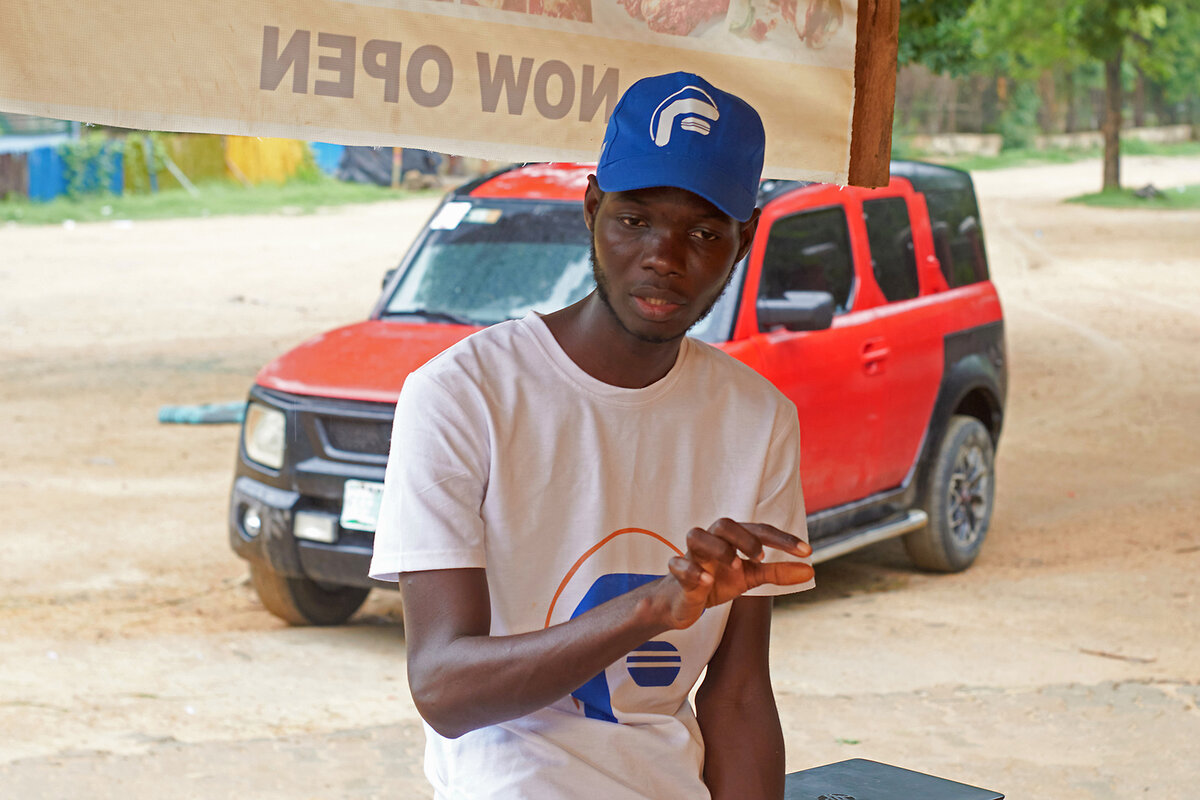
Muhammad Auwal Ahmad wears a cap and shirt with the Flowdiary logo during a meetup in KanoNigeria with some of his educational app’s tutors and students.
Whenever I used to read about Boko Haram terrorists in Nigeria, all I could think was how horrifying and hopeless the situation seemed. But it’s amazing how the human spirit can work around almost any hopeless situation.
Today’s story is about the young man who invented an app to help displaced Nigerian youth learn skills — despite terrorists and a disrupted education.
Nathaniel Bivan reports at the Christian Science Monitor, “Seventeen-year-old Ahmad Aminu finished secondary school and would like to go to college near his village in Zamfara state. But this region of northwestern Nigeria bears the brunt of attacks by bandits who kidnap students for ransom. …
“The 17-year-old Mr. Aminu [has] been able to take – for free, or at very little cost – courses in various digital skills in Hausa. He is becoming a well-known graphic designer within the community surrounding Dalba.
“ ‘The payment depends,’ says Mr. Aminu, the excitement clear in his voice. Designing an invitation card, for example, earns him about 2,000 Nigerian nairas, about $1.25; doing video editing, up to 3,000 nairas.
“ ‘In a month, I make as much as 30,000 naira,’ he says. ‘I really thank God.’ …
“Mr. Aminu is the sort of student whom Muhammad Auwal Ahmad had in mind when he created Flowdiary two years ago as a 23-year-old attending Federal University Gashua in northeastern Yobe state. He says Flowdiary now has more than 8,000 students enrolled from far-flung, impoverished areas across northern Nigeria; on average, almost one-fifth of those are active weekly users. The platform’s name refers to opportunities flowing to young people who might not normally have them.
“ ‘We have students from regions affected by terrorism and banditry … that we train and mentor,’ Mr. Ahmad says, noting that students who speak only Hausa struggle to find online courses in digital skills in their language.
“Mr. Ahmad’s dream began in Bayamari, a village in Yobe state that has only two small schools, a health center, and a police outpost. As a curious tween growing up there, Mr. Ahmad started researching digital technology when his father brought home a mobile phone and, later, a computer. Gradually, Mr. Ahmad started troubleshooting and soon had ambitious digital goals. …
“After unsuccessful attempts at building a couple of online businesses as an undergraduate computer science student, Mr. Ahmad set up Flowdiary in March 2022. It started as a team of tutors, who included some of his friends, teaching digital skills on Telegram to other young people across northern Nigeria at low cost.
“By that November, students could access the Flowdiary website. In February 2023, the app’s release became official. Paying as little as 1,200 nairas per course, students could register to learn web development, graphic design, and other digital skills. Tutors net half of the proceeds from course fees, and the rest goes toward operational costs such as maintaining the app and helping link Flowdiary students with career opportunities, Mr. Ahmad explains.
“Registered as a business, not as a nonprofit, Flowdiary has struggled to find other funding. … But Mr. Ahmad says he is set to obtain some much-needed funding after winning the 2024 Yobe State Research and Innovation Challenge, a prestigious regional competition organized by the Biomedical Science Research and Training Center of Yobe State University, in partnership with Yobe’s state government. …
“In 2011, Al’amin Dalha Suleiman and his seven family members abandoned their home in Maiduguri, the capital of northeastern Borno state, because of the Boko Haram insurgency there. They fled to Kano, more than 500 kilometers (about 310 miles) away, mourning the deaths of neighbors and friends as well as the loss of the family’s hat shop. But discrimination in Kano against outsiders forced them to return three years later to Maiduguri, where Mr. Suleiman struggled to revive the family business. …
“Through a friend on Facebook, Mr. Suleiman heard last year about Flowdiary. He enrolled in several courses, including video editing, web development, and graphic design. There was a major challenge, though – the need for wireless data and a laptop. For months, Mr. Suleiman struggled to finish the courses over his phone, but the payoff – the skills he has acquired – has been worth it. …
“Mr. Ahmad currently teaches computer science in northwestern Kebbi state as part of his National Youth Service Corps requirement. His vision after the one-year program is to expand the Flowdiary platform to reach more young people and – crucially – to help them grow their skills into careers.
“The end of online training for each student does not necessarily mean goodbye at Flowdiary. The Flowdiary team recently set up a mentoring and internship program; any student who takes a course can apply to work with companies that Flowdiary has forged a relationship with. As of late September, 20 students had secured internships – including two with Abdul Gusau, the owner of Abdoul Shoe Ventures in Zamfara.
“ ‘It is impressive to see how effective Flowdiary is through the work the interns are putting in my store,’ Mr. Gusau says. “ ‘The graphic designer has not yet entered the intermediate class, and yet his work is excellent. The same goes for the social media manager, who runs effective ads.’ “
More at the Monitor, here. No paywall. Subscriptions solicited.


 Suzanne's Mom's Blog