Feeds:
Posts
Comments

Posts Tagged ‘diving’

Photo: Maggie Penman/The Washington Post.
Marci Johnson shows off a tiny watering can from deep in a pond. Johnson is a member of Susan Baur’s group Old Ladies Against Underwater Garbage, OLAUG.

A question from today’s article is a perfect example of the real meaning of “begging the question.” Although nowadays the phrase seems to mean “leads to a new question,” good old Fowler’s says it really means something more like “making an unproved assumption.”

Thus “why does diving for trash in a pond make people so happy?” makes the assumption that diving for trash does make people happy.

Let’s read more about the person who begged the question: Susan Baur, founder of the group Old Ladies Against Underwater Garbage.

 ‘It’s a reminder when things feel too overwhelming — it’s not overwhelming if you do it together.’

Maggie Penman writes at the Washington Post, “On an overcast chilly morning in late August, a group of women gather in a sandy parking lot, nearly all of them sporting a bright orange hat with the letters OLAUG — Old Ladies Against Underwater Garbage.

“Founder Susan Baur gets the group’s attention to go over the plan: Two groups of swimmers with masks and snorkels will be dropped off by a pontoon boat in different sections of Johns Pond in Mashpee, Massachusetts.

“Each group, accompanied by a kayaker, will swim in zigzags toward each other, diving as deep as 12 feet to pull trash from the pond’s muddy depths.

“All of the divers — women between 65 and 85 years old — have an enthusiasm for litter. …

“ ‘You literally never know whether you’re going to be excited, humbled, saddened. It’s all there, the whole emotional range you go through on a dive,’ Baur said.

“This area has been cleaned up before, but they know there’s more trash, in particular from a nearby construction site, that is getting dumped in the pond, Baur said. …

“Baur is a retired psychologist. At 85 years old, she is tiny but strong, moving quickly and fluidly as she checks equipment and greets swimmers. She says this project started on a whim in 2018, inspired by her daily swims in freshwater ponds and lakes near her home on Cape Cod.

“ ‘It was three or four or five friends that would get together and clean up a pond and laugh,’ she said.

“They were astounded at how much trash was in local waterways and ponds, and thought they could use more hands. In 2023, OLAUG held tryouts for the first time, making sure volunteers could swim half a mile in under 30 minutes and finish the mile comfortably. They also had to be able to dive repeatedly down 8-10 feet. Overnight, the group expanded to 21 women. The youngest was 64. …

“The dives are organized with walkie-talkies and safety protocols, and coordinated with local homeowners, who often express appreciation with baked goods. Each dive is run by an assigned ‘beach boss’ who handles logistics and checks swimmers in and out of the water. Each diver has an area of expertise. If it’s deep, call Marci. If it’s disgusting, call Susan. …

“Many of the women involved in OLAUG are motivated by environmentalism: wanting to clean up ponds and lakes for the fish and turtles that populate them.

“Some are motivated by the camaraderie or the exercise. For others, it’s the joy of imagining the provenance of the objects pulled out of the mud.

“ ‘Where did this garbage come from?’ asked kayaker Diane Hammer, 70. ‘And how did it get in the pond in the first place?’

“She got involved with OLAUG after moving from Boston to Falmouth in 2020. She looked out her window and saw people in wet suits digging in her pond. Hammer had been watching a lot of true crime during the pandemic, and her first thought was that the divers were FBI agents looking for dead bodies. She soon learned it was Baur and a friend looking for trash.

“ ‘There’s nothing better than doing something good with good people,’ Hammer said. ‘It’s a reminder when things feel too overwhelming — it’s not overwhelming if you do it together.’ …

“This particular Monday morning, divers find a makeshift anchor and a rusted rudder, as well as two shoes — one a woman’s strappy sandal. On another day they found a blue toilet. On another, the back end of a Corvette. They’ve found old beer bottles that seem to have been dumped after an ice fishing expedition a century ago, lots of golf balls and so many baby doll heads. …

“The main reason Baur thinks the women keep coming back to OLAUG is because in the water, they reach a state of flow — the concept in psychology that some researchers believe holds a critical key to happiness.

“ ‘The cool thing about flow is there’s no one thing you have to do to achieve it,’ said Richard Huskey, an associate professor in the communication department at the University of California at Davis who has written about flow. He says the easiest way to understand it is as ‘being in the zone’: being so fully engaged in a task that you are entirely present, totally unselfconscious, not thinking about anything else.

“ ‘There’s nothing like cold water, icky garbage and a little bit of danger to get you out of your head,’ Baur said.

“Marci Johnson agrees. She’s one of the swimmers who joined the group in 2023. Johnson grew up on Cape Cod and moved back with her husband when she retired, but then he died. She was diagnosed with breast cancer. She was feeling isolated and struggling — and then she saw OLAUG was having tryouts.

“ ‘I never was good in gym, I wasn’t on a sports team in school, but I do love swimming,’ she said. ‘You get into a rhythm when you’re swimming long distances, and your mind just goes somewhere else. You work through those problems you’ve been trying to figure out, sitting there thinking about it. But when you’re swimming the answer comes to you. It’s a happy place.’ ”

More at the Post, here.
Read Full Post »

Photos: Libby Keatley.
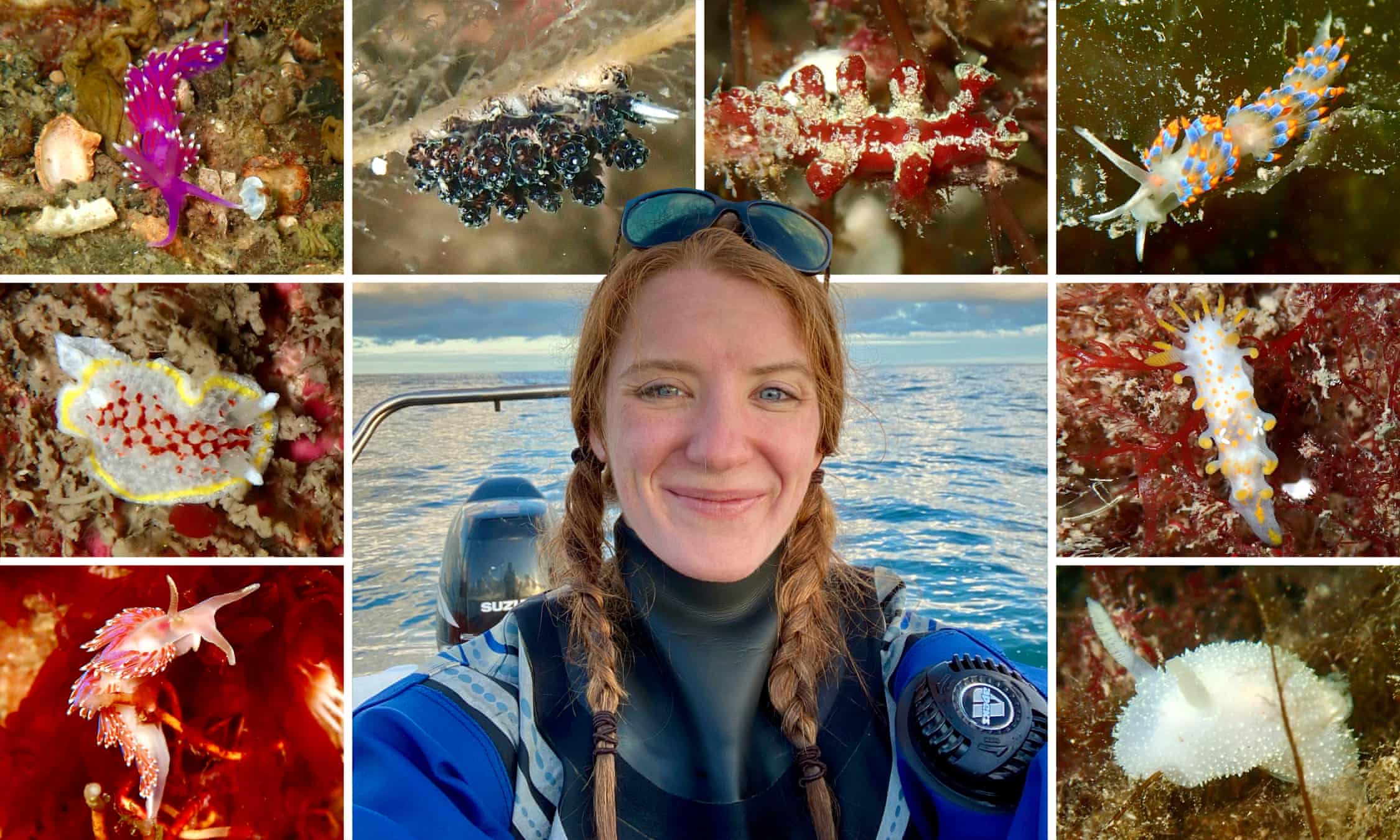
Libby Keatley and some of the “inherently charismaticsea slugs she has encountered. 

After blogging singer Will McMillan told us more than we ever imagined about sea snails once used for a royal purple dye, I remembered that the Guardian had an equally fascinating story on sea slugs. It turns out some young people are huge fans of the critters and are helping scientists keep track of them.

Helen Scales writes, “Two years ago, Libby Keatley was diving off the coast of County Antrim in Northern Ireland when she spotted something unusual. It was a sea slug – or nudibranch – whose transparent body had orange lines running through it and twiggy projections arranged along its back. ‘It was quite distinctive and not like anything I’d seen before,’ she says.

“Keatley called over her diving buddy, Bernard Picton, a local marine biologist and pioneer in UK sea slug studies. He scooped it up in a plastic bag and, back at his lab, confirmed it was a newly discovered species. He named it in Keatley’s honour: Dendronotus keatleyae.

“ ‘Three years ago, I didn’t really know what a nudibranch was or I thought they only lived in tropical countries,’ says Keatley.

‘It just shows you can learn – you don’t have to be somebody who’s been in a lab for 20 years to know that something looks a bit funny or different.’

“For a niche but growing group of amateur naturalists, sea slugs have become an ideal subject: as stunning as butterflies but with the good grace to sit still while you peer in close and take a photograph. Distant relatives of the slimy, drab land-dwellers that live in gardens, sea slugs are an altogether more endearing bunch. Many are daubed in jewel-like colors that warn off predators. Others take on hues to blend in with their surroundings, often gaudy seaweeds and sponges. There are also plenty of sea slugs to discover in UK waters, with about 150 known species across the north Atlantic. …

“To show me why the hobby has attracted a worldwide community of scuba divers and amateur photographers – and how it makes important contributions to scientists’ understanding of how our oceans are changing – Keatley takes me diving in Strangford Lough. An hour’s drive south of Belfast, it is one of Europe’s largest sea inlets and a renowned wildlife spot, home to seabirds, seals and recently a pair of bottlenose dolphins.

“There’s even more going on beneath the waterline. At high tide, the Irish Sea brings in a soup of particles and nutrients which feeds a rich mix of underwater species – and a host of other creatures that feed on them. …

“We are joined on the dive by Keatley’s partner and fellow enthusiast, Phil Wilkinson, and Picton, who recently updated a guidebook to sea slugs of the north Atlantic with Christine Morrow. …

“We find more sea slugs than I’ve ever seen, even in tropical seas: neon pink ones and transparent ones covered with finger-like projections with shiny turquoise tips; another is white with yellow specks and a pair of bunny ears that are for smelling not hearing. We encounter a gathering of sea slugs that look like miniature fried eggs splashed in chili sauce, and Keatley points out a peach-colored specimen hitching a ride on a hermit crab. It feeds on minute hydroids – stinging relatives of jellyfish – that grow on the crab’s shell.

“For Keatley, sea slug spotting was part of an unexpected reawakening of a childhood interest in nature. In January 2019, she learned to scuba dive and was an instant convert to the underwater world. ‘I couldn’t get enough,’ she says. ‘The more I saw, the more I wanted to learn, and then the more I was seeing. So it just snowballed a wee bit.’ ”

Don’t you love the variety of things that people get interested in? At the Guardian, here, you can read about the importance of citizen scientists in the slug world. No firewall. Donations encouraged.

Read Full Post »

Photo: Dorothea Oldani via Unsplash.
Divers get to see wonders the rest of us only dream about.

I’m always intrigued by all the different kinds of work that exist. Today we learn about the work of a diver who is also a successful author.

From the environmental radio show Living on Earth: “Underwater explorer Craig Foster dives nearly every day in the near-shore waters of South Africa, and it’s here that he befriended an octopus, a relationship captured in the 2020 Academy Award-winning documentary My Octopus Teacher. His 2021 book Underwater Wild: My Octopus Teacher’s Extraordinary World brings the kelp forest to life with stunning photographs and gripping prose. Craig Foster joined Host Steve Curwood for a recent Living on Earth Book Club event to discuss the power of connecting with wild nature. …

“STEVE CURWOOD: Oceans cover about 70 percent of our planet and hold 95 percent of our biosphere, that is, places where life can thrive. … Befriending and learning from creatures with gills and without back bones is an unusual pastime for humans, unless you are Craig Foster. Diving virtually every day for years into the near shore waters of South Africa with just a mask, snorkel and flippers, Craig eventually became friends with an octopus and told the story in his 2020 academy award winning documentary, My Octopus Teacher. …

“With friend and diving partner Ross Frylinck, he wrote the 2021 book, Underwater Wild: My Octopus Teacher’s Extraordinary World. [It] tells the stories of the kelp forest with stunning photographs and gripping prose. Craig joined me from Cape Town for a recent Living on Earth Book Club event. I started by asking him to describe where he dives in this underwater world just offshore.

“CRAIG FOSTER: The Great African Sea Forest stretches from right up Namibia all along the West Coast of South Africa, and then turns around the point and goes a few hundred kilometers up the East Coast. It’s about 1,400 kilometers in length. And the actual kelp itself grows to up to 15 meters, or 45 feet, in length. … There are an enormous number of animals in the kelp [and] a great biodiversity of animals living around the forest itself. …

“CURWOOD: One of the most remarkable moments in [My Octopus Teacher] is when she actually extends her arm, a tentacle, and touches your hand. Why do you suppose a wild animal would make contact with a human in this way? …

“FOSTER: In the case of octopus, or cephalopods, they have a natural curiosity. So their whole lives are balanced between this fear and curiosity. And they’re almost like a cat — you know how curious cats are, they just can’t help themselves. …

“CURWOOD: You introduce us to another cephalopod in the kelp forest there: the cuttlefish. And you were lucky enough to witness an incredible display of how cuttlefish have mastered the art of mimicry. …

“FOSTER: I remember very clearly the first day that I saw a tuberculate cuttlefish. This is a small species of cuttlefish that only occurs in South Africa. And they are such masters of camouflage that [when] I looked at this creature, I had no idea what it was. I thought maybe it’s a strange piece of algae. … And it was mimicking the algae. And this animal then changed into a cuttlefish and jetted off and left a puff of ink in front of my face. [This] animal is even better at camouflage than an octopus, if you can imagine that. It’s very small, very vulnerable, soft bodied. So it’s got this incredible way of pretending to be a hard-shelled whelk.

It changes its whole body shape, and it points its arms, and it changes its color, and even tiny details of these little polychaete worms that grow on the backs of the whelk shells, it even mimics those.

“So it fools predators into thinking it’s a hard shell. It even then sometimes pretends to be a hermit crab living in that hard shell, and drags itself along slowly, when it can actually swim, you know, relatively fast. And then if it has to swim, it can actually mimic a fish called a klipvis that lives in this environment. So this animal is truly the master of mimicry and camouflage, it’s quite incredible. …

“CURWOOD: [Living on Earth listener] Nathalie Arias, who’s in the eighth grade asks, ‘How have you used what you’ve learned from the octopus and the experience in your personal life? …

“FOSTER: When you start having relationships with wild animals, and a lot of wild animals, it takes a lot of pressure, strangely enough, off your human relationships. You know, we rely very heavily on human relationships for our well being. But as you start having the relationships with these wild animals, and spending time with them, and I like sometimes spending time alone with them, you kind of feel that — it’s a wonderful feeling — the pressure off the human relationships. … It’s improved, I think, my human relationships.

“CURWOOD: So to what extent does the ocean heal you? I mean, you and your co-author Ross mention in this volume that you’ve been recovering from emotionally traumatic experiences you, you’ve had; you talk about divorce, Ross mentions a sad, difficult relationship with his father. So how has the ocean healed you?

“FOSTER: I think in actually in a number of ways. As I say, the daily immersion, almost anybody can be in a, not a very good mood, or quite tired, lethargic. And I promise you, I’ll take you into that water, 20 minutes later, you’re going to feel completely different. It almost works for everybody. And that’s because there is actually a big brain chemistry shift and a physiological shift, and that can last for many hours of the day. And then of course, having a relationship with wild animals changes one dramatically. You feel connected to your environment, you know their behaviors, you have a sense of place, you don’t feel so separate a lot of the time, you know, so separate; you feel like you are connected to an environment. And that, psychologically, is very empowering.”

Read about Foster encountering a Great White Shark, an amazing clawless otter, and other wonders at Living on Earth, here. Nice pictures. No firewall.

Photo: Craig Foster and Ross Frylinck.
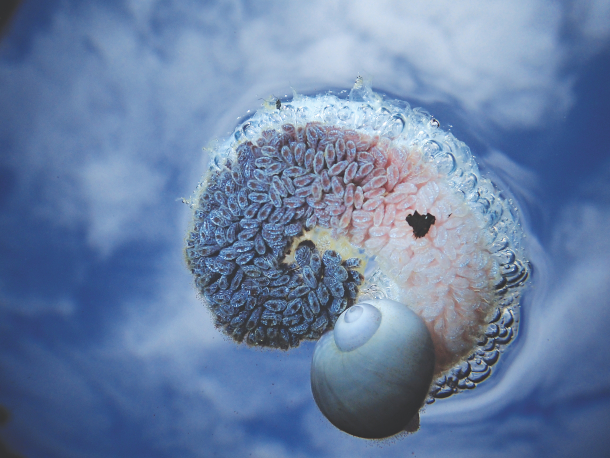
This image of a global bubble-raft shell was taken from below, looking up to the surface. This animal creates a stiff raft out of a stream of bubbles so it can float. They lay their eggs on the raft, too, and that’s what’s visible here: the darker eggs were laid first and have developed more than the newly laid pink ones.

Read Full Post »