Feeds:
Posts
Comments

Posts Tagged ‘dolls’

Photo: Suzanne’s Mom.

Dolls were an important part of my childhood, figuring prominently in what I called My Little House, a neglected corner of our third floor, and later in My Little School. So I was interested in recent research my husband saw about a role dolls can play in any child’s life.

Hannah Devlin reported at the Guardian, “Playing with dolls encourages children to talk more about others’ thoughts and emotions, a study has found.

“The research suggests that playing imaginary games with dolls could help children develop social skills … and empathy. The neuroscientist who led the work said that the educational value of playing with Lego and construction toys was widely accepted, but the benefits of playing with dolls sometimes appeared to have been overlooked.

“ ‘When children create imaginary worlds and role play with dolls, they communicate at first out loud and then internalise the message about others’ thoughts, emotions and feelings,’ said Dr Sarah Gerson, a neuroscientist at Cardiff University and the lead author.

‘This can have positive long-lasting effects on children, such as driving higher rates of social and emotional processing and building social skills like empathy that can become internalised to build and form lifelong habits.’

“The study, funded by the manufacturers of Barbie and published in the journal Developmental Science, involved 33 boys and girls, aged between four and eight who were given a collection of Barbie dolls and accessories such as an ambulance or horse to play with.

“They were left to play spontaneously, but their speech was monitored and they were also fitted with a specialized cap containing a form of brain imaging technology called functional near-infrared spectroscopy (fNIRS). The technique measures changes in blood oxygenation by shining light through the skull, which makes it possible to track brain activity while the subject is freely moving around.

“The study found that the children talked more about others’ thoughts and emotions, a concept known as internal state language, when playing with the dolls, compared with playing creative games on a computer tablet, such as a hairdressing game or a city-building game with characters.

“They were also more likely to address the dolls in the second person, talking to them directly, whereas the characters on the computer screen they tended to refer to in the third person. No difference was observed between boys and girls. …

“Benjamin Mardell, who researches the pedagogy of play at Harvard Graduate School of Education and who was not involved in the work, said: ‘The hypothesis that playing with dolls provides a scaffolding for young children to take the perspective of another, even if that other is inanimate, seems very reasonable.’ …

“Mardell added that the findings ought to apply to any kind of role-play toy, rather than being specific to Barbies. ‘I’d take a broader view of what a doll is,’ he said. ‘[It could be] any object that the child can invest a sense of other into – a stuffed animal, an oven mitt that talks to them, or even an imaginary friend.’

“Children typically start to show signs of internal state language around the age of four. At this age, they begin to voice their thoughts aloud, indicating that they are considering the thoughts, feelings and desires of themselves and others.

“ ‘These skills are really important for interacting with other people, learning from other people, and navigating a variety of social situations,’ Gerson said. ‘It becomes important for making and sustaining friendships, and how they learn from their teachers, and parents.’ ” More at the Guardian, here.

I’ll just add that dolls or “role-play toys” can be important to a child for other reasons, too. When I was a teacher, a mother told me about my student’s hostility to the family’s new baby. The girl was acting out (calling for help) when she kept throwing a baby doll off the dollhouse roof. I myself probably cherished dolls as substitutes for the baby that left our home when I was four. Long story. The point is that dolls become real little people to a child, and the thoughts and feelings experienced with the little people are important.

You might also like this NPR story on the importance of free play in preschool, here.

Read Full Post »

Photo: Sam Butler
“Two-year-old Lula-Belle Butler-Wenlock-Simpson, who was born with heart problems and underwent open-heart surgery, poses with a Special Friends doll whose scar mirrors her own,” explains PRI.

At Public Radio International (PRI), a distributor of some of my favorite shows, I recently learned about personalized dolls for children with disabilities and other big challenges. Bianca Hillier reported the story at PRI’s “The World.”

“Dolls have come a long way since the 1950s. One of the first TV commercials for Mattel Inc.’s Barbie doll sang: ‘Barbie’s small and so petite. Her clothes and figure look so neat.’

“While modern-day dolls aren’t confined to quite as rigid looks, the industry still has room to expand its inclusivity — especially for children with disabilities.

“That’s the challenge Victoria Band faced when her son was growing up. He is deaf in both ears and uses hearing aids. When he was younger, she wanted to give him a doll that also used hearing aids to show that he was not alone.

“ ‘When he went to his [medical appointments], he’d say, “Mommy, it’s a scary place at first. You don’t know what’s happening. You don’t know what [the hearing aids] are going to look like,” ‘ Band said. ‘So if [only] there was a doll there and they could say, “Oh, look, this is what you’re going to have in your ears. Look at all the different colors you could have.” ‘ …

“Band, who has always been crafty, started making her own dolls last year. She called the business ‘Special Friends.’

Working from her home in Dewsbury, England, she now makes dolls who have scars, cleft lips, hearing aids, oxygen tanks, or anything else that matches a child’s special needs. Many of the dolls are custom-made. …

“Band’s handmade dolls have since helped hundreds of kids, including a little girl named Lula-Belle who was born with heart problems and had open heart surgery at 14 weeks old. Lula-Belle is 2 years old now and has a scar down the middle of her chest. Her mom, Sam Butler, found out about ‘Special Friends’ on Facebook. …

“ ‘When she got her first doll, she was like, “Mommy, scar! Scar! Scar! Me scar, me scar!” ‘ Butler recalled. ‘And she pulled up her top. And she was matching scars with her baby.’ …

“Special Friends has been up and running for less than a year, but Band has already sent dolls beyond the United Kingdom to Germany, the US, and Australia. She says seeing the reactions come in from around the world is priceless.

“ ‘You can’t ask for much more than seeing a child really happy,’ Band said. ‘That’s worth more than anything.’

“Band added that the dolls can also be used as an educational tool to teach kids about medical equipment, surgeries, and conditions they may not know about. People need to be ‘more aware,’ she said, so that other children aren’t made to feel different in the first place.”

More at PRI, here.

Read Full Post »

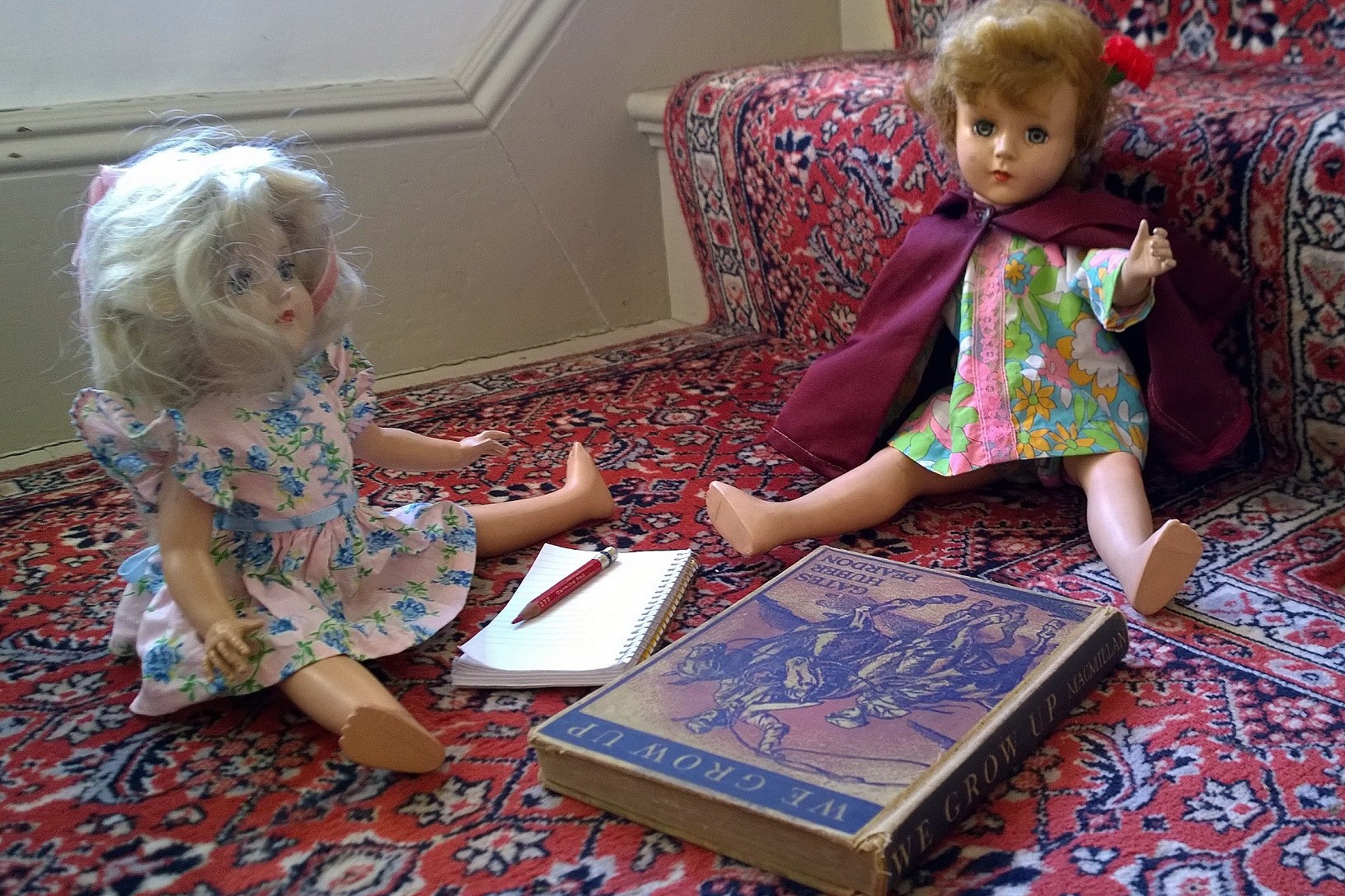
012518-dolls-from-my-childhood

Dolls that used to attend my “school.” I’m sorry to say that the book We Grow Up was pilfered from my second grade classroom.

On the third floor landing in the house where I spent most of my childhood, there was an alcove with a window and a couch. On nice days, the sun streamed in and revealed the perfect spot to set up a space of my own. I called it “The Little House” and hung signs around to indicate it was off-limits to everyone else.

In my space, which eventually evolved into “The Little School,” I set out all the toys related to keeping house or teaching school. The two pupils above I had received earlier. Susie, on the right, is still my favorite. She came into my life when I was 5. The cape is the original, but I don’t know what happened to the blue- and white-striped dress Susie arrived with, or her black shoes and white knee socks.

On the left is Toni, who when I was 7 brought along her hair curlers and styling lotion, courtesy of the Toni hair-perm company. I was an easy grader as a teacher but firm about hard work.

I suppose that whatever children most like to play with reflects their interests and is a way of practicing something grown-ups do that looks like it might be fun. I myself moved on from teaching dolls to using teaching as a camp counselor, a parent, an editor — and an actual teacher.

Nowadays, girls don’t seem to spend as much time with dolls, but nurturing remains a life skill worthy of being practiced by any child. When today’s small daughters enter the workforce (let’s say daughters for the sake of argument), will those engineering and truck driving jobs be the ones that are available? Young adults will probably invent new kinds of jobs, and who knows? Maybe nurturing will be useful in those fields, too. Certainly, there will always be a need for nurturing parents, caregivers, and teachers.

Read Full Post »

I moved from Rochester, New York, more than 30 years ago, so it was only when I went back for a visit that I got to see the storied collections of Margaret Woodbury Strong in a museum built to house them.

When one recovers from the enormity of her obsession, one feels deeply grateful for all the toys and dolls of one’s childhood so beautifully preserved.

The offerings and outreach of the museum have grown like topsy in 30 years. And today another new partnership was announced.

“The great minds of the toy industry will be honored alongside their famous creations when the Toy Industry Hall of Fame combines with the National Toy Hall of Fame under a partnership announced Tuesday.

“The 5,000-square-foot National Toy Hall of Fame gallery at the Strong museum in Rochester will undergo $4 million in renovations, with the goal of opening the combined hall in the fall of 2015.

“The Toy Industry Hall of Fame, whose inductees have included Milton Bradley, Frederick August Otto Schwarz, Walt Disney and George Lucas, has been without a physical presence for about eight years following the closure of the International Toy Center in New York City.

“Leaders of both halls have been talking for some time about combining the two as a way to raise their visibility and exposure and to promote their educational missions. …

” ‘The Strong is an ideal home for this homage to both the toys that have influenced generations of children and the innovative minds that brought them to life,’ Carter Keithley, president of the Toy Industry Association, said at a news conference at the Strong museum, where items like alphabet blocks, roller skates, the Frisbee, Lincoln Logs and the stick occupy places of honor.”

Read more at Yahoo, here. Click “like” if you believe in toys.

Photo: The Strong Museum
“The Strong’s founder, Margaret Woodbury Strong, had a particular interest in dolls and amassed one of the largest collections in the world. The National Museum of Play® at The Strong continues to refine and develop her collection, making it increasingly comprehensive and inclusive. It now includes more than 12,000 dolls and 2,800 paper dolls.”

Read Full Post »