Feeds:
Posts
Comments

Posts Tagged ‘dome’

Photo: Patrick Zachmann/Magnum Photos.
The real miracle: Reconstructing the intricate wood frame of Notre Dame’s roof.

When the unthinkable happens to a beloved cultural icon, what’s next? In the days and weeks after the great fire of Notre Dame Cathedral broke hearts around the world, plans began to take shape.

Joshua Hammer writes at GQ, “Some time after six in the evening on April 15, 2019, Rémi Fromont was sitting at the Brasserie Saint-Malo, a lively café in Montparnasse, Paris, when his phone rang.

“ ‘Notre-Dame is on fire,’ ” said a friend on the other end of the line. … Fromont leapt out of his chair, got on his bike, and pedaled north toward the cathedral. …

“About an hour after his arrival, Fromont, with thousands of Parisians at the scene and millions watching around the world, looked on as the 750-ton spire, made of 1,230 oak beams, blazed, teetered, snapped like a matchstick, and crashed through the roof. Spectators broke into tears of disbelief and horror. …

“The day after the fire, French president Emmanuel Macron made a promise: Notre-Dame would rise again in the next five years.  …

“None of the many priceless paintings, sculptures, and windows that filled the church’s interior — though they were stained by smoke and singed by fire — had been wrecked beyond repair. …

“The roof frame was a different story. Known in French as the charpente, it was an ingenious assemblage of triangular-shaped trusses, each one consisting of horizontal and vertical beams and diagonal rafters designed to support the heavy roof cover and distribute the weight over the walls beneath it. Built from thousands of pieces of wood and assembled without nails, it was a singular achievement, one of the oldest surviving all-wood structures in the world. …

“During World War I, German artillery shells had reduced the cathedral in Reims, another Gothic masterpiece, to charred wood and rubble. In 1919, the architect Henri Deneux launched the restoration, reconstructing the church’s roof with reinforced concrete, a decision that was controversial at the time.

“Fromont had not warmed to Deneux’s approach. He believed that the roof’s charpente could be rebuilt exactly as the medieval carpenters had done it. The approach was not without risks — Fromont had told me, ‘Wood burns. I’m not going to say the opposite’ — but certain measures could be put into place to mitigate its vulnerability.  …

“The roof’s charpente was perhaps [Notre Dame’s medieval woodworkers’] greatest creation. Yet Fromont told me that, until recently, it had never been the subject of serious scholarly study. …

“In 2012, Fromont, then a 35-year-old scholar at Paris’s École de Chaillot, decided to address that absence. For his advanced degree, Fromont proposed spending a year surveying every inch of the charpente. When they were at last granted permission, he and his partner on the project, Cédric Trentesaux, entered the cathedral’s south transept and climbed a winding staircase into the triangular south gable. There they squeezed through an aperture and entered a medieval realm barely visited in over 800 years. …

“The two men emerged from the project with the most extensive blueprint of the 800-year-old structure that had ever been created. ‘It wasn’t a lot, but it was enough,’ Fromont said. …

“There was some skepticism that the charpente could be re-created in its original glory, but Fromont found an ally in François Calame, France’s leading apostle of traditional carpentry. In the early 1990s, as a young carpenter, Calame had visited Maramures‚ a remote region in western Romania. Isolated from a fast-changing world during Nicolae Ceausescu’s 24-year dictatorship, artisans there had kept the old ways of carpentry alive.

“Like in Romania, traditional French axmen used hand tools: the hache de grossière, a long-handled, narrow-bladed axe used to remove large amounts of wood, and the doloire, a broad-bladed, short-handled axe designed for precision chipping following the grain of the wood. It’s slow and physical work: Squaring lumber by hand can take much more time than doing it with buzz saws. For that reason, by the 20th century, axes had all but disappeared as a construction tool. Yet their proponents extol the end result: more pliable, stronger beams, and imperfections that reflect the extensive labor and love of craft. ‘This is a kind of magical work because you feel the material,’ Fromont told me. ‘You smell it and touch it.’ ”

Read what happened next in Paris. The long and fascinating article is at GQ, here. No firewall.
Read Full Post »

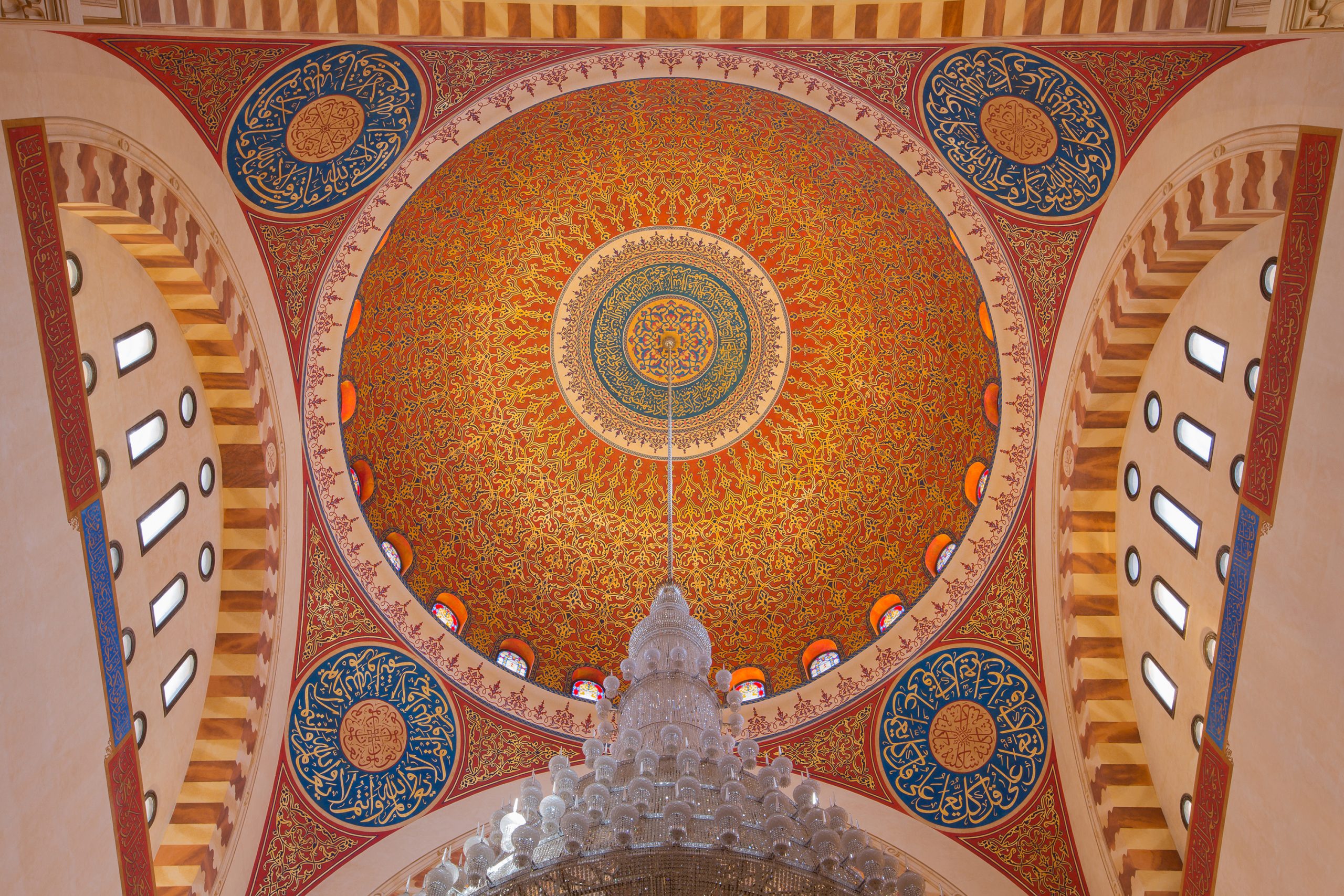
Photo: Harout Bastajian.
The Mohammad al-Amin Mosque, also referred to as the Blue Mosque, in downtown Beirut, Lebanon.

Some years ago, I read Jason Elliot’s fascinating book about his travels in Iran, Mirrors of the Unseen. One thing that stuck with me was his theory about caves and how they might have influenced Islamic art and the dome shape of mosques. I wrote about it before.

Today I chose an article on a man who is often called in to paint or repaint domes, both Islamic and Christian. His own theories are about which types of imagery are best for which sects.

Hrag Vartanian reports at Hyperallergic, “At the center of downtown Beirut is the prominent Mohammadal-Aminmosque, the largest mosque in Lebanon. …

“Inside is a stunning painted dome. It is the work of an artist who has gained a reputation as a leading painter of decorative ornament, particularly in mosques. What may surprise many people unaware of the rich cosmopolitan tradition of Islamic religious art is that the artist, Harout Bastajian, is not Muslim himself. When people ask him how a Christian is creating the decorative program of a mosque, he likes to answer, ‘God works in mysterious ways, brings us all together to decorate his house of worship.’

“He embarked on this artistic path back in 2004, when he was asked by the Hariris, a prominent business and political family in Lebanon, to decorate the newly inaugurated Hariri mosque in Sidon, Lebanon. …

“The journey into painting in sacred spaces has been inspiring for the artist. Not only has he painted the interiors of mosques but he’s also been involved in the restoration of Roman Catholic and Armenian Catholic buildings in Lebanon. He remembers his first mosque commission in Sidon well. ‘When I went in and saw the huge dome, which is like 900 square meters [roughly 9,687 square feet], I couldn’t sleep that night.

‘I was thinking, “How am I supposed to do this?” And then I was playing basketball in my backyard. I saw the basketball, the shape, how it’s divided. So I started thinking, how can I divide the dome and try to manage it?

” ‘And it was easy. Within two months I was able to finish the project with my team,’ he explains. … ‘I go through history, through different schools, and I try to come up with something somehow contemporary and work on it. And I will always use the golden ratio as a fundamental for my work. Regarding the colors, I don’t see one color. I always work with layers of colors.’ …

“He currently has a team of six or seven colleagues who work with him full time, and a graphic designer who helps organize the project plan since Bastajian doesn’t like to work with digital tools. …

“In the last 18 years, Bastajian says, he has painted 37 full and half domes, which translates into over a dozen mosques and many secular projects as far afield as Nigeria, the United Arab Emirates, Saudi Arabia, Kuwait, and Switzerland.

“ ‘[When] I did my first few mosques, I had to travel a lot and check other mosques in order to understand it all better. Then I took some courses in Islamic design and Islamic art [and] after a while it became part of me. I can see the end result only by doing the sketches and preparing the designs.’ …

“He conceives each project from the ground level, where visitors will experience the work, incorporating a mixture of geometric designs, along with vegetal and floral motifs, to create a rich web of patterns. ‘The shape of the dome itself, it has something divine in it because it’s circular. It doesn’t have a start or an end,’ Bastajian explains. ‘And the light that comes in from the windows, they call it the light of God. The dome itself, you feel that it’s flying, it’s something divine.’

“[The artist] is sometimes inspired by other works, such as the designs from the Topkapi Palace in Istanbul, which influenced his work for the al-Aminmosque in Beirut. He adjusts the designs according to the sect: Ottoman designs tend to work better for Sunni spaces, while Shia holy spaces tend to take their aesthetic cues from Persian-influenced styles and geometry.”

More at Hyperallergic, here. No firewall.

Read Full Post »

What happens to the buildings, some of them by great architects, after a World’s Fair is over?

Jade Doskow at Jade Doskow Photography wants to save them. She is part of a group that might save at least one.

From her website: “April 2014 marked the 50-year anniversary of the New York World’s Fair, part of which is the iconic New York State Pavilion, designed by Philip Johnson, one of the most revered architects of the last 100 years.

“Famously described by Ada Louise Huxtable as ‘carnival with class,’ the Pavilion is in serious need of renovation before it deteriorates further. In Doskow’s two large-scale photographs of the New York State Pavilion both the grandeur and the decay of this magnificent structure are readily apparent.

“People for the Pavilion (PFP) is a volunteer-run advocacy organization whose mission is to develop a vibrant community around the structure, and to ultimately preserve and develop a sustainable reuse plan for it.” More here.

Musée magazine writes that Doskow’s interest in the afterlife of World’s Fair buildings extends beyond New York: “Onishi Project Gallery presents Jade Doskow’s ‘World’s Fairs: Lost Utopias,’ for the 50th anniversary of the 1964 New York World’s Fair. Her seven-year project captures the memory of the fair by documenting the architecture and grounds left behind. The images hold a melancholy feeling about people and the spaces they no longer use, while displaying the fun atmosphere of the memories retained in these dormant structures.”

See Doskow’s photos of other World’s Fairs, including Buckminster Fuller’s dome in Montreal, here. 

Photo: Jade Doskow
New York 1964 World’s Fair, “Peace Through Understanding,” New York State Pavilion

Read Full Post »