Feeds:
Posts
Comments

Posts Tagged ‘dugout’

Photos: Avedis Hadjian.
Estonian canoe maker Mr. Ruukel works on his latest dugout canoe outside his barn in Tohera.

Today I want to share a lovely photo essay from the Christian Science Monitor about a canoe maker in Estonia. Be sure to click through and see all the pictures at the Monitor.

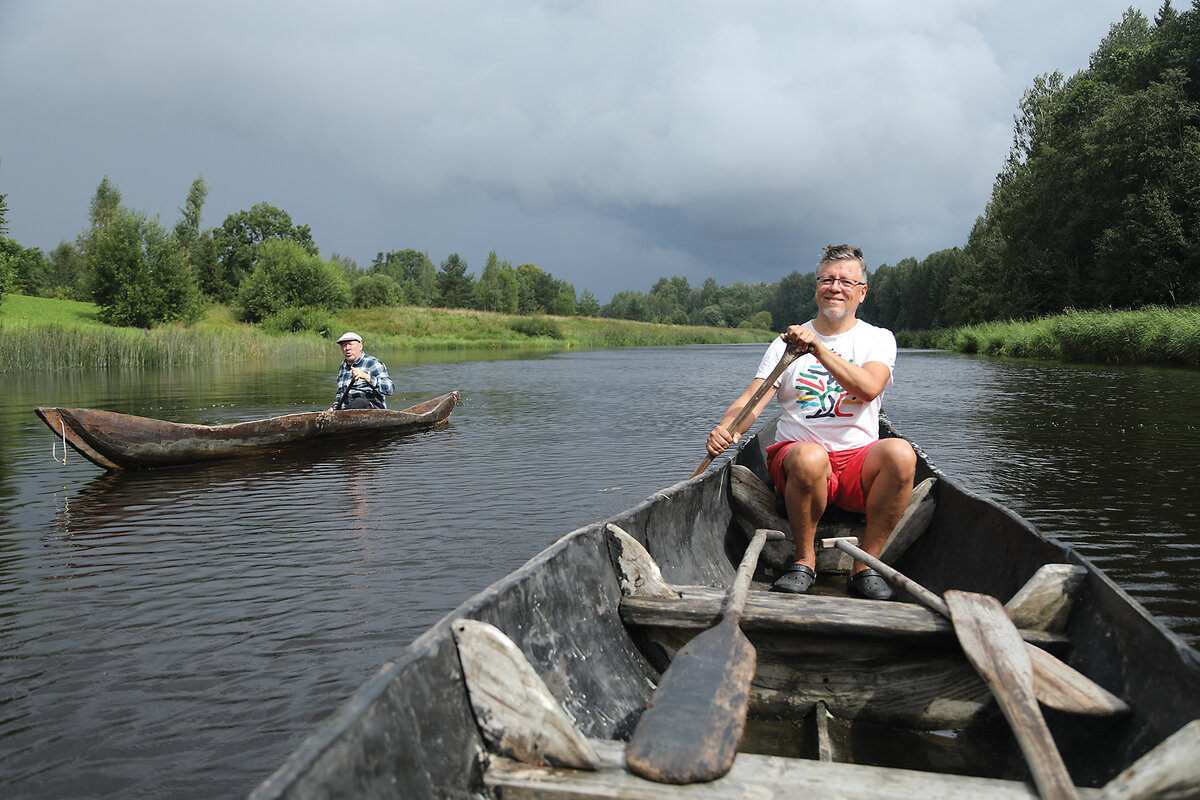
Avedis Hadjian writes, “Aivar Ruukel is one of the last five masters in Estonia who make the Baltic country’s traditional dugout canoe, known as a haabjas. Until the 1960s, it was the conventional means of transportation in the Soomaa, or ‘land of bogs,’ region during the spring floods, locally called the fifth season.

“Mr. Ruukel and Priit-Kalev Parts, another haabjas maker, are the most vocal advocates for preserving the tradition, which is threatened by the making of fiberglass or other modern – often motorized – boats.

“Both Mr. Ruukel and Mr. Parts learned their craft from older masters in the early 1990s, shortly after Estonia gained its independence from the Soviet Union, and are now trying to engage the new generation, training young apprentices in haabjas building. …

“On a gray morning, Aivar Ruukel is scouting for the ideal aspen in the Soomaa, a vast wilderness area in southwestern Estonia. The aspen is the preferred tree for making [the] traditional dugout canoe – an art that is now endangered.

“ ‘The ideal tree should have the shape of a pencil, but every tree is perfect in its own way,’ even if only a few can be used to build the boat, says Mr. Ruukel.

“Some of the trees are covered with black canker, a fungal infection. ‘You can’t make a haabjas out of them, but they are used by woodpeckers to make their nests, so they serve a higher purpose,’ he says.

“Mr. Ruukel is one of the last five masters in the Baltic country who make the canoes. Until the 1960s, it was the conventional means of transportation in the Soomaa [during] the spring floods. …

“Both Mr. Ruukel and Mr. Parts [train] apprentices in haabjas building. A skillful wielding of the axe to hollow out the tree is only part of the required expertise and techniques, which also involve expanding the trunk by filling it with water and then hanging it above a carefully controlled fire.

“What was a necessary means of transportation in the past has now become an Estonian identity marker. In 2021, haabjas building was inscribed on UNESCO’s List of Intangible Cultural Heritage in Need of Urgent Safeguarding.”

More at the Monitor, here.

In the “search” box at this blog, you can find several posts about Estonia, a country that’s interesting in more ways than one. (For example here, here, and here.)

Mr. Ruukel (left) and Jari Hyvönen, his brother-in-law visiting from Finland, paddle in canoes on the Pärnu River.
Read Full Post »

Photo: John Hart/ Wisconsin State Journal.
The State Journal reports, “A 1,200-year-old dugout canoe was raised from Lake Mendota [Nov. 2] by the Wisconsin Historical Society. The canoe … is the oldest intact boat ever recovered from Wisconsin waters.”

My Wisconsin brother sent me a cool article recently about the discovery of an ancient canoe. I suspect that blogger Rebecca Cunningham knows all about this as she lives in Madison.

Barry Adams at the Wisconsin State Journal has the story.

“Tamara Thomsen and Mallory Dragt thought they would take a spin under Lake Mendota on a couple of underwater scooters, motorized gadgets that scuba divers use to propel themselves through the water. It was a beautiful Saturday morning in June, and the duo, who work at Diversions Scuba, debated whether they had just seen a log sticking out of the bottom of the 9,781-acre lake or something extremely rare.

“The discovery, on a slope in 27 feet of water near Shorewood Hills, has turned out to be about as historic as it gets.

“After a bit of investigation, it turns out that Thomsen, who is also a maritime archaeologist for the Wisconsin Historical Society, was right in judging that it was more than just a log: It was a dugout canoe. A few weeks later, carbon-14 dating showed that the 15-foot-long vessel was an estimated 1,200 years old, the oldest intact boat ever found in Wisconsin waters.

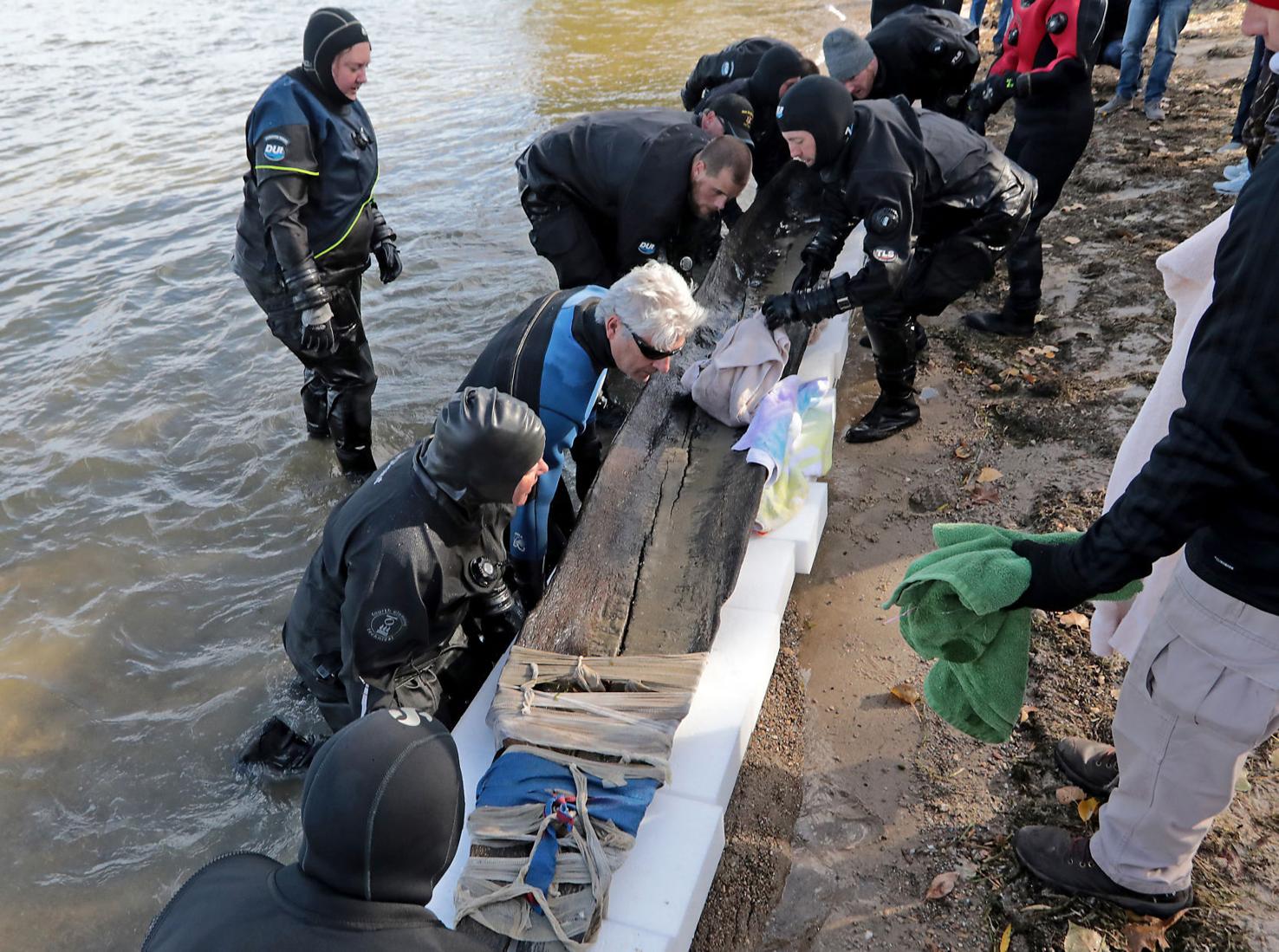
“On a brisk Tuesday, amid a chop of waves and 50-degree water, the canoe was brought to shore by teams of divers who shared fist bumps and hugs to applause from residents of the Spring Harbor neighborhood who had gathered at the beach to witness the canoe’s return to shore.

“ ‘This is the first time this thing has been out of the water in 1,200 years. And maybe they left from this very beach to go fishing,’ said James Skibo, Wisconsin’s state archaeologist. ‘Not only has it been underwater; it’s been under the ground. The reason it’s so well preserved is that it has not been exposed to the light. So that’s one of the reasons we have to start preserving it.

‘There’s living organisms on it that are chewing away on it as we speak.’

“The canoe will ultimately be displayed in the Historical Society’s proposed new and expanded museum on Capitol Square. But for the next two years, it will undergo a series of treatments. The first, in a 16-foot-long, 3-foot-wide tank at the State Archive Preservation Facility on Madison’s Near East Side, will preserve its liquid environment, although mixed in the water will be a biocide to kill any algae or microorganisms. That’s followed with a treatment of polyethylene glycol designed to replace the water that has saturated the wood.

“The process will make the structure more solid and stable, and prevent further degradation, said Amy Rosebrough, a leading expert on the Effigy Mound builders of Wisconsin, who likely made the canoe and inhabited villages and encampments around Lake Mendota and throughout much of southern Wisconsin. A cache of net sinkers, used to weigh down fishing nets, was also found with the canoe, which could have been made from basswood or a walnut tree, two common woods used for dugouts during that time frame.

“ ‘This is extraordinarily rare,’ said Rosebrough. ‘We really don’t have anything like this from Wisconsin. We have found pieces of dugouts before in various lakes (but) nothing this intact and nothing intact this old.’ …

“The people who built the dugout canoes in what is now Dane County were ancestors of the Ho-Chunk Nation. Typical techniques could have included using a combination of burning the inside of the canoe and using stone tools to scrape out the charred and soften remains. Bill Quackenbush, the Ho-Chunk’s tribal historic preservation officer, was on hand Tuesday to watch the dugout canoe emerge from the lake. The Ho-Chunk are referred to as ‘People of the Big Water.’

“ ‘When it comes to items of this nature, if it’s going to protect and preserve the history and culture of us in this area, we’re all in support of that,’ Quackenbush said of the canoe’s recovery. …

“The recovery effort began last week with divers carefully dredging around the canoe. Once sediment was removed and the boat fully exposed, rods of rebar were stuck into the lake bottom and a web of rope tied over the canoe to keep it in place.

“On Tuesday morning, a small armada of boats made their way to the site. … Thomsen drove [a] boat that included Randy Wallander, a volunteer diver from Manitowoc who has years of experience bringing up large objects from Lake Michigan. His equipment included large yellow floats, diving gear and four 45-pound bags of sand that were placed in the canoe to give it weight as it was towed into shore in a sling supported by the floats at just above idling speed. The 1-mile trip took nearly two hours, after which divers unhooked the canoe from a boat and walked it the last 100 yards or so to shore. …

“ ‘It was a team effort,’ Thomsen said. ‘I’m actually surprised at how smooth it went. You always expect for there to be problems and you anticipate the worst and hope for the best, but it came up faster than we thought. Everybody really danced together to make it come up.’ ”

More at Madison.com, here.

Read Full Post »