Feeds:
Posts
Comments

Posts Tagged ‘dye’

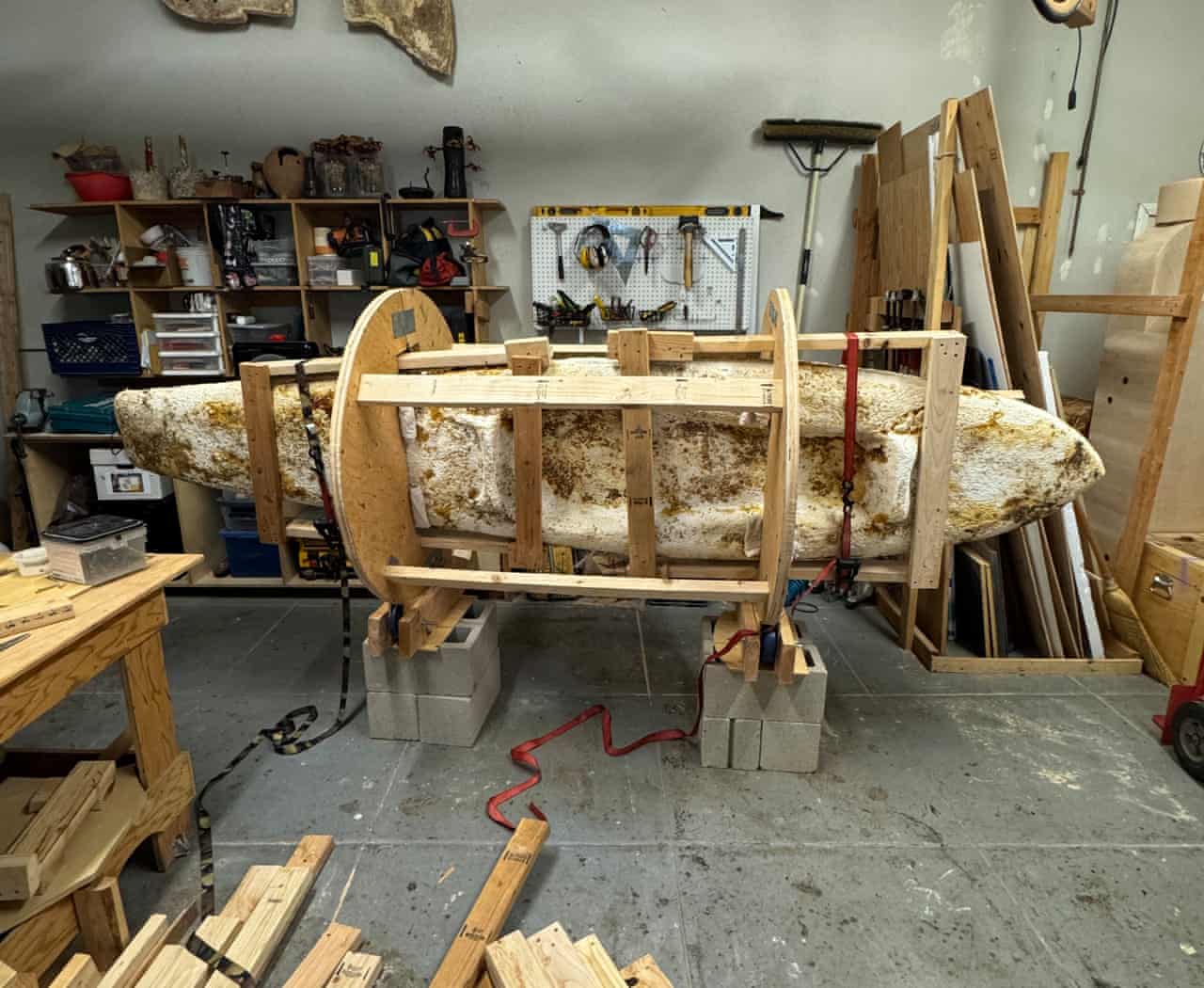
Photo: Jordan Freeman/Sam Shoemaker.
Sam Shoemaker made a kayak entirely from mushrooms.

Mushrooms! What next?

This week I chatted with Ann about a class where she learned to use mushrooms for natural dyes. And you may remember a post, here, about human caskets made from mushrooms.

But, wait! There’s more, says Open Fung, a nonprofit advancing the future of fungi-based technologies, materials, and the arts. Their latest endeavor: making a kayak from mushrooms.

Lisa Kwon reports at the Guardian, “On a clear, still morning in early August, Sam Shoemaker launched his kayak into the waters off Catalina Island and began paddling. His goal: to traverse the open ocean to San Pedro, just south of Los Angeles, some 26.4 miles away.

“But upon a closer look, Shoemaker’s kayak was no ordinary kayak. Brown-ish yellow and bumpy in texture, it had been made – or rather, grown – entirely from mushrooms. His journey, if successful, would mark the world’s longest open-water journey in a kayak built from this unique material.

“With his phone, GoPro camera, walkie talkie, and a compass affixed to his life vest, Shoemaker left shortly before 6am in order to avoid the worst of the swells in the forecast. But three hours in and powering through his ninth mile, the coastline still out of sight, Shoemaker began feeling seasick.

“Suddenly, he heard the sound of a large animal breaching the waters. To his left, a fin whale flashed its glistening tail, then trailed slowly behind him. As the 50-ft creature followed him for three more miles, Shoemaker found the strength to finish out the maiden voyage … which took him 12 hours.

“As he stumbled onto shore with his mushroom kayak still intact, the artist and mycologist embraced his friends and family. …

“Shoemaker began his career as an artist creating sculptures with propagated mushrooms. Upon returning to Los Angeles after graduating from Yale with an MFA in 2020, he began exhibiting artwork that captured the unique behavior of mushrooms as they grew out of hand-built ceramic vessels and blown glass. … Shoemaker now belongs to a small community of scientists and artists exploring the potentiality of fungal innovation as an alternative material that could be used in everything from kayaks and buoys to surfboards.

“Their focus is on mycelium … a pivotal connective tissue in the animal kingdom. Mycelium-based materials in an aquatic context are known as AquaFung, a term coined by Shoemaker’s mentor Phil Ross, an artist and the co-founder of a biotechnology company called MycoWorks that engineers mycelium-based materials including a mushroom ‘leather‘ that can be used in furniture, handbags and biomedical equipment. After cofounding MycoWorks, Ross cofounded Open Fung. …

“Ross argues that AquaFung has many of the appealing properties as plastic – such as being lightweight and buoyant – but without the harmful footprint. …

“Shoemaker began working on his first mycelium boat in 2024. …

He modified a used fishing kayak to serve as his fiberglass mold, then grew the mycelium network inside the mold …

“Shoemaker meticulously dried the resulting kayak composite structure using fans over the course of several months. …

“Confident in his prototype, Shoemaker began searching for appropriate support. Shoemaker met Patrick Reed, the lead curator of the Pasadena-based arts organization Fulcrum Arts, in December 2023 through mutual friends. After a studio visit, Reed was blown away by everything that the artist had to show him. … Shoemaker completed his second mushroom boat in June; grown from the same wild Ganoderma polychromum mycelium. …

“The completion of Shoemaker’s boat marks the second ever water-tested mushroom boat to be made after Katy Ayers, who holds the Guinness World Record for growing, then testing, what was then the world’s longest fungal mycelium boat on a Nebraska lake in 2019.

“ ‘A lot of people really didn’t think it was possible,’ says Ayers, who grew her boat after being inspired by a documentary called Super Fungi. …

“Ayers and Shoemaker credits mycology pioneers like Ross for making the technology more accessible. And mushroom-based materials are slowly beginning to pop up in the mainstream: In 2021, Stella McCartney made headlines with its launch of the world’s first-ever garments made from lab-grown mushroom leather, in consultation with Ross.”

More on the future of fungal materials at the Guardian, here. No paywall: Please consider offering some financial support to the Guardian.
Read Full Post »

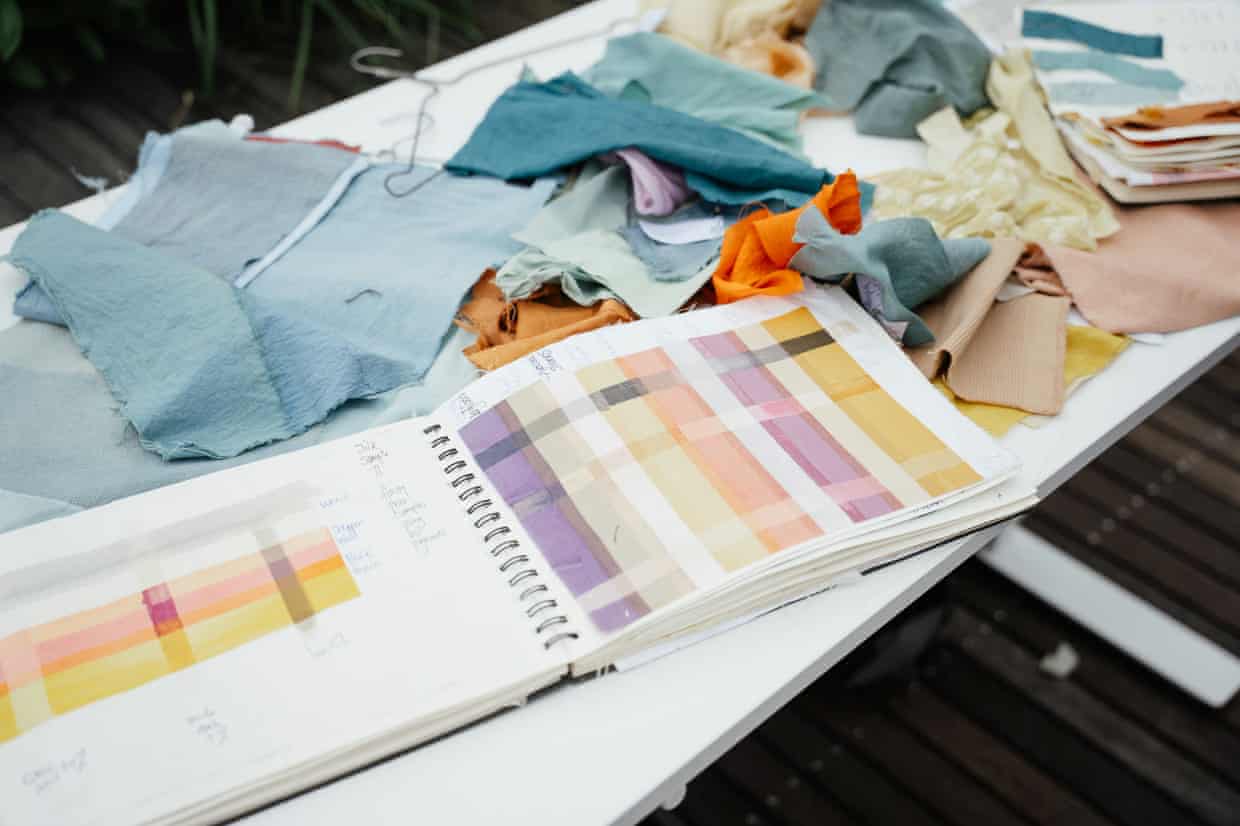
Photo: Rory Murphy.
Chemical dyes are often toxic for the environment and bad for human health, and that is why the National Theatre in London is planning to use natural dyes from a rooftop garden in its costumes.

My friend Ann is deep into using natural dyes for her textile art, and she even grows the plants that are used for those dyes. It is not just that she is concerned about all the synthetics in our environment, she loves the colors that nature produces.

In London, the National Theatre is on the same track.

Helena Horton  writes at the Guardian, “Squint at the roof of the grey, brutalist National Theatre on London’s South Bank and you might be able to spy a riot of color spilling from the concrete. This is the theater’s new natural dye garden, from which flowers are being picked to create the colors for the costumes worn in the theater’s plays.

“Chemical dyes are often toxic for the environment and bad for human health, so the costume designers at the theater are experimenting with using flowers including indigo, dahlias, hollyhocks, camomile and wild fennel to create the vivid colors used in their productions.

“The textile artist, Liz Honeybone, is buzzing with excitement about the opportunities the new garden is bringing. … She has been very concerned about the health impacts of using harsh, synthetic chemical dyes, which require users to be swaddled in protective clothing. …

“ ‘There used to be a thing called dyer’s nose, which is basically when the aniline dyes came in,’ Honeybone said, ‘They used to destroy your nasal membrane.’ …

“The theater is planning to use natural dyes from the garden in every production at the South Bank going forward, starting with Playboy of the Western World, which is on this autumn and winter.

“Claire Wardroper, costume production supervisor at the theater, said it was ‘a beautiful early 19th century piece, with lots of nice woolly jumpers, because it’s set in rural Ireland, and we can certainly get some nice colors into them.’ …

“They are trying to bring a gentler, more environmentally friendly way of dyeing into the mainstream. ‘We are saying that if you want to use this horrible synthetic dye, you can do that, but you can achieve this beautiful look by using a natural dye, and we can do it a little bit slower and a bit more sort of organically,’ said Honeybone.

“Wardroper added: ‘It’s unfortunate to say, but the theatre and film and anything creative in one-shot opportunity entertainment has a history of being incredibly wasteful.’ …

“Honeybone said: ‘It’s been such a good harvest. My indigo is more than I can cope with. I’ve got three shows going on at the moment, so I’ve had to recruit people to help me.’

“People may imagine the colors extracted from flowers will be muted compared with synthetic dyes, but Honeybone said this could not be further from the truth and she has been able to create neon greens and yellows. ‘Our forefathers were drowning in color. They loved it, it wasn’t hard to get and all the tapestries that were up on the wall were a riot of color. What we’re seeing now is the sad, faded leftovers,’ she said.

“Honeybone says she has become ‘obsessed’ with natural dyeing. ‘My daughter gave me a bunch of flowers on Mother’s Day, and I noticed there was some golden rod in it, so whisked that out and dyed with it just to see what it yielded. And it was the most glorious, strong yellow.’

“The garden is not only used for dyes but also as a refuge from the hustle and bustle of the theatre. The pair said actors were frequently seen pacing among the flowers, or sitting down on benches to learn their lines.

“The space is also a haven for wildlife. The grey concrete of the South Bank does not have a huge amount to offer pollinators, and they have been swarming to the garden to sample the nectar from the varied dye plants.

“Wardroper said: ‘We’re seeing so much more wildlife, like hummingbird moths, and we’ve got bees on the National Theatre roof which produce honey for the National Theatre. And they’re loving the variety of plants that we’ve planted as well. These are a new stock of plants that they just haven’t had access to. So the bee person that comes in and caters to the bees is very happy.’

“The pair hope that most if not all of the costumes at the theatre can eventually be produced using natural methods. But for now, Honeybone is enjoying the opportunity to start using these dyes.

“She said: ‘This is such an all round sensory experience, totally engulfed in the smells and the feeling. … It is just wonderful.’ ”

More at the Guardian, here. (Gotta love that someone in this earthy-crunchy field has a name like Honeybone and that Wardroper oversees the wardrobe!)

Read Full Post »

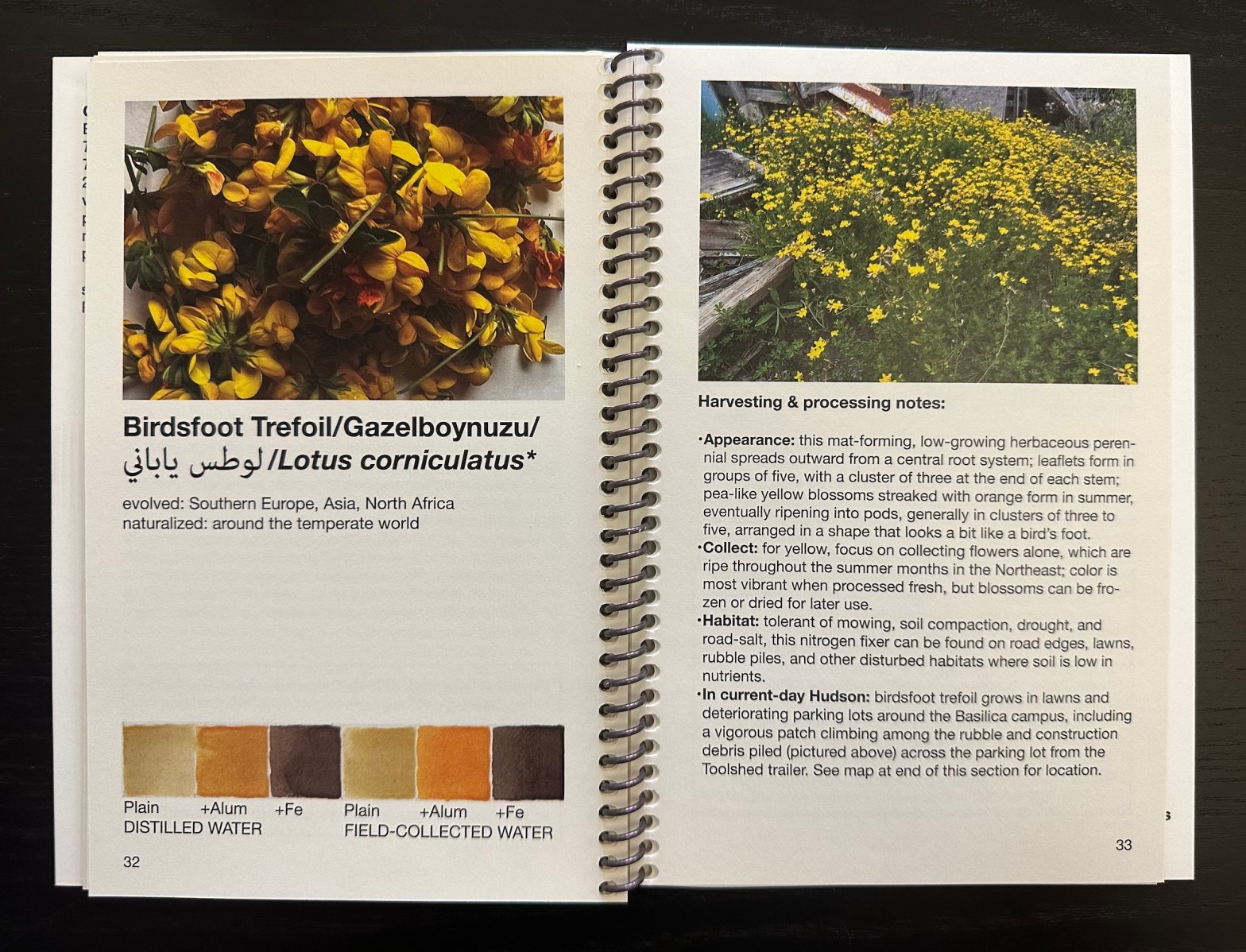
Photo: Lakshmi Rivera Amin/Hyperallergic.
Page spread from Feral Hues, a book by Ellie Irons on making your own paints.

Artistic types are going back to nature for pigments these days. My friend Ann grows special weeds and flowers to make dyes for her beautiful textiles. In today’s Hyperallergic interview by Lakshmi Rivera Amin, we learn about an artist making her own paints.

“Taking the concept of a ‘green thumb’ several steps further, artist Ellie Irons approaches plants as a literal source of color: She creates her watery paintings with pigments tinted by organic hues found in the natural world. These works … record, honor, and reorient our relationship to the vegetation around us, specifically in current-day New York State’s Hudson area.

“I picked Irons’s brain about the process of creating her own paints through harvesting on the occasion of her recent book, Feral Hues: A guide to painting with weeds (Publication Studio Hudson). This interview has been lightly edited for clarity.

Hyperallergic: What is the most joyful part of making your own pigments?
Ellie Irons: There are many joys, which is why I’ve been entranced by the process for so many years: an ever-deepening and shifting connection to urban ecosystems and the land that supports them that emerges through careful, considered harvesting practices; the smells, colors, and textures that reveal themselves when plant parts are processed by hand in the studio; the joy of sharing the process with other humans who also become entranced by the relatively simple act of lovingly harvesting often overlooked weedy plants and creating paint with them; the process of attuning to the cycles of vegetal life sprouting, growing, blossoming, fruiting, [dying] across the seasons and years — there is always something to delight in and harvest, in any habitat, even in deep winter. …

H: How has your practice evolved over the past several years?
“Irons: I would say recently, since maybe 2019, my work has become more locally rooted and grounded. In the decade before that, I found myself investigating plants across urban habitats in a global sense — comparing pokeweed and honeysuckle growing in a parking lot in Taipei with the same species sprouting from a concrete river in current-day Los Angeles, for example.

“I’m still fascinated by those global connections, and find them resonant and relevant, but in recent years my focus and my daily practice have shifted to be more bioregional — I take the Mahicanituck/Hudson River Watershed as a salient range in which to work, connecting with human and plant populations up and down the river from New York City to the Adirondacks. …

“This shifting focus is based on a range of factors, from my increasing discomfort with energy-intensive travel to my new(ish) status as a mother to my day job with a community science and art organization that focuses on hyper-local environmental justice issues, to of course, the ongoing impacts of the pandemic. There are other ways it has changed, of course — writing has become increasingly important to me, as has enduring land-based work (a result of living in a shrinking upstate city where access to soil and open earth is simpler than in New York City, where I started working with plants more than a decade ago).

H: What are your favorite plants to work and be in relation with, and why?
Irons: Perhaps unsurprisingly, I have many favorites, and feel fortunate regularly meet plants who are new to me — my loves change by the season, and across contexts. Right now, in early August, each morning I’m greeted by innumerable, intensely blue Asiatic dayflower … blossoms lining the border of my neighbors’ chainlink fence where it meets the sidewalk.

“The blossoms only last until noon or so, depending on the weather and the intensity of the sun. I take 20 to 30 blossoms most mornings, and store them in a small cup in the freezer, accumulating them until I’m ready to process them into a range of shades of blue.

“I love dayflowers for the way they become unmissable once they catch your eye, and draw you in. They have an unassuming stature, foliage that’s easy to overlook, but when they burst into flower for several hours each morning, the proliferation of electric blue petals — almost sparkling if you look closely — can feel like tiny jewels sprinkled along the sidewalk. …

“Having migrated to the American continent, they live well in cities, where they are sometimes appreciated as a ‘wildflower,’ and are gaining notoriety as a super weed in round-up ready soybean fields, where they’ve demonstrated resistance to the herbicide glyphosate. And in their native China they are being studied as a hyperaccumulator due to their ability to thrive on the polluted soils of old copper mines, absorbing large amounts of heavy metals. …

H: What do you hope anyone interested in approaching plants as material sources for art will first consider and reflect upon?
Irons: I hope people will keep in mind processes of gratitude and respect — of mutual exchange, rather than of taking to satisfy a material need. This can look many ways. Maybe even just asking yourself a few questions before harvesting: Who else might be in relation with this plant, human or more-than-human? What is the plant doing here and why? How long has this plant been here, will they be here tomorrow, or in 100 years?” 

More at Hyperallergic, here. No paywall, but subscriptions are encouraged.

Photo: Ermell/Wikimedia Commons.
Asiatic Dayflower, or Commelina communis.

Read Full Post »

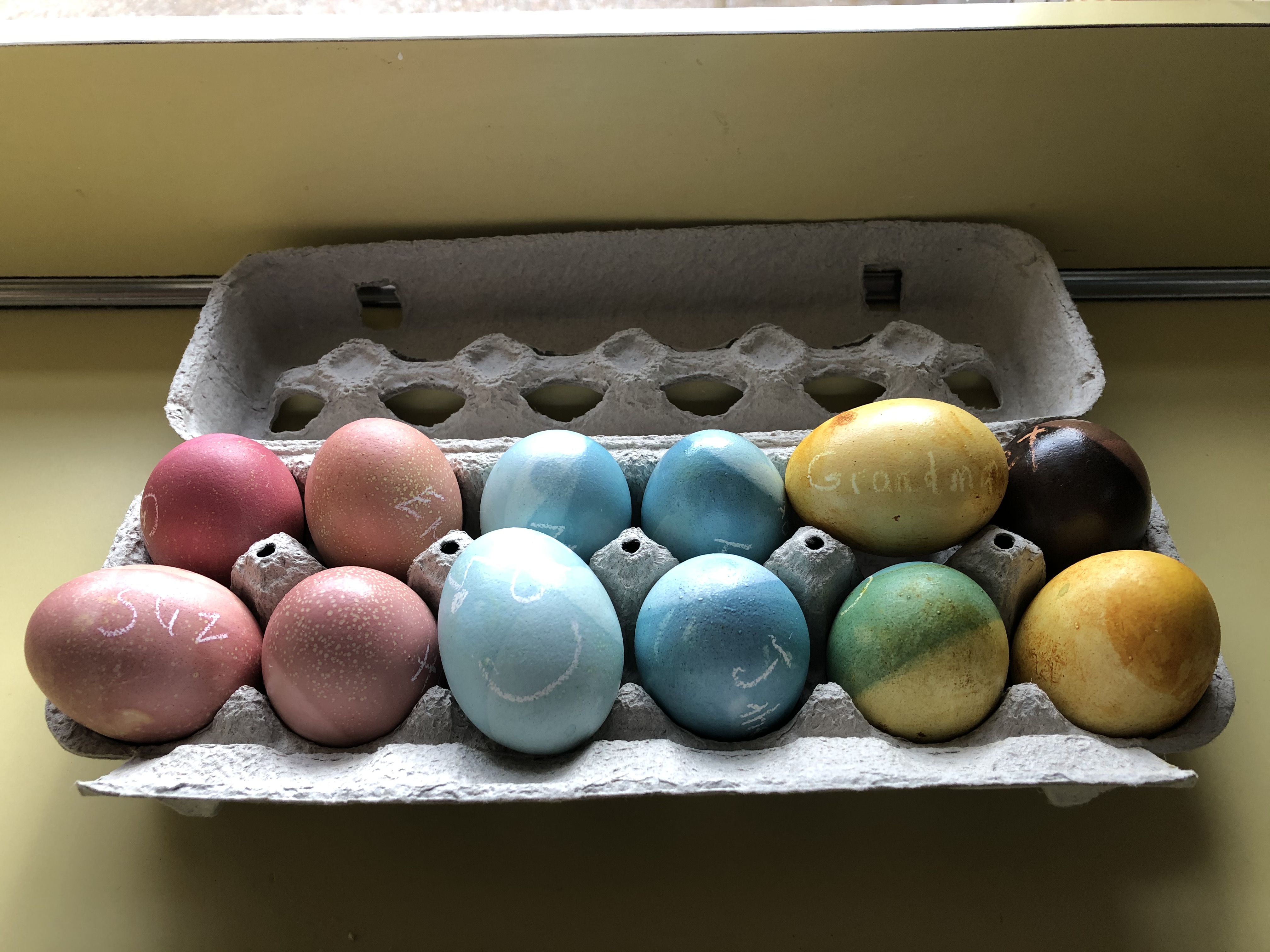
Dyes were made with cabbage, beets, and tumeric because there was a Paas kit shortage this year.

When I made an absent-minded mistake with the egg coloring this year, it occurred to me that misadventures at Easter are sort of a family tradition. For some reason, we like to try new things for this holiday. That’s good. But our adventures frequently lead to hilarious results.

I remember the time our Philadelphia niece and nephew were visiting, and we decided to make bunny cookies from a recipe Suzanne got at Girl Scouts. Barbara went to add milk. The recipe said 2 Tablespoons. She thought it said 2 cups — and, oops! How we laughed!

We turned the cookie batter into something we referred to as “fritters.”

The family has also had lots of experiments with egg-decorating. We’ve tried dipping two sides separately for two-toned eggs; blowing out the raw insides before marbleizing with oil paint floating on water in a bucket; and making Ukrainian wax-resist eggs. Even before John grew up and founded a company that involved visits to Ukraine and employing Ukrainians, he thought we could get Ukrainian egg-decorating instructions and just sit down and do it.

He sat down and did it. I have to say that experiment wasn’t bad.

But I want to tell you about 2021. After not going in a grocery store for a year, I was thrilled to enter at last, and I went looking for white eggs and the Paas coloring kits. The guy who was stocking announced with regret that there were no kits available this year, not even food coloring.

I was floored. But I remembered that one year we made egg dyes with vegetables, so I bought a red cabbage and a beet and went online. One website also suggested tumeric. In three pots, I boiled cabbage for blue, beets for pink, and tumeric for yellow. The tumeric was impossible to strain thoroughly in my strainer and made the yellow eggs all lumpy. (See above.) Plus I forgot the vinegar to set it. The shredded beets worked fine and we ate the leftover beets at dinner.

But I had to do the cabbage twice, and here’s why. The cabbage was the first ingredient I strained after boiling had created a dye. I held the strainer in one hand and the cooled-off pot in the other.

And in true Easter tradition, I poured the dye right down the drain!

Read Full Post »