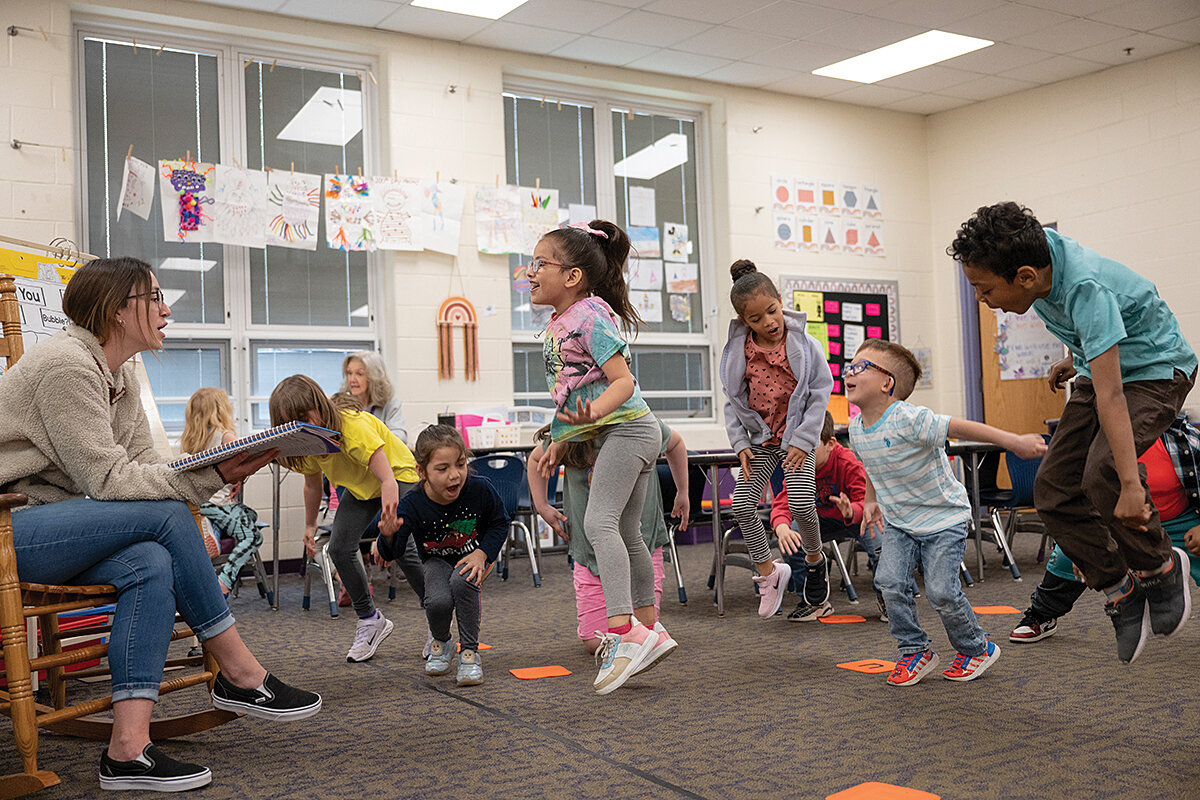
Photo: Riley Robinson/CSM Staff.
“Day-to-day work building trust in the community set the stage for defusing the culture wars confronting Middletown Ohio’s public schools,” says the Christian Science Monitor.
This is a story about a town that had just enough builders of goodwill to get the majority to focus on the things most people valued, agreeing to disagree about everything else constructively.
Courtney E. Martin reports at the Christian Science Monitor, “The police officer gives Marlon Styles’ driver’s side window two reassuring pats once he’s safely inside. Mr. Styles rubs his freshly buzzed head, takes a deep breath, and then fishes his keys out of his suit pants pocket and drives away from the school board meeting. It’s the latest he’s ever left – nearly 1 a.m. – and this time, unlike all the rest, he is not wondering how to get more community members involved. He is wondering how to grapple with a potentially toxic animus in his fairly harmonious town. The culture wars have just come home, and Mr. Styles, the first Black superintendent of Middletown, Ohio, has to figure out what to do. …
“In America, [many] school board meetings are broken. In cities and towns across the country, the public comment period has morphed into yelling, and sometimes even physical violence, over national hot-button topics like critical race theory (CRT), mask mandates, and basic recognition for transgender students. …
“Some public servants are preparing for more conflict by wearing state-of-the-art bulletproof vests to meetings. But there are others, like Mr. Styles, who seek out the protection of the oldest technology there is: trusted relationships. …
“Marlon Styles was chosen as superintendent of Middletown City Schools in 2017 by a school board that felt its district needed an infusion of innovative thinking. Only 15% of Middletown residents have a college degree. The current public school system serves about 6,100 students, slightly more than half of whom are white; nearly 19% are Black, and roughly 16% are Latino. Almost all of them qualify for the free and reduced lunch program. [Public] schools wind up needing to address a host of basic needs, plus plenty of untreated trauma, on a daily basis, without enough resources or recognition. …
“School board president Chris Urso explains: ‘We knew we needed a change. Trust had really fallen. We wanted a leader who was credible, creative, caring, charismatic, and had content knowledge. All the C words! And Marlon was the whole package.’
“Mr. Styles was born and raised in Cincinnati. … His older sister was the first in the family to go to college, something Marlon aspired to but it wasn’t a given. ‘I was never the smartest kid in class,’ he readily admits.
“He had a lot of energy, though, which he channeled into sports – basketball, football, and his favorite: baseball. Saturdays were spent at his maternal grandmother’s house; while eating Grandma Watson’s homemade vanilla ice cream at her kitchen table, he studied the art of relationships. Grandma Watson had a way of showing up for people, he says. If a family at the church lost their jobs or got a harrowing diagnosis, she would put out a quiet call and gather what they needed.
She wasn’t the type to give advice or offer life lessons. ‘Her body at work spoke about the heart she had,’ Mr. Styles remembers.
“When it came time to go to college, Mr. Styles did get in, but he spent two years in remedial classes at Eastern Kentucky University before graduating from Thomas More University. He figured if he taught, then he could coach, so he enrolled in a teacher prep program.
“He fell in love with the buzz of a classroom. Just like Grandma Watson, he liked sussing out what students needed and making it happen for them, motivating them, building them up. Eventually he earned a master’s degree and became a school principal. But Mr. Styles was rarely behind a desk. …
“His first mission as superintendent of Middletown City Schools was to ‘electrify the culture.’ The city of about 50,000 people has a reputation regionally for economic struggle and heroin addiction – once named one of ‘America’s fastest-dying towns’ by Forbes. …
“As he looked out on his nearly 400 employees during his first convocation, an idea popped into his head. ‘Pull out your cellphones,’ he commanded. ‘No really, pull them out! Now take a few selfies with your favorite co-workers smiling and having fun, and post them online with #MiddieRising.’
“The crowd erupted in giddy laughter and threw their arms around one another. Before long, the campaign #MiddieRising became a rallying cry for the whole city. …
“Mr. Styles also formed a committee of community members who volunteered to meet quarterly to hear briefings on Middletown schools. … Mr. Styles thought of them as his ‘positive gossipers.’ He explains, ‘Every time they left a meeting I would say, “Now go out and tell five people in your network something the district is doing to serve our kids.” ‘ …
“The pandemic was a strain on every community, of course, but Middletown City Schools, with Superintendent Styles’ indefatigable optimism and novel strategies for stoking morale, seemed to be mostly sticking together. Until Aug. 23, 2021.”
At the Monitor, here, read how the culture wars broke out in that meeting — first, over the issue of masking, then over everything else. Then read about all the people who came together to help the town find its balance again.
There were dark passages to traverse, particularly for the superintendent. You can’t tell people what to think, and some look at normal history lessons and believe it’s something called Critical Race Theory, actually taught only in colleges. “This woke CRT ideology is not education. It’s indoctrination,” shouted one person.
The Monitor “article was reported with support from University of California, Berkeley Greater Good Science Center for its initiative on intellectual humility.”


 Suzanne's Mom's Blog