Feeds:
Posts
Comments

Posts Tagged ‘ecuador’

Photo: Adri Salido.
From the Christian Science Monitor: “Elsa Cerda (with spear) leads Yuturi Warmi, a group of Indigenous women who guard against illegal mining in the community of Serena in the Ecuadorian Amazon.”

As a group of indigenous women in the Ecuadorian Amazon have shown, when something is wrong in your neighborhood, it pays to join with others and fight.

Al Jazeera wrote a good report on this last year.

“As a child, Leo Cerda would spend his mornings helping his family cultivate cassava, plantains and other fruits and vegetables in their chakra, a traditional garden in Kichwa communities.

“In the Ecuadorian village of Napo, traditions form a large part of family and spiritual life. At around 3 am each morning, before heading to their chakras, many families take part in a traditional tea ceremony. Once freed from his farming duties at around midday, Cerda recalled running to the river to swim and fish with friends. Fish would later be grilled on an open fire and eaten with large amounts of fruit.

“ ‘As a kid, I got to enjoy nature,’ Cerda told Al Jazeera.

“These days, however, the 34-year-old spends his days chasing gold miners from his community and campaigning against those who threaten to destroy his ancestral lands. …

“ ‘Within three years, everything changed,’ Cerda said. ‘The land has been poisoned. There are no more fish, except ones that are contaminated. People eat them, and they get sicker and sicker.’

“A recent study carried out in mining areas of the northeastern Andean foothills of the Ecuadorian Amazon, close to where Cerda lives, revealed high concentrations of toxic metals. They are up to 352 times above permissible limits established by environmental guidelines. …

“Mariana Capparelli, a researcher who contributed to the study, told Al Jazeera it was ‘very sad to see the conditions these communities are exposed to as well as the total degradation of an ecosystem that is so important for the entire planet.’ …

“Due to what critics say is an absence of sufficient government regulation, mining in Ecuador has led to environmental pollution and adverse effects on the health of Indigenous communities. In recent months, authorities have carried out several raids against illegal miners.

But with widespread state corruption and tip-offs given to miners, machinery is sometimes withdrawn immediately before police operations take place, activists say. …

“Ecuador has a national system of protected areas that aims to safeguard biodiversity and local ecosystems in national parks, wildlife refuges, marine reserves and other designated areas throughout the country. Although the government has taken some steps to protect local water systems, rivers have traditionally not been included in this system. …

“According to Andres Tapia, a spokesperson for the Confederation of Indigenous Nationalities of the Ecuadorian Amazon, illegal mining has become ‘uncontrollable’ in parts of the country. …

“ ‘I thought I would always be able to drink from this river,’ Eli Virkina, a member of an Indigenous Kichwa community in Napo, told Al Jazeera. ‘Now I’m at this point where maybe I shouldn’t even swim in the water. That is really heartbreaking for me.’ …

“Across Napo, Indigenous communities and organizations have been monitoring, mobilizing and resisting mining activities. To defend their land, they have formed alliances and connections across riverine communities, including the Amazon’s first women-led Indigenous guard.

“In February 2022, a landmark Constitutional Court ruling recognized the rights of Indigenous communities to have a final say over extractive projects that affect their territories. The ruling ‘offers one of the strongest legal precedents in the world, which upholds the rights of Indigenous peoples to decide on the futures of their ancestral territories,’ according to the Amazon Frontlines advocacy group.

“But in December [2022], the ruling was disregarded when the government approved a mining project in Las Naves in Bolivar province without gaining the consent of affected communities.

“In the meantime, Napo has installed four alarm systems around the village to signal when miners are close by.

“ ‘In our territory, spears were not used anymore, but now we have one in at least every house because it’s part of the way we have to defend ourselves,’ said Majo Andrade, a member of the female-led Indigenous guard Yuturi Warmi. …

“Virkina says Indigenous resistance is vital to the region’s future. ‘Once [Indigenous people] disappear, it is way easier for miners and people to come in and access the river,’ she said. ‘When we have stronger Indigenous communities, we have stronger forests and a stronger river.’ More at Al Jazeera, here.

Adri Salido has a collection of beautiful pictures at the Christian Science Monitor and adds a few more comments to the story of Yuturi Warmi: “Yuturi Warmi refers to a type of ant (Paraponera clavata) that will attack when an enemy enters its territory.

“The group, which formed in 2020, joined with other Ecuadorian and international organizations to urge the government to enforce laws against illegal extraction and to restore habitat. But officials have not acted, according to Yuturi Warmi. Since then, the group has worked to ensure that no illegal mining takes place in its community. It patrols the riverbank, conducts canoe inspections, and maintains constant surveillance. So far, it has kept intruders out of Serena. 

“The situation is far different upstream, in Yutzupino, where illegal extraction has destroyed the basin of the Jatunyacu River, a tributary of the Amazon River.”

More at the Monitor, here. No firewall. Great collection of photos.
Read Full Post »

Photo: Jennifer Junghans.
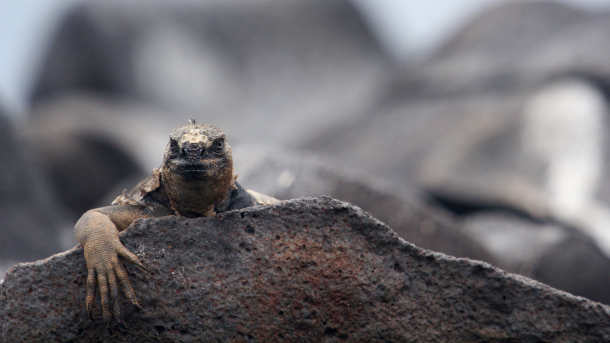
Jennifer Junghans had long dreamed of traveling to the Galapagos to swim with the marine iguanas. Today’s story is about her visit.

My college classmate Jean has purchased her ticket. She bought tickets for her daughters and grandchildren, too. They’re determined to kiss Covid good-bye this year and go see the magical Galapagos Islands.

So for Jean, here are some thoughts about what she might see, courtesy of radio show Living on Earth.

“Writer Jennifer Junghans had always dreamed of going to the Galapagos to swim with the marine iguanas. In 2017 she finally had her chance, and although the iguanas stayed high and dry, the experience brought her up close with blue-footed boobies and blacktip sharks, and face-to-face with a curious pufferfish. Jennifer shares her story of visiting ‘the remote wilderness of her dreams’ with Aynsley O’Neill, who spent a memorable summer studying in the Galapagos. …

“JENNIFER JUNGHANS: For as long as I can remember, I’ve dreamed of traveling to the Galapagos Islands to free dive with the ancient marine iguanas and roam the archipelago as Darwin did as he unraveled our story of evolution.

“He found little value in the marine iguana, insulting their physical appearance, intelligence and behavior. But I fell in love with them when I saw a photo in National Geographic of [marine] iguanas swimming underwater.

“I longed to be right there among them, these gentle giants that often look like statues on land armored in scales with faces that resemble a gentler cousin of tyrannosaurus rex, and snaggle-toothed spines that jut from head to tail, eyes that stare and large claws at the end of hands that look strangely like our own.

“Then, in 2017, I disembarked a small plane from Ecuador and stepped into the remote wilderness of my dreams. …

“Here, the animals are abundant and unafraid. In one startling panoramic view, blue-footed boobies dive like torpedoes into turquoise water.

“Sea lion pups with giant dark globes for eyes and sand all over their faces follow us as they wait for their mothers to return with food. And colossal numbers of my beloved marine iguanas bask in the sun to warm themselves. …

“At night when we anchor at sea, sea lions jump up to rest and sleep on the stern of our boat and we wait for black-tip sharks to appear just below the surface. …

“I gasp when they appear. Several have come and we peer overboard, the mystery of how big the next one will be or how close it will come or from which direction electrifies my senses. In their presence, Hollywood’s characterization of these beings as man-eating predators crumbles and I feel an undeniable resurrection of a connection once lost.

“Out here in the wilderness, … where the planet pulses according to its natural rhythms, it all makes sense.

“We take a long hike up rocky terrain to where Blue-footed Boobies have gathered to mate and raise their young. White puffs of down stretch their gaping beaks upward from beneath their mother’s wing and by the magic of serendipity, we witness the flamboyant courtship dance. …

“But it’s a tiny pufferfish that touches me most. Several swim up to me as I snorkel but one stays. She fans her fins, hovering right in front of me, observing me as intently as I observe her. We stay like this, face-to-face, for several minutes. I’ve never felt so acknowledged or seen. …

“As different as we look, transcending millions of years of evolution, we come from the same origin — in fact we share strikingly similar genomes with pufferfish — and something inside me innately knows it. 

“I never did swim with the marine iguanas as I’ve dreamed of. They spent most of their time basking on land even though they depend on the algae clinging to rocks in the sea, but my time here has given me something greater. Wandering among these wild animals at every turn, I attune to how life unfolds and exists when we are the visitor. …

“AYNSLEY O’NEILL: Thank you, Jennifer, I loved to hear that. I have to say I was extremely excited to get to speak to you, because coincidentally, I spent some time in the Galapagos Islands, in fact, during July of 2017, so we must have been there overlapping at the same time.

“JUNGHANS: Oh, my goodness! I wonder if we crossed paths?

“O’NEILL: [What] are the chances? I was very fortunate that I got to spend some time with each of the animals that you wrote [about], except for maybe the puffer fish. But I have to say, I love that you have an affection for the marine iguanas, because I do, too. … Maybe not the most captivating at first sight.

“JUNGHANS: I almost think they are! I tend to gravitate towards the underdog, always. And so when people see these creatures, and they, they think it’s ugly, or they don’t think it’s worthy of their attention, for me, I see beyond all of that immediately. … I know that there’s a being in their soul just like mine. I love them, so much!

“O’NEILL: I also loved hearing you talk about the sea lions who would jump up to rest near the stern of the boat. I didn’t spend that much time on boats unless I was traveling between islands. But right in front of the school that I was attending was the beach and they would all just come pop up there and hang out with us there.

“JUNGHANS: Yeah, it’s amazing because you are always reminded of the rules, to keep your distance from the animals, and stay away, and don’t touch them, and don’t encourage them. But at the same time, you often find yourself having to move away quickly because they’re following after you, or the sea lions are coming up and touching their noses to yours as you are snorkeling. … I was standing next to this whale skeleton that we had stumbled upon on a beach and my daughter was taking pictures of me and all of a sudden I felt this thing on my back. And it was one of the mockingbirds that had flown onto my bathing suit, crawled up my back! …

“We are used to seeing animals in zoos and aquariums and on television. But [when] you are on the Galapagos, you are witnessing this entirety of this being, and it’s in its natural place. You can sit and stay among them, and observe this kind of life. And we just, we rarely have the opportunity to do that. So it’s, it is wildly magical.”

More at Living on Earth, here. No firewall.

Read Full Post »

I got an intriguing tip from a WordPress blog, The Yoga Hub, about Yale students who found a microbe that eats plastic. The discovery spells hope for breaking down plastics in landfills.

Bruce Fellman writes in the Yale Alumni Magazine, “A group of student bioprospectors from Yale has struck environmental gold in the jungles of Ecuador. The students, through the annual Rainforest Expedition and Laboratory course taught by molecular biochemistry professor Scott Strobel, have discovered a fungus with a powerful appetite for polyurethane. That common plastic often winds up buried in landfills, where it can remain, largely unaltered, for generations.

“In the September issue of Applied and Environmental Microbiology, Jonathan Russell ’11 and his colleagues describe how they isolated, from plants collected during the class’s two-week spring trips, a fungus they identified as Pestalotiopsis microspora—and then discovered its unique polyurethane-digesting talents.” More here.

Sounds promising, but I can’t help worrying about the possible unintended consequences of introducing a microbe to places where it is not native. Maybe cutting back on plastics is still the way to go.

Photograph: Yale University

Read Full Post »