Feeds:
Posts
Comments

Posts Tagged ‘educational’

Photo: Andrea Tinker/Alabama Reflector.
A public tv fan holds up a sign during the Alabama Educational Television Commission’s meeting on Nov. 18, 2025, in Birmingham, Alabama. The AETC ultimately voted to maintain PBS programming through the end of the contract.

PBS is safe in Alabama. At least until June. And if viewers have anything to say about it, it won’t end there.

Andrea Tinker wrote at the Alabama Reflector in November, “The governing body of Alabama Public Television (APT) Tuesday voted to continue its contract with the Public Broadcasting Service (PBS), rejecting a proposal to end its agreement with the broadcaster.

“The commission voted 5-1 to continue the contract after a presentation from APT staff and in front of 50 people, many of whom spoke about the importance of public broadcasting in their lives. …

“Diana Isom, who attended the meeting, told the commission that PBS Kids programming had been invaluable for her son.  

“ ‘PBS is the reason my son is at a kindergarten level at three years old,’ Isom told the commission. ‘My son goes to an autism clinic; all of those kids watch PBS.’ …

“Two commissioners at October’s meeting suggested dropping PBS programming, citing the [administration] slashing the budget for the Corporation for Public Broadcasting (CPB) this summer and what one member of the commission characterized as ideological objections. 

“But the proposal drew sharp criticism from around the state, including over 1,400 emails to APT. …

“ ‘I think it’s important to stand up for quality education, quality programs for our children, especially in economic times such as these, not everyone can afford cable,’ … Julie Reese, one of the protesters, said.

In a letter sent Monday, Gov. Kay Ivey asked the commission to survey the public to see if disaffiliation with PBS had support, and then develop a plan to do so. Pete Conroy, a member of the AETC, passed a motion at the meeting to create a commission to study the issue, consisting of journalists and broadcasters. …

“APT Executive Director Wayne Reid said during the meeting if the station dropped programming it would be replaced by American Public Television, a non-profit syndicator that he said produces ‘complementary programming’ to PBS. But Reid told commissioners that if PBS programming stopped altogether, it could result in a drop in annual membership contributions of $2.4 to $2.7 million, hurting APT operations. …

“Reid said Tuesday the station received emails and phone calls and tags on social media expressing concerns about stopping PBS programs.

“ ‘I’ve been a fan of PBS since my children were little, and they’re now in their 50s. … Carol Binder, a Hoover resident who attended the meeting, said. ‘Now, I love everything on PBS. I have [PBS] Passport, and there’s hundreds and hundreds of programs, and it’s just not right for one, two or three people who don’t like the program to cut it off for everybody in the state.’ …

“Reese said she heard from other protesters that they wouldn’t continue to donate if programming was cut. ‘I just spoke to a gentleman down the corner. … He will not continue donating to APT if PBS folds, which is going to severely impact Alabama public television,’ she said.

“Following Reid’s presentation, Commissioner Bebe Williams made a motion to continue to pay the PBS contract and maintain programming which passed with only one commissioner, Les Barnett, voting no.

“Sens. Linda Coleman-Madison, D-Birmingham, and Rodger Smitherman, D-Birmingham, also spoke to the commission. …

“ ‘You may not be able to travel around the world. I have the opportunity now, but I’ve already been there with public television,’ Coleman-Madison said. ‘And the good thing about it, when I do go, I know where they’re telling me the truth or they’re giving me a snow job. It is trust. We trust public television because we know that the information we get in particular on PBS is going to be true, is going to be factual.’ …

“ ‘I think today really was a huge victory for the state of Alabama, victory for PBS and APT, although it needs constant attention and this is the beginning of a campaign and not the end,’ Conroy said after the meeting. 

“Reid said continuing the contract, which expires next June, gives APT a clear picture of what direction to go next. ‘I’m a business guy. … I don’t like to go back on contracts that we’ve signed.’ “

More at the Alabama Reflector, here. Where do you stand on public television?
Read Full Post »

molly_approved_custom-4fd4462a2c5abefc308739f14d767a277e2b1d4c-s600-c85

Photo: WGBH Educational Foundation
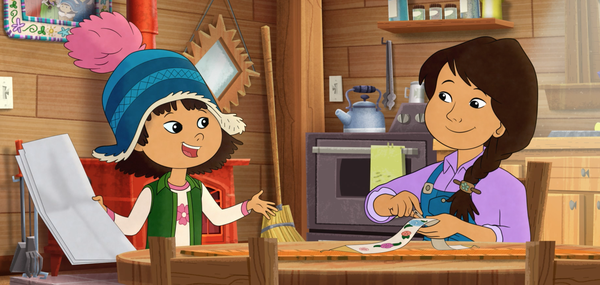
In the PBS program
Molly of Denali, Alaska Native Molly Mabray helps her mom run a trading post in an Alaskan village.

In the old days, TV shows meant to educate children tended to be dry and clunky. Sesame Street began to move the bar, and now my grandkids and other children are learning a lot from shows that are fun, like Wild Kratts and the Octonauts. They amaze me with the facts they produce to correct my misperceptions about nature.

Now they are giving a thumbs up to a new show about indigenous people in Alaska.

Mandalit del Barco wrote about it at National Public Radio (NPR), “For decades, animated children’s stories included negative stereotypes of Indigenous people. …

“More recently, Disney and Pixar got kudos for more authentic representations of Native people in the films Moana and Coco. Now, TV networks and streaming services are reaching children with realistic portrayals on the small screen — where they consume most of their media.

“The new PBS show Molly of Denali is the first nationally distributed children’s series to feature an Alaska Native lead character. She’s 10 years old; her heritage is Gwich’in, Koyukon and Dena’ina Athabascan. She lives in the fictional village of Qyah, population 94. She goes fishing and hunting, and also looks up information on the Internet and on her smartphone.

“Molly is computer-savvy,’ says the show’s creative producer, Princess Daazhraii Johnson. ‘I think it’s really important for us to show that, because we are modern, living people that are not relegated to the past. That stereotype, that romanticized notion of who we are as Native people, is rampant.’

“Johnson says when she travels, she still meets people who assume all Alaskans live in igloos and are Eskimos — ‘which isn’t a term that people really even use anymore up here,’ she says. ‘We have 229 federally recognized tribes in Alaska; we have 20 officially recognized Alaska Native languages here. We are so diverse and dynamic.’ …

“In one episode, Molly learns that her grandfather stopped drumming and singing as a child when he was taken away to a Bureau of Indian Affairs boarding school. ‘At the school we weren’t allowed to sing the songs from our people,’ an elder tells her. ‘We were made to feel bad about who we were.’

“Johnson says this storyline really happened to one of the elders on the show’s advisory board. It’s a kid’s show, so it has a happy ending: Molly and her grandfather sing together.

” ‘We’re just over the moon about Molly of Denali, because this is exactly the type of thing that can really began to shift perceptions in this country,’ [Crystal Echo Hawk, CEO of the media watchdog group IllumiNative] says.

“Echo Hawk says that for years, Hollywood didn’t produce stories about or by Native people because it didn’t think a market existed for them. But that, she says, was shortsighted. Her organization polled more than 13,000 Americans, and found that nearly 80% of them said they want to learn more about Native peoples. …

“For several decades, the Australian and Canadian Broadcasting Corporations have spotlighted shows by and about their indigenous populations. Now, Netflix is partnering with three Indigenous cultural organizations to develop the next generation of First Nation creators across Canada.

“And in the U.S. and in Latin America, Netflix is running the animated film Pachamama. The story centers on a 10-year-old boy in an Andean village who dreams of becoming a shaman. His people suffer under both the Spanish conquest and the Incan Empire.

” ‘It’s told from the point of view of the Indigenous people,’ says Juan Antin, who wrote and directed the film. … Antin, who is from Argentina, says he was inspired by his travels with his anthropologist wife in Bolivia and Peru. ‘There, I fell in love with the culture of Pachamama, which is how the indigenous people call Mother Earth, having respect, love to the Earth,’ he says.

“The Cartoon Network series Victor and Valentino features two half-brothers in a fictitious Mesoamerican village, exploring myths that come to life. For example, they follow the dog Achi into the land of the dead, where they encounter a chupacabra and other legends.

“Animator Diego Molano, whose heritage is Mexican, Colombian and Cuban, … says it’s about time networks began showing cartoons with Indigenous characters and themes. He just hopes it’s not just a fad.”

More at NPR, here, and at the New York Times, here.


Read Full Post »