Feeds:
Posts
Comments

Posts Tagged ‘efficient’

Photo: Jeremy Siegel/The World.
A Tokyo Metro train during rush hour.

Tokyo seems to have found better ways to get around than by car. Public transit can get crowded, of course — it would have to in a city of that size — but many thoughtful touches make it all run smoothly, with less stress for the traveler. And the travelers contribute with good transit behavior.

As Jeremy Siegel reports at Public Radio International’s The World, “At Tokyo’s Ebisu train station, the first thing passengers hear upon arrival is the theme music from the 1940s noir film, The Third Man

“Every train stop in the city has distinctive jingles, subtly and efficiently letting people know where they are and when to get off. 

“In Tokyo, every little way you can make things run more smoothly counts, according to Tomohiko Taniguchi, a former rail executive and adviser to former Prime Minister Shinzo Abe.

“It includes individual station songs; having train employees literally stuff passengers into train cars during rush hour; and enforcing a unique set of unspoken rules for how passengers should act.

“ ‘One of the first things you might have noticed is that people are dead silent in busy trains and crowded trains,’ he said. ‘It is to make [as little] annoyance as possible.’

“Despite a population of 37 million, there’s relatively little congestion and pollution here since the majority of its residents rely on public transit rather than cars. But while Tokyo’s mass transportation system may serve as a global success story, it may not be replicable, because its organic growth over the decades has fostered a unique culture of transit.

“Taniguchi said that he has been taking the train his whole life. After decades of observing Tokyo’s system, he said, he’s come to the conclusion that in many ways, life in this city revolves around trains. …

“The busiest train station of all, with 3.5 million people passing through every day, is Shinjuku station where Hari — who only provided her first name — met a friend on a recent Tuesday evening. Hari said that she [loves] Japanese transit. Despite the fact that she can drive, she hasn’t since moving to Tokyo.

“ ‘The train is just more convenient,’ she said. …

“Japan’s culture of transit can be traced back to the late 1800s, according to Fumihiro Araki, deputy director of The Railway Museum, which houses dozens of old trolleys, rail cars and bullet trains.

“ ‘When Japan moved from a shogun government [with leaders who were emperor-appointed] to a democratic government in the late 19th century, it was decided that railways were absolutely necessary,’ he said.

“The idea was to keep up with Western countries, many of which were growing — and railways played a big part. But after World War II, the US and European countries began throwing money at highways. Japan, which was rebuilding from the war’s destruction, doubled down on trains.

“The country made massive investments in transit, which coincided with a population boom in Tokyo that allowed the train system to grow organically alongside the city. Additionally, they felt it was easier to build railways because of the mountainous terrain, and because the country itself isn’t as spread out as, say, the US. …

“ ‘In other countries, a railway is just a railway. It’s just a place to ride on the train,’ said Shunzo Miyake, who heads up international affairs at the country’s largest railway company, JR East. 

“Miyake, who has visited 40 different countries, said that he believes that the difference has to do with how Tokyo rail operators compete for passengers. They even develop real estate around stations to turn them into economic hubs — places where people want to stay after they get off the train.

“In fact, busy stations like Shinjuku and Shibuya feel like city centers in and of themselves. People can spend an entire day finding hundreds of restaurants to dine at, places to shop at and bars to drink at, virtually without ever having to leave the station. …

“Miyake said that developing Tokyo’s system, and ingraining transit into the city’s culture, has taken time and money. But for companies like JR East — and the many residents who don’t have to contend with traffic — it’s paid off.”

More at The World, here. I highly recommend this show, which I listen to online at GBH.org. It offers voices from around the world that you rarely hear on US media — and often a more positive perspective.
Read Full Post »

Photo: Jacob Posner/Christian Science Monitor.
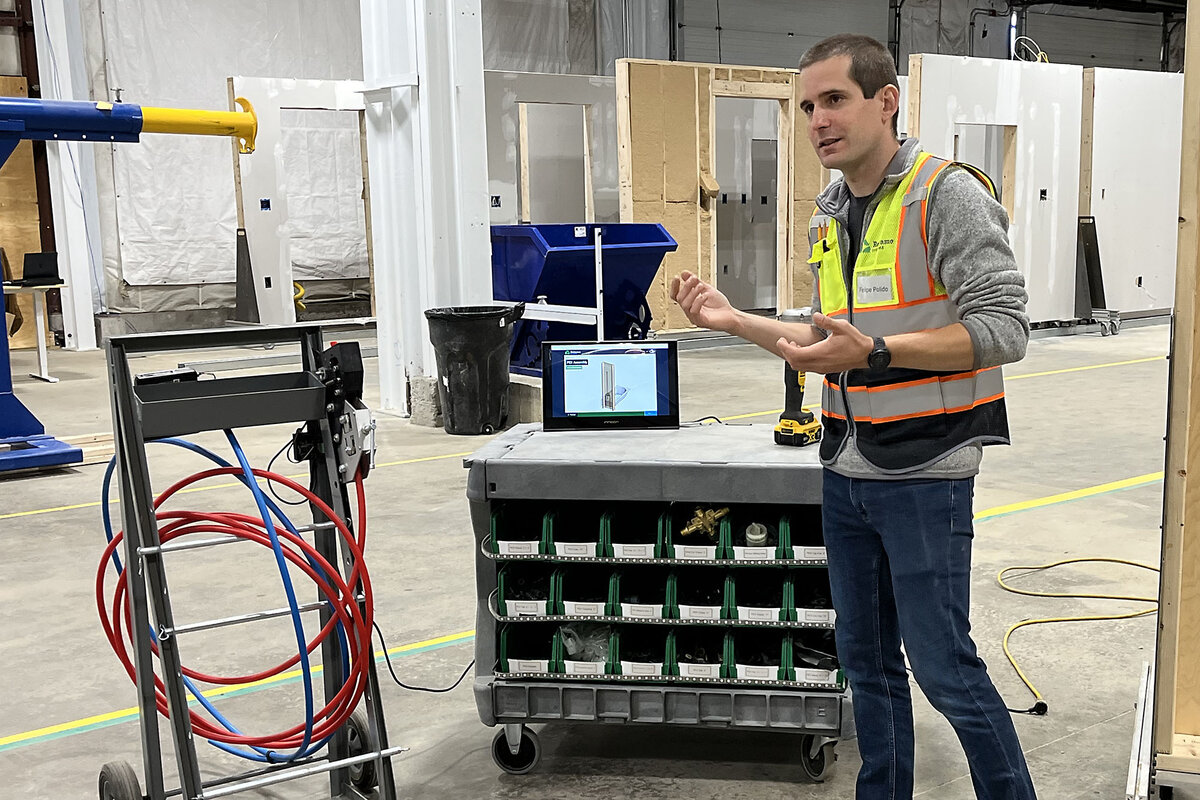
Felipe Polido, co-founder and head of technology at Reframe Systems, explains how the company uses robots and simplified processes in construction.

Innovations of the kind we continue to need in areas such as medicine, housing, and carbon reduction will probably rely more on entrepreneurs and businesses than on government for years to come.

I won’t be the one to begrudge any visionary a reasonable profit. In fact, the only thing that worries me about today’s story is the reduced need for human workers. See what you think.

Jacob Posner writes at the Christian Science Monitor about one company aiming to do so by benefiting others.

“A growing number of startups are trying to reinvent the U.S. homebuilding industry, with big goals of making it both more efficient and more climate-friendly. It is a disruption that many say is past due. The construction industry is not only struggling to meet housing needs but also is one of the country’s largest emitters of greenhouse gases. …

“Massachusetts-based Reframe Systems is among the new companies hoping to change one of the nation’s largest industries. Reframe is developing a ‘next generation’ modular construction method to build high-efficiency housing. Employees follow instructions on iPads to install plumbing and electrical components into robot-made walls, then transport these modules to construction sites, where they are stacked into multifloor units.

“But the challenges are myriad. Despite a huge influx of investor funding, the share of housing stock built through high-tech modular construction remains small. …

“[Recently a crowd] gathered to see a robot build a house. In a concrete-and-steel factory in Andover, Massachusetts, yellow-vested consultants, sustainable builders, and possible investors strain to see past a clear fence. Behind the barrier, a giant blue arm jutting from the floor comes to life.

“Its sensor-covered hand analyzes a pile of wood before emitting a loud hiss, then carefully suctions a two-by-four. Rotating at the shoulder and extending its elbow, the robot methodically delivers the plank to a partially completed wall.

“On the other side of the factory – about the size of a hangar for small planes – a few human workers are on their lunch break. They are employees of a three-year-old company called Reframe Systems, which is one of a growing number of startups across the United States scrambling to reinvent the homebuilding industry. …

“More than 100 startups have entered the industry in the past two decades, according to estimates by Tyler Pullen, a senior technical adviser at the Terner Center for Housing Innovation at the University of California Berkeley. He says there are likely more than 200 construction innovation companies currently doing business in the U.S.

“Like many of these, Reframe is focused on a new form of modular construction to upend one of the county’s largest industries. The company aims to create affordable, net-zero houses, which generate the same or more energy than they consume. Reframe CEO Vikas Enti says he can deliver a hefty return to investors – all while making a significant dent in the housing and climate crises. The next step, he says, is to build a factory that can produce 500 apartment units per year using lessons learned from his small, pilot factory in Andover. Then, he hopes to build a network of facilities across the country, varying their sizes to meet the demands and needs of their region. …

“So far, Reframe has completed one two-bedroom house. …

“The current model for modular construction – using assembly-line technologies to build homes – has its origin in the period after World War II. … But federal support for the movement dwindled, and in recent years, modular construction companies have mostly focused on the luxury housing market and sustainability-focused buyers. …

“The need for companies like Reframe is clear, modular boosters say.

“Energy consumed by residential buildings is responsible for around 15% of all U.S. emissions. Fossil fuels warm most of the country’s roughly 145 million apartment units and houses, in addition to keeping their stoves running and heating water. …

“Reframe was founded by roboticists who used to work at Amazon. Following instructions on iPads, its human employees insert plumbing and electrical wiring into the robot-made walls, turn them into ‘modules,’ and bring them to construction sites, where they are stacked into multifloor, highly energy-efficient homes. Because the iPad instructions are akin to a Lego or Ikea manual, Reframe can employ fewer high-cost, high-skill laborers.

“Having most of the needed professionals – electricians, plumbers, architects, engineers – under the same roof solves a problem of communication Mr. Pullen sees as endemic to the traditional construction industry. Every different professional involved must work together, but they are all ‘masters of their own kingdom,’ he says.

“While not all companies offer net-zero buildings like Reframe, Mr. Pullen says building in a factory setting lends itself to tighter structures that hold their temperature better. Plus, factory construction results in less waste. Companies know what they need to order for hundreds of projects at once; in traditional building, ad hoc orders require far more trucks and often leave behind excess material like piping and drywall.”

More at the Monitor, here. No paywall.

Read Full Post »

Photo: Thomson Reuters Foundation/Rina Chandran
A small farm on top of a mall grows herbs and leafy greens in a high-tech urban farming model that could improve Singapore’s food security.

As agricultural land becomes more scarce around the world, we can all learn from the way tiny Singapore is using rooftop gardens to help feed the population.

Rina Chandran at Reuters writes, “Visitors to Singapore’s Orchard Road, the city’s main shopping belt, will find fancy malls, trendy department stores, abundant food courts — and a small farm. Comcrop’s [6,450-square-foot] farm on the roof of one of the malls uses vertical racks and hydroponics to grow leafy greens and herbs such as basil and peppermint that it sells to nearby bars, restaurants and stores. …

“Comcrop’s Allan Lim, who set up the rooftop farm five years ago, recently opened a 4,000-square-metre farm with a greenhouse on the edge of the city. He believes high-tech urban farms are the way ahead for the city, where more land cannot be cultivated. …

“Singapore last year topped the Economist Intelligence Unit’s (EIU) Global Food Security Index of 113 countries for the first time, scoring high on measures such as affordability, availability and safety.

“Yet, as the country imports more than 90 percent of its food, its food security is susceptible to climate-change and natural resource risks, the EIU noted.
With some 5.6 million people in an area three-fifths the size of New York City — and with the population estimated to grow to 6.9 million by 2030 — land is at a premium in Singapore.

“The country has long reclaimed land from the sea, and plans to move more of its transport, utilities and storage underground to free up space for housing, offices and greenery. …

“Urban agriculture currently produces as much as 180 million metric tonnes of food a year — up to 10 percent of the global output of pulses and vegetables, the study noted. Additional benefits, such as reduction of the urban heat-island effect, avoided stormwater runoff, nitrogen fixation and energy savings could be worth $160 billion annually, it said. Countries including China, India, Brazil and Indonesia could benefit significantly from urban agriculture, it said.

” ‘Urban agriculture should not be expected to eliminate food insecurity, but that should not be the only metric,’ said study co-author Matei Georgescu, a professor of urban planning at Arizona State University.

” ‘It can build social cohesion among residents, improve economic prospects for growers, and have nutritional benefits. In addition, greening cities can help to transition away from traditional concrete jungles,’ he said. …

“At the rooftop farm on Orchard Road, Lim looks on as brisk, elderly Singaporeans — whom he has hired to get around the worker shortage — harvest, sort and pack the day’s output.

” ‘It’s not a competition between urban farms and landed farms; it’s a question of relevance,’ he said. ‘You have to ask: what works best in a city like Singapore.’ ”

The article was reprinted by the World Economic Forum and can be found here. One weird thing about this story: There are still small farms in the countryside, but they are not as efficient as the rooftop gardens and will be cleared — to give the land back to the military. Now, that is truly bizarre.

Read Full Post »

I’m grateful to Scott, a former colleague, for putting this cool thing on Facebook. Looking at these healthy, growing plants is especially warming today, now that the temperature has gone back to 15 F.

Tim Blank at Future Growing LLC (which produces vertical aeroponic food farms) writes, “When you hear about a farm that supplies all-natural, sustainable produce, using 90% less water and 90% less land, one that utilizes the most advanced vertical aeroponic technology on earth, you surely would not guess it would be an Amish farm.

“Yet in Topeka, Indiana, you cannot get produce that is more local, fresh, healthy, and sustainable — even in the middle of an Indiana blizzard — like you can get at Sunrise Hydroponics, an Amish farm.

“Sunrise Hydroponics is owned and operated by husband-and-wife team Marlin and Loretta Miller on their rural farm in Topeka. I have had the privilege of working with the Amish community for more than half a decade, and have come to learn that, while their lives seem simple to many outsiders, their homes, farms, and businesses are highly innovative. The Amish utilize cutting-edge and creative forms of technology to improve their lives, while still falling within the guidelines of their belief system.” Read more here.

Greenhouse at Sunrise Hydroponics

Read Full Post »