Feeds:
Posts
Comments

Posts Tagged ‘el salvador’

Photo: J. Przedwojewska-Szymańska / PASI.
The head of the male figurine is decorated with tattoos or scarification. Made between 410 and 380 B.C.

Here’s a story to tickle the frustrated archaeologist in you. I say “frustrated” because I’m not aware of any actual archaeologists who follow this blog, but many of us find the mysteries of of the field fascinating.

Sonja Anderson wrote recently at the Smithsonian about the excavation in El Salvador of “puppets that resemble modern toy dolls” with movable parts. They look like humans, but creepier.

“Researchers have discovered a trove of ancient clay puppets at an archaeological site in El Salvador, ” Anderson reports. “The five carved figurines are about 2,400 years old, and they may help shed new light on an ancient Mesoamerican society.

Jan Szymański and Gabriela Prejs, two archaeologists from the University of Warsaw, discovered the artifacts atop a ruined pyramid at the site of San Isidro. As they write in a new study published in the journal Antiquity, the items are known as Bolinas figurines: rare puppet-like artifacts that have been found in other ancient Central American sites, such as the early Maya site Tak’alik Ab’aj in Guatemala.

“All of the recently discovered Bolinas figurines have open mouths. The two smallest puppets measure around four inches and seven inches, while the other three stand at about a foot tall. These larger figurines have detachable heads and small holes in their necks and craniums. As the researchers write, this allows for ‘a string to be passed through the neck and tied on the top of the head.’ …

“Compared with neighboring countries, El Salvador’s pre-Columbian history is poorly understood, according to a statement from Antiquity. Excavations are challenging due to the country’s high population density, and volcanic eruptions over thousands of years have damaged and buried archaeological sites.

“ ‘Very little is known about the identities and ethnolinguistic affiliations of the creators of ancient settlements that predate the arrival of Europeans in the early 16th century,’ Szymański says in the statement. ‘This gets worse the further back in time we look.’

“The San Isidro site is a complex of mostly clay structures built by an unknown group, and it remains largely unexcavated. The researchers found the Bolinas figurines while digging at the top of the site’s largest pyramidal structure. Through carbon dating, they’ve concluded the five figurines were made between 410 and 380 B.C.E. [Before Current Era].

“ ‘This finding is only the second such a group found in situ, and the first to feature a male figure,’ Szymański says in the statement. The male puppet sports what appear to be facial tattoos, and the other four are female.

“The researchers think that these versatile Bolinas figurines could have been used during ‘rituals that would involve recreation of some actual events or mythical events,’ Szymański tells IFL Science’s Benjamin Taub.

“ ‘In Mesoamerican thought, still visible today, to recreate something was to actually create it,’ he adds. ‘So if a ruler decided to commission a sculpture of himself, he was effectively cloning himself, allowing himself to look over his people even when he was away.’ …

“Figurines like these have been found in Guatemala and elsewhere in El Salvador, and jade pendants unearthed nearby resemble similar artifacts discovered in present-day Nicaragua, Panama and Costa Rica, per the statement. As such, the ancient inhabitants of San Isidro may have been connected to distant peoples.

“ ‘This discovery contradicts the prevailing notion about El Salvador’s cultural backwardness or isolation in ancient times,’ Szymański adds. ‘It reveals the existence of vibrant and far-reaching communities capable of exchanging ideas with remarkably distant places.’ ”

Reading this story, I kept thinking about a clay figure from a completely different culture, the golem. Wikipedia says the golem “is an animated anthropomorphic being in Jewish folklore, which is created entirely from inanimate matter, usually clay or mud. … In modern popular culture, the word has become generalized, and any crude anthropomorphic creature devised by a sorcerer.”

There must be something in human nature that needs to invent these creatures.

More at the Smithsonian, here. No firewall.
Read Full Post »

Photo: Christian Tunge via Henie Onstad Kunstsenter Museum in Norway.
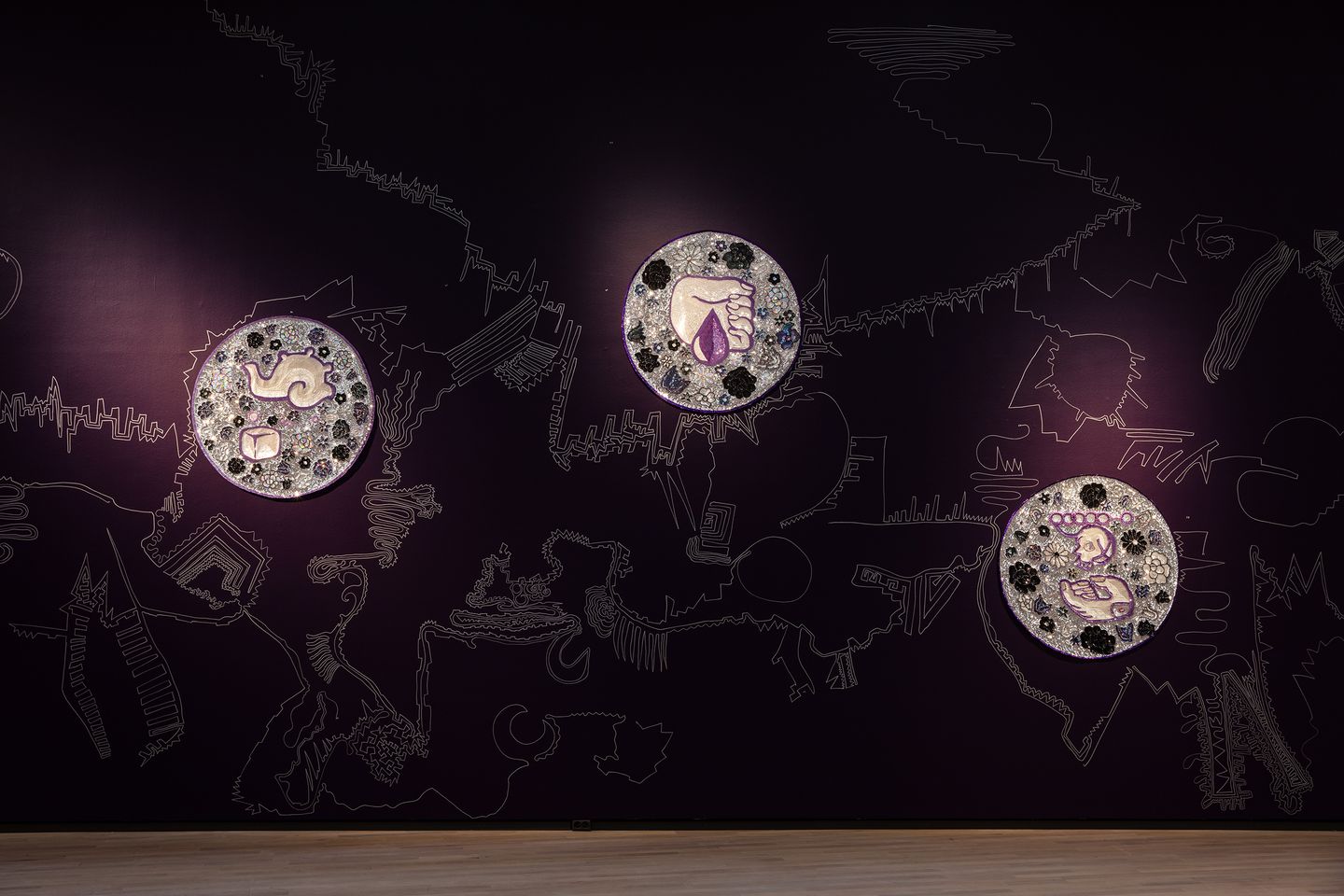
Art by Guadalupe Maravilla: “Embroideries” (2019).

Today’s post is about the artist Guadalupe Maravilla, who has found his own way of using art-making as a healing practice. He is interviewed by Jareh Das at Ocula magazine.

“At the age of eight in 1984, Maravilla fled civil war in El Salvador and arrived in the U.S. undocumented. As an adult, he overcame colon cancer, which led him to learn about global healing practices from cultures as far-reaching as Mayan and Tibetan, alongside standard medical treatments like radiation and chemotherapy.

“Accordingly, his practice brings together often separate knowledge systems, from Western Cartesianism, which sees the mind and the body as separate entities, to non-Western and non-hierarchical approaches that look to nature and natural remedies for healing and tend to view humans as part of a wider cosmological system of equal parts.

“For Maravilla’s first exhibition in Europe, and most comprehensive to date, Sound Botánica at Henie Onstad Kunstsenter (18 March–7 August 2022), over 30 works comprising monumental sculptures, drawings, a large-scale mural, and instances of activated sound baths fill the institute, including four major bodies of work: ‘Tripa Chuca’ (2016–2020), ‘Embroideries’ (2019), ‘Disease Throwers’ (2019–ongoing), and ‘Retablos’ (2021), which are devotional [votive] paintings.

“Speaking to the ethics of artistic creation, both the retablos and embroideries were made with collaborators specialized in such forms, co-authored, and fairly compensated — all of which are important to Maravilla and his wider way of working.

Sound Botánica unfolds over two main gallery spaces with the most captivating and monumental works on view being Disease Thrower #4, #6, #7, #8, #9 (all 2019)—totem-like sculptures that each incorporate a sound gong, assembled from plaster of Paris made by microwaving tissues and plastic that hold together objects collected during the artist’s travels.

“The most recent Disease Thrower #13 (2021) is an astounding work measuring over two meters high made from cast aluminum, moulding vegetation and nature into a constellation of organic forms, some related to the healing and nutrition during Maravilla’s cancer treatment, with notable vegetable forms like squash placed besides real squash at the base of the sculpture.

“In the conversation that follows, Maravilla speaks about forced migration, how trauma manifests in the body and the collective, and disrupting boundaries between art and life, with a practice led by a personal commitment to create a more equal and equitable world.

Jareh Das: Some of your artworks, such as the series of monumental sculptures ‘Disease Throwers’, are activated through performative gestures. I notice they are made of materials like luffa sponges, anatomical models, gongs, glass bottles, and the invented plaster you create by melting tissues and plastic in a microwave.

“These are hybrid, totem-like sculptures that draw from your experience as a child who migrated undocumented to the U.S. They also bridge Indigenous cultures with ritual, and speak to your cancer treatments, which have included modern medical techniques alongside healing practices.

“How did you bring together these intersecting knowledge systems and develop an art practice centered on collective healing experiences, as the exhibition Sound Botánica at Henie Onstad Kunstsenter demonstrates?

Guadalupe Maravilla: I am interested in collective healing and the intersections between the Indigenous and the medical, and dismantling systems. My daily experiences are the core of my work. People often wonder how I can be so open about having cancer, being undocumented, and being a child of war.

“I escaped the civil war in the south of El Salvador in 1984 and migrated to the United States, which separated me from my family; this is very common with migration. Somehow, I made it to the United States — I feel very blessed to be in this position, as an artist now exhibiting all over the world.

“I have a teaching position as a professor and all these great things, so I think of how lucky I am, but I also think back to the kids who did not make it, particularly those who crossed with me. On the other hand, because I’m a cancer survivor too, I can make a direct connection between the trauma of the civil war and seeing violence as a kid and the illness that came to inhabit my body.”

More at Ocula, here. No paywall. You can also listen to an interview at PRI’s the World, here.

Read Full Post »

MilfordStreet is on WordPress, and we’ve been clicking “like” on each other’s posts for a while. His Boston-area photography has been especially noteworthy.

Recently he announced he was leaving his job to teach for several months in El Salvador, after which he would get a master’s that he hoped would enable him to find work teaching English as a second language back in the States.

Wow. I’m so impressed.

Now he is creating blog posts about El Salvador. In “Too Young,” he writes about the school children he teaches who have to work in markets and restaurants to help support their desperately poor families.

The post from MilfordStreet referenced Humanium.org (an international child sponsorship NGO dedicated to stopping violations of children’s rights throughout the world), which called to mind a children’s rights movement in the United States.

Michael Schmidt in Communities & Banking magazine describes increasing efforts to ensure that proposed governmental and other policies don’t inadvertently harm children. He provides these elements of a child-rights impact assessment:

A description of the proposed policy; a description of how it is likely to impact children; an indication of whether it is consistent with the U.N. Convention on the Rights of the Child; identification of any disagreements over the likely impact on children; where adverse impacts are predicted, how they might be avoided or mitigated; an indication of the report’s limitations; parents’ and children’s views; a description of what the measure could have done instead and what needs to be monitored and evaluated after the decision has been implemented; explanations of conflicts (that is, where the interests of children conflict with the interests of others); an analysis of the proposed legislation or policy that weighs the costs and benefits associated with children’s well-being.

Check it out.

Photo: Milford Street

Read Full Post »

Here’s a creative way to address the urgent need for housing in this country: make a deal with Canada to take the houses it doesn’t want anymore.

Kirk Johnson has the story at the NY Times.

“In the San Juan Islands of northwest Washington State, where a severe shortage of affordable housing threatens the economy and the community, a small nonprofit group has found an unlikely way to help anchor families that are struggling to stay — by lifting up unloved houses in Canada, hoisting them onto barges and hauling them to where they are needed. …

“The structures had what builders call good bones, and the group, the San Juan Community HomeTrust, discovered that the cost of transporting them across the Haro Strait from Canada and restoring them here was comparable to the cost of building from scratch. …

“The number of people living in poverty in the county has risen about 17 percent since the end of the recession in 2009, according to census figures, even as the economic recovery in Washington and around the nation gained steam.

“ ‘It’s kind life or death to keep our working families here,’ said Peter Kilpatrick, the project manager in refitting the houses to be imported by the San Juan Community HomeTrust. When the rewiring, painting and structural repairs are finished in June, buyers who have already met income and residency requirements can take possession.

“Through a combination of donated land, government and foundation grants and local fund-raising, the homes will cost the buyers — a hospital worker, several teachers and a massage therapist among them — from $160,000 to $210,000. The median market price here was almost $500,000 at the end of last year.” More here.

Nothing like a little recycling ingenuity applied to a problem! In fact, I was just commenting to a blogger who’s teaching in El Salvador that the locals’ skill at repairing and reusing items is a great foundation for creative problem solving in general. (Please read Milford Street’s report from El Salvador, here.)

Photo: Nancy DeVaux
Houses from Canada were transported by barge to the San Juan Islands in Washington State, where affordable housing is badly needed.

Read Full Post »