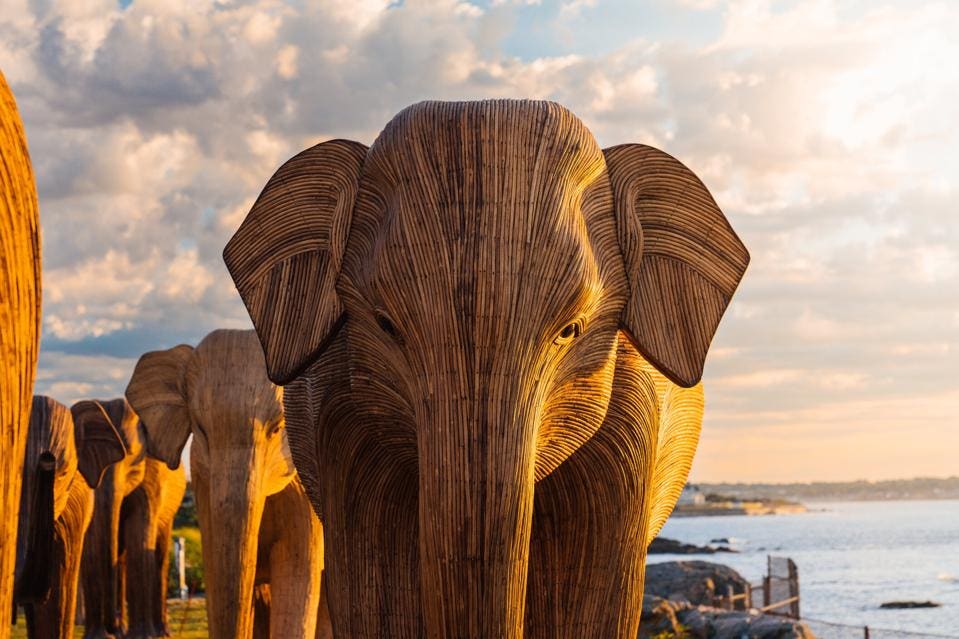
Photo: Corey Favino/Elephant Family USA/Newport Restoration Foundation.
The Great Elephant Migration installation outside Rough Point mansion in Newport, Rhode Island. The elephants are made by indigenous people from an invasive plant.
Here’s a new way to reach audiences with a message about the importance of conservation: a giant “elephant” exhibit in a beautiful seaside setting that tourists visit anyway.
At Forbes magazine, Chadd Scott begins the story by talking about India.
“India has experienced a remarkable population explosion over the past 40 years. Several actually. One is well known. India’s human population has more than doubled since 1980. … Lesser known, and even more extraordinary in light of the country’s surging human population, has been a doubling of its elephant population over that same period, from a bottom-out of around 15,000 individuals to nearly 30,000 today. Populations of Asiatic lions, tigers, and the greater one-horned rhinoceros are also increasing across the country.
“India offers a remarkable example for how humans and wildlife, even the largest of wildlife, can coexist in an ever-developing world. Sharing that message with the world is the mission of the Great Elephant Migration which debuted 100 life-sized Asian elephants in Newport, RI on July 1.
“The elephants — each based on a real, wild elephant from the Nilgiri Hills known by name and personality living alongside people in their coffee and tea plantations — were made by members of the Coexistence Collective, a group of 200 Indigenous artisans from the Nilgiri Biosphere Reserve.
“The herd was produced from the Lantana camara, a toxic, invasive plant overtaking the Indian forest, pushing elephants and other wildlife out and into closer proximity to humans, with greater potential for conflict. …
“ ‘It’s a conservation miracle; it’s contrary to what’s happening everywhere else in the world and it’s definitely owed to an incredibly beautiful perspective on nature and our place within nature,’ Ruth Ganesh, trustee, Elephant Family USA, co-organizer of the Newport presentation along with Art&Newport, and co-founder of the Coexistence Collective, said at The Great Elephant Migration’s opening at Rough Point. ‘That’s what we hope the herd will spread, this beautiful perspective of coexistence and seeing other species as our biological kin.’
“The elephants, and the Indians, prove conservation is as much a mindset as a management plan.
“ ‘That culture of being able to live with animals is the most important thing, more than any of the natural variables about habitat and prey, and all of that,’ Asian elephant expert and co-founder of the Real Elephant Collective in India, Tarsh Thekaekara, told Forbes.com. The Great Elephant Migration exhibition and tour is the brainchild of he and Ganesh. His research in India has focused on human-elephant coexistence. ‘Animals will survive in human dominated landscapes if people tolerate them. That is the bottom line.’ …
” ‘The people who made the elephants [practice] kind of a fusion of Hinduism and animism,’ Ganesh told Forbes.com. Animism attributes a soul and living spirit to animals, rivers, mountains, plants, and other objects often considered inanimate. ‘There’s a spiritual tapestry that underpins the answer to the question why is India succeeding in this way despite so many challenges? It’s the spirituality. It’s this perspective.’ …
“Research published this year by scientists at Colorado State University indicates that elephants have names for each other. …
“Research from 2022 demonstrates the numerous ways elephants grieve their dead and participate in post-death rituals like burial, same as humans. They communicate. Feel pain. Play. Look out for each other. …
“Seeing animals as beautiful people, seeing mountains as deities and rivers as our veins, that it’s a beautiful perspective,’ Ganesh added. …
“ ‘Not just India, in lots of traditional cultures there wasn’t a decimation of wildlife. If you look at conservation in most of the First World, it happened because there was a systematic decimation of all the wildlife,’ Thekaekara explains. ‘When settlers arrived on the North American continent, they wiped out most animals. So, then you had nothing, and you had to conserve.’ …
” ‘Set aside land for nature because you assume people cannot coexist with nature — that model of conservation was inherently separationist.’ …
“Indigenous people the world over have lived more or less harmoniously with wildlife for millennia. That has not been the case with Europeans and their descendants. …
“ ‘If people stopped killing, [animals are] going to come back,’ Thekaekara said. … ‘In coffee and tea plantations, the core of the local economy isn’t upset by the elephants. They don’t eat the coffee or tea, so people’s livelihoods are not affected. It’s only a minor adjustment to your lifestyle to be able to coexist.’ ”
More at Forbes, here. No paywall for your first articles.

 Suzanne's Mom's Blog