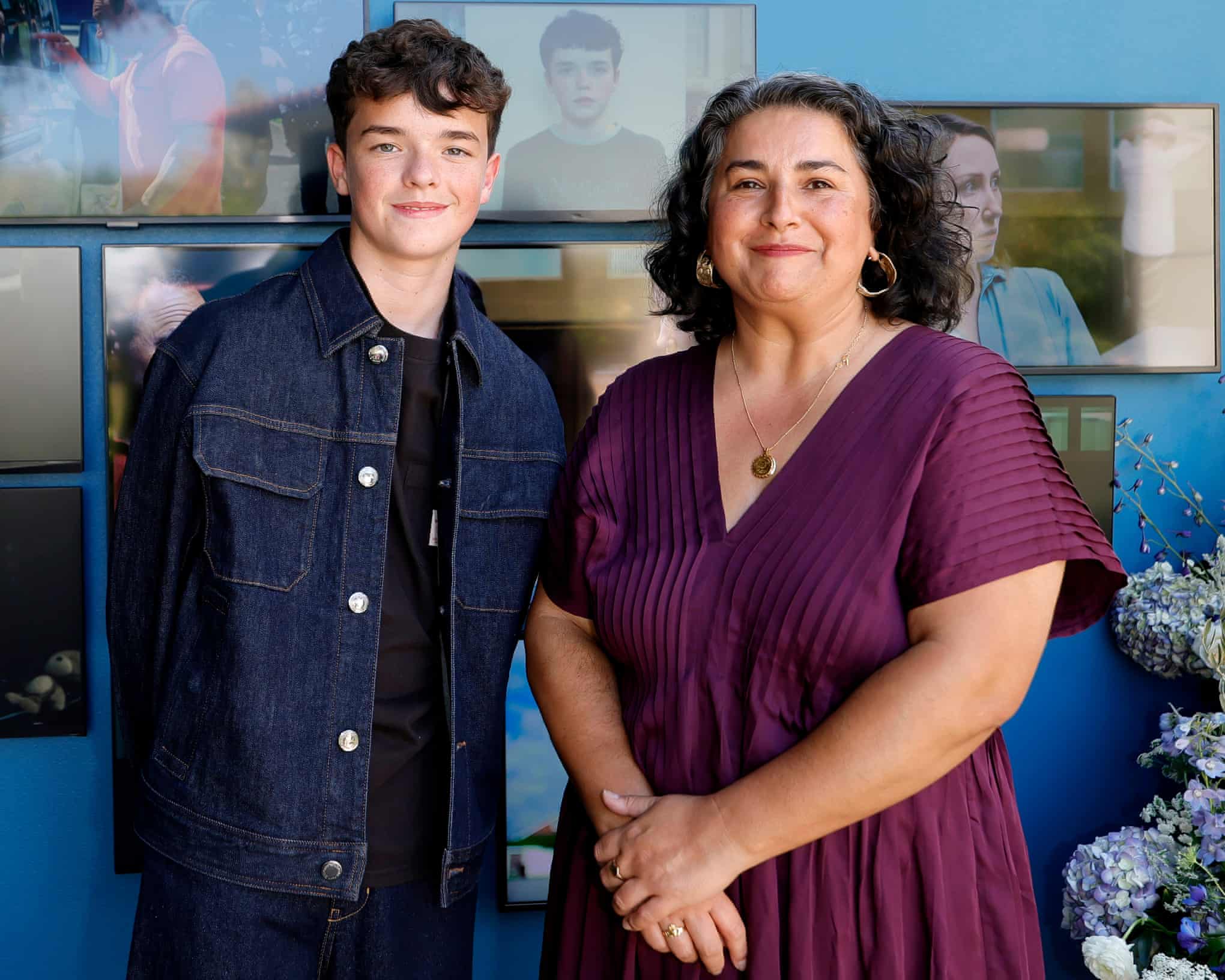
Photo: Frazer Harrison/Getty Images for BAFTA.
Owen Cooper and Shaheen Baig, Adolescence casting director, at the Bafta garden party in Los Angeles last August.
We’ve been watching a very funny British television “thriller” with Christopher Walken called The Outlaws. The ability of the actors to make the danger plausibly nail-biting while also handling the comedy is impressive.
That got me thinking how perfectly the roles have been cast. Which then got me thinking about Walken’s wife, a New Shoreham neighbor, who is known for having cast some pretty big shows. The Sopranos, for example.
Casting is an invisible art that makes all the difference in success. Today’s article by Stuart Heritage at the Guardian shows why.
“At the Emmys in September,” he reports, “Adolescence all but swept the board. It won best limited series. It won awards for writing, for directing, for cinematography. Three of its actors – Stephen Graham, Erin Doherty and Owen Cooper – all took home awards. But Adolescence also earned another Emmy for a craft that often goes overlooked: best casting.
“Shaheen Baig was the woman responsible for casting Adolescence. … There’s no question that the award was deserved. As the woman who populated Adolescence with actors, Baig is ultimately the woman who discovered Owen Cooper. Despite its incendiary subject matter and technical wizardry, Cooper was the beating heart of the series. So revelatory was his performance – in turn heartbreakingly vulnerable and incandescently vicious – that it was hard to believe he was just 14 years old at time of filming, let alone that this was his first ever role. …
“Cooper’s discovery came as the result of a highly targeted six-month search for someone to fill the role. Baig knew that the show would be filmed in the north of England, so that was where she and her team set to work.
“ ‘I chose five cities,’ she says. ‘We then thoroughly researched those cities. We created databases. We looked at schools, youth groups, art groups, music groups. We talked to people that ran the clubs.’
“Once she was convinced that she had a good grasp of the cities, she put a flyer together. ‘We sent it out on social media, and all the places that we had spoken to, and then we essentially street cast,’ she says. ‘We go, we talk to people, we hand out flyers, we engage with people. It’s a lot of work, and it takes time, but that’s how you get the best results.’
“After this phase, Baig and her team received 600 audition tapes to sift through, and gradually went about whittling them down. ‘In the first rounds, we got people to do little improvs, and then every subsequent stage became a little bit more sophisticated. We would see people in the room, do a bit of improvisation with them. Then we’d recall, get them to work from script, until we got down to five.’
“Baig is keen to stress that every one of the final five candidates was ‘brilliant,’ and they all ended up with roles on the show. Nevertheless, Cooper stood out. … ‘We wanted to push him to see where he could go, and he had this extraordinary focus for somebody so young. I mean, that’s a rare find.’ …
“One of the issues with making filmed entertainment, be it movies or TV, is that people often assume that a director or showrunner controls everything from the top down. [The interviewer asks] is there a sense that this is changing at least when it comes to casting?
“ ‘It’s a collaboration, but like every other department – like a cinematographer, an editor, a costume designer – a huge amount of work and skill goes into creating a cast,’ she says. ‘I think it’s really great that it’s suddenly being recognized.’ …
“After starting her career as a production assistant in the 1990s, Baig found herself being drawn more and more towards actors. She eventually became an assistant to Debbie McWilliams, the James Bond casting director, before setting up shop on her own at the start of the century. …
“ ‘There weren’t really many other people like me,’ she says. ‘Working-class, from Birmingham, mixed race.’ … And so she began to work with Open Door, an organization that seeks to help young actors who lack the resources and financial means to attend drama school.
“ ‘Being able to go to drama school is a privilege, and it can feel quite a long way away for many, many people,’ she says. ‘Applying for drama school is expensive. Travel to your auditions is expensive. Open Door has worked really hard to break down some of those barriers. We work with people on movement, on voice, on auditions. We pair people with buddies, so they have somebody to connect to who has got a career. It’s all about making sure there are people in our industry that are recognizable to you.’ ”
More at the Guardian, here. No firewall. Donations needed.

 Suzanne's Mom's Blog