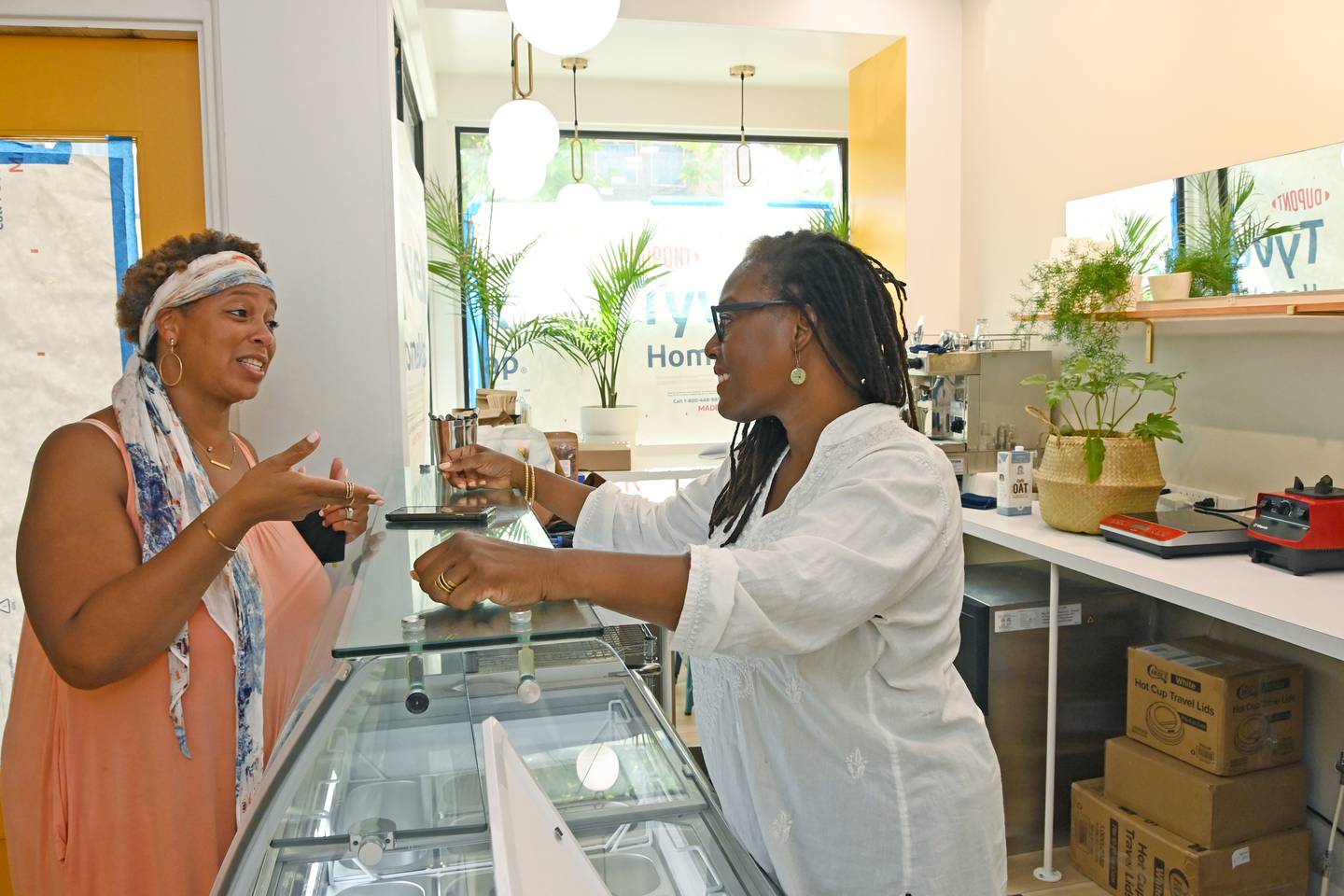
From left, Lynnette Dodson, co-owner of Cuples Tea House, talks with Nicole Foster, co-owner of Cajou Creamery, inside the creamery. “They are among five Black-owned businesses in the 400 block of N. Howard St. that will help to revitalize this long neglected area,” says the Baltimore Sun.
Yesterday I wrote about people pulling together to help Ukraine. There is strength in numbers, as Pete Seeger said in the line that I often quote: “One and two and 50 make a million.”
Another aspect of pulling together is seen in the “solidarity” movement described by Lisa Elaine Held at the Washington Post.
“On a [2021] fall morning, despite the chill in the air, workers at Taharka Brothers Ice Cream were packing a freezer truck and a van with pints of honey graham, peanut butter cup and pistachio. In the office, business metrics on retail performance, catering and home delivery moved across a screen on the wall. ‘It’s a really busy day,’ said Detric McCoy. ‘Even right now, I don’t think I could run it by myself.’
“He doesn’t have to. In December 2020, Taharka officially became a worker-owned cooperative, and McCoy shares responsibilities that would typically fall on one person’s shoulders. …
“In November 2020, popular pizzeria Joe Squared reopened after a covid-19 hiatus with 13 new worker-owners. This fall, the plant-based dessert shop Cajou Creamery also became a cooperative. And in early December, Union Craft Brewing announced it had added six longtime employees as owners and in the future would offer ownership to all employees after five years with the company. …
“Historically, restaurants have been places where power imbalances — between the front and back of the house, star chefs and kitchen staff, servers and customers — were tolerated. The industry also disproportionately depends on the labor of people from marginalized groups — including people of color and undocumented immigrants. …
“ ‘Co-ops have always emerged and scaled during crises,’ said Tori Kuper, the operations coordinator at the New Economy Coalition who is also on the board of the U.S. Federation of Worker Cooperatives. After the 2008 recession, Kuper said, the number of coops in the U.S. skyrocketed, and the spirit of mutual aid that arises during an economic downturn can also lead to interest in what the coalition calls ‘the solidarity economy.’ …
“Baltimore has been tending the fire of its solidarity economy for years, and many look to it as a model, Kuper said. …
Much of the story can be traced back to 2004 and Red Emma’s, a vegan cafe and bookstore that grew out of an anarchist bookstore called Black Planet Books.
“The seven founders set out to create a space for the city’s radical left and thought adding food and coffee to the bookstore would bring in more people, said Kate Khatib, who was one of those originals and is still a worker-owner.
“Worker cooperatives operate in many different ways, and Red Emma’s structure is entirely non-hierarchical. Everyone who is hired starts at the same hourly wage regardless of experience or background and is put on a track to ownership. If all goes well and they pass certain benchmarks over a set period of time, they join a team of worker-owners who share equal decision-making power and profits. Wages increase with time worked, but the highest-paid worker can never make more than twice the lowest. … She said, ‘We really started drilling down into: What does it mean for a business in this sector to be sustainable? And … how do we create jobs that are sustainable?’
“One answer was that they needed capital to buy a space, but traditional banks weren’t set up to lend to a group, and choosing the person with the best credit to take on the loan went against their operating values, since it strengthened the economic power of the most well-resourced owner over others. Red Emma’s began working with other cooperative organizations to fix that issue, which led to a nationwide cooperative lending network and then a local outfit that could provide both funding and technical assistance to worker coops. Today, that organization, the Baltimore Roundtable for Economic Democracy (BRED), connects the city’s growing patchwork of cooperatives.
“Emily Lerman, a project officer at BRED, is also one of the founders of Mera Kitchen Collective, which began as a group of friends hosting pop-up dinners and grew into a catering business that showcases the dishes of chefs from around the world. …
“But even with Lerman’s technical expertise, Mera has struggled to structure its business as a true cooperative. Immigration and visa issues have gotten in the way, as they do for many co-ops, so Lerman and her co-founders have focused on ensuring collective decision-making and on using the expansion to eventually put everyone on the team on salary and start profit-sharing. …
“Nicole Foster and Dwight Campbell of Cajou Creamery started selling ice cream, made from scratch with cashews instead of cows’ milk in such flavors as horchata, baklava and Mexican cacao, out of a new storefront on Howard Street in August. As they got up and running and planned further expansions, they worked with BRED to finalize a cooperative structure with an even more targeted goal: to create opportunity for formerly incarcerated people returning home. …
“Campbell said, ‘We want to give people a chance to show that they are much more than just somebody who served time. We want to give people the ability to dream about a future, to have ownership instead of thinking “I am just a drone. I’m here to work for a paycheck.” ‘ “
More on that at the Post, here.

 Suzanne's Mom's Blog