Photo: Sushmita Pathak.
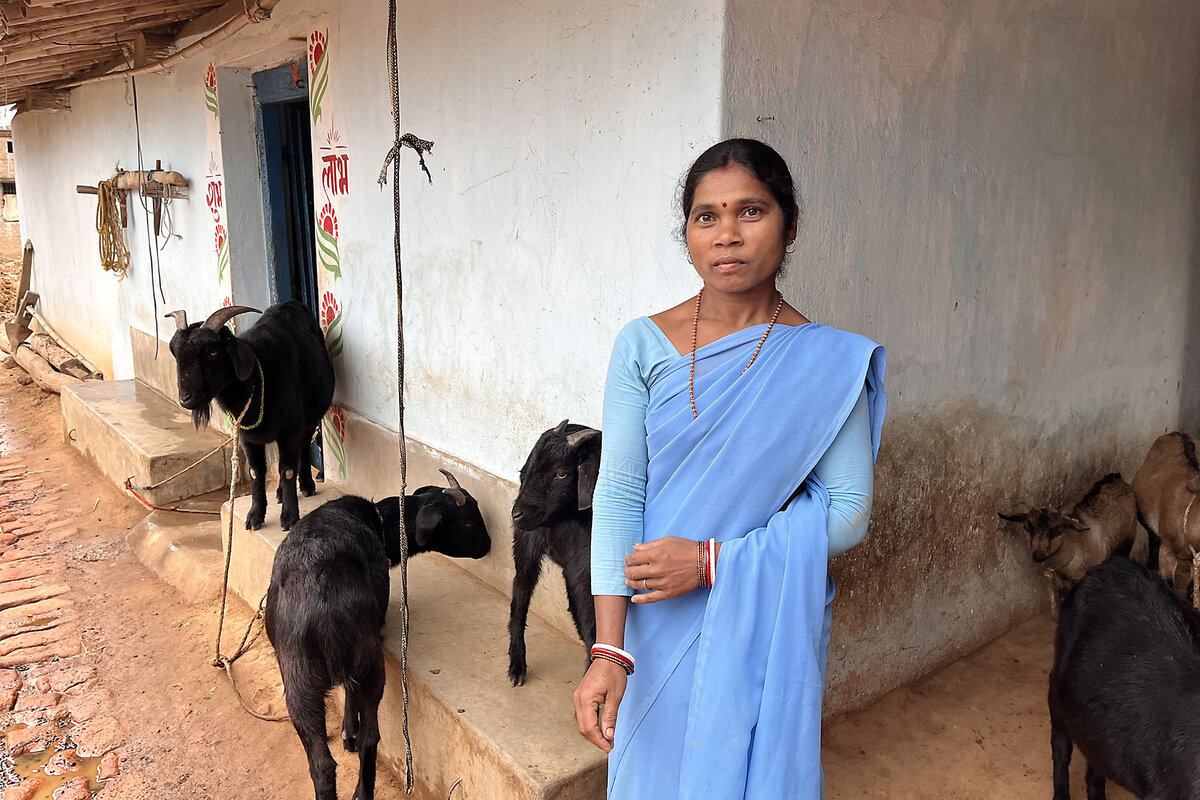
Ritmani Devi, one of roughly 60,000 women in India trained as goat nurses under the Pashu Sakhi initiative, stands with her herd in Angara, India, March 19, 2024.
It seems wrong somehow that there should ever be a need to “empower” women, anymore than there is a need to empower men.
But such is the case, whether women live in rich countries or in the most impoverished villages of India.
Still, it’s better to have empowerment initiatives for women than to do nothing about the imbalance.
At the Christian Science Monitor, Sushmita Pathak reports from India about one such initiative, “Dressed in a light-blue sari, Ritmani Devi cradles two black baby goats as she guides a flock of ducks toward its coop. …
“A few years ago, this muddy yard was much less lively. Ritmani Devi’s goats would often die, she says, and the ones that survived weren’t very healthy. This was common here in the east Indian state of Jharkhand and throughout the country.
“India is home to one-sixth of the world’s goat population. A goat is a valuable asset for a low-income family, ready to be sold at a moment’s notice in case of emergencies. But with owners lacking basic animal health knowledge, that’s all they were – a one-time, last-ditch safety net, rather than an alternative stream of income. Plus, poor access to veterinary services led to high mortality and morbidity rates among goats.
“Now, results from one novel initiative that began a decade ago indicate the tide may be turning. The Pashu Sakhi, or ‘friend of the animal,’ program works to fill gaps in veterinary care by transforming rural, semiliterate women into community animal health care workers, or ‘goat nurses.’ With support from the Indian government, the World Bank, the Gates Foundation, and others, around 60,000 women across India have been trained to provide services like vaccination and deworming, leading to a spurt in goat populations in several states. They are paid for the care they provide, and gain a sense of pride and independence. …
“At the community hall near Ritmani Devi’s home in Getalsud village, the walls are painted with training material, including illustrations of common symptoms to look out for, like swelling under the animal’s mouth or pale eyes, and tips on how to negotiate better rates for goats in the market.
“Jharkhand was one of the first states in India to adopt the Pashu Sakhi model. Having women at the forefront of the initiative was a natural choice, says Swadesh Singh, a livestock specialist at the Jharkhand State Livelihood Promotion Society, the government agency that runs the program.
“In rural India, the responsibility of managing small ruminants and poultry usually falls on women. Meanwhile, veterinary doctors – who sometimes serve multiple village clusters alone – focus on larger, more valuable animals like cows and buffalo. Before the program, goat mortality in Jharkhand was 50%, says Dr. Singh. Authorities say that figure is now below 15% – thanks in large part to the state’s goat nurses.
“The typical Pashu Sakhi candidate has at least eight years of schooling. After being selected by the state’s livestock department, they’re taught how to administer vaccines, what type of fodder is best for the animals, and how to give preventative care. More advanced nurses also get trained in managing disease, performing castration, goat breeding and marketing, and more.
“Goat nurses are often the first responders in any livestock-related medical emergency, in addition to conducting regular check-ups and advising others on goat rearing. Their proximity is a huge advantage. Hailing from the same community that they serve makes it easier to build trust, and the women can take on as much work as they like.
“Livestock owners pay a fixed sum for each service – about 12 cents for every vaccination, for example – and goat nurses also receive a small stipend from the government. Ahilya Devi says she makes anywhere from $25 to $85 a month. That money goes toward her children’s school fees, groceries, and other household expenses – and, occasionally, a personal treat like makeup.
“ ‘Earlier, I had to consult my husband for every expense,’ she says. …
“To be sure, the work comes with challenges. Farmers are often reluctant to pay for services, says Dr. Singh, and there’s the risk that goat nurses may be threatened or harmed if an animal dies under their care. …
“Still, the initiative has paid rich dividends. In some districts of Bihar, Maharashtra, and Haryana, goat mortality fell to single digits. Between 2012 and 2019, Jharkhand’s goat population – which had become stagnant – grew by nearly 40%, and another livestock census is expected to take place this year. Spurred by the program’s success, goat nurses in some parts of Jharkhand are also being trained to cater to larger animals like cattle, says Dr. Singh. …
“The initiative has contributed to ‘the building of social capital and self esteem’ among urban women, wrote [Observer Research Foundation senior fellow Arundhatie Biswas Kundal]. People often refer to the goat nurses as ‘doctor didi,’ meaning an elder sister or person you think highly of. …
“But none of this happens overnight. When Ahilya Devi first started as a goat nurse, people would look at her with some suspicion. ‘Even those from my own village did not recognize me, because I did not step out of the house much,’ she says.
“Now, nearly a decade later, they welcome her into their homes with respect.”
More at the Monitor, here.


 Suzanne's Mom's Blog