Feeds:
Posts
Comments

Posts Tagged ‘empower’

Photo: AFP.
Students attend a class
at Afghanistan‘s Radio Begum in 2021. The founder wanted to get the station set up in hopes that the coming Taliban takeover would spare it.

What does it take for women’s voices to be heard? It depends a lot on the local culture but even more on the determination of individual women working together.

Gabe Bullard writes at Nieman Reports, “On March 8, 2021, a new radio station launched in Kabul: Radio Begum, run by women, for women. The timing was deliberate — the station opened on International Women’s Day, and just as the United States military was withdrawing from Afghanistan.

“ ‘I decided to launch this radio station in order to be ready for the day the Taliban takes power,’ said Hamida Aman, the station’s founder. ‘We knew that as soon as they take power, it will be segregation, and again, it will be against women.’

“Five months later, the Taliban retook Kabul and imposed new laws restricting women’s access to schools and their movements in public. Five years later, Radio Begum is still on the air. The station follows the letter of the law, even as restrictions tighten. It doesn’t cover politics or any subjects that are off-limits to public discussion among women under Taliban edicts. Instead, it focuses on health, religion, and providing educational programs to replace the schooling women are now prohibited from receiving. 

“ ‘They banned schools, but not education,’ Aman said.

“Begum may be unique in Afghanistan, but its model is in practice around the world. It is one of many women-run radio stations — from rural India to the Peruvian Amazon — that, although not part of a formal network, share many attributes and goals. 

“Some of these stations, like Begum, are oases of information in areas where women are restricted in what they can access. Others, in countries where the government is less restrictive, provide an antidote to male-dominated media that ignore issues that affect women. And still other stations challenge cultural barriers and break the silence around topics that are rarely if ever discussed. …

“ ‘There is no more public space for women, and it’s kind of a public space,’ Aman said of her station. 

Women have been working to create these kinds of spaces on-air since the earliest years of radio. … ‘Radio bridged, connected, and blurred the boundaries between the private and public spheres and by doing so, spoke to women as housewives, workers, consumers and citizens,’ says a UNESCO report on radio’s position in the world. 

“Modern women-run radio stations have seized on this potential to blur boundaries and adapted it to changing times and to specific locations and audience needs. 

“ ‘If given the opportunity, radio becomes a really important agent of change for women, in particular, especially in cultures where to speak out and to be open and to have an opinion, to have a say, can kill you,’ said Monica De La Torre, a media professor at Arizona State University and author of the book Feminista Frequencies. …

“Even as advancing technology has led to new independent media outlets and expanded ways of sharing and accessing information, radio remains a powerful medium for breaking barriers, broaching taboo subjects, and speaking directly to oppressed or obscured groups in society. The nonprofit that runs Begum, for example, also operates a TV station that broadcasts via satellite from France (where Aman is now based), and it has a smartphone platform as well. Because it’s not within Afghanistan’s borders, the television channel can be more open in its programming, but for Aman, radio will always have a place. ‘It’s cheap and everybody can have access,’ she said.

“Radio remains accessible and portable, even without an internet connection, electricity, or the ability to read. The fact that broadcasts generally come from a local tower gives radio a geographic connection that isn’t inherent to most other media. And through call-in programs, broadcasts aren’t limited to one-way conversations. 

“For Begum, this means women can — within the parameters of government restrictions — ask questions they may not be able to ask elsewhere, as the station’s programs center around life issues, and are interactive, Aman said. Listeners ‘can call us at any time, to talk with our doctors, to talk with our psychologists, to talk with our spiritual counselor to get information about religion,’ she added.

“Even when women don’t have specific questions, there’s value in hearing other women’s voices on these programs, according to Saba Chaman, who was the first director of Radio Begum and has worked for Begum TV since 2024. ‘It provides them with an opportunity to listen to other women, to listen to the way they talk, to listen to the way they start and finish their sentences,’ Chaman said. 

“Operations haven’t been entirely smooth for Begum, however. In February 2025, Taliban officials alleging violations of the law raided the station, arrested two employees, confiscated hard drives, phones, and documents, and shut down the broadcast. The station was back on the air in a few weeks, and the employees were released in a few months.

“ ‘It hurt us a lot. It was really a painful year for us,’ Aman said. ‘But despite all these challenges, we continue our activities.’ 

“Radio also offers another key benefit to its audience: anonymity. Listeners can tune in privately and there’s no record of their activity once they switch off the receiver. Nobody knows who is listening, who is speaking on-air, or who is calling in. The ability to anonymously call a station comes up often in conversations about women’s radio, usually with a similar narrative.

“Station managers have stories of women who call in to share experiences they can’t talk about with the people around them. Other women hearing the stories then realize they’ve had similar experiences. They call, too, and the process repeats, with more women calling in anonymously.  

“ ‘You could call in and maybe disguise your voice a little bit, or maybe share something so intimate and personal because of the medium,’ said De La Torre, the Arizona State University media professor. Because a station is local, a caller knows they will be heard by their community when they dial in to share a story. A listener knows they’re hearing their neighbor’s voice. Each broadcast chips away at a culture of silence.” 

More at Nieman Reports, here.
Read Full Post »

Photo: Sushmita Pathak.
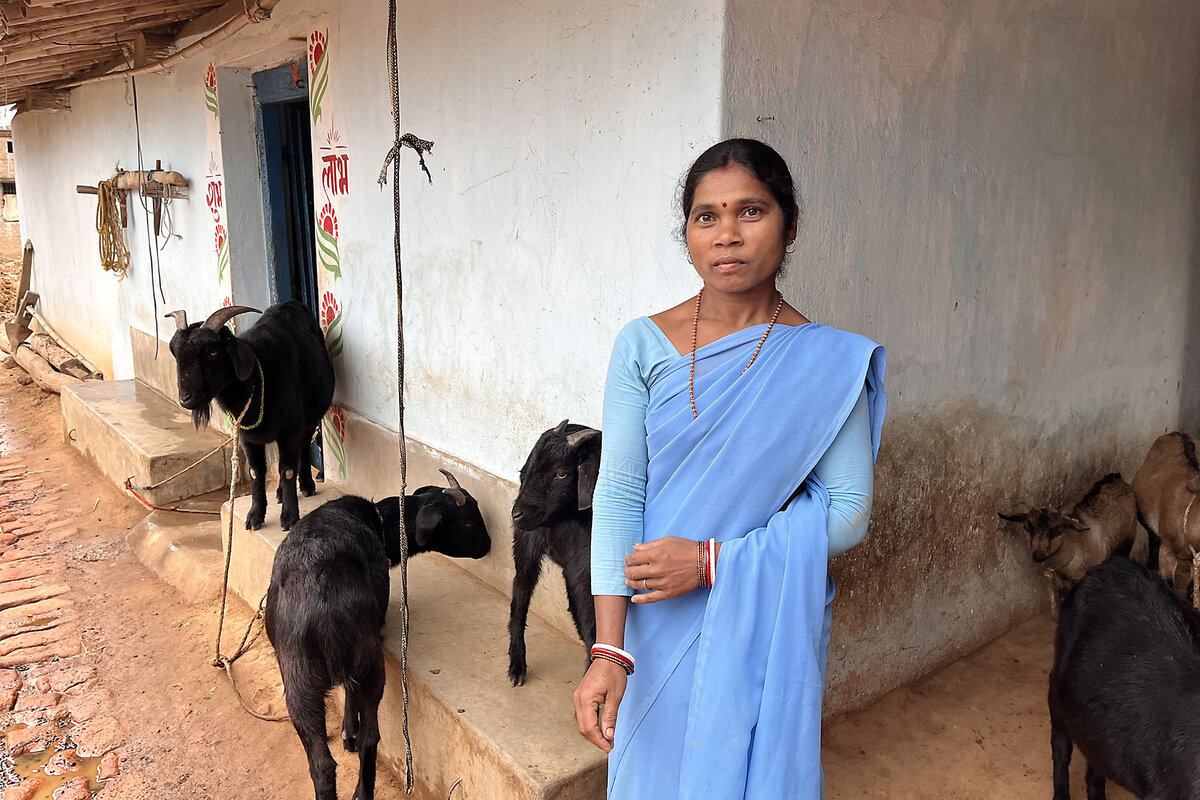
Ritmani Devi, one of roughly 60,000 women in India trained as goat nurses under the Pashu Sakhi initiative, stands with her herd in Angara, India, March 19, 2024.

It seems wrong somehow that there should ever be a need to “empower” women, anymore than there is a need to empower men.

But such is the case, whether women live in rich countries or in the most impoverished villages of India.

Still, it’s better to have empowerment initiatives for women than to do nothing about the imbalance.

At the Christian Science Monitor, Sushmita Pathak reports from India about one such initiative, “Dressed in a light-blue sari, Ritmani Devi cradles two black baby goats as she guides a flock of ducks toward its coop. …

“A few years ago, this muddy yard was much less lively. Ritmani Devi’s goats would often die, she says, and the ones that survived weren’t very healthy. This was common here in the east Indian state of Jharkhand and throughout the country.

“India is home to one-sixth of the world’s goat population. A goat is a valuable asset for a low-income family, ready to be sold at a moment’s notice in case of emergencies. But with owners lacking basic animal health knowledge, that’s all they were – a one-time, last-ditch safety net, rather than an alternative stream of income. Plus, poor access to veterinary services led to high mortality and morbidity rates among goats.

“Now, results from one novel initiative that began a decade ago indicate the tide may be turning. The Pashu Sakhi, or ‘friend of the animal,’ program works to fill gaps in veterinary care by transforming rural, semiliterate women into community animal health care workers, or ‘goat nurses.’ With support from the Indian government, the World Bank, the Gates Foundation, and others, around 60,000 women across India have been trained to provide services like vaccination and deworming, leading to a spurt in goat populations in several states. They are paid for the care they provide, and gain a sense of pride and independence. …

“At the community hall near Ritmani Devi’s home in Getalsud village, the walls are painted with training material, including illustrations of common symptoms to look out for, like swelling under the animal’s mouth or pale eyes, and tips on how to negotiate better rates for goats in the market. 

“Jharkhand was one of the first states in India to adopt the Pashu Sakhi model. Having women at the forefront of the initiative was a natural choice, says Swadesh Singh, a livestock specialist at the Jharkhand State Livelihood Promotion Society, the government agency that runs the program.

“In rural India, the responsibility of managing small ruminants and poultry usually falls on women. Meanwhile, veterinary doctors – who sometimes serve multiple village clusters alone – focus on larger, more valuable animals like cows and buffalo. Before the program, goat mortality in Jharkhand was 50%, says Dr. Singh. Authorities say that figure is now below 15% – thanks in large part to the state’s goat nurses.

“The typical Pashu Sakhi candidate has at least eight years of schooling. After being selected by the state’s livestock department, they’re taught how to administer vaccines, what type of fodder is best for the animals, and how to give preventative care. More advanced nurses also get trained in managing disease, performing castration, goat breeding and marketing, and more. 

“Goat nurses are often the first responders in any livestock-related medical emergency, in addition to conducting regular check-ups and advising others on goat rearing. Their proximity is a huge advantage. Hailing from the same community that they serve makes it easier to build trust, and the women can take on as much work as they like. 

“Livestock owners pay a fixed sum for each service – about 12 cents for every vaccination, for example – and goat nurses also receive a small stipend from the government. Ahilya Devi says she makes anywhere from $25 to $85 a month. That money goes toward her children’s school fees, groceries, and other household expenses – and, occasionally, a personal treat like makeup. 

“ ‘Earlier, I had to consult my husband for every expense,’ she says. …

“To be sure, the work comes with challenges. Farmers are often reluctant to pay for services, says Dr. Singh, and there’s the risk that goat nurses may be threatened or harmed if an animal dies under their care. …

“Still, the initiative has paid rich dividends. In some districts of Bihar, Maharashtra, and Haryana, goat mortality fell to single digits. Between 2012 and 2019, Jharkhand’s goat population – which had become stagnant – grew by nearly 40%, and another livestock census is expected to take place this year. Spurred by the program’s success, goat nurses in some parts of Jharkhand are also being trained to cater to larger animals like cattle, says Dr. Singh. …

“The initiative has contributed to ‘the building of social capital and self esteem’ among urban women, wrote [Observer Research Foundation senior fellow Arundhatie Biswas Kundal]. People often refer to the goat nurses as ‘doctor didi,’ meaning an elder sister or person you think highly of. …

“But none of this happens overnight. When Ahilya Devi first started as a goat nurse, people would look at her with some suspicion. ‘Even those from my own village did not recognize me, because I did not step out of the house much,’ she says.

“Now, nearly a decade later, they welcome her into their homes with respect.”

More at the Monitor, here.

Read Full Post »

I liked this story at TreeHugger on protecting trees and fighting poverty at the same time — especially the part about the importance of women in the effort.

Sami Grover writes, “The old trope that we can either have economic development or environmental protection has been pretty much blown out of the water by this point. …

“Nowhere is this more true than the dry lands of Africa, where desertification, resource depletion, climate disruption and political unrest have all taken their toll on communities’ ability to survive and thrive. There is, however, plenty to be hopeful about too. …

Tree Aid, a charity which works with villagers living in the drylands of Africa, has long been at the forefront of this fight. By working cooperatively with villagers and on-the-ground non-profit partners in Africa, the charity doesn’t just plant trees, but rather increases villagers’ capacity to protect, nurture and utilize trees to protect their soils, increase agricultural yields, and provide a buffer against the drought, floods and failed crops that are predicted to get ever more common with the advance of climate change.

“A new free report from the charity, entitled Building Resilience to Climate Shocks, the charity is seeking to spread the word about how trees can be used to both alleviate poverty and protect the environment at the same time. …

“Previous tree planting efforts in the drylands have often failed because they’ve either focused on the wrong species of trees, or they have failed to take into account the needs, resources and skills of the local population. …

“Unless short-term needs are met, long-term needs are compromised. … Tree Aid has worked with villagers to develop alternatives to ecologically damaging land management practices:

TREE AID provides training for villagers to plan ways to make money in the short-term as well as the long. For example by producing honey from the bees which live on unburnt land and using fallen trees for fuelwood. This gives them enough income to sustain and invest in their futures and environments, as well as preparing themselves for weather extremes. …

“One of the strategies the charity uses to build climate resilience is to establish ‘Tree Banks’ within a community. These banks are essentially mixed-species tree plantings that can provide for a range of needs from fuel wood to animal fodder to fruit or other products. Each community establishes rules and management practices for when and how a Tree Bank may be used. …

“Any successful strategy for regreening these regions must work within those cultures to empower and educate women as caretakers of the environment: When women take part in decision-making there is a long-term positive impact on trees. They become important forest caretakers.”

More at Tree Aid, here ,and at Treehugger, here.

Photo: Tree Aid


Read Full Post »