Feeds:
Posts
Comments

Posts Tagged ‘endangered language’

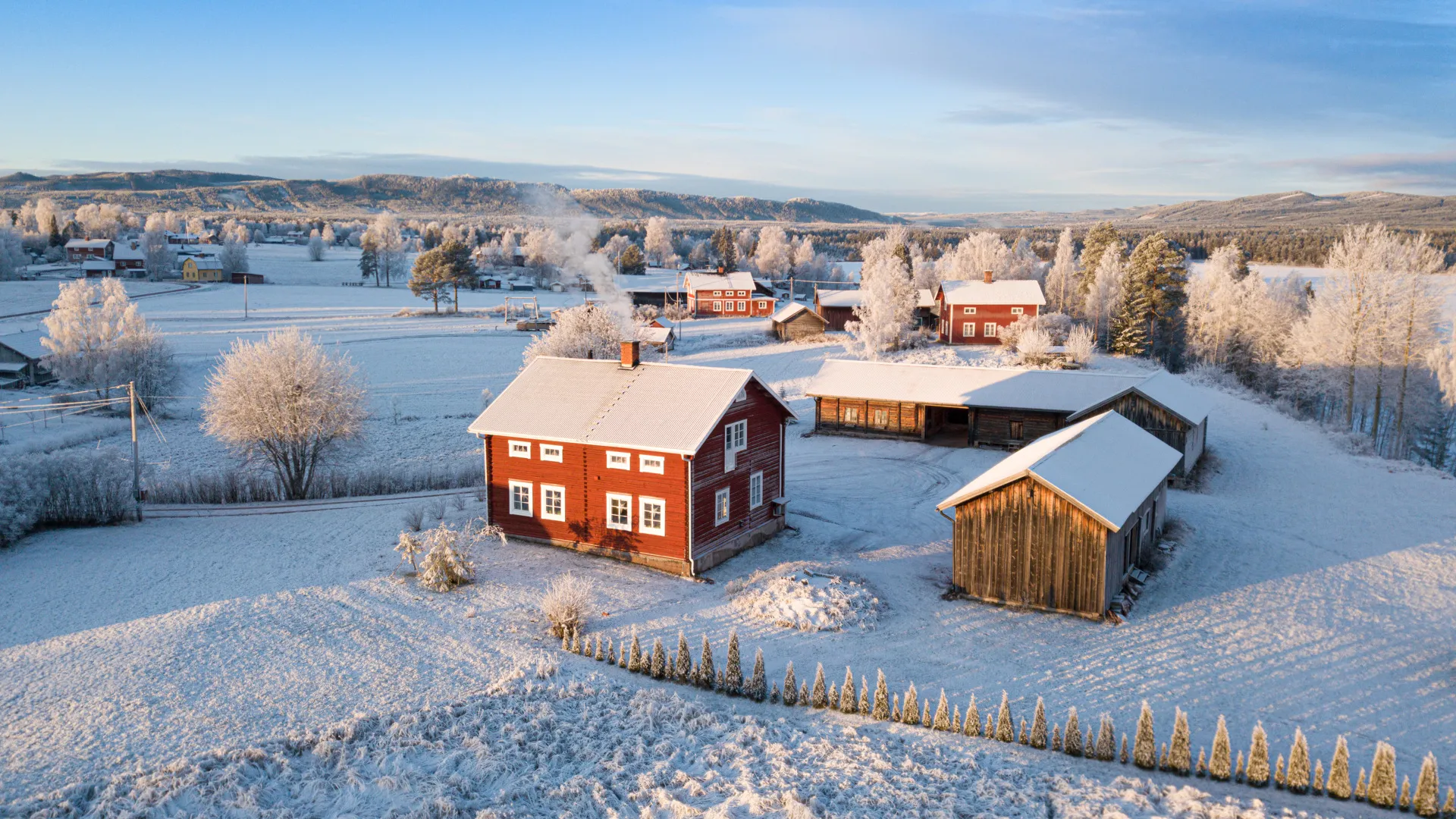
Photo: Visit Dalarna.
One of the languages spoken in Älvdalen, Sweden, has the charmingly elvish-sounding name of Elfdalian. Älvdalen is part of Dalarna, the area best known for colorful wooden horses.

I’m always interested in learning about endangered languages, and the radio show The World introduced me to one tucked away in the Swedish town Älvdalen.

Älvdalen appears to be a part of Sweden that, for context, is closer to that Norwegian Olympic site Lillehammer than to better known Swedish towns.

Bianca Hillier reported at The World that “an organization called Ulum Dalska, based in a small Swedish town called Älvdalen, is on a mission.  For decades, members have been working hard to help save a language called Elfdalian, a remnant of Old Norse.

“ ‘We had our first meeting on the 1st of June in 1984,’ said press secretary Björn Rehnström. ‘And the biggest hall in Älvdalen was filled with people.’

“Elfdalian sounds nothing like the country’s national language, Swedish, which Rehnström said destabilized the language about 100 years ago. At that point, Elfdalian became stigmatized.

“Ulla Schütt, also a Ulum Dalska member, saw the impact firsthand while growing up in Älvdalen.

“ ‘My parents spoke Elfdalian with each other, and with my grandma and my aunts and uncles and everyone around,’ Schütt said. ‘But when they turned to me, they spoke Swedish.’

“Schütt said her parents spoke Swedish with her because that’s what was spoken in schools. Students were even discouraged to speak Elfdalian in the classroom. Now, there’s only about 2,500 speakers left. But people are getting creative in the fight to change that trend.

“The language is getting a boost on Minecraft. Musicians are releasing new songs with Elfdalian lyrics. Several children’s books were also translated into Elfdalian, including Le Petit Prince, by Antoine de Saint-Exupéry.

“Additionally, Rehnström helps run a popular Facebook group that offers courses in the Elfdalian language, where he posts lessons to the group’s 1,800 global members.

“ ‘[People are from] America, Australia, South America, Indonesia, Haiti, Cape Verde,’ he said. …

“The local government supports the teaching and preservation of Elfdalian. … The language is also recognized on an international level. In 2016, it was assigned an ISO language code, which helps the internet distinguish one language from another.

“But the national government of Sweden is a different story. They currently consider Elfdalian a dialect of Swedish, not its own language.

“Speaking in Elfdalian, Swedish MP Peter Helander recently asked Parliament why that’s the case. But before Culture Minister Amanda Lind could answer the question, the parliamentary speaker interrupted them both to say that only Swedish may be spoken in the chamber. Helander said the ‘only Swedish’ remark proves his point, that Elfdalian should be considered its own language. …

“Schütt said every time a language dies — which some research suggests is as often as once every two weeks — it is a sad moment. To her, losing Elfdalian would be an especially tragic loss. …

“Getting Elfdalian recognized as a language by the Swedish government, she added, is key to making sure that death doesn’t come.”

Read more about Elfdalian at The World, here, and at the blog Transly, here.

Dala horses come from the region where Elfdalian is one of the languages spoken.

Read Full Post »

Photo: Conférence PPL 2022.
Brian Maracle shares his technique for teaching the Mohawk language at Canadian conferences such as Multidisciplinary Approaches in Language Policy and Planning (LPP or in French, PPL).

I love learning about other languages and sometimes pick up tidbits through my volunteering with ESL teachers. But languages in danger of dying out are especially interesting to me. If they die out, we lose too much about the ways others see the world.

Today’s story is about a technique for teaching a particular endangered language.

Ian Austen wrote at the New York Times from Ontario, Canada, “When Brian Maracle returned in his mid-40s to the Mohawk community near Toronto that he had left when he was just 5, he didn’t have a job and knew almost no one there.

“But perhaps the biggest challenge facing him was that he neither spoke nor understood much Kanyen’keha, the Mohawk language. More than a century of attempts by Canada’s government to stamp out Indigenous cultures had left Mr. Maracle and many other Indigenous people without their languages.

“Now, 30 years later, Mr. Maracle has become a champion of Mohawk, and is helping revive it and other Indigenous languages, both in Canada and elsewhere, through his transformation of teaching methods.

“ ‘I never studied linguistics, don’t have any teacher training, my parents weren’t speakers,’ he said in his office at an adult language school he founded about two decades ago in his community, the Six Nations of the Grand River territory, southwest of Toronto. Yet, linguistics academic conferences now feature him as a speaker. …

“From the 19th century into the 1990s, thousands of Indigenous students were taken from their homes, sometimes by force, and placed into Canada’s residential schools system. There, they were forbidden from speaking their languages and from practicing their traditions in what a national commission later characterized as ‘cultural genocide.’

“The system failed to entirely eradicate Indigenous languages, but its effect was nevertheless devastating for the 60 Indigenous languages found in Canada.

“Today restoring Indigenous languages has been a component of Canada’s push for reconciliation with its Indigenous people. … Four years ago, the government passed the Indigenous Languages Act, which formally recognizes the importance of these languages and requires the allocation of money — more than 700 million Canadian dollars to date — for teaching them.

“But none of that was around when Mr. Maracle arrived at Six Nations, and the program that was available, he found, was ill-suited for adult students.

“ ‘Indigenous languages are extremely different from English,’ said Ivona Kucerova, the director of the Center for Advanced Research in Experimental and Applied Linguistics at McMaster University in Hamilton, Ontario. ‘But typically what you see is that the local Indigenous language teaching methodologies are designed to teach Western languages.’

“Mr. Maracle said the problem with his first, unsuccessful lesson was that the instructors, generally Mohawk elders without training as language teachers, were tossing out ‘whole words.’

“ ‘They just expected by dropping a word on you and saying it louder that you’d somehow figure it out,’ Mr. Maracle said. ‘They didn’t understand how the language really is structured.’ …

“Mr. Maracle found the answer about 25 years ago in the office of David Kanatawakhon-Maracle, no direct relation, a lecturer at the Western University in London, Ontario.

“ ‘There were little bits of paper all over this big table,’ Mr. Maracle recalled. The lecturer told Mr. Maracle words he had been longing to hear: ‘He said: “I think I’ve got a new way of teaching the language.” ‘

“There were about 60 slips of paper on his office table, and they ‘were the Rosetta Stone of all the things that you need to be a competent beginning speaker,’ Mr. Maracle said.

“Kanyen’keha is a polysynthetic language, where a single word can function as an entire sentence. Those words are made up of morphemes, small elements that change their meaning depending on how they are combined. …

“Understanding that these elements were the key to unlocking the language was the breakthrough Mr. Maracle needed to attain fluency. But other students at the school he helped start in 1999 were still struggling. It became apparent that someone needed to build a curriculum and teaching program around the morphemes, including a color-coded system for grouping them, which Mr. Maracle did through trial and error.

“One essential discovery was figuring out that learning Kanyen’keha requires ‘looking at the world with Mohawk language eyes,’ he said. In comparison with other languages, Kanyen’keha relies heavily on verbs.

Objects are generally described by what they do. The word for ‘computer,’ for example, roughly translates as ‘it brings things up.’

“ ‘We don’t teach you how to say “pencil,” “chair,” ”shoe” for six months,’ Mr. Maracle said. ‘Because the language is a verb-based language, the names of things are less grammatically important.’

“Prof. Kucerova, the director of the linguistics center in Hamilton, regards Mr. Maracle as a linguist despite his lack of formal training. She said tests showed that his students emerged with a university-level fluidity in two years.

“ ‘I have never seen anyone else bring adult learners to that level of language, to be able to speak at this level after two years,’ she said, adding that Mohawk ranks with Arabic in terms of difficulty for English-speaking students. ‘That’s really astonishing.’

“ ‘I became literally mesmerized by the extent of his work,’ Prof. Kucerova said. ‘He’s figured out this improbable, but linguistically extremely smart, method of delivering this radically different language to adults.’ ”

More at the Times, here.

Read Full Post »

Photo: Regional Municipality of Wood Buffalo.
Stop signs in Cree and Dénesųłiné installed in Fort Chipewyan, Alberta, Canada.

Language and culture are important in so many ways, including helping individuals define for themselves and others exactly who they are. I am reminded of the made-up languages my friends and I used in childhood, especially Goose Latin. We were the only ones who understood it, and we liked being special that way.

In Canada, where residential schools once tried to strip indigenous children from their own special language, an effort is being made to give it back.

Chico Harlan and Amanda Coletta wrote about restitution of the Cree language at the Washington Post in July. I got the story via MSN.

“Lucy Johnson never spoke the Cree language when she was growing up. Her father wouldn’t allow it. He called it ‘jungle talk.’ He didn’t elaborate much until he was weeks away from dying of alcoholism. Then he told his children that he associated the language with his experience at Ermineskin residential school. …

“ ‘The more he spoke, the more punishment he received,’ Johnson said.

“It’s a legacy of Ermineskin that Johnson, now 55 and a paralegal, can’t speak the language of her people. Nor can her six siblings. Across Canada, the often brutal residential school system, designed to assimilate Indigenous people into White, European culture, succeeded in breaking the tradition of passing on languages from generation to generation — and put the survival of some in jeopardy.

“But now, 25 years after the last residential school was shuttered, some Indigenous communities [are] reviving and relearning their native languages. It’s a movement fueled by a desire to recover what has been lost, and by a sense that progress is possible. The youngest Cree didn’t attend residential schools. Unlike their parents or grandparents, they didn’t internalize the idea that speaking their language might be wrong.

“Isaiah Swampy Omeasoo, 20, studied and made himself fluent in Cree. His wife is expecting a child in February, he said, and he’ll speak to his son or daughter in the language. …

“In Maskwacîs — an area with four First Nations reserves on the Alberta prairie between Edmonton and Calgary — Cree, the most widely spoken Indigenous language in Canada, can be found written on stop signs, municipal buildings and emergency vehicles. A local radio station has Cree-speaking DJs. The school district says its mission is about ’embedding’ Cree culture and language into education — a direct response to the damage wrought by residential schools.

“But restoring a language isn’t easy. Steve Wood, the vice principal at the high school, said only six of 54 staff members can speak Cree fluently. Many in the community aren’t conversational. Robert Ward Jr., the radio station manager, says he sometimes runs into ideas on air that he can’t express because he lacks the vocabulary. He’ll admit as much on live radio, he says, with the hope that an elder will call in and help him.

“ ‘This is a language that’s been taken from us,’ he said. …

“The United States also ran what were called Indian boarding schools through much of the 19th and 20th centuries. The Interior Department is now investigating abuses in that system. …

“In 2018, the four First Nations in Maskwacîs signed an agreement with the federal government that gave them far greater control over education, allowing them to offer and design a curriculum infused with the Cree language, culture and traditions.

“Brian Wildcat, the superintendent of the Maskwacîs Education Schools Commission, said educators are planning to pilot a new curriculum in the fall with a heavy focus on the Cree language, identity and way of life. He hopes it eventually will replace the district’s current curriculum, which was written by the province. …

“Wood, the vice principal, called restoring the language a ‘monumental effort’ — and one that requires immersion. So he tries to use Cree as much as he can: when ordering a sandwich at the local Subway or filling his car up at the gas station. ‘The language has to be heard for people to pick it up,’ he said.

“It’s with the young people, he said, where he sees progress.

“ ‘We have kids that come home from our kindergarten schools who know more Cree than their parents,’ Wood said. ‘It’s a product of what transpired.’ ”

More at MSN, here.

Read Full Post »

image

Photo: Sunaina Kumar
Women of Jad tribe spinning wool in Dunda village, Uttarakhand. Their language belongs to the Tibeto-Burman group of languages and is one of 780 (possibly 850) in India.

Here is a heretical thought from someone who loves language: if practically everyone speaks a different language from everyone else, maybe we don’t need language? One must at least ponder the question of whether there is a better way to communicate with others. I’ve no idea what it could be. Even gestures have different meanings in different cultures.

There is always a need to communicate, isn’t there? It’s a puzzle. Even English, despite its frequent role as the bridge language Esperanto was meant to be, suffers from so many Orwellian uses of common words today, you can hardly trust it to convey what you mean.

These thoughts came to me because of an article by Sunaina Kumar at Atlas Obscura on the amazing array of languages in India alone.

Kumar writes, “In 1898, George A. Grierson, an Irish civil servant and philologist, undertook the first ever Linguistic Survey of India. It took Grierson 30 years to gather data on 179 languages and 544 dialects. The survey was published in 19 volumes, spanning 8,000 pages, between 1903 and 1928. …

“Ganesh Devy was frustrated by this lack of contemporary data, especially the discrepancies he saw in the existing numbers. Since the government wasn’t likely to start on a new survey in the near future, Devy, a former professor of English from the western state of Gujarat, launched the People’s Linguistic Survey of India in 2010. The name refers to the fact that it was the people of the country, and not the government, that embarked on this project.

“With single-minded ambition, he put together a team of 3,000 volunteers from all parts of the country. Since 2013, the PLSI has published 37 volumes, featuring detailed profiles of each of India’s languages. The project is expected to be completed by 2020 with 50 volumes. In the linguistic landscape of India, the work done by PLSI is not just pathbreaking, it is crucial in recording and thus preserving the languages of the country for future generations. …

“The challenge of putting a disparate team together with a minuscule budget of 8 million rupees ($1,17,000) — provided by a private trust — to map the languages spoken by 1.3 billion people was enormous.

“ ‘My team was not made of linguists, but people who could speak their own language,’ Devy says. ‘We had writers, school teachers, philosophers, social scientists, some linguists. We also had farmers, daily wagers, car drivers, people who had been in and out of jail. They had an intimacy with their language. Even if it was less scientific, it was authentic.’ These volunteers were asked to record data about the languages they spoke, including the history of the language, its grammatical features, and samples of songs and stories. It was chaotic, Devy admits, but he traveled to every corner of the country to train the team and the final product was vetted with academic rigor.

“So far, the PLSI has recorded 780 languages in India and 68 scripts. When Devy embarked on the mammoth project, even he did not expect to unearth that many. He says that the PLSI could not report on nearly 80 languages for various reasons, including accessibility of a given region due to remoteness or conflict, which brings the estimated total number of languages closer to 850.

“Based on data from the survey, Devy estimates that in the last 50 years, India has lost 220 languages, including some within the last decade. …

“ ‘India has some of the oldest surviving languages,’ says Devy. ‘A language like Tamil has been around for 2,500 years. Some of the tribal languages would be even older.

These languages have survived because they have a philosophical context to them and that philosophy is part of the lived lives of the speakers.’ …

“After mapping India’s languages, Devy, whose spirit is unflagging at 67, has turned his attention to the world at large. His next project is the Global Language Status Report. The UNESCO states that nearly half of the over 6,000 languages spoken in the world may disappear by the end of this century. The GLSR proposes to cover the languages of Africa and South America, two regions where languages are fast disappearing without any trace, and where linguistic diversity has not been mapped. …

“ ‘I have been traveling to Africa for a year now and I am not deterred by the scope of mapping 54 countries,’ Devy says. ‘The experience with PLSI was great fun, and I believe if people decide to do something, they actually can.’ ”

More here, at Atlas Obscura.

Read Full Post »

To me it’s tragic that languages are disappearing and, with them, unique cultures.

Small, determined efforts can bring attention to the problem, as I noted this morning when the filmmaker behind Marie’s Dictionary retweeted this from North Carolina’s Pilot Mountain Elementary School (@pilotMtnElem).

Third grade students are learning about Marie’s Dictionary and endangered languages. @goproject #scsed #pmespirates @UNESCO

Excellent. Third graders are sure to spread the word.

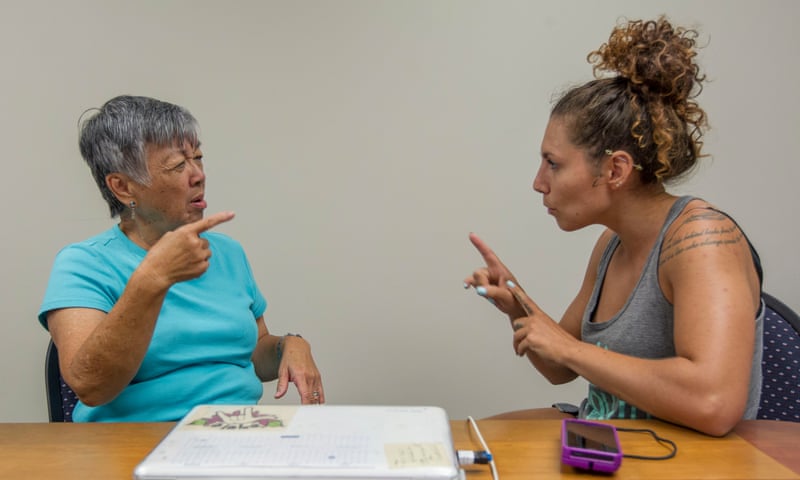
Recently, I came across an article on another threatened language, Hawaii Sign Language.

“In 2013, at a conference on endangered languages, a retired teacher named Linda Lambrecht announced the extraordinary discovery of a previously unknown language. Lambrecht – who is Chinese-Hawaiian, 71 years old, warm but no-nonsense – called it Hawaii Sign Language, or HSL.

“In front of a room full of linguists, she demonstrated that its core vocabulary – words such as ‘mother,’ ‘pig’ and ‘small’ – was distinct from that of other sign languages. …

“The last-minute arrival of recognition and support for HSL was a powerful, almost surreal vindication for Lambrecht, whose first language is HSL. For decades, it was stigmatised or ignored; now the language has acquired an agreed-upon name, an official ‘language code’ from the International Organization for Standardization, the attention of linguists around the world, and a three-year grant from the Endangered Languages Documentation Programme at the School of Oriental and African Studies in London. …

“An initial estimate of up to 280 surviving HSL signers was soon revised down to 40, then down to just 10 or so old-timers still likely to be competent in HSL. ASL had made deep inroads even among these signers, but there was evidence, especially from Lambrecht’s signs, that HSL was distinct, and lay close enough to the surface to be recovered. Spoken languages such as Basque, Welsh, and Hawaiian have come back from the brink of extinction – could HSL be the first sign language to do it?”

The article is from the Guardian by way of the blog Arts Journal. Read it here.

Photo: Eugene Tanner Photography, LLC
Linda Lambrecht, left, teaches Hawaii Sign Language.


Read Full Post »

My husband’s latest alumni bulletin had a lot of great articles. One was about a new effort to save endangered languages, starting with Zapotec, an indigenous Mexican language.

If you go to this website and click the buttons, you can see and hear the effort that has gone into recording the ways that Zapotec words are pronounced. It’s the “Tlacolula Valley Zapotec online talking dictionary.”

The initiative has received support from the National Geographic and the Living Tongues Institute for Endangered Languages.

Photo: AxisOfLogic.com

Read Full Post »

As I mentioned the other day in the post about the Latin newscast on Finnish radio, I am interested in endangered languages.

Now a composer who is also interested has melded voices of  threatened languages with his music.

Corinna da Fonseca-Wollheim writes at the NY Times that the “Vanishing Languages” project by Kevin James, “a New York-based trombonist and composer, is a rare hybrid of conservation effort and memorial, new music and ancient languages.

“Prodded by Unesco statistics that predict that by the end of the century half of the world’s 6,000 languages will be extinct, Mr. James spent months in the field tracking down and recording the last remaining speakers of four critically endangered tongues: Hokkaido Ainu, an aboriginal language from northern Japan, the American Indian Quileute from western Washington, and Dalabon and Jawoyn, aboriginal languages from Arnhem Land in Australia.”

Reviewing a concert James gave at a New York venue, da Fonseca-Wollheim says, “ ‘Counting in Quileute,’ which opens with bells struck and bowed and swung in the air and ends with the ring of a Buddhist prayer bowl, had a strong ritualistic feel to it.

“The often puzzling actions of the players — flutists whispering into mouthpieces, a cellist tapping with both hands on the fingerboard as if playing a recorder — appeared like a secret choreography designed to bring forth the voices of the dead filtered through the crackle of old phonographs.

“The imperfections of these old recordings, which Mr. James used alongside those he made recently in the field, show how heavily smudged the window is that we have on these vanishing cultures. And yet at times it seemed as if it were these voices who were willing the performance into existence.” (Isn’t da Fonseca-Wollheim a lovely writer?) More.

For a couple other blog discussions of endangered language, click here or here.

Photo: Ruby Washington/The New York Times
Leah Scholes of Speak Percussion using a double bass bow to play a bowl as part of “Vanishing Languages.”

Read Full Post »