Feeds:
Posts
Comments

Posts Tagged ‘eno’

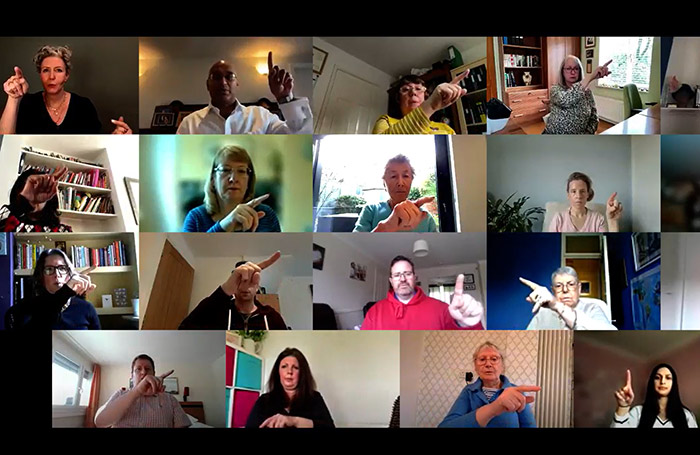
Photo: English National Opera [ENO].
Participants in an ENO Breathe live Zoom session.

An incurable disease from mouse droppings may be hogging the headlines right now, but don’t forget that we’re still figuring out how to treat Covid — especially “long Covid.” (See the Harvard Gazette on recent long Covid research, here.)

Today’s story shows how different fields can learn from one another. Just to go to work, opera singers, for example, needed to overcome Covid-generated breathing challenges. Today they are sharing what the’ve learned.

Hattie Fisk writes at the Stage, “English National Opera’s program to support people suffering from long-Covid continues to deliver clinically measurable improvements, according to a new study.

ENO Breathe is a free, live six-week online course developed in collaboration with clinicians from Imperial College Healthcare NHS Trust and uses singing techniques with a particular focus on lullabies from around the world. It was initially developed in 2020 to support people recovering from Covid-19.

“Supporting more than 4,829 participants since its launch in September 2020, the program has expanded to take referrals from 85 NHS partners nationally.

“Published in the Lancet Digital Health, a new study looked at 1,438 of these participants and found that 80% reported improved levels of breathlessness, with 61% having achieved clinically important improvements in breathlessness. 

“Of the participants, 87% said that it had a positive impact on their general well-being and 73% reported improved anxiety levels.

“These findings build on earlier data published in April 2022 from the program’s initial randomized controlled trial and provide evidence for potential further integration of the program in NHS services, the study said.

“Recent participant of ENO Breathe Janardhan Rao called the program ‘transformational.’

“He said: ‘As a doctor who contracted Covid-19 early on, in my line of work, the lasting effects of the disease have been devastating. I had to stop working as I had real difficulty catching my breath. I could not speak for any length of time and was continuously exhausted. … I was breathless all the time, but with the weekly program of mindful breathing exercises and simple lullabies, I found that I could speak in sentences again. As my breathing improved, I found that I had the energy to go back to work. I am so grateful for this program,’ he continued.

“Beth Warnock, ENO director of Engage, added: ‘Research such as this continues to show the powerful role the arts can play in healthcare, particularly when delivered in close partnership with clinicians. We are incredibly grateful to our partners at Imperial College Healthcare NHS Trust for their expertise and collaboration in both developing and rigorously evaluating ENO Breathe. Building on this evidence, we now look forward to expanding ENO Breathe further to support people living with COPD and asthma.’ “

More at the Stage, here.
Read Full Post »

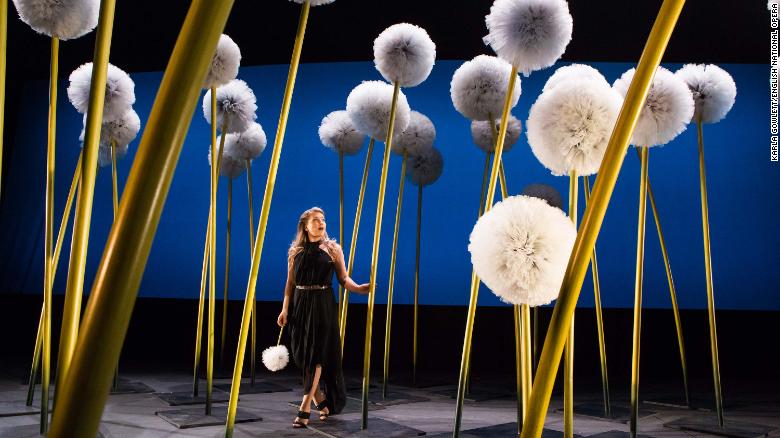
Photo: ENO via CNN.
Australian soprano Alexandra Oomens singing for a English National Opera (ENO)
program that works on singing, breathing and well-being for recovering coronavirus patients.

Who has a story that could happen only in a pandemic? Today I have one silly one that involves me and one serious one that involves opera singers helping Covid patients.

Silly story first. Because I haven’t been going to stores since the pandemic started, I haven’t collected any five-dollar bills to give as tips to delivery people. So I write $5 checks to “cash.” Well. Twice now, a woman I have never met in a nearby town has rescued a muddied check I wrote from her driveway and mailed it back to me. We must have the same milkman, one who is careless with his tips. Meanwhile, I’m gaining a penpal!

Andrew Dickson writes at the New York Times, “On a recent afternoon, the singing coach Suzi Zumpe was running through a warm-up with a student. First, she straightened her spine and broadened her chest, and embarked on a series of breath exercises, expelling short, sharp bursts of air. Then she brought her voice into action, producing a resonant hum that started high in a near-squeal, before sinking low and cycling up again. Finally, she stuck her tongue out, as if in disgust: a workout for the facial muscles.

“The student, Wayne Cameron, repeated everything point by point. … Though the class was being conducted via Zoom, it resembled those Zumpe usually leads at the Royal Academy of Music, or Garsington Opera, where she trains young singers.

“But Cameron, 56, isn’t a singer; he manages warehouse logistics for an office supplies company. The session had been prescribed by doctors as part of his recovery plan after a pummeling experience with Covid-19 last March.

Called E.N.O. Breathe and developed by the English National Opera in collaboration with a London hospital, the six-week program offers patients customized vocal lessons: clinically proven recovery exercises, but reworked by professional singing tutors and delivered online.

“While few cultural organizations have escaped the fallout of the pandemic, opera companies been hit especially hard. … The English National Opera, one of Britain’s two leading companies, has been trying to redirect its energies. …

“In a video interview, Jenny Mollica, who runs the English National Opera’s outreach work, explained that the idea had developed last summer, when ‘long Covid’ cases started emerging: people who have recovered from the acute phase of the disease, but still suffer effects including chest pain, fatigue, brain fog and breathlessness.

” ‘Opera is rooted in breath,’ Mollica said. ‘That’s our expertise. I thought, “Maybe E.N.O. has something to offer.” ‘

“Tentatively, she contacted Dr. Sarah Elkin, a respiratory specialist at one of the country’s biggest public hospital networks, Imperial College N.H.S. Trust. It turned out that Elkin and her team had been racking their brains, too, about how to treat these patients long-term. …

“Twelve patients were initially recruited. After a one-on-one consultation with a vocal specialist to discuss their experience of Covid-19, they took part in weekly group sessions, conducted online. Zumpe started with basics such as posture and breath control before guiding participants through short bursts of humming and singing, trying them out in the class and encouraging them to practice at home.

“The aim was to encourage them to make the most of their lung capacity, which the illness had damaged, in some cases, but also to teach them to breathe calmly and handle anxiety — an issue for many people working through long Covid.

“When Cameron was asked if he wanted to join, he was bemused, he said: ‘I thought, “Am I going to be the next Pavarotti?” ‘

“But Covid-19 had left him feeling battered.. … ‘Everything I did, I was struggling for air,’ he said.

“He added that even a few simple breathing exercises had quickly made a huge difference. ‘The program really does help,’ he said. ‘Physically, mentally, in terms of anxiety.’ Almost as important, he added, was being able to share a virtual space and swap stories with other sufferers. ‘I felt connected,’ he said. …

“And how was Cameron’s singing now? He laughed. ‘I’m more in tune,’ he said. The program had helped him reach high notes when singing along in the car, he added. ‘Having learned the technique, you can manage much better,’ he said. …

“It wasn’t just patients and clinicians that had benefited, Mollica said: E.N.O. Breathe had also given musicians and producers at the company something to focus on during a bleak time. ‘Everyone’s found it really motivating,’ she said. ‘It’s fantastic to realize that this skill set we have is useful.’ ”

More at the New York Times, here.

Read Full Post »

I am taking a playwriting class at the Cambridge Center for Adult Education with Peter Littlefield, who also does a lot of directing. Here is an opera (Handel’s “Partenope”) he co-directed at the English National Opera. I wish I had a real video, but this is what I could find on YouTube.

I just had one class so far, and it looks like it’s going to be a lot of fun. The students are an interesting mix of ages and backgrounds, and I’m really looking forward to getting to know everyone. One woman, as it happens, teaches in a Boston elementary school where I volunteer.

I really like Peter’s sort of associative approach to playwriting, in which you mess around with images and ideas that interest you, then set them aside while you play with different images and ideas, and ultimately see how they converge. To me the attraction is that you’re less likely to get bored with what you are doing than if you were trying to force an idea into a structure. (I really am sick of writing coaches who harp on “structure.” I believe a structure will emerge.) We did a really funny exercise for openers.

Although I have often tried to write plays, the only actual class I ever had was in writing for TV, which I took while getting a master’s in communications at Syracuse’s Newhouse School. It was all about the formula: one, two three, gag (joke); one, two three, gag; one, two three, gag. Spirit crushing.

For fun, watch the first few minutes of opening-night comments on my teacher’s production of Partenope.

Comments may be sent to suzannesmom@lunaandstella.com. I will post them.

Asakiyume comments: I’m so excited about this playwriting class. You must have such a great sense of theater from *watching* so many plays, and you’ve definitely got stories to tell. I hope you’ll share any scripts that you do write.  (Your thing about television screenplays, with the “one, two, three, gag” made me laugh because of the alternative meaning of gag–which is what, of course, someone with an artistic vision and free spirit must surely do if trapped with such a formula.)

Read Full Post »