Feeds:
Posts
Comments

Posts Tagged ‘entertainment’

Photo: Jace Downs/AMC via AP.
A scene from the show The Walking Dead. Producers of season two of Walking Dead: Dead City are looking for extras in Boston. Click here.

Despite research from the Federal Reserve and others showing that film tax credits hurt the finances of states more than they help, they remain enormously popular.

Jon Campbell writes at the Gothamist about a recent New York study that is skeptical about this kind of tax credit. He also reports that many people just want to believe.

“New York’s $700 million-a-year tax break for film and TV productions isn’t providing taxpayers with a good return on investment, according to a new analysis commissioned by the state itself.

“The state Department of Taxation and Finance quietly released a 359-page report late last month analyzing New York’s major tax incentive programs, which are meant to attract and retain businesses. The analysis, authored by consultant PFM Group, was required by lawmakers two years ago.

“The results show a decidedly mixed bag, with some tax breaks — including the state’s marquee Excelsior Jobs Program — performing well, the report found. But the return for the state’s Film Tax Credit, which Gov. Kathy Hochul and lawmakers boosted by $280 million annually last year, was not nearly as positive.

‘Based on an objective weighing of the costs and benefits, the film production credit is at best a break-even proposition and more likely a net cost to the state,’ according to the report.

“For every dollar the state gave in tax breaks from 2018 through 2022, the Film Tax Credit drew an estimated 15 cents in direct tax revenue, the analysis found. …

“The state’s biggest industry-specific tax break belongs to the film industry, which gets $700 million a year to film or do post-production work in the Empire State. Hochul and legislative leaders are big supporters of the program, which has helped lure hundreds of productions over the years.

“The tax break can be considerable. It covers up to 30% of a film’s qualified production costs, with another 10% available if productions are filmed in certain counties north of New York City. The credit is also refundable, meaning the state pays out the excess money if it exceeds a film production’s tax bill. …

“Beyond the lackluster return on investment, PFM’s report surmised that much of the filming that occurred in New York would have happened regardless of the tax credit. … When adding indirect and induced jobs — employees who don’t work directly on production but whose employment stems from it — that return rises to 31 cents. …

“[A] prior state analysis, crafted by Regional Economic Models Inc., estimated the Film Tax Credit generated $1.70 in state and local tax revenue for every dollar the state gave up in 2021 and 2022.

E.J. McMahon, founder of the Empire Center, a fiscally conservative think tank, argued that the prior analysis was too simplistic and assumed the film industry wouldn’t have created any jobs without the tax breaks. PFM’s analysis, he wrote, was ‘meatier’ and ‘less credulous.’ …

“PFM estimated the Excelsior program has a return of $5.25 in tax revenue for every $1 the state forgoes, when including indirect and induced jobs.

“[State Sen. James Skoufis, a Hudson Valley Democrat who pushed for the new report in the state budget] said the report’s findings on the Film Tax Credit fell in line with his expectations.

“ ‘There are some of us, myself included, that believe that the Film Tax Credit and the associated entertainment tax credits are such a bad deal that they ought to be repealed,’ he said. ‘But the politics is the politics in the state Legislature, and that continues to remain an uphill climb.’ …

“Josh Levin, vice president for state government affairs for the Motion Picture Association’s Northeast Region, said New York’s Film Tax Credit is ‘essential’ for ensuring the state ‘retains its position as a top hub for production activity and union jobs.’ …

“Lawmakers extended the Film Tax Credit for an additional 10 years. It’s scheduled to run through 2034.” More at Gothamist, here.

Maybe constituents’ delight in seeing movies being filmed in their neighborhoods is what motivates lawmakers. In that case, how about accounting for it differently — as a state expense for resident entertainment?

Read Full Post »

Photo: Antonio Olmos/The Guardian.
Debbie Chazen, Gemma Barnett and Josh Glanc, the stars of JW3’s holiday pantomime in London.

There’s a kind of Christmas entertainment in England (English friends: correct me if I am describing this wrong) called a pantomime, or panto. I have read about it but never seen it. It’s kind of like the old, slapstick Punch and Judy show, but without puppets.

This year, a comedy troupe in London is doing a takeoff of Christmas panto in a Jewish storytelling style.

Deborah Linton writes at the Guardian, “What else would you call ‘Britain’s first professional Jewish pantomime’ but Red Riding Hood and the Big Bad Pig? And where else would you set it but north London, at Hanukah? At the JW3 centre in London – an arts and community venue. …

“The cast of the first professional stage production to merge two great traditions in Jewish storytelling and festive panto are gathered around a table sharing their experiences of both. And the crossover, it transpires, is richer and more obvious than one might first imagine.

“Comedy, community, a fairytale quest and a flawed hero are ‘at the heart of every panto,’ says the show’s writer, Nick Cassenbaum. ‘But I think it comes from … the Talmudtoo.’ …

“So, too, the panto dame, he says – in this instance Mother Hoodman, Red’s eccentric mum who appears on stage heavily made up, wigged and wearing a voluminous dress modeled on a Hanukah dreidel singing You Spin Me Round – has a natural home in both traditions. ‘A panto dame is warm, loving and says the wrong thing. It’s a Jewish mother,’ says Cassenbaum. …

“Audiences will be immersed in a production that combines Jewish humour and music (imagine new lyrics to Jewish artists including Amy Winehouse, Doja Cat, Paul Simon and Craig David) with traditional panto magic – lots of slapstick comedy, a scene where the leads get lost in the woods, and cartoonish baddies – as it transposes the millennia-old Hanukah miracle into a fairytale fit for 2023.

“Cassenbaum’s premise is that Red, a hard-working young scientist pushing against the plans her mum – the dame – has for her to marry a Jewish doctor, sets out on a quest to find enough sustainable energy to power her village through Hanukah. … The wolf, the main antagonist in the storybook version, is replaced here by a hyper-capitalist pig, the best known non-kosher animal of the lot. Although, Cassenbaum explains, ‘in my mind, all the characters are Jewish, even the pig, who as a city boy who made a lot of money under Thatcher, maybe isn’t so open about his Jewishness.’

“Cassenbaum, a former street performer … was interested ‘in how we could hold both things – something that was really British, all the panto techniques, but something that also felt unashamedly Jewish. With panto, you have to pick from the canon of fairytales. Red Riding Hood is such a short story, you’re not so set with the script. I wanted to make something that can hold Jewish traditions, dense Jewish jokes and reflect certain Jewish archetypes, so you’ll see the ex-black-cab driver and a wolf who is a neurotic mess.’ …

“It mirrors the generational Jewish experience – and the immigrant humor that accompanies it. ‘Humor is our biggest cultural export. It’s truth humor,’ says Josh Glanc, an award-winning Australian comedian who plays the pig. …

” ‘In British popular theatre, Jews were there from the [beginning] – Bud Flanagan (who sang the theme tune to Dad’s Army), writers Barry Cryer and Marty Feldman – but they weren’t “out.” Then, with more modern comedians, like Matt Lucas and Sacha Baron Cohen, the Jewishness is secondary to the joke. Through it all, there’s something about using community and humor as a way of fitting in and being part of things, a means of assimilation.’

“Gemma Barnett, who plays Red, agrees. ‘It’s intense self-awareness,’ she says. … ‘Red’s constantly trying to work out if she believes what her mum believes. I love the character.’ …

“East London-born musical director Josh Middleton, a world-leading klezmer (eastern and central European Jewish folk) musician, has given Streisand and other Jewish artists a klezmer flavor, via accordion and violin live on stage, as well as a lyrical rewrite and song sheet, in pure panto style. …

“ ‘Let’s take the premise of rewriting pop songs, because that’s what people expect at panto, but let’s do people of Jewish descent. … I want them to recognize the songs and enjoy that familiarity, and I want them to feel they’re at a Jewish panto,’ says Middleton.”

More at the Guardian, here. No paywall, but they do rely on donations.

Read Full Post »

Photo: Jonathan Atk/Cunard.
“Boundless as the Sea” is a new piece created for Cunard cruises by Owen Horsley from Shakespearean love scenes, including Romeo and Juliet, Macbeth, Othello, The Winter’s Tale, Troilus and Cressida, and A Midsummer Night’s Dream.

Several of my friends are back to taking cruises now that Covid appears manageable. Today’s post is about some new entertainment offerings on cruises. I enjoyed reading about them about as they bring to mind the “Royal Viking Singers and Dancers!” that our family got such a kick out of on our one cruise, 1990.

Siobhan Burke reported in January at the New York Times about a very modern dance group taking to the high seas. And Emma Powell had a Daily Mail story about Cunard Lines tapping the Bard.

Burke wrote, “On a late-summer night, three choreographers greeted friends at the New York opening of their latest show, exchanging hugs and chatting through masks over the blare of pop music. Neon projections in the theater, a nightclub-like space called the Red Room, exclaimed ‘Welcome to the Show!!’ Cocktail servers wove efficiently through the crowd with trays of drinks, as nimble as the dancers who would soon take the stage.

“It could have been one of the many clubs or theater spaces where the choreographers — Ani Taj, Sam Pinkleton and Sunny Min-Sook Hitt — had performed and presented their work over the past decade, as members of the Dance Cartel, a group founded by Taj in 2012 and known for its exuberant, open-to-all, party-meets-performance live events.

“But a few features set this space apart: the screen outside the entrance beckoning ‘Sail Into Something Spectacular’; the fluorescent signs reading ‘PORT’ and STARBOARD to mark stage left and stage right; the enormous pink inflatable whale onstage.

“How had the artists landed here, on a 2,770-passenger luxury cruise ship, which on this particular night was docked in Manhattan, en route to Miami? Among the three of them, they have choreographed for Broadway, television, opera, music videos, museums and other arenas. But as Taj said when they recently got together for a video interview, a foray into cruise ship entertainment was ‘not something any of us expected to be on the timeline of our careers.’

“ ‘We definitely had a moment of: A cruise ship — did they get the right people?’ Pinkleton said, recalling his confusion when he and Taj, who are represented by ICM Partners, were invited by their agents to pitch a show to Virgin Voyages, a new adults-only cruise line founded by the British billionaire Richard Branson. ‘I think we had a very narrow idea of what making a show for a ship would mean.’ …

“Dance shows on cruise ships typically take place on proscenium stages, for seated, stationary audiences. … In the group’s first and signature work, ‘OntheFloor, which Taj and Pinkleton directed, dancers maneuver around and among a standing audience, their irrepressible energy an invitation to join in. …

“Still, she and Pinkleton answered the call for a pitch.

“We said, ‘Yeah, we’ll accept that challenge and come up with something that surely won’t fly,” ‘ Taj said.

“ ‘We were like, “This seems like a fun exercise,” ‘ Pinkleton added, ‘and dared ourselves to present a pretty authentic version of what we would like to make.’

“That exercise, which began in 2017, has now become a full-fledged, hourlong production aboard the Scarlet Lady, the first Virgin ship to set sail for paying customers.”

Funny article. See it at the Times, here.

Meanwhile, the Daily Mail reports, “The Royal Shakespeare Company has teamed up with British cruise line Cunard to take the Bard’s work out to sea as part of a three-year partnership.

“Voyagers on the Queen Mary 2 will be able to enjoy several pieces during transatlantic crossings from Southampton or explorations around Norway’s fjords.

“One such performance is ‘Boundless as the Sea,’ a brand new piece created by Owen Horsley from Shakespeare’s iconic love scenes including Romeo and Juliet, Macbeth, Othello, The Winter’s Tale, Troilus and Cressida and A Midsummer Night’s Dream. …

“Workshops will be on offer as well as events ‘where the actors will perform their personal favorite sonnets and speeches, and answer questions from the audience.’

“The Queen Mary 2 will also host touring exhibition, ‘Digital Diorama: An Augmented Journey Through Shakespeare’s Stratford,’ with some of the RSC’s most popular productions including Hamlet, Henry V, The Merry Wives of Windsor and As You Like It screened in the on board cinema. … The first voyages will run from May 29 until August 12 and then again from September 15 to November 13.”

More at the Daily Mail, here.

Read Full Post »

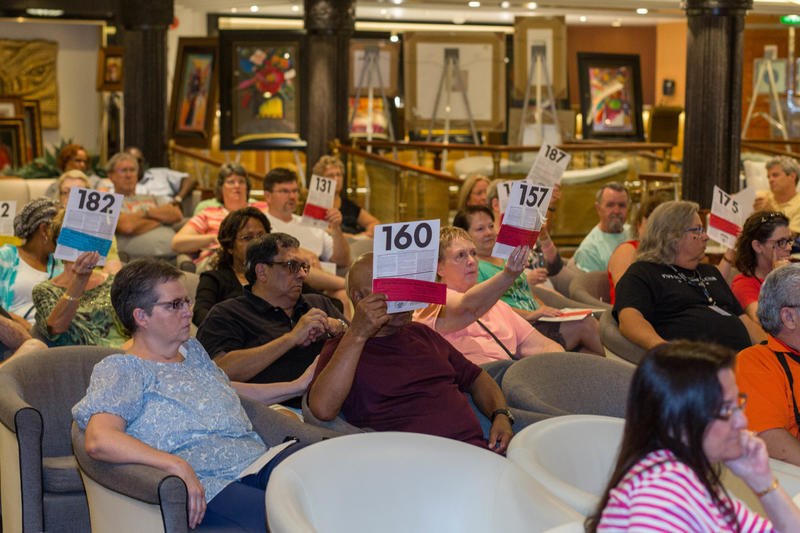
cruise-auction-4

Photo: Cruise Critic
A Park West art auction in the Star Lounge on Royal Caribbean’s Navigator of the Seas.

My family went on a cruise only once (1990, New York to Bermuda), so in terms of special features, we know about Broadway-type entertainments, and that’s it. “Let’s give a warm welcome to the Royal Viking singers and dancers, Everyone!”

But cruise lines keep trying to outdo each other in offerings. One couple I know chooses their trip based on what chamber music group will be playing. And if you are into fine art or auctions, there’s a cruise for you, too.

Of course, you’re not going to pick up something valuable for cheap.

Sarah Cascone writes at Artnet, “I was lounging poolside, cocktail in hand, when I heard the announcement. The grand finale art auction was about to start.

“It was a weekend cruise from Miami to the Bahamas aboard Royal Caribbean’s recently refurbished Navigator of the Seas. … As I entered the event, hosted by cruise-ship auctioneer Park West Gallery, I bypassed the registration table, heading straight for the auction floor, where a waiter was handing out glasses of sparkling white wine.

“From the start, it was clear that this was no regular art auction. After a brief spiel encouraging folks to buy art as a legacy to leave to their children, the auctioneer, Robert Borotescu, got down to business.

‘I don’t know if you’ve seen Oprah,’ he said. ‘We have some surprises under the chairs.’

“Cue a frenzy as the few guests in the room rushed to upturn every seat cushion. There were no car keys to be found, but there were $100 certificates for discounts on winning bids.

“Borotescu, a dark-haired Romanian man in his mid-to-late 30s, endeared himself toward the crowd by offering additional raffle tickets for $100 credits throughout the auction. … With his pleasantly urbane accent, Borotescu set his audience at ease, acknowledging that they probably never had the time to visit art museums and galleries. But they were here now, and it was his job to make sure that they went home with something they absolutely loved. …

“Borotescu told us that [Park West] operates on 100 cruise ships, and claimed that the art aboard the Navigator of the Seas alone was worth $3 million. Representing some 200 artists, the company holds 1,200 auctions every month. …

“Unlike most art world organizations, Park West seems to hire employees with largely non-art backgrounds. Borotescu’s LinkedIn lists six years in fine jewelry and watch sales at Louis Vuitton Moet Hennessy before joining the company. A quick perusal of resumes of other auctioneers and art directors at the company yields unconventional experience in HVAC, used car sales, fitness instruction, and Royal Caribbean’s beverage team, to list just a few. …

“Park West specializes in what it calls ‘graphic works’: Mass-produced reproductions of original paintings, signed by the artist and released in limited editions. Some are giclée prints — a fancy term for high-quality inkjet prints. Other pieces might look like paintings, but these more expensive offerings are often merely hand-embellished, with brushstrokes layered over a printed image to give it a more ‘authentic’ feel. …

“ [The auctioneer] said: ‘If we look at the Oxford Dictionary of Art, every single artwork that can be traced back to the artist, or was created under the artist’s supervision, is considered to be an original work of art.’ …

“Most of the time, you won’t even take home the exact work you’re bidding on. Park West will ship you a functionally identical copy from its warehouse, rather than going through the trouble of turning over the on-board stock, according to Bloomberg Business. …

“The bidding kicked off with a piece by Peter Max, a well-known Pop artist who met Scaglione, Park West’s founder, back in the late 1960s, and has been represented by him ever since. …

“ ‘This is one of the gems we have on the Navigator of the Seas,’ Borotescu told the crowd, claiming that the ‘printed painting on canvas’ was valued at $23,500, but that he could start the bidding at $20,000. Less than 30 seconds later, the work was sold for $20,700.

“Max has decades of experience exhibiting at international museums. The highest auction record for a work of his is $53,125, according to the artnet Price Database. … Other artists on offer had decidedly less impressive CVs. Borotescu proudly proclaimed that Park West is the only gallery to represent David ‘Lebo’ Le Batard, noting that the artist is known for his paintings of cats and owls. …

“Every attendee was encouraged to enter a free raffle to take home a massive, unframed Thomas Kinkade [your blogger comments, ‘Ugh!’]. … One gimmick in particular stood out: A pair of works presented turned away from the audience, and sold as one lot, without any idea of what they looked like. ‘They are going to be two of the most gorgeous works of art that anyone has ever seen,’ Borotescu promised the audience. ‘Once you turn it around, if it’s something you don’t like, you don’t have to keep it.’ …

“And then there was Tweety.

“Borotescu never named the artist responsible for designing the tiny print, relying on the Looney Toons character’s name recognition … Supposedly, the artwork, which was just a couple inches high and therefore impossible to see from across the room, was valued at $549.

“ ‘Let’s have some fun,’ Borotescu suggested, asking everyone in the room to hold up their bid card. He opened the bidding at just $20. Two thirds of the crowd dropped out when he raised the price to $40, and suddenly the auctioneer slammed down the hammer, selling the cartoon bird to a handful of guests.”

More here, where you can also read about the latest confusion surrounding works by Peter Max, one of the featured artists.

I think if you didn’t take it too seriously, an onboard art auction would be fun. Gimmicks such as surprises under the chairs somehow make me think of a kid’s birthday party. The whole experience seems to play to the child worldview that is buried but available for anyone to tap in adulthood.

Read Full Post »

The website “The Dodo: For the Love of Animals” recently posted about a man who built a little choo-choo train to give dogs rides.

Stephen Messenger writes, “Eugene Bostick may have officially retired about 15 years ago, but in some ways that was when his most impactful work began. Not long after, he embarked on a new career path of sorts — as a train conductor for rescued stray dogs. …

“Over the years, Bostick has taken in countless abandoned dogs. But more than just keeping them safe, he’s found an adorable way to keep them happy, too.

“While the rescued dogs have plenty of room to run and play on Bostick’s farm, the retiree thought it would nice to be able to take them on little trips to other places as well. That’s about the time he was inspired to build a canine-specific form of transportation just for them.

” ‘One day I was out and I seen this guy with a tractor who attached these carts to pull rocks. I thought, “Dang, that would do for a dog train,” ‘said Bostick. ‘I’m a pretty good welder, so I took these plastic barrels with holes cut in them, and put wheels under them and tied them together.’ And with that, the dog train was born. …

“The dog train has come to attract a fair share of attention among locals who occasionally stop to ask if they can take a few pictures. But for Bostick, it’s all about bringing a bit of joy to a handful of dogs who had been through so much before finding themselves as his cheerful passengers.”

Bostick tells Messenger, “Whenever they hear me hooking the tractor up to it, man, they get so excited, they all come running and jump in on their own. They’re ready to go.”

More.

Photo: Tiffany Johnson/Facebook

Read Full Post »

I heard something fun at the radio show “On the Media” this morning.

“The Norwegian Broadcasting Corporation has been creating some of the world’s slowest TV — shows like a 7 hour train ride or 18 hours of salmon fishing. Norwegian audiences are loving it. Brooke [Gladstone] speaks with Rune Moklebust of the Norwegian Broadcasting Corporation about why he thinks so-called ‘boring TV’ is actually quite exciting.” Listen to the show here.

In case you want more detail, the Wall Street Journal covers the story, too.

WSJ reporter Ellen Emmerentze Jervell writes, “Executives at Norway’s biggest television company, the NRK national broadcasting service, have work on their hands trying to figure out how to extend a recent string of broadcast hits that have drawn millions of viewers in this small Scandinavian nation to their TVs for many hours at a time.

“One idea currently on the table is to launch a live show in which experts knit while spectators sit in their living rooms eagerly awaiting the next stitch.

“Another scheme is to produce a 24-hour-long program following construction workers building a digital-style clock out of wood, shuffling planks to match each passing minute.

“When the time changes from 09:45 to 09:46, the crew turns the ‘5’ into a ‘6.’ When the clock strikes 10:00, the job is tougher as each digit needs to be reconfigured.

” ‘That part of the show will actually be really exciting,’ says Rune Moklebust.” More at the WSJ, here.

Erik, someone needs to ask Svein if he (or the baby) has been watching. Apparently slow TV is soothing and meditative. I guess Norwegians need that as much as anyone else.

Nov. 9, 2013 update: Watching knitting.

Photo: Norwegian Broadcasting Corporation

Read Full Post »

Speaking of theater, here’s a new one on me.

According to Edward Rothstein in the NY Times, “Passengers on ‘The Ride’ — a tour bus with floor-to-ceiling windows and nightclub-style audio — tool through Manhattan, encountering such (pre-arranged) sights as a businessman breaking into tap dance, a juggler tossing hot dogs, and a ballerina in a glowing tutu dancing around Columbus Circle.” Read more.

I’d love to look out a bus window and see a businessman breaking into a tap dance. Years ago, I knew a tap dance teacher who wanted to organize groups of “shoppers” who could suddenly break into choreographed tap routines up and down supermarket aisles. Am still looking for them.

I do have to wonder what NYC tourists expect to see when they look out bus windows. An artsy guy, my brother’s classmate, was walking down the street in Greenwich Village minding his own business one day in the sixties when someone leaned out of a bus and called, “There’s one of them now!” One of what? he wondered.

Whatever you’re looking for in New York, you can probably find it. All you have to do is believe.

Read Full Post »