Feeds:
Posts
Comments

Posts Tagged ‘equality’

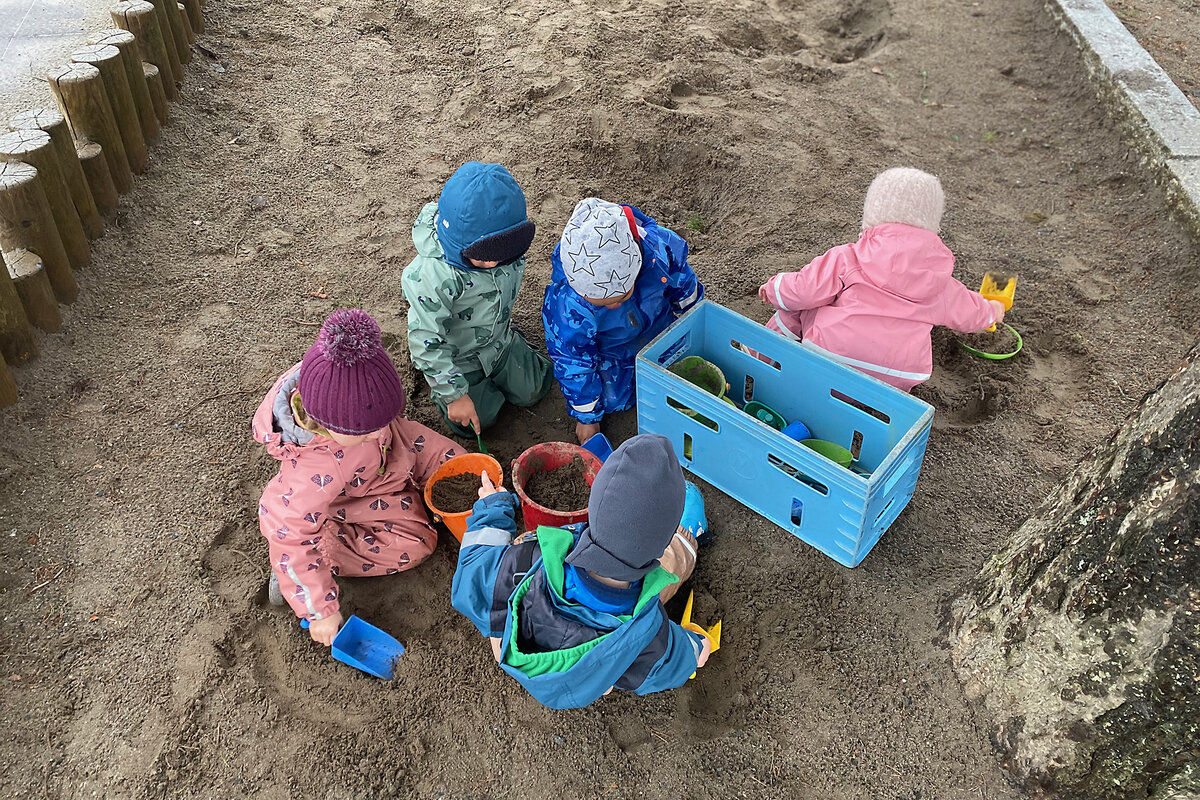
Photo: Jackie Mader/The Hechinger Report.
In Norway, a joyful, secure childhood is a legal right.

I was intrigued by today’s story on Norway’s approach to childhood. One point that made me smile was that the children in early-education programs take naps outdoors, bundled up in sleeping bags. My younger grandson took naps that way. Maybe because he’s half Swedish. Those Northerners don’t believe in bad weather.

Jackie Mader writes at the Hechinger Report via the Christian Science Monitor, “Just north of Oslo, Sylvia Lorentzen’s two child care programs straddle a narrow, winding road that leads up to the lush forests that encircle parts of Norway’s capital.

“In Norway’s system of universal child care, children ages 5 and under immerse themselves in nature. In the winter, those in Ms. Lorentzen’s care learn to ski and sled. In the summer, they swim, canoe, and rock climb – and then rest in hammocks.

“Around age 4, they learn how to safely use a knife. Then they huddle together outside, whittling wooden figures out of sticks to practice. By age 5, they are cutting logs with a saw and building fires. Toddlers nap outside, bundled inside puffy, miniature sleeping bags affixed to their strollers.

“Universal child care is ‘both seen as an investment for the society and an investment for the child,’ says Kristin Aasta Morken, a program leader in the city of Oslo. Public funding covers 85% of operating costs for child care programs in Norway. Parents pay about $182 per month.

“In the United States, it’s parents, mostly, who cover the costs for this care – though some employers and local jurisdictions may offer partial reimbursement.

‘Social differences are something Norway does not accept.’

“ ‘Kindergarten is so important to level out social inequities,’ says Robert Ullmann, head of a consortium of child care centers. ‘In Norway, we think it’s democratic that everyone can have the same opportunities and move out of being poor. Social differences are something Norway does not accept.’ …

“ ‘A really important pillar of Norway’s early ed philosophy is the value of childhood in itself,’ says Henrik D. Zachrisson, director of the Centre for Research on Equality in Education at the University of Oslo. ‘Early ed is supposed to be a place where children can be children and have the best childhood possible.’

“It’s an idea that undergirds Norway’s nationalized approach to its ‘kindergartens,’ which here serve children age 5 and younger, including toddlers and infants. …

“On a drizzly morning earlier this year at Preståsen Kanvas-barnehage, one of Mr. Ullmann’s kindergarten programs in south Oslo, children roam around an expansive play yard, building sandcastles under the canopy of a large pine tree. Others zoom down a hill on bikes.

“In another playground on campus, children shriek as they splash through a large puddle. This draws more children hoping to play. Rather than caution the children about getting wet, a teacher walks over and hands them buckets to have at it.

“Children with disabilities, who are often segregated in American child care programs, are included in activities. Some of them have a city-funded aide who attends to their needs.

“In some rooms, posters on the wall show pictures of common items or common requests, so children still learning Norwegian can point to what they need. In one room, children are learning about the Muslim holiday, Eid al-Fitr. …

“Ironically, Norway’s policies have been inspired in part by American studies that found troubling language skills gaps between higher- and lower-income children. Other influential American scholarship also revealed high educational returns from investing in early childhood programs.

“ ‘The argument I’ve heard is that if you don’t send your children to kindergarten, then you steal some possible experiences from them,’ says Adrian Kristinsønn Jacobsen, a doctoral candidate at the University of Stavanger in Norway who studies early childhood science education rooted in experiencing nature.

“There are important contexts affecting each country’s approach, however. Norway is home to about 5.5 million people, and about 82% are ethnically Norwegian. This population lives in an area roughly the size of Montana. Norway is also a top producer of oil, which helped generate a per capita household income that was over $104,000 in 2022, according to the International Monetary Fund.

“The U.S., on the other hand, has 62 times the number of residents that Norway has and a far more diverse population. In 2022, per capita household income in the U.S. was about $77,000.

“In Norway, nearly 1.4% of the country’s gross domestic product goes toward early childhood programs. The U.S. spends less than 0.4% of its GDP, according to the Organization for Economic Cooperation and Development.

“Public funding covers 85% of operating costs for child care programs in Norway. As of this summer, the tuition parents pay has been capped at about $182 per month. This applies to both public and private programs, and includes in-home kindergartens, which preserve a certain amount of choice for parents. Programs receive funding on a per-child basis. Kindergartens that care for children under 3 years old receive twice the funding of those ages 3 to 5, since toddlers and infants require more individualized care.

“Norwegian children are guaranteed a spot in a kindergarten after they turn 1 year old – about the time many parents’ paid leave ends. If parents decide not to send their children to a kindergarten, they receive financial assistance to stay home.

“Norway’s understanding of kindergarten is deeply ingrained in its culture. But these benefits, signed into law in the Kindergarten Act of 2006 – which repeats the word ‘play’ 56 times – also express some of the country’s deeply held values.

“Child care programs must acknowledge ‘the intrinsic value’ of childhood, according to the 63-page law. ‘The Kindergarten must be based on fundamental values in the Christian and humanist heritage and tradition, such as respect for human dignity and nature, on intellectual freedom, charity, forgiveness, equality and solidarity, values that also appear in different religions and beliefs and are rooted in human rights,’ the law declares. …

“The law proclaims, too, that kindergartens should ‘promote democracy and equality and counteract all forms of discrimination.’ ”

More at the Monitor, here.

Read Full Post »

Illustration: Wingårdhs.
Tomelilla, a town in southeast Sweden, is focused on sustainability and has plans to build a school with reused materials.

With half of my family in Sweden for the fall semester, I am interested in Swedish stories. Here is one about residents in the Skåne district determined to live sustainably.

Abigail Sykes reports at the Guardian, “In a small town in Sweden, the local authority is carrying out an unusual experiment.

“In 2021 one of the team had been reading an article about the concept of doughnut economics – a circular way of thinking about the way we use resources – and he brought it up. ‘I just mentioned it casually at a meeting, as a tool to evaluate our new quality of life program, and it grew from there,’ says Stefan Persson, Tomelilla’s organizational development manager.

“The concept, developed by British economist Kate Raworth is fairly straightforward. The outer ring or ecological ceiling of the doughnut consists of the nine ‘planetary’ boundaries. These are the environmental limits that humans are at risk of passing – we’ve already crossed the safety thresholds on climate change, ocean acidification and biogeochemical flows, for example, but remain within safe limits on our atmospheric aerosol loading. The inner ring forms a social foundation of life’s essentials, and the ‘dough’ in between corresponds to a safe and just space for humanity, which meets the needs of people and planet. …

“ ‘Doughnut economics is like running a farm. Using an excess of resources, like nutrients, on your crops is a mistake. Not using enough is a mistake too,’ says Persson’s colleague Per-Martin Svensson, who is a farmer when he is not doing council work. …

“Doughnut economics is being used in Tomelilla, in Sweden’s southern Skåne region, in several ways. It has been integrated into financial planning and decision support, so that rather than building a new ice rink, the plan is now to revamp an existing building.

“The local government produces an annual portrait of how well it is doing at meeting doughnut economics targets. The best results in the latest diagram were on air quality, housing and social equality. Air quality in the area was good to begin with, but in order to keep improving it, young people at lower and upper secondary school have been given a free travel card for public transport. It is hoped the measure will also improve social equality in terms of access to education and health. Overcrowding and income disparities have both decreased, but it’s hard to link that directly to any of the council’s work.

“Education is a priority, but targets such as carbon emissions, biodiversity and health are more difficult to meet. Emissions have not been decreasing, but in 2023 the town council adopted a climate program to achieve net zero by 2045. …

“Tomelilla’s flagship doughnut economics project, though, is planning a new school. The council hasn’t built a school – or any other big development – since the 1990s. The project is still at an early stage so no decisions have been made about the final construction.

“Last year, a consultant report made recommendations for the project. These included using existing and carbon-neutral materials as far as possible, growing hemp as a building material on the current site; building the school around a greenhouse for growing vegetables as well as for educational and social activities; and making the school an off-grid energy producer using solar power and batteries. …

“This vision has carried over into the council’s procurement requirements, although budget constraints and other considerations have meant it is still unclear whether all of these ideas will come to fruition. …

“It has certainly been demanding. Is it even possible to use the resources needed for a large construction project and stay within the doughnut? Persson thinks it may not be possible but he is focusing on the bigger picture, with a more holistic view of social change. ‘In individual projects, there are always trade-offs. But we’re also looking at how the local community as a whole can move towards the doughnut model. I think that if we’re going to build anything, it should be democratic meeting places and schools.’ …

“Tomelilla is the first local government to attempt to deliver infrastructure and education using doughnut economics. … With a population of about 7,000, it is certainly one of the smallest towns in the international network of the Doughnut Economics Action Lab, dwarfed by Barcelona, Glasgow and Mexico City, which are all putting Raworth’s theories into practice in local governments. …

“The people of Tomelilla welcome the challenge and are extremely proud of the way their town is forging a path. As Jonna Olsson, one of the staff at the council says: ‘Doughnut economics is a really interesting way to work with sustainability. It feels cool to be a cog in international change.’ ”

More at the Guardian, here. No firewall.

Read Full Post »

Photo: Anne Pinto-Rodrigues.
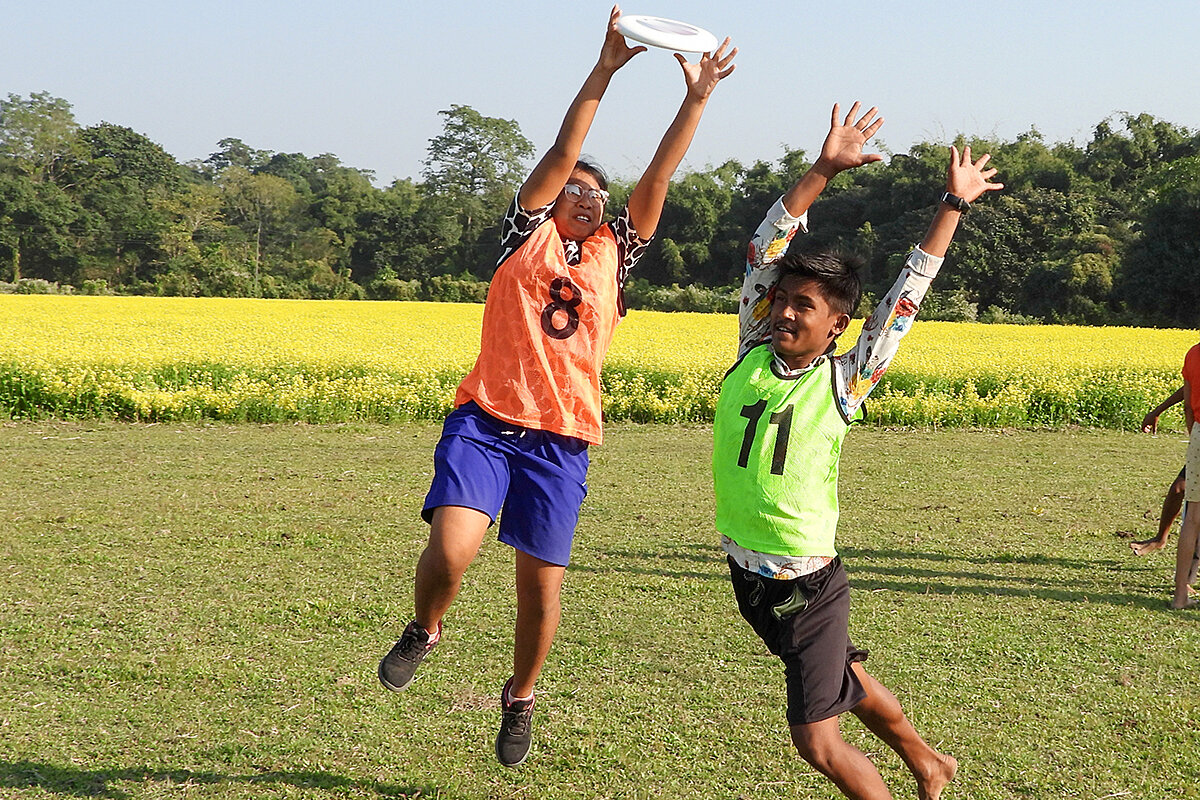
Phungbili Basumatary (left) completes a pass during in ultimate Frisbee in Rowmari village, India. She says the sport has allowed her to bond with teammates from different ethnic backgrounds.

The reason I share so many stories from the Christian Science Monitor is that they seek out good news whenever possible. In India, where ethnic violence has grown worse in recent years, a happy kind of game is drawing young people of different faiths together.

Anne Pinto-Rodrigues writes at the Christian Science Monitor, “On a cool Sunday afternoon, a white disc whizzes through the air in Rowmari village, located in the Indian state of Assam. A teenage girl snatches it out of the air, earning applause and supportive whoops from the other players on the field, who all come from different villages.

“The American flying disc game officially known as ultimate – or ‘ultimate Frisbee,’ for those not worried about trademark infringement – was virtually unheard of in this part of the world till a few years ago. But it’s rapidly gaining popularity throughout northeast India. That includes Assam’s Chirang district, where over 30 girls and boys gathered in Rowmari village last December for a coaching session organized by the Action Northeast Trust (ant), a rural development nonprofit. …

“Chirang was not always this idyllic. Starting in the 1980s, the region experienced over two decades of ethno-religious conflict between the majority Bodos, Muslims, and the several other groups. Poverty is rampant, as are gender inequality and child marriage. But ultimate, with its emphasis on self-governance, provides an opportunity to foster peace among Assam’s newest generation.

“Today, 3,500 children and youth from nearly 100 villages participate. …

“ ‘I’ve observed a substantial transformation in the behavior and attitudes of the young people in communities where the [Frisbee] program is active,’ says Dr. Deben Bachaspatimayum, a social activist and teacher of peace studies based in Manipur, another state contending with violence in northeast India.

‘This bottom-up peace-building approach is helping youth discover a society based on equality and justice.’ …

“The region is largely peaceful now, but as recently as 2014, outbreaks of violence in Chirang and neighboring areas left over 100 dead and thousands homeless. 

“ ‘After the 2014 conflict, we were looking for something that would bring communities together,’ says Jennifer Liang, co-founder of the ant. “Something girls could get involved in.’ …

“It’s a mixed-gender, noncontact, and relatively new sport, meaning everyone in the community would be building their skills from scratch. The game involves two teams of seven players each, who score points by completing passes. There are no referees – instead, players must communicate with each other to call fouls and resolve conflicts. …

“So in 2015, the ant introduced a very simple version of the game to a cluster of villages known as Deosri that had been struggling with violence. … The league recruits young people between the ages of 11 and 14. Team members all come from the same village and, as a result, tend to be from the same ethnic group. The challenge is learning to work with the opposite gender. 

“ ‘Initially in these villages, the boys were skeptical about being in a mixed-gender team,’ says Ms. Liang. ‘In due course, they realized that the girls are equally important.’ …

“Manoranjan players can graduate to the more competitive Rainbow league, where the ant introduces more rules to promote peace building. Each team must include players from a minimum of three different villages, three different ethnicities, and three different mother tongues. … Rainbow sessions end with group discussions on burning social issues like child marriage and suicide. …

“Ms. Ray, who’s part of Durgapur village’s Rajbongshi ethnic group, [said that ultimate came] to the region, ‘there were times we would tell children from other communities or religions not to play with us,’ she says, with great remorse. ‘Now I treat everyone equally.’

“Although ubiquitous in America, Frisbees and other flying discs are available only in one sporting goods store in Assam’s capital city. Ms. Liang hopes that in the future, discs will become available in every village shop, as easy to come by as a soccer ball.

“ ‘My dream is that Frisbee doesn’t remain a nonprofit-led program, but rather something all children can play,’ says Ms. Liang.”

More at the Monitor, here.

Read Full Post »

Photo: Library of Congress
This powerful image symbolizes the awakening of the nation’s women to the desire for suffrage. The torch bearer is striding across the western states, where women already had the right to vote, toward the east where women are reaching out.

This month I’ve been enjoying a different tea every day after my daughter-in-law had the kind thought of giving me a teabag-a-day Advent calendar. I do like trying new teas. Today I’m thinking about the role tea has played in American history. No, not just when men threw tea into Boston Harbor to protest “taxation without representation,” but when women urged people to buy Equality Tea.

Janelle Peters writes at the Atlantic, “Access to daily necessities has long been a priority for social-reform movements. … When it came time for women to get the vote, tea played a role, too. Women such as the wealthy Alva Vanderbilt-Belmont held ‘suffrage teas,’ where support for the cause was proclaimed. The tea parties also served as fund-raisers, a practice that extended to the teas themselves.

“In California, suffragist women showed how both tea and the national movement of women’s suffrage could be democratized at the state level. Two suffrage teas generated revenue for political organizing in the run-up to the 1911 election. … Equality Tea sprang up in Northern California and spread throughout the state. In Southern California, Nancy Tuttle Craig used her position as one of the only female grocers in the state to package a ‘Votes for Women’ tea. …

“By the late 19th century, the suffragette cause had stalled in the Golden State. … It took a decade and a half for California women to prove that they had a broad base of support to gain the right to vote in state elections. The 1911 vote was hard-fought. Suffrage leagues and reform-minded women organized feverishly, but women’s suffrage still did not pass in San Francisco. This time, the rest of the state made up the difference. Tea smoothed over the gap between San Francisco, Los Angeles, and San Diego in supporting women’s suffrage.

“Equality Tea was based in Northern California. Distributed by the Woman’s Suffrage Party, it spread through the state. San Francisco storerooms served the tea in tearooms decorated with a Chinese theme. Suffrage-minded consumers could purchase Equality Tea in half-pound, whole-pound, and five-pound boxes. Varieties included Ceylon, English breakfast, young hyson, gunpowder, and oolong. Some suffrage organizations, like the Club Women’s Franchise League, served Equality Tea at their headquarters in the St. Francis Hotel on Saturday afternoons.

“[Equality Tea] was also sold at regional fairs and by mail order. Ads appeared in venues ranging from local newspapers to medical journals. Some grocers carried the tea, and

there were women who refused to pay their grocery bills if their grocer did not carry Equality Tea.

“The ability to order by mail assured that the tea’s purveyors did not discriminate against rural or lower-class residents, groups of the population with stronger support for women’s suffrage.

“Tea became a central feature of the political strategy of San Francisco suffragists. On August 22, 1911, The San Francisco Call reported that the Votes for Women club had prepared a ‘suffrage special’ train that would carry feminist speakers to the state fair in order to be heard by people from all parts of the state. … By emphasizing tea on the suffrage train, the Votes for Women club focused on how accessible the basic civic right could be.”

Read more at the Atlantic, here, while I head off for tea at Pamela’s home.

Read Full Post »

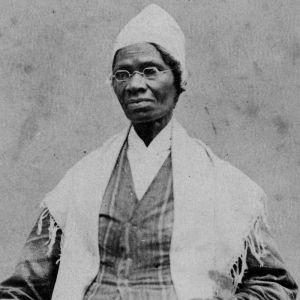
Today let’s hear from Sojourner Truth (1797-1883), who gave this speech extemporaneously at the 1851 Women’s Convention in Akron, Ohio. She begins by addressing two parallel causes: the fight for freedom of “the negroes of the South and the women at the North.” Then she goes on to say that as a black woman, women’s rights are her cause, too.

“That man over there says that women need to be helped into carriages, and lifted over ditches, and to have the best place everywhere. Nobody ever helps me into carriages, or over mud-puddles, or gives me any best place! And ain’t I a woman? Look at me! Look at my arm! I have ploughed and planted, and gathered into barns, and no man could head me! And ain’t I a woman? I could work as much and eat as much as a man — when I could get it — and bear the lash as well! And ain’t I a woman? I have borne thirteen children, and seen most all sold off to slavery, and when I cried out with my mother’s grief, none but Jesus heard me! And ain’t I a woman? …

“Then that little man in black there, he says women can’t have as much rights as men, ’cause Christ wasn’t a woman! Where did your Christ come from? Where did your Christ come from? From God and a woman! Man had nothing to do with Him.

“If the first woman God ever made was strong enough to turn the world upside down all alone, these women together ought to be able to turn it back , and get it right side up again! And now they is asking to do it, the men better let them.

“Obliged to you for hearing me, and now old Sojourner ain’t got nothing more to say.” Except she’s still saying it: that the rights of one group are inseparable from the rights of all.

More here.

Photo: Biography.com

mtm1otk1mzmyodiynji2mjc0


Read Full Post »

In Tanzania, women farmers appearing on a TV show called in English “Female Food Heroes” are bringing attention to the importance of their work and the barriers to expansion.

Oxfam America reporter Coco McCabe writes about contestant Edna Kiogwe, “She grew up in a farming family and knows well the hurdles they face, especially women farmers who, in her country, own only a small fraction of the land. …

“It’s that inequality — and the lost opportunities buried beneath it — to which Kiogwe and 14 other women farmers helped to bring attention this year as contestants in the fifth season of a highly popular reality TV show shot in Tanzania and aired across East Africa. Called Mama ‘Shujaa wa Chakula ,’ or ‘Female Food Heroes,’ the Oxfam-sponsored show celebrates the vital contributions women farmers make in feeding the planet, and highlights the challenges many encounter on a daily basis, including limited access to land, credit, and training opportunities. …

“In the village of Kisanga, where ‘Mama Shujaa wa Chakula’ was filmed [in 2015], the 15 contestants learned a great deal about the struggles local farmers face in feeding their families. Each of the women stayed with a village family for the duration of the three-week shoot, and daily contests included designing tools that could be useful to Kisanga farmers, interviewing them about their agricultural challenges, and putting together skits to help bring attention to those hurdles. …

“Kiogwe [now] spends most of her time in Dar es Salaam, a coastal city about a two-and-a-half hour drive away, where she lives and works as a civil servant. But her city life belies her village roots — and her keen interest in farming. Unlike most women in Tanzania, Kiogwe owns her own land, given to her by her forward-thinking father on her wedding day. She harvests corn, cassava, rice, and sugar cane, carefully aligning her 28 days of annual leave from her city job with peak work times on her small farm in the Morogoro region. …

“ ‘I want to make agriculture like a business,’ says Kiogwe. … With a little effort, greater value can be added to the fruits farmers grow, for instance.

“ ‘Change it from fruit to juice, we can sell it … We can add value to maize — maize flour for porridge — and you can have a good label and good packaging and compete with international businesses. That is my dream.’ ” More here.

According to OXFAMCloseup, the nonprofit’s quarterly magazine, the episodes shot in Kisanga, Tanzania, aired in five countries and had 14 million people tune in. The magazine adds, “Versions of the program are now being produced in Ethiopia and Nigeria, and some finalists have become involved in local, national, and even global farmer advocacy.”

Photo: Coco McCabe / Oxfam America
Edna Kiogwe helps her host family with the morning chores in Kisanga, where the TV show “Female Food Heroes” was filmed in 2015.

Read Full Post »