Feeds:
Posts
Comments

Posts Tagged ‘evolve’

Dance at a Powwow

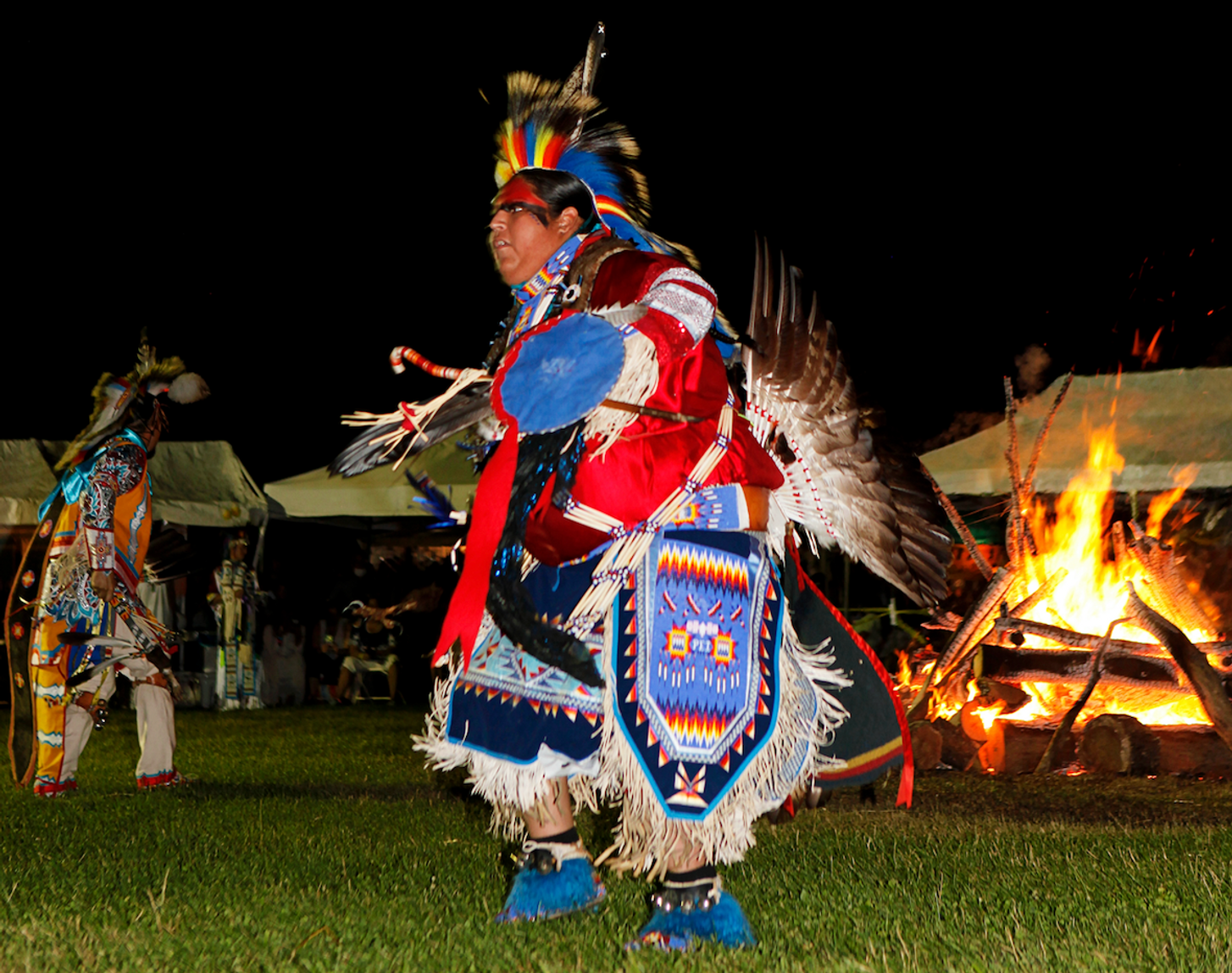
Photo: Linda Dulan.
In July, the Thunderbird American Indian Dancers hosted its 42nd annual powwow at New York’s Queens County Farm Museum. Seen here, an old-style men’s dance.

I’ve always wanted to get to the Narragansett tribe‘s summer Powwow in Rhode Island. And I will do it yet — never mind how busy summer gets.

In today’s post, Dance magazine whets my appetite even more with wonderful pictures from a “dance powwow” in New York State.

“Over the course of three days in July, the Thunderbird American Indian Dancers hosted its 42nd annual powwow at Queens County Farm Museum. Founded in 1963 by members of the Mohawk, Hopi, Winnebago and Kuna (San Blas) tribes, Thunderbird is the oldest resident Native American dance company in New York, and puts on the city’s largest powwow, drawing dancers from more than 40 tribal nations for a series of performances and dance contests, as well as crafts and food stands.

The next morning the mother showed the women how to make the dress, showed them a special dance and sang a very special song for them. Sure enough, her daughter got well.

Dance Magazine joined [a] sunset bonfire to capture some of the competitions, and asked Thunderbird director Louis Mofsie and company dancer Michael Taylor to share their insights on the place of dance within the powwow.”

They write, “The powwow is a social gathering where we get together to dance and sing, to meet old friends and make new ones. Originally a Western/Great Plains tradition, it does not have any religious or ceremonial significance — our religious and ceremonial dances and songs are restricted and closed to outsiders.

“Dancing is the major activity. Over the weekend, there are dance competitions and also what are called intertribal dances, where the dancers from all tribes are invited to participate. Our bonfire each evening during the gathering is there to help us travel back in time to the days when we had no spotlights. It reminds us of our past, our connection to our heritage and how it has survived through all our hardships to this day.

“As Native American people, we start dancing at a very young age. Dancing at powwows is how we learn the different styles of dances and what they represent. It helps us to connect to our roots and reinforces our awareness of who we are. It also reminds us that Native American dance is the original dance in America—and is still alive today. …

“Women’s Fancy Shawl Dance. This dance dates back to around 1945, right after the Second World War. Native American women and men had volunteered for the armed services and traveled all over the world. During their travels they observed how the women in many different countries were dancing. When they returned home, they decided to introduce a different style of dancing. Traditionally, the women did a very slow, graceful movement around the outer edge of the dance circle, and the men would be doing more vigorous movement on the inside. The Fancy Shawl Dance is much faster in rhythm, more vigorous and permits them to dance on the inside of the circle. The women wear shawls with very long fringe along the edges, and as they move, the fringe reminds you of the feathers that the men wear. Although the women do not wear the feathers and bells on their legs like the men do, their footwork and movements are very similar.

“Men’s Fancy Dance. They say this dance also originated around the end of the Second World War. When the men returned home from the war, they also wanted a more vigorous style of movement. Fancy dancing is much faster than traditional men’s dancing. Each of the dancers tries to create as many fancy steps as they can while keeping time with the singing and drumming. The men wear feathers with ribbons attached to each end, and they carry dance wands that are decorated with ribbons and feathers.

“Women’s Jingle Dress Dance. This dance tells the story of its origin. There was a mother who had a very ill daughter. One night she had a dream, and in it she had a vision: She was told to show the women how to make a special dress with little cones or jingles on it, show them how to do a special kind of dance and sing them a very special song. If she did all these things, it would help her daughter get well. The next morning the mother showed the women how to make the dress, showed them a special dance and sang a very special song for them. Sure enough, her daughter got well. The dance started out as a healing dance but has come down to us as one of the more popular competition dances at the powwow gatherings.”

I never thought about it before, but why should any community have an art form that never evolves. I love the idea that indigenous people who returned from WW II incorporated new influences into traditional dance. More at Dance, here.
Read Full Post »

093020news20band20lede

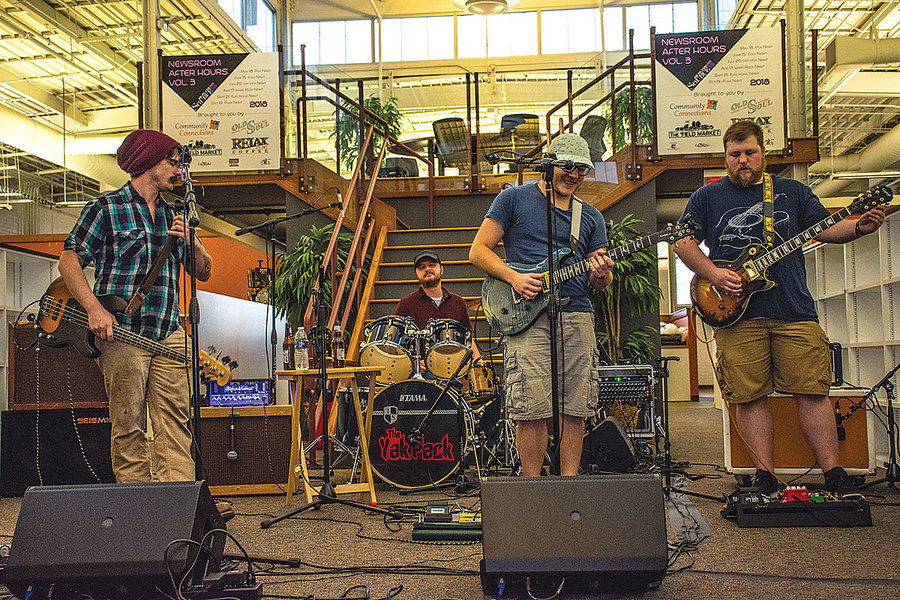
Photo: Richland Source
As part of its effort to engage community members, an online news startup in Mansfield, Ohio, holds free Newsroom After Hours concerts that feature local bands — and free beer and food.

Local journalism is in trouble as giant organizations like GateHouse Media buy up papers and cut staff. That’s a problem not only because of the jobs lost but because so much important news is first revealed thanks to investigations at the local level.

Still, there are always people who will find find opportunity when everything looks bleak.

Doug Struck writes at the Christian Science Monitor, “Noah Jones is working. The young reporter for the Richland Source, a local news startup in the heart of Ohio’s Rust Belt, listens to the jazz quartet warm up and eyes the crowd. Then he takes the mic.

“ ‘Thank you for coming out tonight,’ Mr. Jones intones, in his best master-of-ceremonies voice. ‘Now let’s welcome the Mansfield Jazz Orchestra quartet!’

“The small concert, with free beer and food for the public, is in the middle of the shared-space newsroom of the Richland Source, an online site started by a businessman who thought his city needed more news.

“The monthly Newsroom After Hours concert – from jazz to pop to hip-hop – is just one of the unfamiliar roles for some journalists and publishers trying bold experiments to buck the wholesale die-off of local news sources around the country. Like mad inventors, they are furiously writing and rewriting plans to find what works, often in small-scale, community efforts. …

The University of North Carolina at Chapel Hill last year found that in the past 14 years, 1,800 newspapers have closed – 1 in every 5 across the country – creating a U.S. map spotted with ‘news deserts.’

“A Pew Research Center analysis in July showed newspaper circulation since 1990 dropping by half, to 31 million last year. Pew noted jobs in all newsrooms plunged by one-quarter in the past decade. A Wall Street Journal study published in May said Google and Facebook have sucked up 77% of digital advertising revenues from local markets. …

“For years, observers have warned of the effects of this loss of news coverage: paralyzing partisanship, lower voting rates, government corruption, little accountability among public officials, less civic engagement. … Equity firms have bought up many local news outlets at fire-sale prices, often slashing staffs and coverage to drain the last bit of profits. …

“[Carl Fernyak, founder of the Richland Source,] says he knew ‘zero, nothing’ about news publishing when he began the Richland Source six years ago, but predicts the organization is now within 18 months of breaking even. …

“In 2013, Mr. Fernyak joined a Chamber of Commerce study of the sagging Rust Belt town. ‘Without fail, each one of the businesses said we have an image problem, a self-esteem problem,’ he says. ‘Ninety-five percent of the coverage was crime.’

“Mr. Fernyak was in the office equipment business, but within six months he had hired a president, a veteran managing editor, and a few journalists, and started the Richland Source. … The site, which Mr. Fernyak adamantly keeps free to readers, offers up a smorgasbord of hard news and homespun stories. A recent front page included a shooting-suicide next to news that Barb Weaver had once again won the county fair’s lemon meringue pie contest. The site has local sports, summer parades, short features on business owners, and occasionally a deep dive into a social problem.

“To support this, and to bond with readers, the Richland Source and its owner do some decidedly untraditional things. There are the newsroom concerts, trivia nights at a local brewery, movie nights, and roundtable discussions with high school students – all staffed in part by Richland Source employees.

“The Source has a marketing arm that crafts social media strategies and ads for businesses, the editors are trying to sell an artificial intelligence program they use to generate short stories on high school games, and the staff solicited $70,000 from businesses and community groups to pay for two extensive reporting projects. Reporters are expected to make an ‘ask,’ through email and social media appeals, for readers to sign up for memberships at $5 to $20 a month. …

“ ‘I like it,’ says Cheryl Moore, a clerk at the 111-year-old Hursh Pharmacy. ‘It’s current, it’s true, and it’s factual.’

“The mayor of the town concurs. ‘They’ve been a breath of fresh air,’ says Timothy Theaker, who was first elected in 2011. ‘If the news is always negative, it starts tearing down the community.’ …

“Mr. Fernyak thinks newsrooms and owners are figuring out models that will work. ‘We’ve had a crazy amount of support from our community for this,’ he says. ‘I had people saying, “It’s about time.” ‘ ”

More at the Christian Science Monitor, here.

Read Full Post »