Feeds:
Posts
Comments

Posts Tagged ‘fairies’

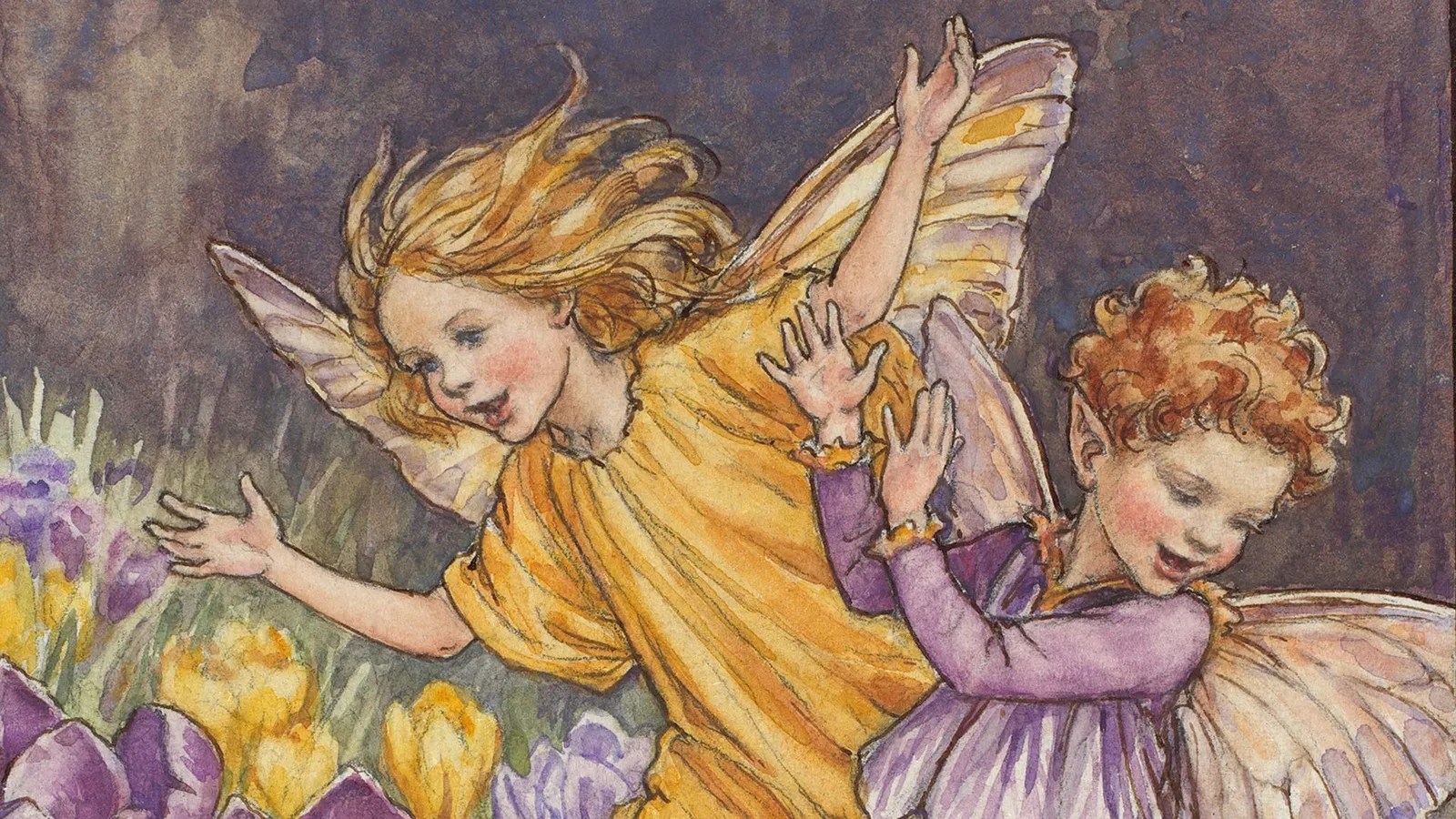
Photo: Estate of Cicely Mary Barker, 1934 Flower Fairies.
The Crocus Fairies from Flower Fairies of the Spring – the watercolors are still popular today with “fairycore” fans, the BBC opines.

Hannah will remember my devotion to the subject of today’s post. Fairies. I have always been into fairies, and long ago Hannah joined me in bringing them to life.

Meanwhile in the UK, the BBC’s Holly Williams writes this about them: “Imagine a fairy. Is the picture that appears in your mind’s eye a tiny, pretty, magical figure – a childish wisp with insect-like wings and a dress made of petals?  

“If so, it’s likely you’ve been influenced by Cicely Mary Barker, the British illustrator who created the Flower Fairies. 2023 marks 100 years since the publication of her first book of poems and pictures, Flower Fairies of the Spring – an anniversary currently being celebrated in an exhibition at the Lady Lever Gallery in Merseyside, UK.  

“The Flower Fairies’ influence has endured: they have never been out of print, and continue to be popular around the world. … Barker’s delicate watercolors certainly helped cement several tropes we now consider classic – almost essential, in fact – in the iconography of the fairy: they are miniature, sweet and youthful, they are intertwined with plants and the natural world, and they are distinctly twee.

“Yet her drawings were also ‘firmly footed in realism’ points out Fiona Slattery Clark, curator of the show. … Barker drew children from the nursery school her sister ran in their house in Croydon near London; each was assigned a flower or tree, and Barker’s detailed illustrations were botanically accurate – she would source samples from Kew Gardens, says Slattery Clark. Even the petal-like wings and fairy outfits were closely based on plants: an acorn cup becoming a jaunty cap, a harebell becoming a prettily scalloped skirt. 

“The Flower Fairies were an immediate hit – but Barker was far from the only artist of her era to find success with fairies. In fact, fairy fever swelled within the United Kingdom for over half a century, reaching something of a peak around the time the Flower Fairies emerged in 1923. Over 350 fairy books were published in the UK between 1920 and 1925, including in Enid Blyton‘s first fairy foray, a collection of poems called Real Fairies in 1923. Fairy art even had the stamp of royal approval: Queen Mary was a fan of Ida Rentoul Outhwaite‘s ethereal drawings, and helped popularize them by sending them in postcard form. …

“But for many hundreds of years, they were not necessarily tiny and fey, but grotesque or fierce elemental forces, capable of great darkness. ‘In 1800, if you thought your child was a fairy it would have been like demonic possession – you would have put that child in the fire to drive out the fairy,’ points out Alice Sage, a curator and historian.

“Yet within 100 years, the whole conception of fairies completely changed. … Fairies became a fashionable subject for Victorian artists, often taking inspiration from Shakespeare’s A Midsummer Night’s Dream and The Tempest. John Anster Fitzgerald, Edwin Landseer, John Everett Millais, Joseph Noel Paton, Arthur Rackham and even JMW Turner – among many others – painted supernatural sprites from the 1840s onwards. But there was still a sense of otherworldly strangeness in many of their depictions – as seen in the work of Richard Dadd, who made his hyper-intricate fairy paintings while living in a Victorian asylum. …

“Barker never made any claims for fairies being real – ‘I have never seen a fairy,’ she wrote in a foreword to Flower Fairies of the Wayside. But it is worth noting that she first published the Flower Fairies at a moment when the desire to believe in magical beings was at a rare high. In 1920, Britain was gripped by the story of the Cottingley Fairies, after two girls claimed to have photographed fairies at the bottom of their garden in West Yorkshire – and were widely believed.

“Their beautiful photographs were created by paper cut-outs, floating on hat pins. Although many were skeptical, they nonetheless also fooled many of the great and the good – the photographs were brought to prominence by no less than Sir Arthur Conan Doyle, the author of Sherlock Holmes, who wrote a whole book about it, The Coming of the Fairies, in 1922.

“Cousins Elsie Wright and Frances Griffiths were aged 16 and nine when they took the first photos. Many years later, in the 1980s, they admitted it was a hoax, explaining that they kept up the pretense that the fairies were real a because they felt sorry for the middle-aged men, like Conan Doyle, that so wanted to believe. …

” ‘For Conan Doyle, it was all about a search for another realm of being that related to life after death, vibrations, telepathy, telekinesis – this fascinating world on the edge of the limits of human perception,’ says Sage. ‘And obviously that’s connected to the loss of his son in World War One.’ …

“Sage is pleased to see the Flower Fairies exhibited in a fine art context at the Lady Lever gallery. For a long time, men painting fairies has been considered art – but when women do it, it’s just silly flowery stuff for children. ‘This is fine art – it’s mass, popular fine art,’ insists Sage.”

More at the BBC, here. No paywall. If you live in the UK, you have until November 5 to see the fairy exhibit at the Lady Lever Art Gallery, Port Sunlight Village.

Read Full Post »

Oh, I do love kindhearted stealth projects. This worldwide campaign promotes reading. Chayanit Itthipongmaetee filed a report about it at KhaosodEnglish in Thailand.

“ ‘A Little Prince’ was hiding at BTS Siam [Bangkok Transportation System, or Skytrain]. A ‘Cat in the Rain’ was discovered at BTS Sala Daeng. …

“Fairies hid copies of these books and more in public places [in early August] as a local launch of The Book Fairies project, an international initiative in which people leave texts for others to discover in cities around the world. After readers finish a book, they are supposed to pass it on to others.

“One of the Bangkok book fairies said she learned about the book-drop project a few days before attending Saturday’s TedxBangkok. At the event held inside the KBank Siam Pic-Ganesha Theatre, she sneakily dropped five copies of best-selling memoir ‘Tuesdays with Morrie.’

“ ‘I was really excited for my first book drop, hiding one book at a time, mostly on breaks throughout the event,’ said the woman. …

“She was delighted to hear from one of her book beneficiaries a day later.

“ ‘Dear #bookfairies, I found this at #TEDxBangkok and took it home with me. I don’t know who you are but thank you for passing it on,’ wrote Facebook user Awm Has Standards. …

“Asked what kind of books she wants Thais to read more, the Bangkok book fairy said it would be literary publications for youths.

“ ‘This might sound strange, but I would love to recommend everyone to read English children’s books. … They are doors to creativity, language learning and life lessons. With or without pictures, the exciting stories for children always allow you to be free with your imagination and color them wild. They are also a good start for those who want to practice English.’

“The Book Fairies campaign was originally launched March 8 on International Women’s Day. The campaign became world-famous when British activist and actress Emma Watson, best known as Hermione Granger in the ‘Harry Potter’ film franchise, left copies of books with feminist themes around cities such as London, Paris and New York.”

More here.

Photo: The Book Fairies Thailand / Facebook

littleprince-420x420

Read Full Post »


Photo: Irish History
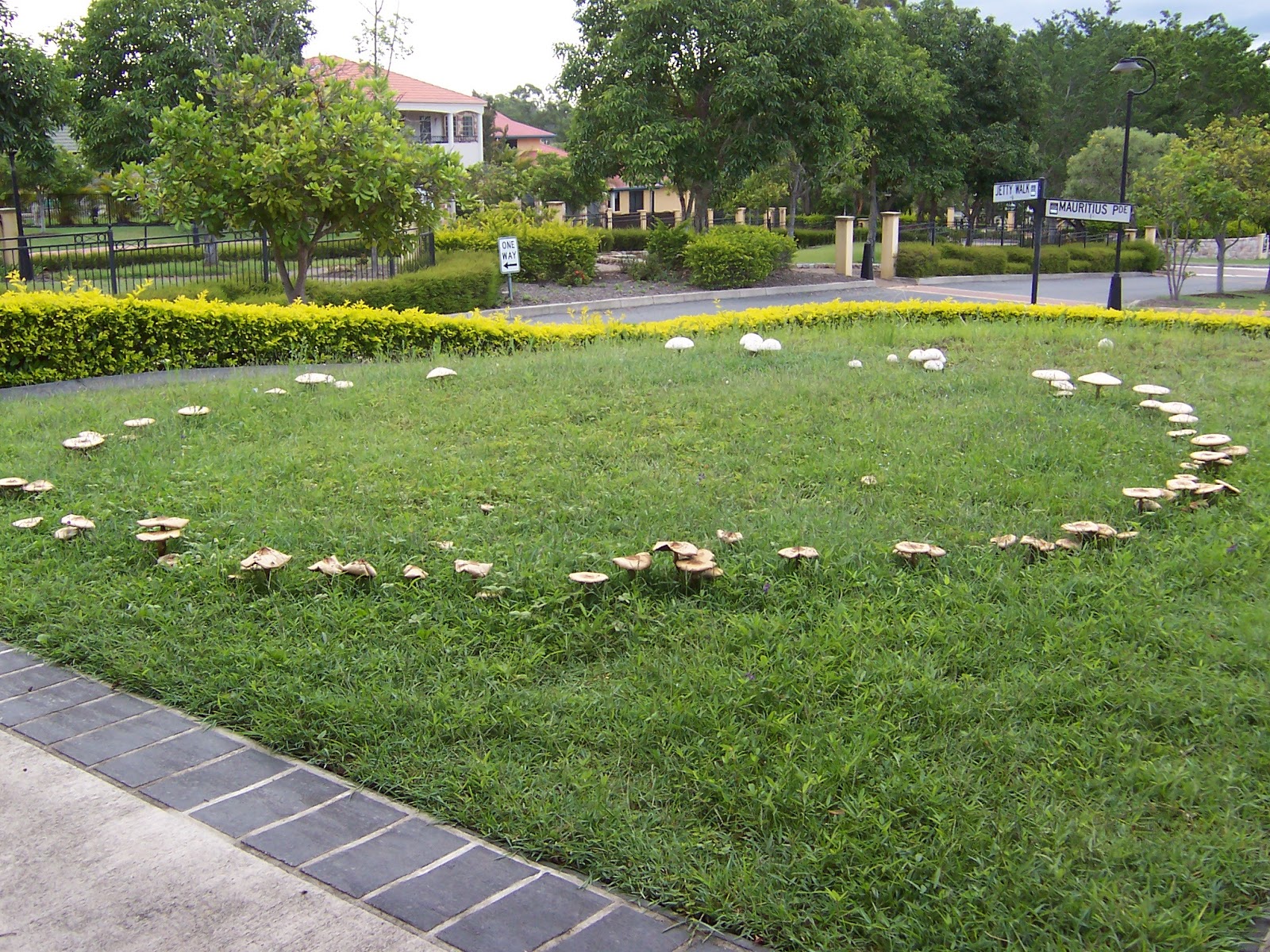
In Ireland and elsewhere, a ring of mushrooms is thought to be a
fairy ring.

Turtle Bunbury posts lots of interesting stories about Ireland on Facebook, and recently he shared an article about the notoriously vengeful Irish fairies.

Michael Fortune, folklorist and filmmaker, writing at an Irish publication called the Journal, says that “there’s not a village in the country that doesn’t have these fairy stories. Our folklore tell us that they inhabit certain places: bushes, stones, corners of fields and especially old enclosures which number 40,000 plus around the country. …

“It’s generally claimed that we have lost some 10,000 since they were first mapped in the 19th century and this is mostly due to mechanisation and developments in agriculture, land reclamation etc.

“Growing up on the coast of Wexford my own late father brought me to every raheen in our area, while in the same breath showed me the spots where others once stood and most importantly, told me who was involved in removing them and the consequences they suffered. …

” ‘It’s not worth the risk,’ I repeatedly hear from farmers. …

“When the landscape changed due to developments in agriculture and field formation over the centuries, these physical spaces were left behind, untouched and this is where your fairy paths come into play. …

“We literally have thousands of stories relating to the consequences of building/interfering on such paths recorded in our archives or alive in the stories of communities around the country. …

“In extreme cases I’ve seen houses abandoned due to the torment brought on by the fairies. And if your DIY skills couldn’t fix it, you’d call for some outside expertise and I’m not talking Dermot Bannon here with his concepts of light and open spaces. No, more along the lines of those those ancient Druid like fellas with their prayers, magic water and long flowing cape ie the local parish priest.

“Although Rome mightn’t have agreed with their actions, there are numerous accounts of priests being brought in to perform exorcisms of sorts on such houses all over the country. In my own village in Wexford one such story still survives of a priest who was brought into a house which the fairies visited every night and after ‘driving the fairies out, he died three weeks later as a result of his efforts.’ Such was the power of the fairies.” More at the Journal, here.

I loved Fortune’s video of two believers. I especially loved their brogue since I failed to record James‘s speech, and now he’s gone.

Film: Michael Fortune
Two men discuss encounters with the fairies in Ireland.

Read Full Post »

Art: Cicely Mary Barker (thank you, Lili Matthews, for the correction)

I happened to hear from Hannah this week. We went to the same schools from age 4 through age 13. We’re in touch from time to time but not regularly, so I was pleasantly surprised.

Hannah mentioned she remembered “playing fairies in the wonderful fields behind your house.” Although I don’t have a mental picture of the two of us playing fairies there, I am not surprised to learn we did. Fairies were a big part of my childhood. Even now, I occasionally catch myself wondering if they could be real.

Hannah got me thinking of other imaginative play in childhood: tea parties with cinnamon toast in an attic closet with Carole, the woodland path where Patsy and I walked without speaking because of deep magic, plans with Ursula to perform “Snow White and Rose Red” before the movie at the Lafayette Theater (if only our brothers would cooperate and play their assigned roles), nefarious scheming with the Jukes kids on the roof of a small building, outdoor theatricals with the Cummings kids.

You will say we must not have had television, but in fact we had the first tv in the neighborhood, and kids from all around gathered to watch Disneyland on a tiny black & white screen on Saturdays. And you can bet that whatever magic Walt dreamed up was magic I believed.

Read Full Post »

Photo of John Bauer: Wikimedia Commons

When I was poking around the web for art to illustrate my post Iceland Has Elves, I found a lovely picture by John Bauer.

I didn’t know anything about him. But Stuga40 wrote in the comments that he was Swedish. She knew where he had lived before his untimely death in 1918 and said she grew up on his fairy stories.

I decided I wanted to know more.

Wikipedia says John Bauer is “best known for his illustrations of Bland tomtar och troll (Among Gnomes and Trolls). Princess Tuvstarr and the Fishpond  [is] perhaps Bauer’s most notable work. …

“Bauer’s early work was influenced to a large extent by Albert Engström and Carl Larsson, two contemporaries and influential painters. Bauer’s first major work was commissioned in 1904, when he was asked to illustrate a book on Lappland. It was not until 1907 that he would become known for his illustrations of Bland tomtar och troll, the yearly fairy tale book.”

A contemporary story collection called Swedish Folk Tales uses Bauer’s illustrations and is available here. Also, someone posted a bunch of his illustrations on Pinterest, including a sweet Santa Lucia.

John Bauer art showing a boy and a troll: Wikimedia Commons

Read Full Post »

Doubtless you know about fairy circles, also called fairy rings. According to Wikipedia, they’re a “naturally occurring ring or arc of mushrooms. The rings may grow to over 10 metres (33 ft) in diameter, and they become stable over time as the fungus grows and seeks food underground.

“They are found mainly in forested areas, but also appear in grasslands or rangelands. Fairy rings are detectable by sporocarps in rings or arcs, as well as by a necrotic zone (dead grass), or a ring of dark green grass. If these manifestations are visible a fairy fungus mycelium is likely to be present in the ring or arc underneath.

“Fairy rings also occupy a prominent place in European folklore as the location of gateways into elfin kingdoms.”

But in Africa, there is a different kind of fairy circle that doesn’t seem to have anything to do with mushrooms.

Did you catch the article by Sindya Bhanoo in the NY Times?

“The grasslands of Namibia — and to a lesser extent its neighbors Angola and South Africa — are speckled with millions of mysterious bare spots called ‘fairy circles,’ their origins unknown.

“Now, a study based on several years of satellite images describes the circles’ life span as they appear, transform over decades, and then eventually disappear.

“Writing in the journal PLoS One, Walter R. Tschinkel, the study’s author and a biologist at Florida State University, reports that the circles can last 24 to 75 years.

“The circles, which range from about 6 to 30 feet in diameter, begin as bare spots on an otherwise continuous grass carpet; after a few years, taller grass starts to grow around the circle’s perimeter.”

The reader is left with the question, Are these circles gateways to elfin kingdoms? What kind of elves are in Namibia?

I don’t understand why scientists don’t investigate matters like that.

Update July 13, 2012: Asakiyume has been tracking down stories about African fairy circles. Read this.

Update March 30, 2013: NY Times has fingered a particular species of sand termites, Psammotermes alloceru. Read this.

Photograph: Walter R. Tschinkel

Read Full Post »