Feeds:
Posts
Comments

Posts Tagged ‘faith’

Photo: Francine Kiefer/The Christian Science Monitor.
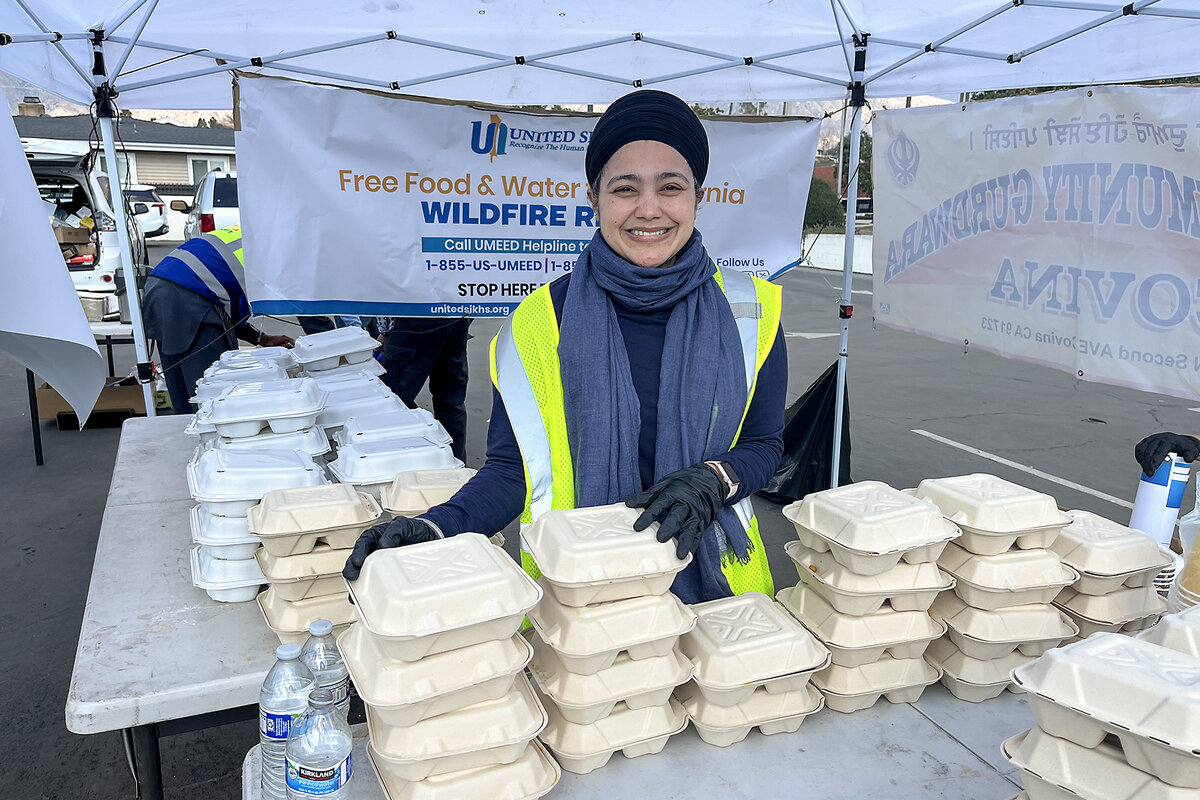
Meetan Kaur, of United Sikhs, stands with hot meals of basmati rice and chickpea curry for fire evacuees at the Pasadena Church East Campus donation center, Jan. 17, 2025.

Despite the loss of many houses of worship in the recent Southern California fires, faith communities are rising up to help others. And helping others others is helping the volunteers themselves begin to feel hopeful. (Scientologists? Why not? We are all human beings in a disaster.)

Francine Kiefer and Sophie Hills write at the Christian Science Monitor, “Cars pull into the Pasadena Church parking lot, waved forward by a couple of Scientologists. Christian volunteers hand out groceries and diapers. Orange, yellow, and black turbans dot the crowded lot, as Sikh volunteers dish out hot chickpea curry and basmati rice and cups of steaming chai.

“The line of cars stretches around the lot. Volunteers pass meals through car windows and load back seats with pet food, toiletries, and paper goods. Some Sikhs traveled from as far as New York and Canada to cook and serve meals to people displaced by the wildfires. The chai, especially, gets five-star reviews from volunteers and evacuees alike.

“ ‘That’s what we’re really hoping to do here – it’s really offering solace, offering comfort, in this absolutely crazy time,’ says Meetan Kaur, an organizer with United Sikhs, an international aid organization.

“The Eaton Fire destroyed thousands of homes, schools, restaurants, and businesses. Houses of worship burned, too. But their congregations are still here, gathering to pray in borrowed spaces and distributing food and clothing. …

“Organized religion provides space for worship and spiritual study, but it can be especially helpful when disasters strike because there’s already ‘a built-in system of caring,’ says Cynthia Eriksson, a dean at Fuller Theological Seminary, who specializes in the intersection of faith and mental health. …

“At the Pasadena Church, Chanel Jackson is loading up SUV after SUV with free groceries. She attends the Faithful Central Bible Church in Inglewood, clear across Los Angeles. But she’s driven to this donation and distribution center by both her faith and her roots.

“Ms. Jackson grew up in Altadena, so like several other volunteers, she says this is personal. Two of her schools burned. She knows some of the people in line. Sporting a ‘Dena’ T-shirt – that’s what folks call the Altadena-Pasadena area – she talks about the imperative from Scriptures to help the poor.

“ ‘A lot of people – their faith is shaken,’ she says. ‘They’re questioning God – “Why me?” – which I completely understand and empathize with. But God is in the people; God is in the angels. God is in the people that are here at this relief center, trying to help families in need.’ …

“The tragedies and hardship calls on a core aspect of faith: community. ‘It’s about the connection to something bigger than ourselves,’ says Rabbi Joshua Levine Grater, the director of Friends in Deed, a local interfaith nonprofit. His family lost its house in the Eaton Fire, as well as its synagogue, where he was once head rabbi and is now a congregant. …

“But leaders rescued 13 Torah scrolls before the building burned. When the fire died, one wall remained, etched with a mural that members didn’t know was hiding behind drywall. It depicts people and animals in the desert, beneath a single palm tree. …

“Founded 130 years ago, Friends in Deed focuses on the most needy people, operating a food pantry and providing housing assistance and case management. Since the fires, the requests for help have only increased. But so have the donations and volunteers.

“Despite the uncertainty his family and so many others face, there’s only one choice, says Rabbi Grater. ‘We have to find the courage to rebuild a step at a time.’ … The teachings and stories of the Torah are there as ‘reminders that there’s still an immense amount of love in the world.’

“In Altadena, at least five different places of worship succumbed to the wildfire. … First Church of Christ, Scientist, Altadena, whose edifice was spared, says it plans to share its space with nearby congregations once it’s safe to return. …

“For some, that generosity is central to their faith. A gurdwara is not just a place of worship, but also a place to coordinate and supply aid, says Gurvinder Singh, international humanitarian aid director for United Sikhs.

Seva, which translates to ‘selfless service,’ is a call to action, says Mr. Singh. That goes hand-in-hand with the tradition of langar, a community meal.

“ ‘It’s really the basis of humanity,’ says Ms. Kaur at the Pasadena Church. ‘It’s bonding through food.’ ”

More at the Monitor, here. Also, see how LA libraries are helping, here. No paywall.

Read Full Post »

Photo: Chenyao Liu.
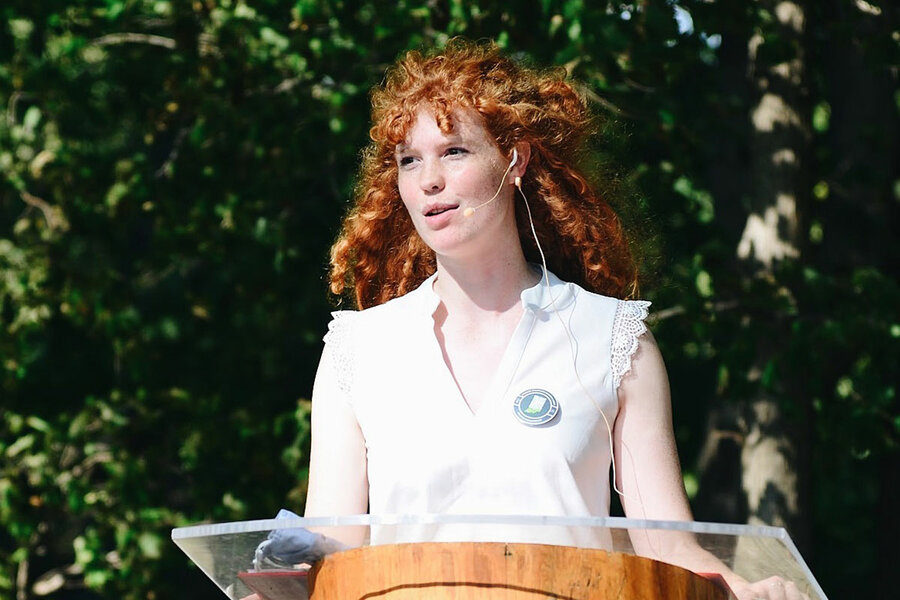
Elsa Barron speaks at Hoosier Interfaith Power and Light’s Faith Climate Summit, where she was moderating a panel on environmental justice, Oct. 10, 2021.

No group of people is monolithic. All individuals have their own individual views. Which is why we should never assume anything about people who identify with a particular group.

An ESL teacher I work with attends a congregation where almost everyone’s politics are X although hers are Y. She sends her daughter to their school because she loves it overall, but she teaches her daughter some differences at home.

I’m sharing an article that gets into religion just because I thought it was interesting, but if it offends anyone, I hope you know you can tell me. It’s about a small but growing group of American evangelical environmentalists.

Erika Page has the story at the Christian Science Monitor.

“Should I stay or go? It was a question Elsa Barron had wrestled with on her own for years. Now, at a public panel on faith and the climate at the COP26 summit in Glasgow, Scotland, she was on the verge of voicing it aloud to a crowd of strangers.

“The panelists, faith leaders from the All Africa Conference of Churches, hadn’t named names. But Ms. Barron had gleaned the message. One of the biggest impediments to climate action in their communities was … her home community: evangelical Americans, who hold an outsize influence in missionary ministries in Africa.

“She had bitten her tongue through the Q&A session, nervous about being vulnerable in such a high-profile crowd. But just as the moderator moved to close the event, she felt her hand shoot up.

“ ‘I grew up in that community,’ she recalls admitting to the panel, heart racing. ‘What is needed from me in this moment?’ 

“For evangelical environmentalists, the temptation to leave the church behind and take their climate concerns elsewhere is high. This is especially true among younger generations, who [are] more likely to worry about climate change than their elders. Ms. Barron, for one, stood on the brink of abandoning her faith just a couple of years ago. 

“So the response she got from those panelists at COP26 last November has stuck with her. 

“ ‘If you have the opportunity to be rooted in your community, asking questions, pushing for change, and advocating for communities that don’t have an inroad to these spaces, then that’s probably the biggest thing you can do,’ she remembers being told. 

“The choice to stay and fight has not been easy, demanding resolve, patience, and the courage to speak up, again and again. But at a time when writing off those with differing views has become commonplace, Ms. Barron has found that her empathy and love for her community [have] helped her work with, instead of against, those on the ‘other’ side of the climate divide. 

“ ‘It takes a lot of courage to not just pick one side or the other, especially in such an extremely polarized society,’ says Melanie Gish, author of God’s Wounded World: American Evangelicals and the Challenge of Environmentalism. …

“In the United States, climate awareness and urgency have grown steadily in recent years. … Even among white Evangelicals, thought has been shifting. A poll conducted by Yale and other groups in 2020 found that 44% of them attributed global warming to human activity, up from 28% when the Pew Research Center asked a similar question in 2014.

“And the National Association of Evangelicals just renewed a call to action to mitigate the environmental crisis from a ‘biblical basis,’ updating a report from 2011. Yet climate skepticism remains disproportionately high among evangelical Christians, even compared with other religious groups. Some evangelical leaders have pitted environmental movements against religion, painting the former as a politically motivated threat to a faith-driven life. Many simply don’t see church as the place to address environmental concerns. …

“[At the University of Notre Dame, Ms. Barron read] one little book that hit her ‘like a ton of bricks.’ The text was Laudato Si, the 2015 encyclical on ‘care for our common home’ written by Pope Francis. She still remembers her visceral response to her first read.

“ ‘It felt like, “Oh my goodness, how did I miss this?” ‘ she says. Until then, her religion and her love for the natural world had existed in separate spheres. Now, she began to see the environmental crisis as a deeply spiritual crisis, built on a foundation of greed, extraction, and irreverence. And with that understanding came an accompanying spiritual obligation. 

“ ‘If we don’t care about it and don’t do something about it, we’re failing to fulfill two of our callings as people of faith: to care for creation and to love our neighbors,’ she says over Zoom from her family’s home in Illinois. 

“That’s the idea behind ‘creation care,’ an environmental movement grounded in biblical direction, such as the duty to ‘tend and keep’ the Garden of Eden. … The ideas have been more readily adopted outside the U.S., especially in places on the front lines of climate change. …

“Even though creation care, also known as environmental stewardship, has become more widely accepted in the U.S., being a young evangelical environmentalist can be lonely. …

“[Ms. Barron’s] mother texted her about a group called Young Evangelicals for Climate Action. YECA was founded with the support of the Evangelical Environmental Network in 2012. In addition to the group’s advocacy, the organization trains youth fellows on writing op-eds, talking to representatives, leading projects in their own communities, and engaging effectively with church members and leadership.

“Ms. Barron says she held back none of her trepidation in her application essay to be a fellow – and was welcomed into the fold. For the first time, she met a host of evangelical environmentalists grappling with similar questions, while working to shift the culture on climate within their own churches and college campuses. …

“ ‘It starts with conversations; it starts with one-on-ones … telling your church leaders and pastors what you’re passionate about,’ says Tori Goebel, national organizer and spokesperson for YECA. ‘It’s not necessarily about facts and statistics and different scientific figures, but rather it’s just sharing stories and connecting to shared values.’ ” 

More on Evangelical environmentalists at the Monitor, here.

Read Full Post »

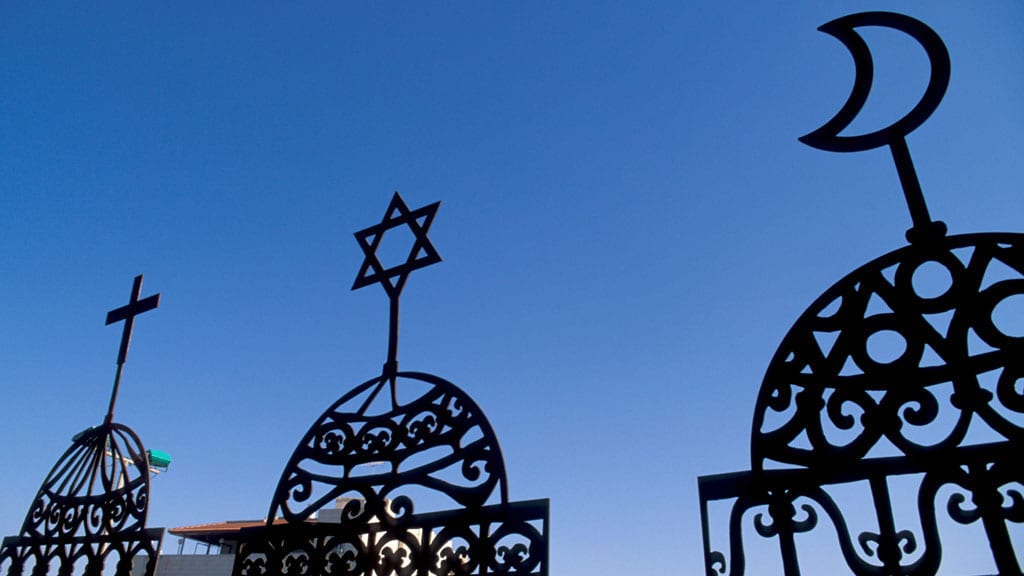
Photo: Menorah Islands Project.
Christianity, Judaism, and Islam are referred to as the “Abrahamic” religions because they are all rooted in a common ancestor – the biblical Abraham.

Today is like an alignment of planets because the three main Abrahamic religions are celebrating three important holidays at the same time: Ramadan, Passover, and Easter. I was thinking it would a good day to remind ourselves what the three faiths have in common, so I did an internet search and found information at the British Library.

The library had put the question in the hands of Anna Sapir Abulafia, Professor of the Study of the Abrahamic Religions at the Faculty of Theology and Religion at the University of Oxford and a Fellow of Lady Margaret Hall.

She writes, “When people refer to the Abrahamic religions they are usually thinking of Judaism, Christianity and Islam. There are, in fact, more Abrahamic religions, such as the Baha’i Faith, Yezidi, Druze, Samaritan and Rastafari, but this article will focus on the main three aforementioned.

“The term ‘Abrahamic’ highlights the hugely important role which the figure of Abraham plays in each of these traditions. Jews, Christians and Muslims look to their sacred texts to find the history of Abraham and how it has been interpreted through the ages. For Jews, the central text is the Hebrew Bible consisting of the Torah (the first five books or Pentateuch), the Prophets (Nevi’im) and the Writings (Ketuvim). Abraham’s story unfolds in Genesis, the first book of the Torah. …

“For Christians, the Hebrew Bible is the Old Testament, the precursor of the New Testament that narrates the birth, ministry, death and Resurrection of Jesus Christ as well as the life and preaching of the earliest followers of Jesus. For Christian understandings of Abraham the Letters of St Paul are of particular importance.

“Muslims engage with the figure of Abraham/Ibrāhīm in their holy book, the Qur’an, as well as in the Hadith, the body of writings which transmit the sayings and actions of the Prophet Muhammad.

“Let us turn to Genesis to map out the story of Abraham, which is shared by Jews and Christians. In Genesis 12: 1–3 Abraham (at that stage his name is still Abram) is called by God to: ‘Go from your country and your kindred and your father’s house to the land that I will show you. I will make of you a great nation, and I will bless you, and make your name great, so that you will be a blessing … and in you all the families of the earth shall be blessed.’ “

Professor Abulafia proceeds to describe in detail how each of the religious traditions perceives Abraham. She explains that Abraham has a son with Hagar (Ishmael) and also with Sarah (Isaac), saying, “trouble brews between Sarah and Hagar as their sons grow up, and Sarah persuades Abraham to send Hagar and Ishmael away (Genesis 21). God promises Hagar that Ishmael too will be made into a great nation.

“God then tests Abraham’s faith by commanding him to sacrifice Isaac (Genesis 22). But when Abraham is about to sacrifice Isaac on Mount Moriah, an angel stops him and directs his gaze to a ram caught in the thicket. The ram is sacrificed instead of Isaac. …

“In Jewish tradition, Abraham became identified as the ‘first Jew.’ He is depicted as the embodiment of the faithful Jew upholding God’s commandments. Traditionally, Jews see themselves as the descendants of Abraham through his son Isaac and Jacob, his grandson. …

“In Christian tradition, Abraham’s faith became paradigmatic for all those who followed Jesus. In the words of St Paul, in Romans 4: ‘For what does the scripture say? “Abraham believed God, and it was reckoned to him as righteousness.” ‘ …

“Islam shares with Judaism the narrative of Abraham’s destruction of idols in the service of the worship of the one true God. In Surah 37 of the Qur’an, Abraham ‘said to his father and to his people, “What is that which ye worship? Is it a falsehood – gods other than Allah that ye desire? Then what is your idea about the Lord of the worlds?” … Then did he turn upon them, striking (them) with the right hand. … He said: “Worship ye that which ye have (yourselves) carved? But Allah has created you and your handwork!” ‘ …

“In the same Surah, Abraham has a vision that he must sacrifice his son. As in the Bible, Allah intervenes in time. The Qur’an emphasizes that this was a difficult trial which both Abraham and his son passed with flying colors. It does not specify whether the son was Isaac or Ishmael, although today most Muslims believe that it was Ishmael/Ismā‘īl.

“The biblical narrative concerning the dismissal of Hagar and Ishmael is paralleled in the Muslim tradition with Abraham taking Hagar and Ishmael to Mecca, where in due course Abraham and Ishmael build the Ka‘bah, the focus of the Hajj.” More from the professor here.

I wrote another post in 2011, here, on the Abrahamic faiths. In a 2014 post, I described a nonprofit that brings together young people from the three backgrounds. A post earlier this year was on an Abrahamic collaboration that is helping Afghan refugees in Maryland, here.

Read Full Post »