Feeds:
Posts
Comments

Posts Tagged ‘fake’

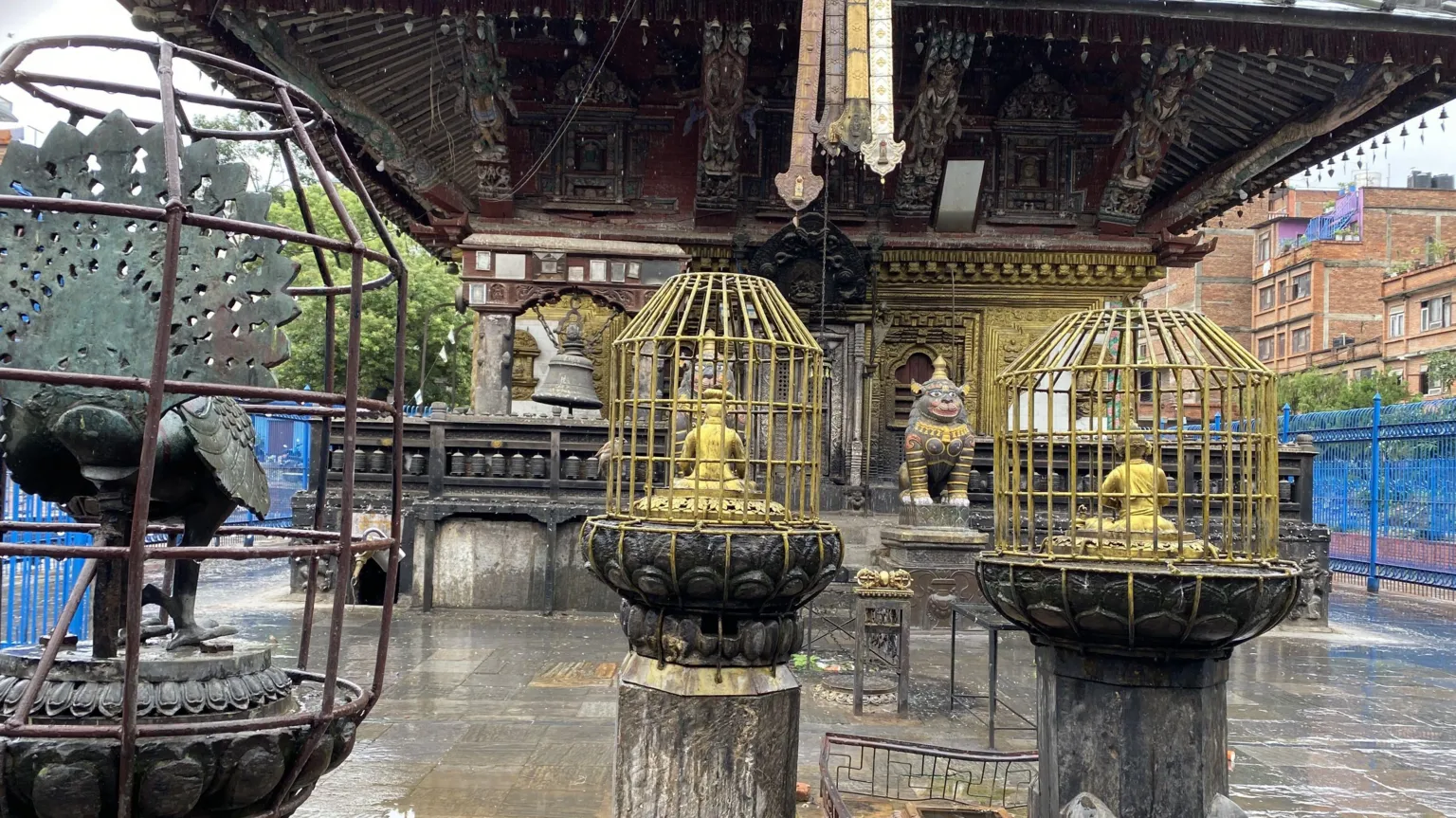
Photo: Sanjaya Dhakal/BBC Nepali.
In Nepal, some communities have put their recovered idols in iron cages for security.

Who does art belong to? For centuries, looters have justified their thefts by asserting that they aim to protect the stolen art for posterity. That no longer holds up, and now art is getting returned to the plundered countries.

And if you play nice and return Nepali idols, you may be given an accurate replica.

Sanjaya Dhakal writes at The Guardian, “Along a small street in Nepal’s Bhaktapur city stands an unassuming building with a strange name — the Museum of Stolen Art. Inside it are rooms filled with statues of Nepal’s sacred gods and goddesses.

“Among them is the Saraswati sculpture. Sitting atop a lotus, the Hindu goddess of wisdom holds a book, prayer beads and a classical instrument called a veena in her four hands.

“But like all the other sculptures in the room, the statue is a fake. The Saraswati is one of 45 replicas in the museum, which will have an official site in Panauti, set to open to the public in 2026.

“The museum is the brainchild of Nepalese conservationist Rabindra Puri, who is spearheading a mission to secure the return of dozens of Nepal’s stolen artifacts, many of which are scattered across museums, auction houses or private collections in countries like the US, UK and France.

“In the past five years, he has hired half a dozen craftsmen to create replicas of these statues, each taking between three months and a year to finish. The museum has not received any government funding. His mission is to secure the return of these stolen artifacts – in exchange for the replicas he has created.

“In Nepal, such statues reside in temples all across the country and are regarded as part of the country’s ‘living culture,’ rather than mere showpieces, says Sanjay Adhikari, the secretary of the Nepal Heritage Recovery Campaign. Many are worshipped by locals every day, with some followers offering food and flowers to the gods. …

“It is also common for followers to touch these statues for blessings — meaning they are also rarely guarded — leaving them wide open for thieves.

“Nepal has categorized more than 400 artifacts missing from temples and monasteries across the country, but the number is highly likely to be an underestimate, says Saubhagya Pradhananga, who heads the official Department of Archaeology.

“From the 1960s to the 1980s, hundreds of artifacts were looted from Nepal as the isolated country was opening up to the outside world. Many of the country’s most powerful administrators back then were believed to have been behind some of these thefts — responsible for smuggling them abroad to art collectors and pocketing the proceeds.

“For decades, Nepalis were largely unaware about their missing art and where it had gone, but that has been changing, especially since the founding of the National Heritage Recovery Campaign in 2021 – a movement led by citizen activists to reclaim lost treasures. …

“There are many hurdles. The Taleju Necklace, dating back to the 17th century, is a case in point. …

“It’s still unclear how it might have been stolen and many in Nepal had no idea where it might have gone until three years ago, when it was seen in an unlikely place – the Art Institute of Chicago.

“It was spotted by Dr Sweta Gyanu Baniya, a Nepali academic based in the US who said she fell to her knees and started to cry when she saw the necklace.

“According to the Art Institute of Chicago, the necklace is a gift from the Alsdorf Foundation — a private US foundation. The museum told the BBC it has communicated with the Nepali government and is awaiting additional information.

“It’s not just a necklace, it’s a part of our goddess who we worship. I felt like it shouldn’t be here. It’s sacred,” she told the US university Virginia Tech. …

“But [Saubhagya Pradhananga, who heads the official Department of Archaeology] said Nepal’s Department of Archaeology had provided enough evidence, including archival records. On top of that, an inscription on the necklace says it was specifically made for the Goddess of Taleju by King Pratap Malla.

“It’s these ‘tactics of delay’ that often ‘wear down campaigners,’ says one activist, Kanak Mani Dixit. ‘They like to use the word “provenance” whereby they ask for evidence from us. The onus is put on us to prove that it belongs to Nepal, rather than on themselves on how they got hold of them.’ …

“Many worshippers are now a lot more paranoid — putting these idols in iron cages to protect them from going missing.

“Mr Puri however hopes his museum will eventually have its shelves wiped bare.”

More at the BBC, here. No paywall.

Read Full Post »

Photo: Daguerre Val de Loire via the Guardian.
The family thought their painting was a fake, but it turned out to be an authentic work by Pieter Bruegel the Younger, “L’Avocat du village” (“The Village Lawyer”). It sold at auction for $850,000.

It can sometimes happen in families as younger generations come along, new people marry into the family — and those who know the history of a painting on the wall die off — that the importance of a work becomes something no one takes seriously.

I remember the husband of a babysitter John had when he was three scoffing about a painting his wife said was a Turner. I believed the babysitter was better informed. Today I wonder where that painting is.

Jonathan Edwards reports at the Washington Post about a similar situation.

“Malo de Lussac entered the tiny, dimly lit TV room in October, expecting the unremarkable as he assessed the value of the art and artifacts in his new client’s home in northern France. Then, a painting caked in dust and almost entirely hidden by a door caught the auctioneer’s eye.

“Pay it no mind, his client told de Lussac. Yes, the family had long called it ‘The Bruegel,’ but it was an affectionate dig at a painting that was clearly a fake.

“Turns out, the family joke was a hidden masterpiece, a genuine work of Pieter Bruegel the Younger, a 17th-century Flemish artist. Painted more than 400 years ago, ‘L’Avocat du village’ — or ‘The Village Lawyer’ — sold [in March] at auction in Paris for the equivalent of about $850,000 — the result of a discovery that de Lussac described as one of the most thrilling of his career.

“ ‘I was very, very surprised,’ de Lussac said.

“His coup started out as a workaday assignment: Travel from Paris to a client’s home in northern France to estimate how much their artwork and artifacts would sell for at auction. Because of the home’s size, he’d blocked out the entire day to accomplish the job.

“For the first hour, everything went as expected. After a half-hour of chatting and building a rapport with the owner over coffee, they started touring the house by surveying the living room. They then moved to the kitchen. Everything fell within de Lussac’s expectations: furniture, china, some ‘interesting’ but relatively unimportant paintings.

“They moved on to a TV room, where his client directed his attention to some 19th-century paintings they thought would be of the most interest. … Then de Lussac spotted part of a painting covered in dust and mostly obscured by a door. He shut it to get a look at the entire work. The brushstrokes, the colors, the canvas material: It all rang true with de Lussac’s knowledge of Bruegel the Younger. Born in Brussels around 1564, Bruegel was the eldest son of Pieter Bruegel the Elder, one of the most prominent artists of the Flemish Renaissance in Flanders, a Dutch-speaking region of what is now Belgium. …

“ ‘My heart was beating so hard,’ de Lussac said.

“The owners broke the bad news: The painting had long been regarded as a knockoff by the family. Their forebears had purchased it in the late 1800s, and it spent the next century bouncing to different houses as younger generations inherited the work. …

“But acting on his hunch, de Lussac pressed the current owner. Everything he observed jibed with what he knew of Bruegel the Younger, who had painted several works depicting the same scene of a Spanish official collecting taxes from Flemish peasants.

“The owners were skeptical but willing to let de Lussac send the painting to a Bruegel expert in Germany. In December, they got word: It was genuine.

“[DeLussac] said that he believes the original buyer purchased it as a genuine Bruegel, and that knowledge of its authenticity was lost to time.”

More at the Post, here. At the Guardian, there is an earlier version of the story without a firewall, here.

Read Full Post »

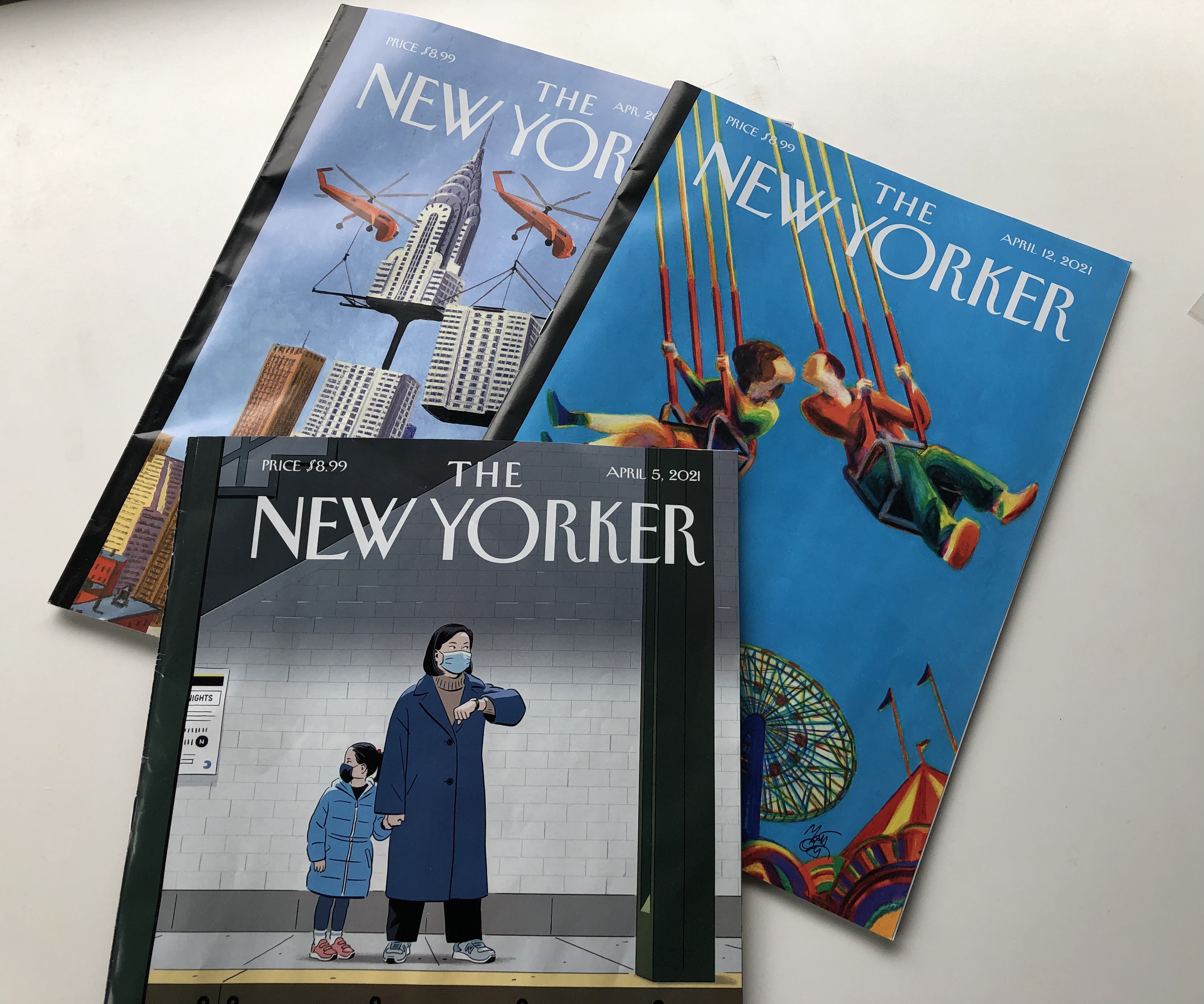
These are real New Yorker covers, but for a laugh (or a tear), check out fake pandemic covers created for an art class, here.

In New York, an art teacher’s creative idea in the pandemic was to make magazine covers in the style of the New Yorker magazine. The next thing the students knew, their work had gone viral on social media.

Michael Cavna writes at the Washington Post, “A masked woman pauses to perch between two worlds: the Zoom-room confines of her virtual life this past year, and the real physical realm of a post-pandemic future. As her classmates spring across a laptop keyboard, the emotional moment resonates, a split-second frozen in art.

“Its creator, Lauren Van Stone, a New York college student originally from Connecticut, rendered the work to empathize with anyone else enduring virtual learning. ‘I felt inspired to illustrate a piece that focused on the tentative reopening of schools,’ she says, ‘and the mixed feelings that many students will inevitably have upon re-entering society.’

“Van Stone created the artwork for her third-year illustration class taught this semester by Tomer Hanuka [@tropical_toxic on Twitter] at the School of Visual Arts in New York. Hanuka had asked his students to create moving-past-the-pandemic works in the style of a New Yorker magazine cover — and was so impressed with the finished pieces that he shared some of them last week on Twitter.

“Soon, the virtual world was as moved by the students’ art as Hanuka was. Within a few days, the first tweet in the viral thread of 17 works attracted more than 130,000 likes and more than 30,000 retweets. Nearly 60,000 liked Dou Hong’s poignant image of two figures on a park bench: One is of a woman, the other an outline filled with names of covid victims. …

“Hanuka, a veteran illustrator who has contributed covers to the New Yorker, was shocked by the public response. … He had merely sought to give the student artworks some exposure beyond the classroom. But his timing couldn’t have been better: As millions of Americans are vaccinated daily amid cultural debates over evolving social and medical protocol, the art reflects the year we’re emerging from — and where we hope soon to be. …

“The assignment was to analyze the storytelling mechanisms within ‘classic’ New Yorker covers and create original ideas using some of that visual vocabulary.

‘It’s about observing a seemingly mundane detail that, by the way it’s presented, illuminates a bigger story,’ says Hanuka. …

“Amy Young, who’s originally from Vancouver, British Columbia, created a powerful cover showing a family around the table with the deceased matriarch missing, her living husband and their wall picture bathed in the lavender tint of loss. Existing alongside the buoyant hope of vaccination, she says, is the ‘grief, sorrow and perhaps even bitterness experienced by those whose loved ones have already passed away. I wanted to show that duality of emotions in my cover, and how they can find co-existence in a family.’ …

“Katrina Catacutan, from Baltimore, drew a reunion with her significant other, in a home brimming with her collection of pandemic plants that evolved to include ‘propagating cacti’ and various vegetables.

“Once their works were posted on Twitter, the students were stunned by the impassioned response. ‘It really showed me just how powerful art is, in the way it can connect countless people from across the world over one shared feeling or image,’ says Jane McIlvaine of New York, who depicted a cat watching its formerly locked-down owner exit their home. …

“As for their teacher, he is not only wowed by the outcome, but also by how his young artists have persevered academically during the pandemic. Some of them hold day jobs, and some have been cut off from their families for a year. Yet, Hanuka says, ‘They had the emotional bandwidth to gather for four hours a week — and that’s just my class — to discuss color choices and compositions with all the gravity and focus these topics demand. … They were asked to find logic in the chaos — to make sense of it, by way of beauty. They practiced their craft rigorously and showed up.’ ”

See the covers at the Washington Post.

Read Full Post »