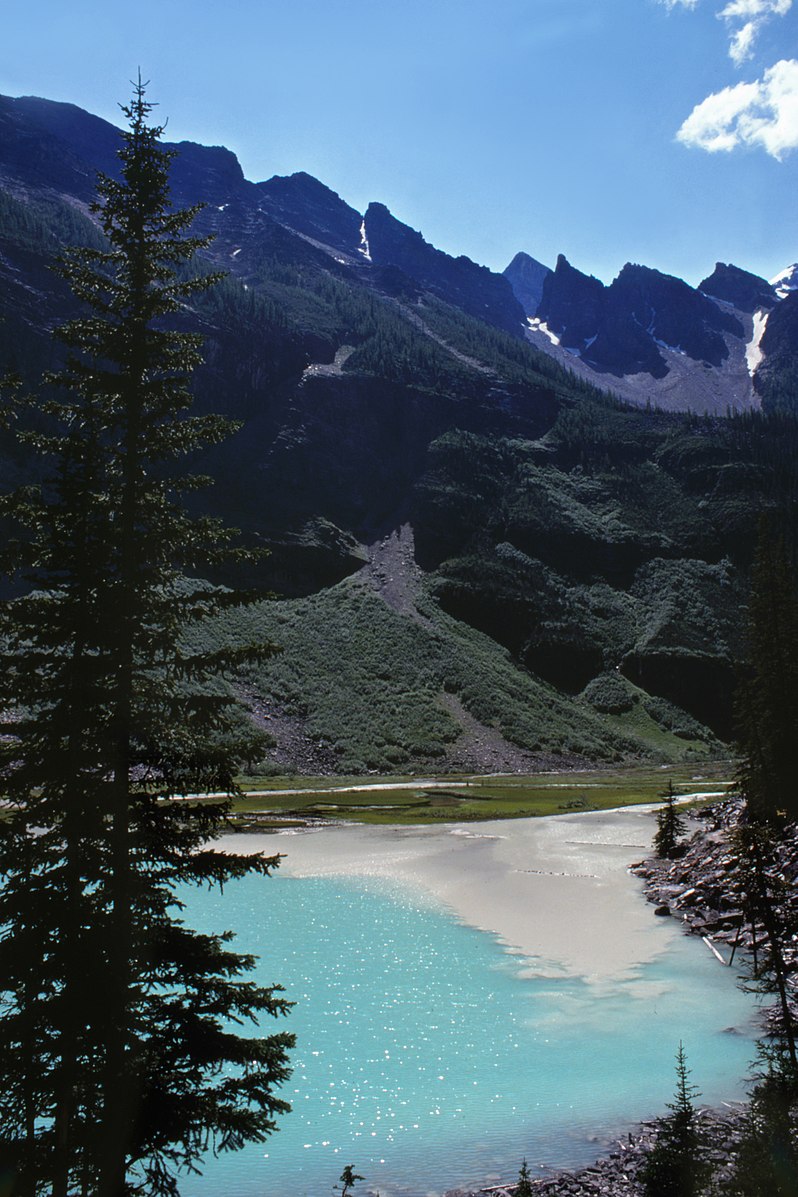
Photo: WikiPedant/ Wikimedia.
An example of “glacial rock flour” pours into Lake Louise, Alberta, Canada.
Here’s a new-to-me theory: a discharge from our melting glaciers may be able to soak up some of the unwanted carbon in the atmosphere.
Dino Grandoni writes at the Washington Post, “Minik Rosing grew up around the fine mud flowing from Greenland’s glaciers. It wasn’t until much later, when his own daughter had grown up and was in her mid-20s, that he realized how special it is.
“During a family vacation in rural Greenland, where there was no electricity, she was fishing ice out of a milky-blue fjord for a gin and tonic when that mud gripped her feet so tightly that she had to abandon one of her boots.
“As temperatures rise, meltwater is flushing out millions of tons of this stuff: ultrafine powder ground down by the island’s melting glaciers. Geologists have a culinary-sounding name for the microscopic particles: ‘rock flour.’
“The loss of his daughter’s boot got Rosing thinking. Maybe those tiny grains of rock could be used to trap something much bigger: the carbon emissions that are altering the frozen landscape and way of life on the island.
“ ‘Greenland has been seen as the example and the horror story of climate change, and never been portrayed as a part of the solution,’ said Rosing, a geology professor at the University of Copenhagen in Denmark who was born in Greenland.
“As global emissions continue to rocket, he is part of a growing group of scientists looking for ways to suck carbon right out of the sky, an example of a sometime contentious suite of technologies called geoengineering. …
“Give it enough time and most of the carbon dioxide that humanity is pumping into the air will be taken back by the planet. CO2 dissolves in rainwater and reacts with rocks to form carbon-containing compounds that lock the gas out of the atmosphere. That naturally occurring process, called ‘chemical weathering,’ literally petrifies the air.
“The problem — at least for us humans — is that chemical weathering takes millennia to work its carbon-absorbing magic. Humanity doesn’t have that kind of time: The U.N. Intergovernmental Panel on Climate Change says society needs to drastically reduce CO2 emissions by the end of the decade. The situation has gotten so bad that the panel of scientists says we need to develop ways of pulling carbon from the air to avert catastrophe.
“So what if we could speed things up? What if, Minik Rosing and other scientists wonder, we exposed more carbon-absorbing rocks to the carbon-laden air? They call that technique ‘enhanced weathering.’
“Most enhanced-weathering proposals involve pulverizing tons of basalt or other rocks and spreading them across the land. But all that crushing would consume an enormous amount of energy that might result in more greenhouse-gas emissions. That’s where rock flour comes in.
“Glaciers flow over the bedrock like a slow-moving river. Over centuries, the tremendous weight of the ice grinds the rock underneath into a fine powder only a few ten-thousandths of a centimeter, or microns, in diameter — finer than most sand found on a beach. …
“The fineness of the grains is the flour’s advantage. It gives the substance an enormous surface area to expose to the air, making it an attractive candidate for enhanced weathering. …
“To test how well rock flour stashes carbon, Rosing and [Christiana Dietzen, a soil scientist working with Rosing] hauled about 200 tons of the stuff from Greenland for experiments.
“The material packed a one-two punch, according to a pair of papers the researchers published last year: Not only did it suck up carbon when spread over farm fields in southern Denmark, but it also enriched the soil with nutrients and increased the yield of corn and potatoes in the first year of application.
“The researchers estimate that, given enough time, spreading rock flour on all agricultural land in Denmark would suck up a quantity of carbon approximately equal to the annual emissions of that country (or of Hong Kong or Syria). Preliminary results show longer-lasting crop yields in nutrient-poor soil in Ghana.”
More at the Post, here.




 Suzanne's Mom's Blog