Feeds:
Posts
Comments

Posts Tagged ‘fdr’

Photo: Harris & Ewing/Library of Congress Prints and Photographs.
Frances Perkins, Secretary of Labor under President Roosevelt.

I once read a fascinating biography of Frances Perkins, Secretary of Labor under President Franklin Delano Roosevelt. In the book, biographer Kirstin Downey set out to prove that Perkins was both the conscience of FDR and The Woman Behind the New Deal. (My take on the book is here.)

Recently, at the Guardian, Michael Sainato reported that President Biden had been asked by members of Congress and the National Park Conservation Association to create a monument to Perkins.

“Perkins, who served three terms under Franklin Delano Roosevelt from 1933 to 1945,” Sainato writes, “was the first woman to be appointed to a presidential cabinet and the longest-serving secretary of labor in US history.

“In 1911, Perkins was a witness to the Triangle Shirtwaist factory fire in New York City, which killed 146 people, mostly young women, and was one of the deadliest industrial disasters in US history. The tragedy greatly affected Perkins and helped inspire her labor activism in the subsequent decades.

“She said of her position: ‘I came to Washington to work for God, FDR and the millions of forgotten, plain common workingmen.’

“As secretary of labor, Perkins was one of the driving forces behind Roosevelt’s New Deal policies and pushed for many longstanding labor policies including a 40-hour work week, a federal minimum wage, unemployment compensation, worker’s compensation, the abolition of child labor, and social security. ‘The New Deal began on March 25, 1911. The day that the Triangle factory burned,’ Perkins said.”

At Goodreads, I observed that, according to biographer Kirstin Downey, Perkins “was the main person pushing the New Deal. Roosevelt, who was more cautious and political, trusted her and listened to her while many others in his circle came and went. She was unfailingly hardworking and skilled at understanding people and working with everyone, although in her first few months in Washington, she made some missteps that caused her trouble later.

“Her career didn’t start in Washington, though. She was focused on working people and their needs from college days, taking a teaching job in Chicago and spending all her spare time at Hull House, where she made lasting connections. When she lived in New York City, she was active in the rights of working women and child laborers. Greatly influenced by seeing the appalling Triangle Shirtwaist Factory fire after failing to get reforms, she worked harder than ever on workplace safety. She was the right hand of NY Governor Al Smith for some years and then the right hand of FDR when he succeeded Smith as governor.

“Perkins had a variety of roles in Washington over several decades but her biggest influence is seen in initiatives that got people working in the Depression and improved workers’ rights and workplace safety. …

“Downey wrote at the book’s end: ‘The secret of Frances’s success was that she had done what she did selflessly, without hope of personal gain or public recognition, for those who would come afterward. It was a perpetuation of the Hull House tradition of the old teaching the young how to advocate for the yet unborn. …

” ‘Factory and office occupancy codes, fire escapes and other fire-prevention mechanisms are her legacy. About 44 million people collect Social Security checks each month; millions receive unemployment and worker’s compensation or the minimum wage; others get to go home after an eight-hour day because of the Fair Labor Standards Act [all of which she shepherded]. Very few know the woman responsible for their benefits.’ “

By the way, although there are comparatively few monuments to women in the US, cities are trying to get up to speed. In New York alone, there are statues to Women’s Rights Pioneers, Joan of Arc, Harriet Tubman, Eleanor Roosevelt, women veterans, Gertrude Stein, and one coming soon of Shirley Chisholm, a Black woman who ran against Richard Nixon, and more. Click here for great photos.

More at the Guardian, here. No firewall, but if you click here, you can help support the Guardian journalism.
Read Full Post »

Photo: Kevin Bacher / NPS, Flickr CC BY 2.0.
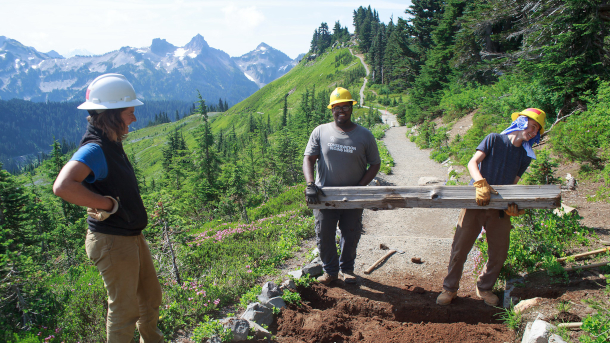
A Student Conservation Association crew is all smiles as they work to restore a trail in the popular Paradise area of Mount Rainier National Park.

I love the way the radio show Living on Earth zeroes right in on whatever environmental issue is most important at any given time. In this episode, it discusses federal plans to tap civilians concerned about climate change — kind of the way FDR tapped civilian energy during the New Deal.

Host Steve Curwood talks to Washington Governor Jay Inslee about how a climate corps could aid conservation, combat climate disaster, and help save energy.

“CURWOOD: The modern CCC harkens back to the Civilian Conservation Corps created by President Franklin Delano Roosevelt in the 1930s. FDR’s CCC put some 3 million men to work in conservation efforts. … Today a Civilian Climate Corps could put people to work reducing the risk of forest fires, restoring wetlands, planting trees, and weatherizing homes both in the United States and abroad. During the Democratic primary, several of President Biden’s opponents also proposed a climate corps. Among them was Washington state Governor Jay Inslee. … Welcome back to Living on Earth, Governor!

“Let’s say that you were to take a look at your own state of Washington for some examples of the kind of work that the CCC would do. You’ve had horrendous wildfires, so I imagine you’re very interested in thinning the forests, the fuel that can add to those. Where else might it be especially useful?

“GOV. JAY INSLEE: Everywhere. This is a ubiquitous opportunity, because anywhere there’s a house, there is an opportunity to reduce energy wastage. And that’s the first place you get clean fuel, the very cheapest, first, most productive fuel, clean energy … stop wasting it. So helping people rehab their houses, get more insulation into their homes, starting with those who are in low-income homes, who frequently are living in places that just waste humongous amounts of energy, so these poor folks are trying to make huge energy payments to the utility company. … Then a part that I think hopefully is more focused on vocational skill development … to really focus on a long-term career, not just in the climate corps. That might be as exotic as, you know, learning how to maintain electric vehicles, because that’s we’re going to be driving. …

“CURWOOD: Many young people I speak to are desperate to do something to deal with the climate emergency, which they see as this humongous freight train barreling at them out of the future, and no way to jump out of the way. …

“INSLEE: I hear this as well, how do I plug in? What do I do? Where do I go, you know, what, you know? And this is just perfect to capture that huge energy that’s out there. [We] want that energy to be released. And I think this climate corps is a way to do that. It will help as well build, you know, public support, political support. …

“CURWOOD: The original Civilian Conservation Corps under FDR reinforced some social injustices, and even segregated black and white corps members into different camps, and there weren’t a whole lot of women that were involved in this. How can this new CCC help progress towards greater equity in our society?

“INSLEE: You’ve put your finger on a very important point. One is the most obvious one, which is economically to give people more economic opportunities. And I’m convinced it will do that big time. [Also] we have so many children, urban children particularly, who’ve never had experiences in the natural world. And giving them these experiences in a vocational setting is life changing for people. …

“My dad and mom used to re-vegetate alpine meadows on the slopes of Mount Rainier during the summer. They ran a group called the Student Conservation Association. [They] were kids, mostly from the East Coast, who came out to Mount Rainier National Park. [Once] they got that shovel in their hands, and once they spent a night in the tent, they were conservationists for their whole lives.”

More here.

Read Full Post »

As everyone knows, there was serious unemployment when Franklin D. Roosevelt was president, so, in collaboration with Congress, he had the government hire people to create work that continues to benefit us —  roads and parks, for example, and fine art.

Unfortunately, some murals and sculptures from the 1930s and 1940s have been lost, so the search is on to reclaim it.

Matthew Blitz at Atlas Obscura has the story. “The United States government wants its art back. Special Agent Eric Radwick, who works in the Office of Investigations for the General Service Administration’s Office of the Inspector General, is working to do just that — to locate and recover government-owned long-lost artwork of the New Deal-era federal arts programs. It could be hidden in plain sight.

“It could be in grandma’s attic. It could be in the possession of art collectors. No matter if it was found in the trash or cost a few grand, the art is federal property. … Most people, upon realizing they are in possession of federal property, are cooperative. …

“On May 9th, 1933, President Franklin Delano Roosevelt received a rather curious letter from an old classmate and professional artist George Biddle. Since his March inauguration, President Roosevelt had implemented the most aggressive 100 days agenda in the country’s history in hopes of solving the Great Depression.

“While absurdly busy — he had just delivered his second Fireside Chat and was about to sign both the Farm Relief and Unemployment Relief bills — this note gave him pause. In it, Biddle wrote that he had long admired the Mexican government for paying artists ‘plumbers’ wages’ to paint murals on government buildings expressing Mexican ideals. Perhaps the President should consider something similar in the United States? …

“The letter got the President’s attention. A month later, Biddle met with members of FDR’s administration in Washington about his proposal. By the end of 1933, the first national art relief program — the Public Works of Art Project — was established.

“Over the next decade, the American art scene flourished thanks to the financial encouragement of the government. According to Smithsonian Magazine, in the first four months of 1934 alone, nearly 4,000 artists were hired to produce over 15,000 paintings, murals, sculptures and other works of art for federal buildings across the country. In 1935, the Works Progress Administration’s Federal Art Project was established, the largest of these programs both in scope and number of artists employed. …

“At a time of crisis in America, these programs not only provided an enormous collection of artwork for public consumption, but gave the creators a sense that they were needed. ‘It made them feel like they counted,’ says Virginia M. Mecklenburg, Chief Curator at the Smithsonian American Art Museum.”

Oh, my, what an enlightened federal government! Sometimes one hopes for history to repeat itself.

Read about the challenges of tracking down missing federal artwork at Atlas Obscura, here.

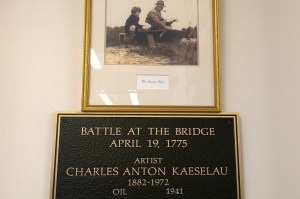
Once upon a time, when the federal government was concerned about unemployment, it paid people to work, artists included. That’s why many murals appeared in post offices and other government buildings in the 1930s and 1940s. This post office mural by Charles Anton Kaeselau depicts the shot heard ’round the world at Concord’s North Bridge.

042617-Kaeselau-North-Bridge-mural

042617-Kaeselau-North-Bridge-mural

Read Full Post »