Feeds:
Posts
Comments

Posts Tagged ‘female’

Photo: Michael Claxton Collection.
Ellen Armstrong as a teenager in a costume she would typically wear while performing as a magician.

Among the many accomplished black Americans almost lost to history is a young female magician called Ellen Armstrong. Today we find out what Vanessa Armstrong at the New York Times (no relation) learned about this intriguing performer when she was assigned to write a belated obit.

“In December 1949, an article in Ebony magazine showcased a dozen Black magicians as ‘among America’s oldest entertainers although few in number.’ The sole woman among them was Ellen Armstrong,. …

“Armstrong began by practicing magic onstage with her father but later performed a solo act full of illusion and humor. One trick involved a blank pane of glass in a picture frame, where a cascade of sand fell from top to bottom when she turned it upside down. When the sand cleared, the frame held an image of someone famous, like the boxer Joe Louis. In another routine, called ‘Miser’s Dream,’ she made coins appear out of thin air and land with a miraculous clunk into a metal bucket. …

“Ellen Emma Armstrong was born on Dec. 27, 1905, in South Carolina to Ida [and] John Hartford Armstrong. The Armstrongs were a magic-performing dynasty, believed to be the first to come from and focus on the Black community. Her father started performing with his brother when he was a teenager. Later, he performed with Ellen’s mother, who died soon after giving birth to Ellen, and then with his second wife, Lillie Belle.

“Ellen was only 6 when she started performing with her father and stepmother, going by the name ‘Little Zelle,’ as they traveled to Black schools and churches along the East Coast, from Key West, Fla., to Philadelphia. … They performed during a time of legal segregation, sundown towns and lynchings. …

“J. Hartford Armstrong, as Ellen’s father was billed, and Lillie Belle had what they called a ‘Second Sight’ act: One of them, blindfolded, identified people and objects while fed information by the other via an elaborate verbal code system. Ellen did some mind-reading of her own in the show, and as she grew older she developed a ‘Chalk Talk’ routine in which cartoons she drew morphed into different images as she told a story.

“ ‘There were times when she would draw hats and then a rabbit coming out of it, and then she would elaborate on the rabbit, turn it upside down, and it’d be a picture of Abraham Lincoln,’ said Michael Claxton, a historian of magic and a professor of English at Harding University in Arkansas.

“Ellen Armstrong studied at the Haines Institute, in Augusta, Ga., and Barber-Scotia College, in Concord, N.C. After she graduated, she continued in the family business. When her father died of heart failure in 1939, she worked the circuit with her stepmother for three years or so. When her stepmother retired, Armstrong continued on her own, using dozens of props she had inherited from her father. But she continued to invoke her father’s name. …

“ ‘She did everything in honor of her father,’ said Nicole Cardoza, a magician who is making a documentary highlighting Armstrong and other Black female entertainers. …

“The places where she brought her act — churches and schools, mostly — were a refuge for African Americans and integral to Black culture, serving as public squares ‘that allow for joy, that allow for pleasure, that allow for restoration amidst the climate of injustice,’ said [Treva Lindsey, a professor at Ohio State University specializing in Black popular culture and African American women’s history]. …

” ‘Armstrong was fully aware of the inequities Black people faced, and as a Black woman she faced discrimination on two fronts. ‘We talk about Jim Crow often, but we don’t often talk about Jane Crow,’ Lindsey said, referencing the term coined by the activist and legal scholar Pauli Murray.

“The magician Kenrick Ice McDonald, in an interview, touched on the same point. ‘White women had to put up with chauvinism, yes, but they could still go in the front door of a theater,’ he said. He added, ‘To travel while Black can get you killed.’

“[Armstrong] continued to practice magic until about the 1970s. ‘She performed until she couldn’t perform anymore,’ Cardoza said. …

“Armstrong died on March 21, 1994, in a nursing home in Columbia, S.C. She was 88. … In January 2024, she was posthumously inducted into the Society of American Magician’s Hall of Fame. Today, a second documentary in which she figures prominently is also in the works, titled Going Fine Since 1889: The Magical Armstrongs, by the filmmaker Jennifer Stoy.”

More at the Times, here.

Read Full Post »

Photo: Popi Sibiya.
Blogger Popi Sibiya didn’t see herself in any travel writing about Africa and decided to write from a female traveler’s point of view. Here she is in Matadi, Congo.

We all know that a lot of things in our world have historically been male-oriented. Medical research, for example. As women step up to correct imbalances, that sort of bias is being corrected. Today we learn about online travel influencers who are providing a fuller picture of where and how to travel. Safety is one thing that might be more of an issue for women.

Ayen Deng Bior reports from Senegal for the Christian Science Monitor, “Last year, South African travel blogger Popi Sibiya found herself cruising the canals of Ganvié, a village on stilts in the middle of a lake in Benin. As she sat in the back of a wooden canoe, she pulled out her smartphone and began broadcasting the experience to her 40,000 Instagram followers. …

“Ms. Sibiya is a former kindergarten teacher who has spent much of the last two years crisscrossing the African continent on public transportation – and now has over 100,000 followers. She is part of an emerging group of young African women travel bloggers who are using their social media platforms to redefine what adventure travel looks like in Africa – and who gets to experience it. They are pushing back on the stereotype that travel on the continent is the exclusive domain of khaki-clad Europeans on safari or sunburned Americans sipping cocktails on Zanzibari beaches – and inviting their mostly African audiences to do the same. 

“African travelers ‘are starting to prioritize fun and adventure’ on their own continent, says Ms. Sibiya, whose followers are mostly well-off South Africans used to traveling to Europe, the Middle East, and Asia for their vacations. On her account, ‘they see that we also have beautiful beaches; we don’t have to go to Thailand,’ she says.

“Each year, African countries clock more than 80 million visitors, and the industry generates about 25 million jobs, according to the World Travel & Tourism Council, an industry advocacy group. 

“Still, African countries are rarely featured on global ‘where to visit’ lists – at least outside stock-standard international favorites like Morocco, Mauritius, South Africa, and Egypt. 

“Ordinary travelers with large social media followings are filling that void, says American travel journalist Rosalind Cummings-Yeates, who has traveled extensively in the region and often uses travel influencers to help plan her trip. 

“ ‘We don’t have to rely on traditional media [anymore],’ she says. Instead, would-be travelers can scroll the feeds of influencers like Ebaide Joy, Instagram alias @go_ebaide, a Nigerian adventure traveler currently riding her motorcycle from Nigeria to Kenya. Or like Ess Opiyo (@ess_opiyo), a Kenyan travel guide with a passion for offbeat destinations. …

“Margot Mendes has seen firsthand the power of social media to transform how people travel in the region. She lives in Dakar, Senegal, where she works in marketing. She puts the same skills to use on her Instagram account, @thedakardream, where she shares her life and travels with her 33,000 followers. 

“Her grid features scenes from bustling open-air markets, peach-colored sunsets overlooking cerulean hotel pools, and glimpses of local cuisine including baguette sandwiches and spiced rice dishes. 

“Ms. Mendes started the account five years ago, when she moved back to Dakar from Paris, where her Senegalese and Bissau-Guinean family had migrated when she was a child. Originally, the page was just to show her worried friends and family in Europe how much Dakar had transformed in the decades since they emigrated. 

“ ‘It was just me being curious about my culture and going to places to discover my own culture,’ she says. 

“But soon her page began to gain an audience beyond people she knew. She says her new followers – most of them African – told her they loved seeing their own continent branded as a glamorous travel destination for the first time. 

“Ms. Mendes’ account has the feel of a glossy travel magazine, but for many young African women documenting their travels, it is important not to shy away from the continent’s struggles – or the challenges that make travel there tricky to navigate. 

“Recently, for instance, Nigerian British travel blogger Pelumi Nubi completed a 10-week road trip from London to Lagos. … Ms. Nubi documented the journey for more than a quarter million people on her Instagram account, @pelumi.nubi. Her posts bounced between travel highs – like when Lumi the Peugeot’s wheels touched African soil for the first time in Morocco – and lows – a video of Lumi’s crumpled hood after she slammed into a parked car on a dark road in Ivory Coast. 

“ ‘You have the people who are trying to paint [Africa] as a war-torn place, a dangerous place, and then you have the people who are trying too hard to sell it as this paradise,’ says Ms. Sibiya, whose page cheerfully records her travels in rickety buses she describes as ‘hearses’ and doesn’t shy away from her brushes with poverty, bad roads, and chaotic border crossings. …

“Ms. Sibiya says her audience is mainly other South Africans, many of whom tell her they are experiencing the continent’s beaches, safaris, fancy hotels, and restaurants for the first time through her account. For many, the issue is partly cost. Counterintuitively, flights between African countries are often more expensive than flights from the continent to international travel hubs like Dubai in the United Arab Emirates or New York. And instead of high speed trains or rental cars, overland travelers often have to choose between taking rundown public transport or paying up for a private car and driver. 

“Ms. Sibiya funds her travels through paid subscriptions to her Instagram account, which cost 140 rand (about $7) a month and give access to more detailed and frequent travel updates than her public page. Currently, she has around 1,200 subscribers.”

More at the Monitor, here. No firewall. Subscriptions are reasonable.

Read Full Post »

An Octopus Tantrum

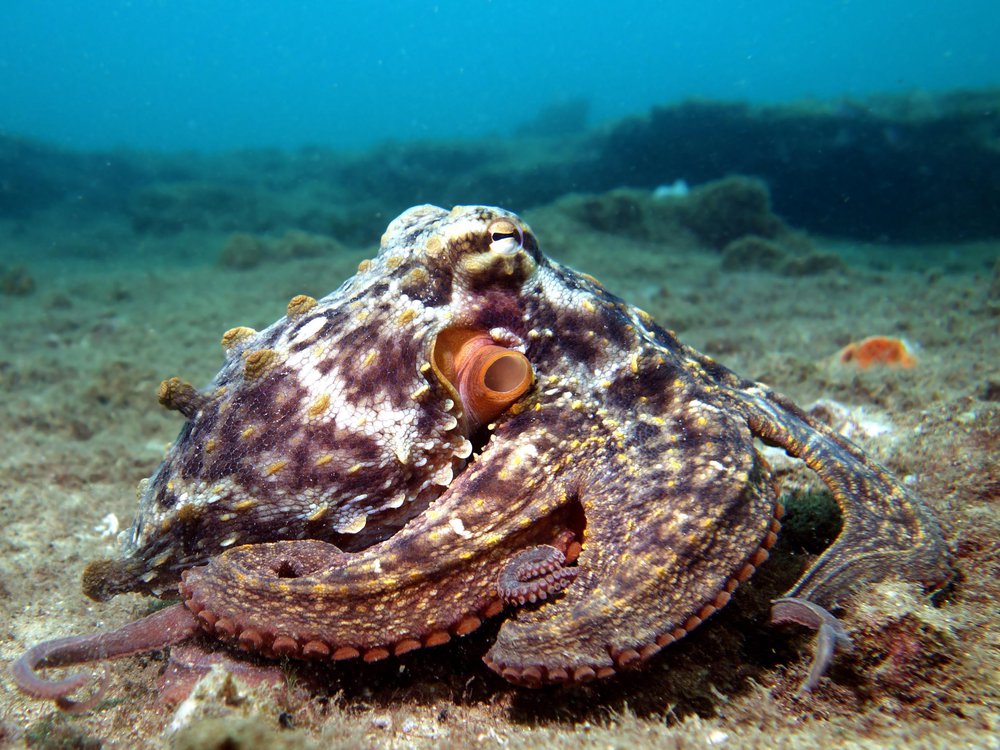
Photo: John Turnbull via Flicker via the Smithsonian.
Female octopuses are far more likely than males to ‘throw’ objects at others.

Have you ever read a book by the popular naturalist Sy Montgomery? She loves every kind of creature (except the Bobbitt worm) and can write and talk engagingly about them all. She’s a regular visitor to the radio show Boston Public Radio (BPR). I hear her Wednesdays as I go to visit the Rhode Island grandchildren, and she loads me up with implausible but true animal stories to share.

Recently, Montgomery talked with BPR hosts Jim and Margery about octopuses throwing things to defend their space. Later, I read about this mostly female behavior at the Washington Post.

Jennifer Hassan wrote, “It looks like a scene from a tense thriller movie — a dark octopus rises from its lair on the ocean floor, sneaking up toward another octopus that lurks, barely visible, nearby among a blanket of shells and algae.

“The second octopus shrinks away, while the first attacks by raising its arms and shooting a cloud of debris through the water toward it. … While octopuses have long been known to thrash around underwater, researchers now believe they have video evidence that shows the creatures can not only throw objects — an uncommon behavior in animals — but may also be capable of deliberately targeting each other. Perhaps out of rage, perhaps to protect their eggs — or possibly because they are seeking the octopus equivalent of personal space.

“Researchers from the University of Sydney described several incidents of octopuses throwing debris during social interactions, including attempted sexual exchanges, which they said provided evidence that octopuses were targeting each other on purpose.

“They had analyzed more than 20 hours of footage from Jervis Bay, off the south coast of New South Wales, Australia, from 2015 and 2016, observing 10 octopuses from the octopus tetricus species — also known as gloomy octopuses or the common Sydney octopus. Their findings published [in November] in the peer-reviewed PLoS One journal.

“In one clip, a female octopus threw 17 objects in 60 minutes — hitting other octopuses nine times.

On another occasion, a single female threw material 10 times, with half of those attempts successfully hitting a male in an adjacent den who had been attempting to mate with her. …

” ‘We can’t be sure, but we think some hits are probably intentional,’ Australian researcher and professor Peter Godfrey-Smith told the Washington Post, adding that they found the wild octopuses used a ‘jet-propelled throw’ to project material through the water — essentially, by releasing the debris from their arms while also creating a powerful jet from the siphon located under their arm web.

“Researchers say the frequent octopus throws ‘appear to be mildly aggressive’ and that this apparent targeting of members of the same species ‘is a rare form of nonhuman projectile use,’ which has only been documented among a handful of social mammals.

“ ‘We doubt if it’s playful,’ Godfrey-Smith said of the behavior caught on camera. ‘I think a lot of it is probably about the octopus equivalent of “personal space.” ‘ …

“The report acknowledges that it is difficult to prove the gesture is targeted, as ‘showing intention in a behavior is difficult in non-human animals.’

“ ‘Some throws hit other octopuses, but is this deliberate? We certainly don’t think it’s 100 percent clear, or close to that. But I do think it is more likely than not,’ Godfrey-Smith said.

“Nonetheless, the study adds, the throws are significant even if there is no deliberate targeting — because ‘they do have social effects in interactions between individuals’ studied at the sites.

“Octopuses hit during such throws ‘often altered’ their behavior in response — many ‘octopuses in the line of fire ducked, raised arms in the direction of the thrower, or paused, halted or redirected their movements,’ researchers said.

“Researchers say they hope to do further research and plan more recordings, though they have faced challenges in recent years due to the coronavirus pandemic and storms and flooding in Australia.”

More at the Post, here.

Read Full Post »

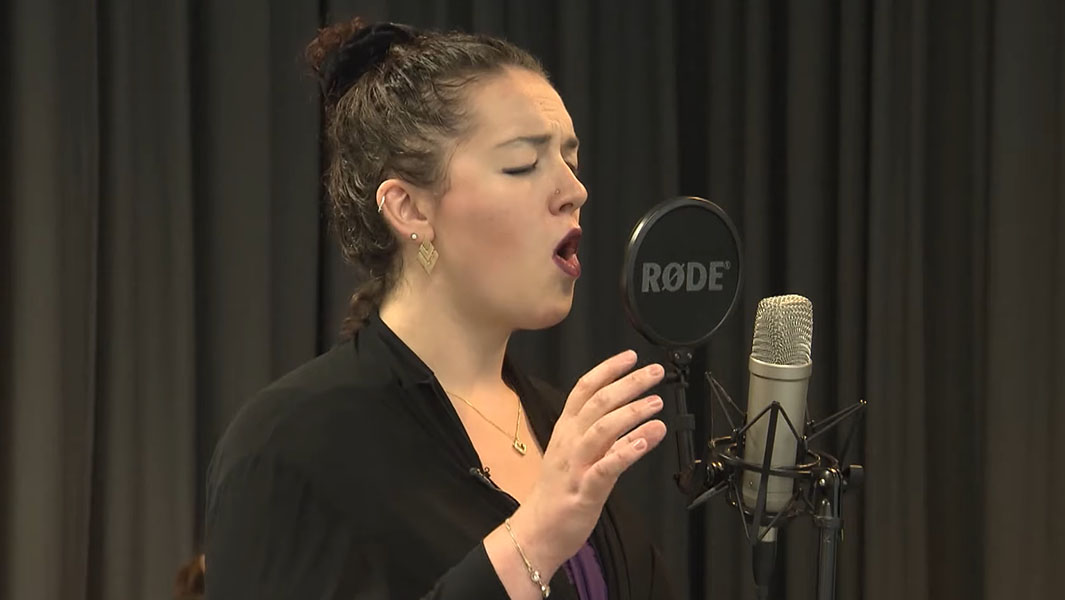
lowest-vocal-note-header_tcm25-584243Photo: Guinness World Records
Helen Leahey, a Welsh musician living in Germany, recently broke the record for the lowest vocal note (female).

Hello, friends, are you ready for another story on the unusual world records that adventurous humans can’t wait to break? (Remember this one on a poetry recitation in 111 languages and this one on running backwards?)

Well, let me introduce you to Helen Leahey, the “Bass Queen.”

Connie Suggitt writes at the Guinness World Records website that Leahey “sang from a D5 to a D2 note at an incredibly deep 72.5 hertz(es) in her attempt at the Music School Wagner in Koblenz, Germany.

“Helen, originally from St Asaph in Wales but now living in Germany, has recently returned to singing after the birth of her first child. …

” ‘I have been encouraged for some years to pursue a musical career professionally, in part because of my unique voice,’ Helen explained. ‘Everywhere I sing, I hear that nobody has heard a woman who can hit the low notes like me. I guess I wanted to see how unique my voice truly is.’ …

“During her attempt, Helen had eight industry professionals present, including qualified music teachers and sound engineers. Her witnesses were Tatjana Botow, a singing teacher, and Elmar Wald, a sound engineer. …

“After a couple of attempts, sound engineer Tobias Jacobs confirmed Helen had achieved the record-breaking low note. …

“Helen’s naturally deep voice has helped define and shape her music career, as has Celtic roots. In her songs, many instruments can be heard, including the guitar, Irish bouzouki, harmonica and the Irish drum (Bodhrán). …

” ‘When I play music, there is no filter, nothing, nowhere, where I can hide. Singing my own songs in front of an audience is incredibly humbling and intimate,’ Helen says on her website.” More at Guinness, here.

I have known women in a cappella groups who have deep enough voices to sing the bass line, but this takes the cake.

Read Full Post »

Photo: Afghanistan National Institute of Music
Afghanistan’s first all-female orchestra, Zohra, is touring.

I’ve been interested in Afghanistan since before the headlines were all about the US conflict there. At least since reading Jason Elliot’s excellent An Unexpected Light and seeing the Tony Kushner play Homebody: Kabul. But lately I have an even stronger interest as Erik’s sister works on women’s rights in Afghanistan for the United Nations.

This BBC story provides one angle on Afghan women’s rights. Vincent Dowd has the report.

“Five years ago, a unique all-female orchestra was formed in Afghanistan, a nation where only a few years previously music had been outlawed and women barred from education. Now Zohra is visiting the UK for the first time.

“No-one claims that in Afghanistan, the Taliban influence has been rooted out entirely. Violence continues. But two decades ago, the Afghanistan National Institute of Music would have been unthinkable.

“ANIM was founded in 2008, with international support, to bring music education to young Afghans. … ANIM teaches music skills to some 250 young people, both male and female. That figure is about to rise to 320 and there are plans to expand to cities such as Herat, Mazar-e Sharif and Jalalabad.

“About 70% of the young people at the institute come from disadvantaged backgrounds — some used to work the streets selling vegetables, plastic bags or chewing gum to support their families. Ages range from 12 to around 20.

“But five years ago, ANIM founder by Dr Ahmad Sarmast was urged to start a new project specifically to benefit girls.

” ‘One of our students told me we needed a group of four or five girls to play pop music,’ he says. ‘I liked the idea but almost at once it became clear most of the girls at ANIM wanted to join. Suddenly we were talking about a full orchestra.’ …

“There are around 100 female students at ANIM, 23 of whom have come to Britain. Their numbers will be doubled when they play in concert with the London-based Orchestra of St John’s and others. Instruments they’ve brought with them include the sarod, the rubab, tabla drums and the dutar.

“The music performed is a combination of traditional Afghan music and western classical. For instance, their new arrangement of Greensleeves contains attractive new instrumentation probably not envisaged by Ralph Vaughan Williams in 1934.

“The conductor for the Afghan pieces is Negin Khpalwak, who at 22 is one of the older musicians in the group. She joined the school not long after it opened — not initially with the idea of conducting at all. …

” ‘It’s much easier for me to conduct when we play Afghan music,’ she says. ‘We’re very familiar with it and we play together easily. If we perform something like Greensleeves — which I think is very well-known in England — we have to concentrate extra hard.’ …

“Negin Khpalwak says even in Kabul, students can still sometimes encounter people beyond the school who think it’s wrong that the orchestra even exists.

” ‘They will say that in Islam women aren’t allowed to go to school, not just for music but to study anything. But it’s not true — women have their own rights and those people need to be educated. Our music isn’t the only way to do that — but it’s one way.’ ”

More here.

Read Full Post »

Photo: Bettmann Archive/Getty Images
Though her works have largely been lost, Lois Weber made at least 138 films before 1940 — many of which addressed social issues like capital punishment, urban poverty and birth control.

Early movies were made of highly flammable nitrate, which is one reason many have not survived. In the case of the filmmaker Lois Weber, another reason might have to do with being a woman.

Howie Movshovitz reports at National Public Radio [NPR], “As Hollywood continues to struggle with the underrepresentation of women behind the camera, most people have forgotten that 100 years ago, one woman ruled.

“Her name was Lois Weber. Counting shorts and feature-length movies, she directed at least 138 films — all before 1940. She became the first American woman to direct a feature-length dramatic film with The Merchant of Venice in 1914.

” ‘In her day, she was considered one of the three great minds of the early film industry, alongside D.W. Griffith and Cecil B. DeMille,’ says Shelley Stamp, a film historian at the University of California, Santa Cruz.

“Today, most of her works are virtually impossible to see. But two of her most important films have now been restored and released to theaters and on disc.

“Shelley Stamp wrote a book about Weber and the notes for the new DVDs. She says the filmmaker often took a different tack from her contemporaries.

” ‘She was a very vocal advocate for cinema’s ability to portray complex social issues in a popular narrative form,’ Stamp says. ‘She considered cinema what she called “a voiceless language.” And by that I think she meant cinema had an ability to convey ideas to anybody, regardless of their educational level, regardless of their command of English, right, at a period when there were many immigrants to the U.S. who did not speak English as a first language.’

“Weber was born in 1879 outside Pittsburgh to a religious middle-class family. She was a child prodigy pianist who spent two years playing organ and evangelizing around the city.

” ‘She started preaching on shop corners, and when she went to New York, she started working at these Salvation Army-type places to help people,’ Dennis Doros says. With his wife Amy Heller, Doros co-founded and runs Milestone Films, which is releasing the restored version of Weber’s movies. ‘She was never really a preacher, but she was always an activist for the poor.’ …

“Before she became a filmmaker, Weber left evangelizing to tour the country as a concert pianist — until one night a key broke and shattered her nerve to perform. She left the concert stage for the theater stage, and eventually directed her first short film in 1911.

“From early on, she advocated for complex roles for women and for serious engagement with social issues. According to Stamp, Weber made films about the fight to abolish capital punishment, about drug addiction, about urban poverty, about the campaign to legalize contraception.

“Weber took up the cause of young women going to work in her 1916 film Shoes, which has been released by Milestone with a new score. …

“The same year that Weber wrote and directed Shoes, she was entrusted with Universal Pictures’ anchor film, The Dumb Girl of Portici (dumb as in mute). It stars internationally famous Russian ballerina Anna Pavlova in a sweeping historical epic.”

More at NPR, here. I was sad to read this part: “Lois Weber died penniless in 1939. Friends paid for her funeral.”

Read Full Post »

skatekitchen_custom-7cb11468e3eaad2e6acb94579b8e6315ed0687dc-s700-c85

Photo: Magnolia Pictures 
In the film Skate Kitchen, the introverted Camille (played by Rachelle Vinberg, left) finds her tribe of skaters in New York City. The filmmaker found her subjects almost the same way — instinctively.

What I especially loved about this article on making a female-skateboarder movie was the director’s sixth sense. She hears girls on the subway talking in a wildly creative way and experiences vibes that direct her to pursue a new path of possibility.

Lakshmi Singh reports at National Public Radio, “Director Crystal Moselle made waves three years ago when her documentary The Wolfpack won the grand jury prize at the Sundance Film Festival. The film told the true story of six brothers growing up in confinement in Manhattan’s Lower East Side — and it all began from a chance encounter Moselle had with the brothers on the street.

“Her new film comes from a similar place. Skate Kitchen follows a group of teenage girl skateboarders and activists rolling their way through the streets of New York. This time, she met them on the subway.

From the NPR interview:

“I learned to understand my instinct. There’s this thing that happens to me. …  I’m like: Oh, this is something. This is interesting. I just — I have to explore it. …

“I was on the train in New York City. I was on the G train. And I heard this voice that just — you know, sometimes there’s a voice that’s so charismatic, you just have to figure out who’s talking and what’s happening. I mean, that’s how I am. And I look over, and there’s these three teenage girls, and they have skateboards. And Nina [Moran] — she’s telling a story. I can’t remember what the story was about. I think maybe it was about a party she went to or something that happened in the park that day. And she has that kind of voice that almost silences a room where you want to — just everybody stops what they’re doing and they want to see who’s talking.

“And so I — just out of curiosity and out of this instinct that I’ve kind of gained from my past project, I just — I feel like there’s this moment where I sort of know that there’s something there and I have to figure it out. And I went up to them and asked them — I just said, hey, you know, introduced myself. I said, my name’s Crystal. I’m a filmmaker, and I’d love to talk to you guys. Maybe you guys would be interested in doing some sort of video project at some point. [And] — I don’t remember saying this — I said, is there more of you? …

“They’ve found all these really interesting pockets [of the city], and they go to these skate parks, and they have these, like, spots that they skateboard and they just use the architecture of buildings. And you know, people chase them away. And it’s just, like, this kind of really riveting scene. And I would just start hanging out with them and experiencing it myself. They’d even, like, make me jump on the skateboard. They’re like, if you’re going to hang out with us, you have to skateboard. Here’s the board. Skate down the block. …

“The girls actually met through YouTube. They would be commenting on each other’s videos and, you know, that’s how they would create these communities because it’s difficult. Like, if you’re a girl living on Long Island and there’s no other girls around that skateboard, you can go to, you know, a social media platform to find other women that also do the same thing that you do that’s, like, something specific. …

“I think that it’s actually a really positive thing to be able to find people that are, I guess, your tribe. …

“When I was with Rachelle one day — Rachelle Vinberg, who plays Camille. She was skating with all these boys. And they all rolled by, and the little girl [watching the film crew] didn’t notice them at all. And then Rachelle rode by with her hair just like in the wind. It was just an epic moment — she’s, like, carving down this hill. And this little girl, like, stopped in her tracks and just watched her and, like, saw the future.”

More here. I love how this director is drawn by curiosity to pursue things that are unfamiliar and interesting. Having something interesting to think about is apparently as essential to her as food.

Read Full Post »

Maria Toorpakai is the top-ranked female squash player in Pakistan. Toorpakai is coached by retired Canadian squash star Jonathon Power, pictured here.

WBUR’s Only a Game is great at searching out fascinating sports stories that few media channels cover. Here is one about a female squash player bucking the odds in a conservative part of Pakistan, where girls just don’t do this kind of thing.

Karen Given reports, “There are places in this world where games aren’t just games and where sports heroes have the power to be more than just pixels on a television screen.

“One of those places is Waziristan, part of Pakistan’s tribal region. That’s where Maria Toorpakai grew up. Her sport was squash, and her hero was Jonathan Power — a Canadian who, in 1999, became the first North American squash player to become No. 1 in the world.

“From an early age, Toorpakai wasn’t like the other girls.

” ‘When I was two years old, I could see the happiness in boys’ faces and more glow. But most of the women are just no one, you know? …

” ‘I thought maybe it’s the differences because boys have different clothes than girls. So then I took all my girly dresses and I took it to the backyard and I burnt them, and I was four-and-a-half. I saw my father and he didn’t say anything but when I looked at him he just smiled and said, “Well, I guess I have a fifth son now.” ‘

“Toorpakai’s father allowed her to masquerade as a boy and play sports. But when she discovered squash at the age of 12, the family’s secret began to unravel.

” ‘There’s a proper squash academy and he took me there. And he asked what we should do for squash, and my son wants to play squash. The director of the squash academy, he said definitely we will give membership to this kid. You have to bring the birth certificate first. My father got a little nervous.’

“Maria Toorpakai tells her story In Her Own Words. To hear the full story, click [this page] the play button below the headline at the top of the page. Toorpakai’s book is called ‘A Different Kind of Daughter.’ ”

I really recommend becoming familiar with WBUR’s Only a Game, here. It’s syndicated nationally, and non-sports fans love it as much as sports fans.

Longtime host Bill Littlefield is an unusual sports maven. An English professor, he covers football but especially how it hurts athletes, and he has instituted an approach to interviews (like Toorpakai’s) in which a talented interviewer (like Karen Givens) asks probing questions that enable interviewees to tell their own story. The interviewer’s voice doesn’t appear. I love this idea. It sounds so natural.

Read Full Post »

No, I’m not thinking of the 19th century, of George Eliot (Mary Ann Evans), Currer Bell (Charlotte Brontë), or George Sand (Amantine-Lucile-Aurore Dupin). Masculine names are taken more seriously than feminine ones nowadays, too.

Here is a woman who put it to the test.

Catherine Nichols writes at the Jezebel blog, “The plan made me feel dishonest and creepy, so it took me a long time to send my novel out under a man’s name. But each time I read a study about unconscious bias, I got a little closer to trying it.

“I set up a new e-mail address under a name—let’s say it was George [Suzanne’s Mom asks, ‘What is it about the name George?’] Leyer, though it wasn’t—and left it empty. Weeks went by without word from the agents who had my work. I read another study about how people rate job applicants they believe are female and how much better they like those they believe are male. …

“So, on a dim Saturday morning, I copy-pasted my cover letter and the opening pages of my novel from my regular e-mail into George’s account. I put in the address of one of the agents I’d intended to query under my own name. I didn’t expect to hear back for a few weeks, if at all. It would only be a few queries and then I’d close out my experiment. I began preparing another query, checking the submission requirements on the agency web site. When I clicked back, there was already a new message, the first one in the empty inbox. Mr. Leyer. Delighted. Excited. Please send the manuscript.

“Almost all publishers only accept submissions through agents, so they are essential gatekeepers for anyone trying to sell a book in the traditional market rather than self-publishing. …

“I sent the six queries I had planned to send that day. Within 24 hours George had five responses — three manuscript requests and two warm rejections praising his exciting project. For contrast, under my own name, the same letter and pages sent 50 times had netted me a total of two manuscript requests. …

“I wanted to know more of how the Georges of the world live, so I sent more. Total data: George sent out 50 queries, and had his manuscript requested 17 times.

He is eight and a half times better than me at writing the same book.

“Fully a third of the agents who saw his query wanted to see more, where my numbers never did shift from one in 25. …

“Most of the agents only heard from one or the other of us, but I did overlap a little. One who sent me a form rejection as Catherine not only wanted to read George’s book, but instead of rejecting it asked if he could send it along to a more senior agent. Even George’s rejections were polite and warm on a level that would have meant everything to me, except that they weren’t to the real me. George’s work was ‘clever,’ it’s ‘well-constructed’ and ‘exciting.’ No one mentioned his sentences being lyrical or whether his main characters were feisty. …

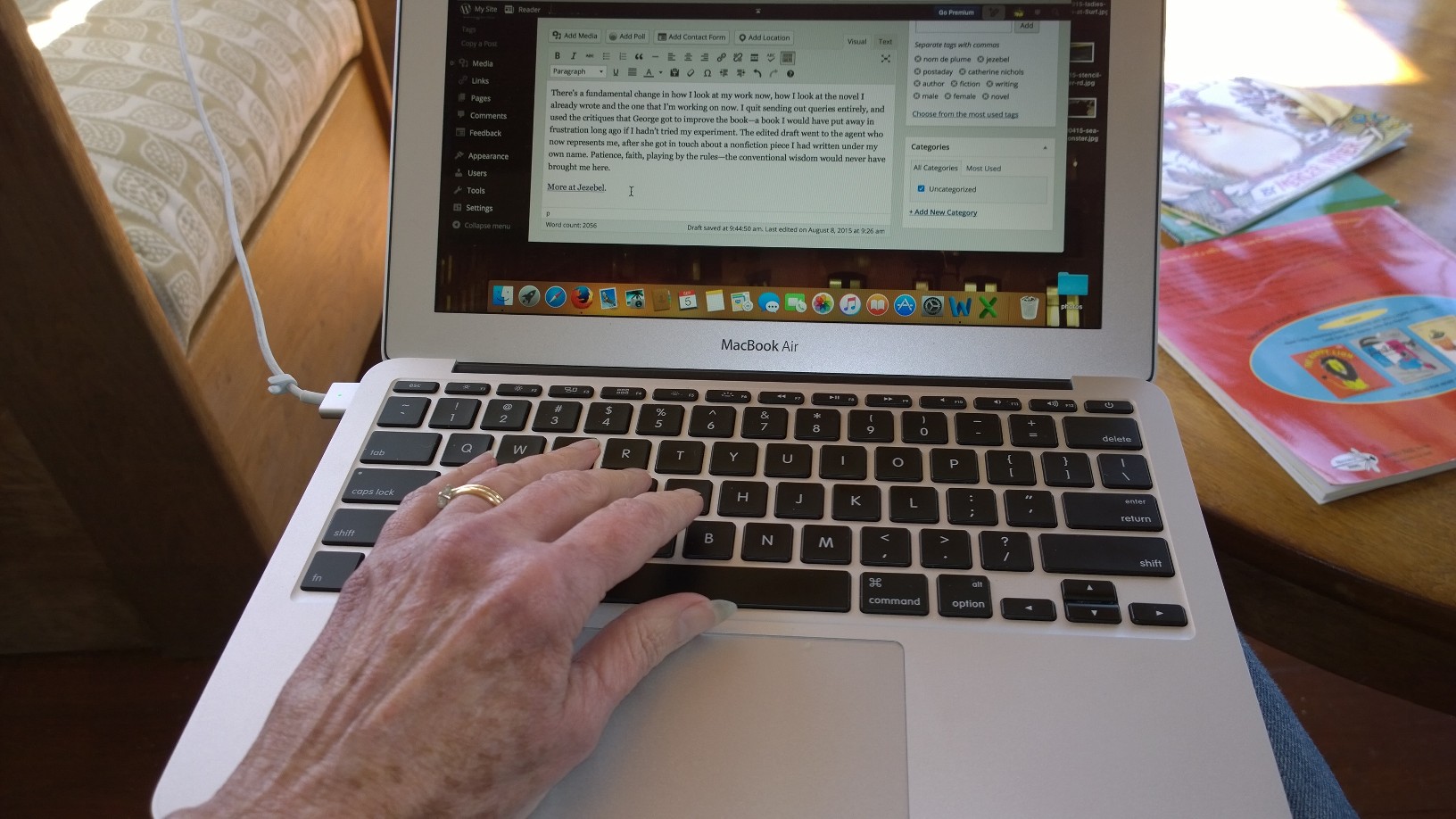
“I quit sending out queries entirely, and used the critiques that George got to improve the book — a book I would have put away in frustration long ago if I hadn’t tried my experiment. The edited draft went to the agent who now represents me, after she got in touch about a nonfiction piece I had written under my own name. Patience, faith, playing by the rules—the conventional wisdom would never have brought me here.” More at Jezebel.

Whew. Now I’m wondering if the fantastic (male) nonfiction writer ML Elrick got some rejection letters because recipients thought he was a female masquerading as a male.  Like JK Rowling. Who now writes mysteries as Robert Galbraith.

090515-typing

Read Full Post »