Feeds:
Posts
Comments

Posts Tagged ‘feminist’

Photo: Ng Han Guan/AP.
A worker arranges books in a Chengdu, China, bookstore that specializes in nüshu, a centuries-old secret script.  

As a kid I always liked the idea of communicating in mysterious ways. For a long time, my friends and I used what was called Goose Latin, which was based on English but with syllables repeated using an “f” in front. Did you ever hear of it? Something like Pig Latin.

I liked the idea of leaving messages in strange places and talking through a tin can on a string and making up a code known to maybe one other person.

So I was intrigued to read today’s report on a secret style of writing that women in China once used.

Huizhong Wu writes at the Associated Press (AP), “Chen Yulu never thought her home province of Hunan had any culture that she would be proud of, much less become an ambassador of. But these days, the 23-year-old is a self-proclaimed ambassador of nüshu, a script once known only to a small number of women in the south China.

“It started as a writing practiced in secrecy by women who were barred from formal education in Chinese. Now, young people like Chen are spreading nüshu beyond the women’s quarters of houses in Hunan’s rural Jiangyong, the county whose distinct dialect serves as the script’s verbal component.

“Today, nüshu can be found in independent bookstores across the country, subway ads, craft fair booths, tattoos, art and even everyday items like hair clips.

“Nüshu was created by women from a small village in Jiangyong, in the southern province where Mao Zedong was born, but there’s little consensus on when it originated. Scholars estimate the script is at least several centuries old, from when reading and writing were deemed male-only activities. So the women developed their own script to communicate with each other.

“The script is slight with gently curving characters, written with a diagonal slant that takes up much less space than boxy modern Chinese with its harsh angles. …

“Women lived under the control of either their parents or their husband, using nüshu, sometimes called ‘script of tears,’ in secret to record their sorrows: unhappy marriages, family conflicts, and longing for sisters and daughters who married and could not return in the restrictive society.

“[Xu Yan, 55, the author of a textbook on nüshu] is also the founder of Third Day Letter, a nüshu studio in Beijing named after a centuries-old practice by the script’s practitioners. The third-day letter is a hand-sewn book presented in farewell to a woman in Jiangyong on the third day after her marriage, when she’s allowed to visit the childhood home she left.

“The script became a unique vehicle for composing stories about women’s lives, typically in the form of seven-character line poems that are sung. A secret world sprung from the script that gave Jiangyong women a voice through which they found friends and solace. …

“Chen, who studied photography at an art school in Shanghai, said her male professors often doubted that she could keep up with the male photographers because of her slight physique. That attitude, she said, is ‘in every aspect of life, there’s nowhere it doesn’t touch.’

“She was frustrated but didn’t see much room to push back — until she learned about nüshu. ‘I felt that I had received a very strong power, and I think a lot of women need this power,’ she said.

“Chen wanted to make a documentary about feminism and came across nüshu in her online search. When she realized the script originated from Jiangyong, just a few hours from her hometown, she immediately knew that she had found her graduation project’s topic.

“The more she learned about this script, the more she learned about its duality: that it was as much a painful thing as it was a source of strength.

“In her documentary, she follows He Yanxin, a formally designated inheritor for nüshu who is now in her 80s. … He comes from Jiangyong and says she was forced to marry a man she didn’t want to be with, who physically abused her and tore up photos from nüshu meetups and workshops she attended. She did not feel that the script had made her life materially better, according to Chen’s first-person account, published on social media. Yet, He is the one who urged her to learn the script.

“Formal inheritors of the script have to be from Jiangyong, Chen said, and have to master the nüshu, but there was nothing stopping her from sharing her love of the script with others. …

“Lu Sirui, a 24-year-old working as a marketer, learned about nüshu from online feminist groups and joined Chen’s nüshu-focused WeChat group.

“ ‘At first I just knew that it was a women’s inheritance, belonged only among women,’ Lu said. ‘Then, as I got to know it better, I realized that it was a kind of resistance to traditional patriarchal power.’ “

More at AP, here.
Read Full Post »

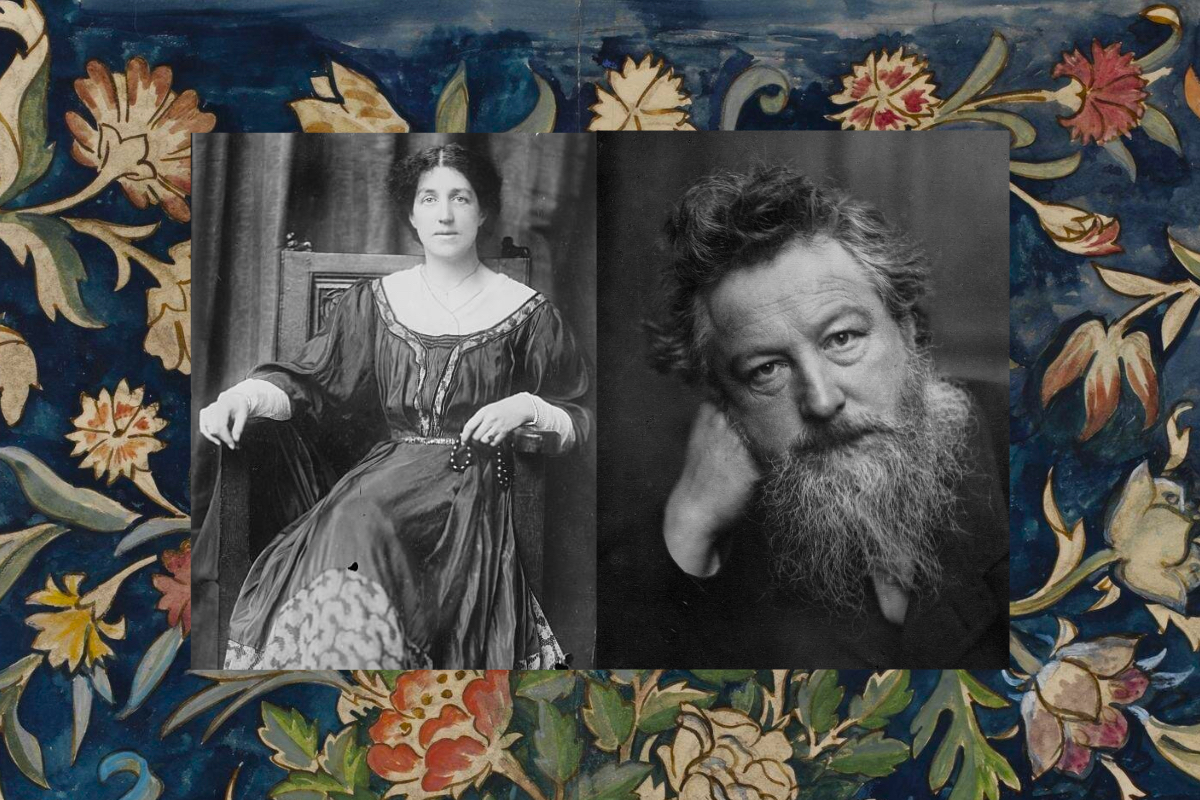
Photo collage: Isabella Segalovich/Hyperallergic, using images from Wikimedia Commons.
Detail of embroidery design by May Morris overlaid with portraits of May and her father William Morris.

Is this the year that the contributions of women get recognized in a big way? There seems to be something in the air.

In any case, today’s story draws attention to art that most of us have known about for years as the work of William Morris. Who knew that much of it was by his daughter May?

Isabella Segalovich wrote recently at Hyperallergic, “On a bright, sunny day in Victorian England, a little curly-haired May Morris gleefully handed a ball of wriggling worms to her father, William. The legendary textile and wallpaper designer smiled: He was both glad to have fresh bait for his favorite pastime of fishing and proud to see his daughter happily playing in the dirt, a freedom afforded to few girls of their social class. 

“There’s plenty to admire about artist William Morris, from his timeless ornamental wallpaper designs to his late-in-life turn to socialist politics, where he imperfectly but tirelessly fought for workers rights and against British imperialism. Less well known is that by all accounts, William was a pretty great dad, who encouraged his two daughters, Jenny and May, to grow into incredibly talented designers themselves. …

“The sisters soaked up their father’s aesthetic brilliance as they carefully observed him experiment with drawing, calligraphy, and textile dying; William even provided them with their own dying kits for messy, colorful play. May enrolled in what is today the Royal College of Art in 1878, where she studied embroidery. This was in no way preparing her for a life of a housewife with an under-appreciated textile skill. Rather, her father had been slowly training her to take over the reins at his historic company’s embroidery department at only 23 years old — a business decision typically reserved for the sons of the era, not its daughters.

“There, she began designing patterns for Morris & Co. that became mainstays of the company, some of which, unfortunately, were later misattributed to her father. She supervised a team of embroiderers as they produced all manner of textiles, from bedspreads to book covers to altar cloths. Soon, she was a leading artist of the progressive Arts and Crafts Movement.

“Before long, the two were close comrades in the small but mighty English socialist movement: May stood close on blustery London sidewalks as William became a kind of socialist street preacher. Together, they broke from the Social Democratic Federation in 1885 and took part in founding the Socialist League, where May took charge of the group’s library and became close friends with Karl Marx’s daughter, Eleanor, another one of the league’s founders. …

“Scholars have noted that William Morris was certainly a flawed crusader for women’s rights, once proclaiming that ‘it would be poor economy setting women to do men’s work’ in the same breath that he called for ‘absolute equality of condition between men and women.’ A powerful feminist, May greatly improved upon his political legacy by co-founding the Women’s Guild of Arts for the crafters who were not allowed into the Arts and Crafts Movement’s foundational Art Worker’s Guild. 

“It’s quite likely that no one knew William Morris better than May did. After his death, while caring for her older sister who struggled with epilepsy, she edited a whopping 24 volumes of her father’s writing, each with introductions so studied and lengthy that they were later published as their own two volume set. Biographer Fiona MacCarthy wrote that their relationship was ‘partly suffocating, in the intensity of its demands, but in another sense a kind of freedom … It released her latent talents and brought her into contact with ideas and activities far beyond the reach of most young women of her period and class.’ 

“Even so, May was undervalued in her time, and she knew it. ‘I’m a remarkable woman – always was,’ she wrote to playwright George Bernard Shaw in 1924. ‘Though none of you seemed to think so.’ “

Gorgeous pictures at Hyperallergic, here. No firewall. Subscriptions encouraged.

Read Full Post »

duazqv5w0aea-x9

Although I’ve always been a fan of Dickens, his abjectly self-sacrificing women could get pretty cringe-worthy at times. Which is why I wondered how the character of Madeline would be handled in the Royal Shakespeare Company dramatization of Nicholas Nickleby back in 1980.

Madeline is at the altar with a miserable old codger she is about to marry to save her invalid father from penury when her father’s remorse causes a fatal heart attack. Saved by the bell.

But what would a 20th century audience make of Madeline?

Interestingly, the actor played Madeline as a mild but strong woman who was not being forced to a desperate act by anything but her love for her father and her sense of herself and her values. She immediately stepped away when the dreadful choice was no longer necessary.

Hmm. It’s hard to describe. But I was really impressed by the actor’s ability to convey a more modern woman without changing any of the words in the Victorian novel.

Meanwhile, at this year’s Women’s March, a group of 13-year-old girls transformed the typically self-abjugating Disney princesses into 21st century feminists. That caught the attention of BuzzFeed reporter Brianna Sacks and ultimately Teen Vogue.

De Elizabeth at Teen Vogue wrote, “Huge crowds gathered in cities all over the world [January 20] for the second annual Women’s March, and among the masses of people were plenty of colorful signs and creative outfit choices.

“One group of 13-year-old girls at the Los Angeles march took their posters and their wardrobe to the next level with a Disney princess theme.

“BuzzFeed News reporter Brianna Sacks shared photos of the Disney crew on Twitter, writing: ‘These 13-year-olds took “damsels in distress” and turned it around.’

“In the pictures, you can see the six girls dressed as various princesses — including Aurora and Belle — and carrying signs with powerful messages related to the classic fairy tales.

” ‘Bright young women, sick of swimmin’,’ one sign read, in an homage to The Little Mermaid‘s Ariel. ‘I will not let it go’ was the slogan of the girl dressed as Elsa from Frozen, while Peter Pan’s Tinkerbell carried a poster saying, ‘Pixie dust won’t fix this.’

“When Sacks asked the girls why they chose to dress as these iconic characters, [Ava/Sleeping Beauty] replied: ‘We’re sick of being seen as princesses, so we made our own take on it.’ ”

I am not surprised to see Teen Vogue pick this up: the magazine has become quite a cultural phenomenon in the last year, speaking truth to power. Check out its impressive array of topics, here.

PS. Kevin’s daughter is the lovely, new-world mermaid.

Read Full Post »