Feeds:
Posts
Comments

Posts Tagged ‘finns’

Photo: Oodihelsinki.
Veera the robot on patrol at $116 million Oodi library in Helsinki, Finland. Last year, the average Finn visited libraries nine times and borrowed 15 books.
Finns really love libraries.

Whenever I write about libraries, I think of blogger Laurie and the young adult fantasy series she wrote called the Great Library Series. Laurie is someone who appreciates the power of books, the magical power of reading.

Apparently the Finns do, too.

Oliver Moody reports at the Times [of London], “In the €100 million [~$115 million] Oodi library, which looms over central Helsinki like a cruise ship from the future, robots called Tatu, Patu and Veera trundle back and forth between the shelves and the reading rooms.

“Against this backdrop, foreign visitors might be surprised to see how many children and teenagers are engaged in an almost unsettlingly archaic activity: reading and borrowing books. …

“Last year the average Finn visited them nine times and borrowed 15 books, resulting in the highest lending figures for 20 years.

“The appetite for children’s and young adults’ literature has risen to a record for the third year in a row, with a total of 38 million loans in 2024. That works out at about 40 books or other pieces of material, such as audiobooks, for each person under the age of 18. …

“Even by the standards of a country that is often ranked as the most literate on the planet, the numbers are remarkable. In Britain, the total number of loans has fallen to less than half of what it was at the turn of the millennium, despite a tentative recovery in the wake of the pandemic, and about 40 libraries a year are closing.

“Visits to German public libraries are still about a fifth lower than they were before the advent of Covid-19 and about one in five of them has shut down over the past decade.

“The most obvious explanation for the phenomenon is that Finland values its libraries and invests accordingly. The state spends about €60 [~$70] per capita on the public library system each year, approximately four times as much as the UK and six times as much as Germany.

“Where other countries rely on corporate skyscrapers or shopping centers for their visions of architectural modernity, Finland often looks to its libraries, such as Oodi and Vallila in Helsinki, the main Metso library in Tampere, or the revered 20th-century designer Alvar Aalto’s projects in Rovaniemi and Seinajoki.

“They have traditionally served as engines of social mobility and integration. Erkki Sevanen, professor of literature at the University of Eastern Finland, grew up in a working-class family in Eura, a thinly populated district of villages 110 miles to the northwest of Helsinki.

“ ‘My parents and relatives did not used to read books, but there was a fine and well-equipped public library in our home village,’ he said. ‘It opened a whole world of classical literature and philosophy for me in the 1960s and 1970s.’

“Sevanen said the public libraries were a significant part of the reason he had ultimately pursued a university career, and that today they perform a similar function for immigrants to Finland. …

“The roots of this culture predate Finland’s independence in 1918. Like large parts of Scandinavia and continental northern Europe, it was profoundly influenced by Lutheran Protestantism and its insistence that each individual should engage with the texts of scripture for themselves.

“ ‘The ability to read was a requirement for everyone who wanted to get married. To demonstrate their reading skills, people were tested at church gatherings,’ said Ulla Richardson, professor of technology-enhanced language learning at the University of Jyvaskyla.

“The movement gathered steam in the 19th century, when Finland was a semi-autonomous duchy in the Russian empire and the new public libraries were focal points for an emerging sense of national identity.

“They remain important hubs for Finnish society, providing a space in which people can be alone and together at the same time. ‘Many Finns tend to consider libraries almost as sanctuaries,’ Richardson said.

“Alongside computers and internet access, they offer board games, video games, musical instruments, sewing machines, seasonal theatre passes and even sports equipment in some cases. These services are particularly valued by families with straitened financial means, who might not otherwise be able to afford school textbooks or other media.

“ ‘The libraries are spaces that children and teens can access freely, especially if they don’t have other places to go,’ said Richardson. ‘These days we also have self-service libraries open when there are no personnel working.’ ” More at the Times, here.

The point about libraries helping immigrants acclimate reminds me that when I was still volunteering onsite instead of online (before Covid), we would take classes of immigrants to the nearest public library in Providence and explain how to get a library card.
Read Full Post »

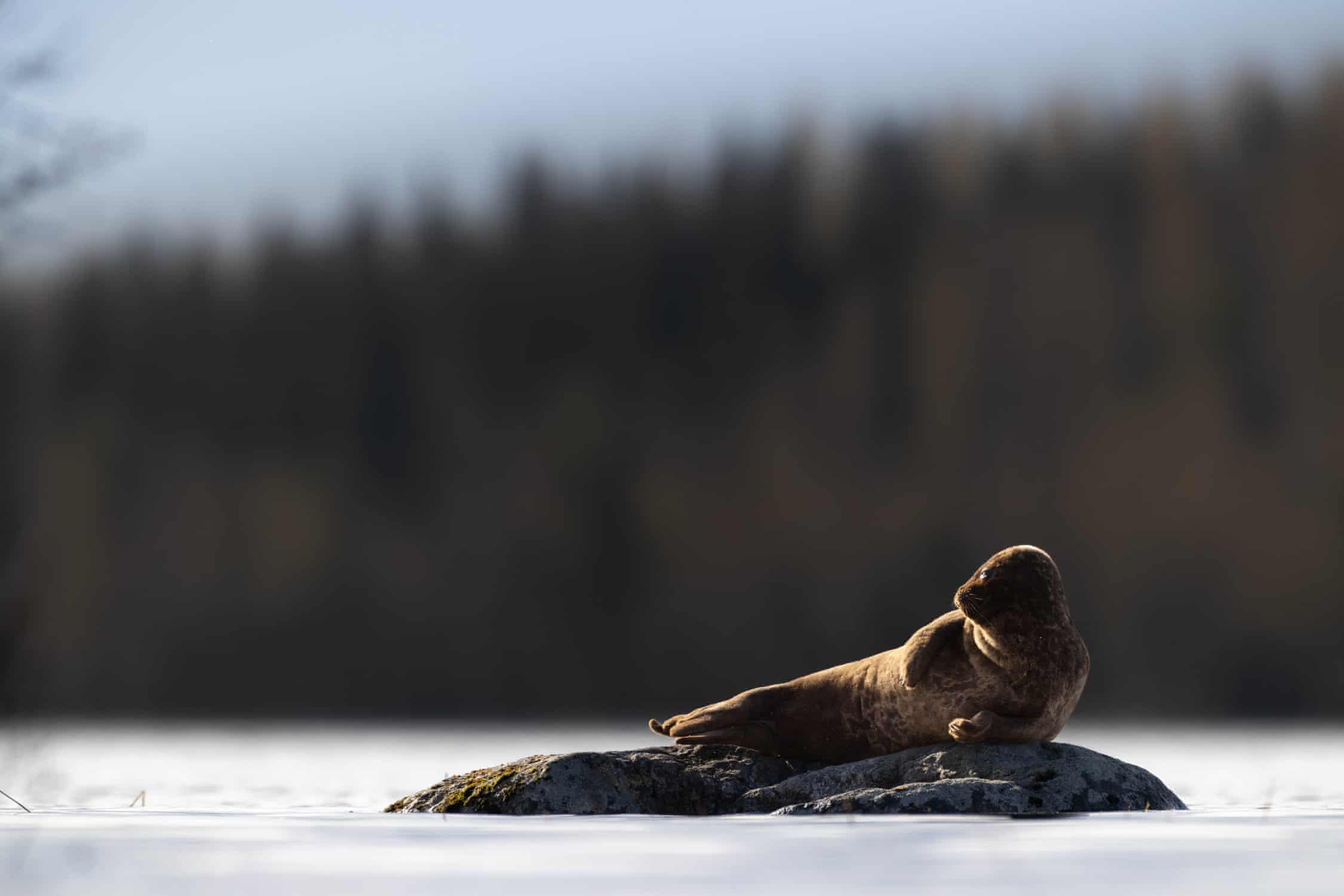
Photo: Samuel Bloch.
Saimaa ringed seals are very sensitive to disturbance, and it is forbidden to deliberately approach them without a permit.

I once wrote here about one of John’s a Ukrainian employees who told me that in Soviet days it was dangerous to read certain books. People read The Master and Margarita, for example, under the library table with a flashlight if no one was around.

I don’t think we are there yet, but I do have a sense that a whole segment of our society will be living an alternate life and trying not to draw attention. That might include people who care about wildlife and global warming, like the Finns in today’s story.

Phoebe Weston writes at the Guardian, “Eight hours shoveling snow in -20C [-4 F] might not sound like the ideal day out, but a committed team of volunteers in Finland are working dawn to dusk building enormous snow drifts for one of the world’s most endangered seals.

“The Saimaa ringed seal was once common around Lake Saimaa in the south-east of the country, but only 495 of them remain.

“The seals make ‘snow caves’ inside snow drifts where they raise their young and protect them from the elements and predators such as red foxes – but as the climate warms, the snow is disappearing. To save these rare seals, 300 volunteers spend days shoveling snow into piles [23 feet long] around the edge of the frozen lake. Last winter they made 200, and the seal population is growing as a result. …

Volunteers meet at first light and work until dusk. [Vincent Biard, a PhD student and volunteer from the University of Eastern Finland] describes the day as ‘kind of fun,’ and adds, ‘you actually have an impact, which is nice. If we don’t do it, then they would just go extinct quite quickly.’ …

“Saimaa seals are less than 1.5 metres long and each one has a unique fur pattern – individual to each animal, like human fingerprints. In the late 1980s their population dwindled to its lowest point, with fewer than 200 left, driven by hunting and deaths caused by fish traps. Accidental deaths in fishing nets remain a challenge.

“Now, the seals are fully protected but the threat of the climate emergency looms large. Between 1925 and 2002, the maximum thickness of the ice decreased by 1.5cm [~i/2 inch] a decade. In mild winters the ice caves can collapse, leaving the pups exposed, with up to 30% of them dying.

“Human-made snow drifts are larger and ‘more durable than natural snow drifts,’ says [Jari Ilmonen, coordinator of Our Saimaa Seal Life, which is an EU-funded program]. …

In the future, ice cover is expected to disappear before the pupping season has ended.

“There have already been some winters where there has not been enough snow to create an artificial drift. In some cases the seals have been known to breed elsewhere, but with no snow ‘just a few would hang on,’ says Ilmonen.

“However, scientists from the University of Eastern Finland are working on plan B. They are creating artificial dens, or nest boxes, that mimic the real thing, with preliminary research showing the seals use them for resting, giving birth and nursing their young. The nest boxes could be used in ice-free winters, researchers say. …

“There are about 40 dens on the lake, where three pups have already been born, but Ilmonen wants to get more out there. ‘If you think that there are maybe 500 seals and maybe 100 pups born each year, you’d need a lot of the boxes,’ he says.

Find more of the Guardian’s age of extinction coverage here, and follow the biodiversity reporters Phoebe Weston and Patrick Greenfield in the Guardian app for more nature coverage.

More at the Guardian, here. No firewall, but voluntary subscriptions support responsible news.

Read Full Post »

Trust those Finns to come up with a crazy idea that really works.

Timon Singh writes at Inhabitat.com about a team of Finnish researchers from Aalto University and their electricity-free computer powered by water droplets.

Singh writes that the researchers “developed a new concept for computing that doesn’t require standard electric power. Instead, the team creates collisions of water droplets on a highly water-repellent (superhydrophobic) surface. The research, which was published in the journal Advanced Materials, could form the basis for tomorrow’s electricity-free computing devices.

“After a series of experiments, the team determined that the ideal conditions for rebounding water droplets on superhydrophobic surfaces required a copper surface coated with silver and chemically modified with a fluorinated compound. This allowed the surface to be so h2o repellent that water droplets rolled off when the surface was tilted slightly. Using superhydrophobic tracks, the droplets were able to be guided along designed paths.

“Using this method, the researchers demonstrated that water droplets could be used to demonstrate ‘superhydrophobic droplet logic.’ In the university’s press release, the team used the example of a memory device that was built where water droplets act as bits of digital information.”

If you aren’t deterred by the technical language, read more here.

Now I just need to know if the earth has enough water to make this green technology for computing a reality. We have an awful lot of computers.

Photo: Inhabitat.com

Read Full Post »

When you consider all the minority languages that are endangered today — many of which I’ve blogged about (for example, here) — it seems a bit perverse to be bringing back Latin on the radio. But as one more way to interest people in languages, how bad can it be?

For the Finns, who have to speak many languages because hardly anyone speaks theirs, it’s just one more.

As John Tagliabue wrote in yesterday’s New York Times, the Internet has given a boost to “a weekly summary of world events and news broadcast by Finnish state radio — not in Finnish, but in classical Latin. …

“In recent weeks, the subjects have included the financial crisis in Cyprus, an unusually brilliant aurora borealis and the election of Pope Francis. …

“It may be no coincidence that the broadcast began in 1989, the year Communism collapsed in Eastern Europe and the Finns turned toward Western Europe. For educated Finns, Latin had long been the country’s link to Western culture, and they were required to study the language in school. …

“While the broadcasts once went out over the airwaves, with shortwave reception for listeners outside Finland, more and more listeners tune in to the program’s Web site, through podcasts and MP3 downloads.” More.

Image: Wikipedia
Cicero Denounces Catiline, fresco by Cesare Maccari, 1882–1888. It’s what Suzanne’s Mom thinks of when she thinks “Latin.”

Read Full Post »