Feeds:
Posts
Comments

Posts Tagged ‘first nations’

Photo: Kat Baulu/Wikipedia.
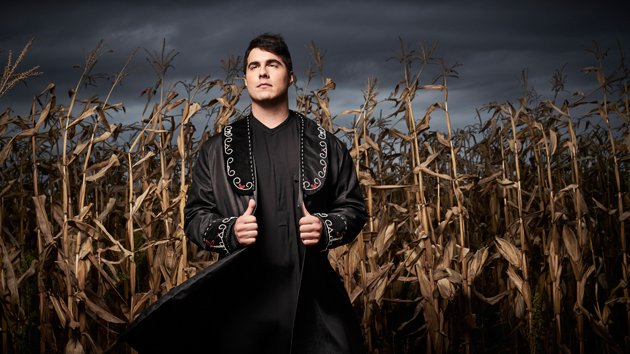
Alanis Obomsawin in photo of the crew of Canadian film
Waseteg, 2010.

What caught my attention in one story about Alanis Obomsawin was that when an instagrammer I follow went to a dinner with the filmmaker, the 91-year-old prepared the food herself. That is, she’s still going strong.

CBC Radio interviewed Alanis Obomsawin not long ago in an episode produced by Nicola Luksic.

“At the age of 91, prolific Abenaki artist and filmmaker Alanis Obomsawin is not slowing down. For nearly 70 years, her storytelling and documentary work has served as a mirror for Canada, vividly capturing and reflecting Indigenous experiences, providing a space for all Canadians to witness perspectives that have otherwise been suppressed and ignored.

“Obomsawin talks about her life’s influences and the quiet power of listening in her 2023 Beatty Lecture at McGill University.

” ‘I continue making documentaries. In those days, everything was so full of pain and danger. It was hard for our people to imagine change,’ she told an audience at Pollack Hall on McGill’s downtown campus. ‘My dear brothers and sisters, we are all born with a gift. And to each one of you. Your life is sacred. You must change the perspective from limitations to all is possible. Slowly change came.’ …

“Making documentaries was a way to provide a space for Indigenous experiences that would otherwise go unseen and unheard, nurturing better Indigenous and settler relations. …

“After her Beatty Lecture, the legendary documentary filmmaker and artist spoke to IDEAS host Nahlah Ayed. …

Nahlah Ayed
“You said that you see this as a moment when all is possible. Can you speak a bit more about you know, you’ve seen a lot of change in the relationship between the Indigenous people of this country and the settlers on this land? 

Alanis Obomsawin
“I think that it didn’t happen overnight. It’s been very bad for many generations. And part of that is why I’m still here, because I really believe what is possible. But the extraordinary thing, like let’s say even 10 years ago, I could not have talked the way I do now.

“For instance, if you’re in conversation with anybody from anywhere, if you mentioned the word treaty, the reaction I know with me was all, ‘Oh, that doesn’t even exist anymore. No, there’s no treaty.’ And it really annoyed me. Something awful. But I made a film called Trick or Treaty. That tells you a lot. And since then, it is very much used at all levels. …

Ayed
“What’s changed? 

Obomsawin
“I think the educational system has changed. For many generations, the books that were used in places were called The History of Canada, written by the brothers of the Catholic Church, which was pretty ugly, full of lies and designed to create hate towards our people. I was getting beat up all the time as a child. When I figured it out, I thought if the children could hear a different story, they wouldn’t be like that. They’re not born racists. And that’s when I started singing and it took quite a while to get to that point. But telling stories to children. I’ve done hundreds of schools over the years, and I still do whenever I can. …

“I can say that now I can see Canada is at the front for a lot of things concerning education. So then this is a big change. And I don’t want anybody who is making the changes to get discouraged. I want to praise them because I see the difference. And I think I’m lucky to have lived this long to see the difference. …

Ayed
“What do you look forward to as evidence of a genuine attempt at truth and reconciliation in Canada?

Obomsawin
“Well, you’re not going to believe me, but it’s happening. I don’t know what exactly it will come to. And I never thought that, for instance, I could be part of a group with the government that we criticize and you know, they’re listening. We have some of our own people who are working there [in government]. There are the possibilities and the strength is there. I’m not saying it’s going to happen tomorrow, but we work on it.” More at CBC Radio, here.

This post about Obomsawin was inspired by Eve Respini (Curator_on_the_Run), who wrote at Instagram: “Honored to be invited to dinner at home with 91 year old legend, film-maker, singer and activist #alanisobomsawin. She cooked us (colleague @sirishr and I) a wonderful meal, serenaded us with songs and stories, and reminded us to cherish the sweet moments in life. Merci Alanis.”
Read Full Post »

Photo: Melanie Stetson Freeman/CSM Staff
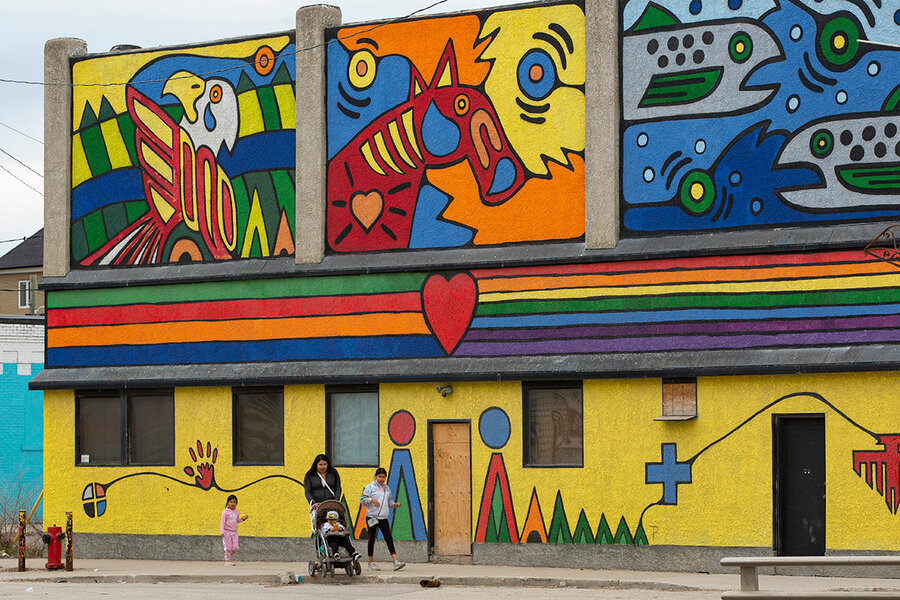
An Indigenous mural fills the front of a building in the North End of Winnipeg, Manitoba, on May 11, 2022.
First Nations in Winnipeg are rethinking their history with the powerful Hudson Bay Company, says the Christian Science Monitor.

It may take a long time, but it’s possible for wrongs to be righted. At least a bit.

Sara Miller Llana reports at the Christian Science Monitor on how the indigenous people of Winnipeg, Canada, are moving toward a new future as they rethink their history with the exploitive Hudson Bay Company and the fur trade.

“After the Hudson’s Bay Co. department store shuttered its hulking, 650,000-plus-square-foot building in downtown Winnipeg in 2020,” she writes, “Peatr Thomas was asked to replicate one of his murals in the empty windows.

“The Inninew and Anishnaabe artist at first hesitated. If any entity casts a colonial shadow in Canada, it is the Hudson’s Bay Co.

“Established in 1670 by the king of England, the HBC existed for centuries as a fur trading enterprise that upended the lives of First Nations as it aggressively expanded into what would later become Canada. Mr. Thomas didn’t want to be affiliated.

“At the same time, the flagship store in Winnipeg looms large — physically and in historical relevance. Mr. Thomas saw an opportunity to share his vision of a ‘new future,’ he says, ‘built on truth.’

“Today his vibrant mural, ‘Aski Pimachi Iwew,’ reflects back the story of the earth’s renewal. Animals painted in black, upon a red background representing dawn, depict the seven ancestor teachings of ‘Turtle Island,’ what many Indigenous people call North America: love, wisdom, respect, courage, honesty, humility, and truth. …

“His mural would be a taste of what’s to come to downtown Winnipeg. Since April, colorful flags and banners have enlivened the building’s drab neoclassical facade, installed by the Southern Chiefs’ Organization (SCO), which represents 34 First Nations groups in southern Manitoba.

“This spring HBC, now a holding company that owns businesses and investments including Saks Fifth Avenue, transferred the building to the SCO. The Indigenous leaders plan to turn it into a multifaceted facility centered around low-income housing for the urban Indigenous community, as well as restaurants, pop-up stores, and space for artists. It will also become the new seat of SCO governance.

“At a time when Canada says that Reconciliation with Indigenous peoples is a driving goal at the highest levels of government, the transfer of a colonial icon to Indigenous leaders resonates with symbolism. …

“ ‘I think it was important for us to let it be known that this is the change that’s coming,’ says Jerry Daniels, the grand chief of the SCO, whose offices are currently based on the industrial outskirts of Winnipeg near the airport. ‘This is what Reconciliation is.’ …

“HBC is Canada’s oldest company. It was chartered in 1670 by King Charles II, after two fur traders convinced him that a base on the shores of the Hudson Bay would provide direct access to the beaver pelts so popular in Europe at the time.

“HBC would come to rule over trapping grounds that represent a third of Canada today. And in its pursuit it would drive settlement across the continent, acting as a de facto government and disrupting communities that had been self-sustaining with their own sophisticated trade networks and diplomatic ties to one another. …

“In an elaborate ceremony, Grand Chief Daniels, in a beaded headdress, transferred two beaver pelts and two elk hides, the traditional ‘rent’ under the original charter, to the governor of HBC, New York business executive Richard Baker.

“Sophia Smoke was invited there as the oral historian. She’s an eloquent 14-year-old from Dakota Plains Wahpeton First Nation in Manitoba. … She addressed the crowd in the Dakota language, which her grandmother taught her, before continuing in English. ‘Today there is no mistaking, we are changing the course of history for good,’ she told the crowd. …

“Today, Winnipeg counts the largest urban Indigenous population in Canada with over 92,000 (in a population of 750,000). It has led to a vibrant Indigenous social and cultural scene that is increasingly present on the cityscape. But the economic reality of Indigenous peoples, dispossessed from their lands, also comes into stark view here.

“According to the latest census figures, 31% of Indigenous people in Winnipeg live below the low-income threshold, compared with 13% of the non-Indigenous population. Homelessness is a major problem for the city, and 66% of those in emergency shelters, transitional housing, and safe spaces identify as Indigenous. Child poverty is the highest of any province. …

“Mr. Daniels, from Long Plain First Nation, says he experienced much turbulence growing up, part of the child welfare system for a while. He says providing stable housing will have a ripple effect on the community that’s suffered poverty and intergenerational trauma, especially from the residential schooling system.

“ ‘Families are built on the stability of their grandparents and their great-grandparents who were able to provide the knowledge and the love and support to engage in different areas,’ he says. ‘We didn’t have that opportunity.’ …

“Wehwehneh Bahgahkinahgohn is meant to be a vibrant hub, with two restaurants and community space. It will showcase Indigenous art and culture and include a museum that tells the role that Indigenous people played in the founding of HBC from their perspective.

“The building reinforces a transformation already underway in Winnipeg. There is Qaumajuq, billed as the largest Inuit art center in the world, that opened last year. There is the Canadian Museum for Human Rights, which dedicates a significant portion of its permanent display to the truth about Canada’s violent assimilationist policies. Indigenous murals, sculpture, and gardens color the cityscape. …

“The new project could become a model for other Canadian cities and landmarks, says Lloyd Axworthy, a former Canadian foreign minister and former president of the University of Winnipeg who is an adviser on this project. … ‘This project dispels the idea of Native people being dependent on welfare and all those kinds of stereotypes. No, they are entrepreneurs, they are activists doing important things, and they can manage a big project.’

“Stephen Bown, author of the book The Company, which tells the story of the first 200 years of HBC, says the Winnipeg project in some ways takes history full circle. ‘The amount of Indigenous involvement in that business often goes unrecognized,’ he says.

“While run from London, HBC on the ground depended on the knowledge, savvy, and goodwill of the Indigenous inhabitants. ‘That began right from the very, very beginning. … The symbolic significance could be that the company is returning maybe in one sense to its roots as an Indigenous-run thing.’ ”

More at the Monitor, here. No firewall.

Read Full Post »

Photo: Chelsey Geralda Armstrong.
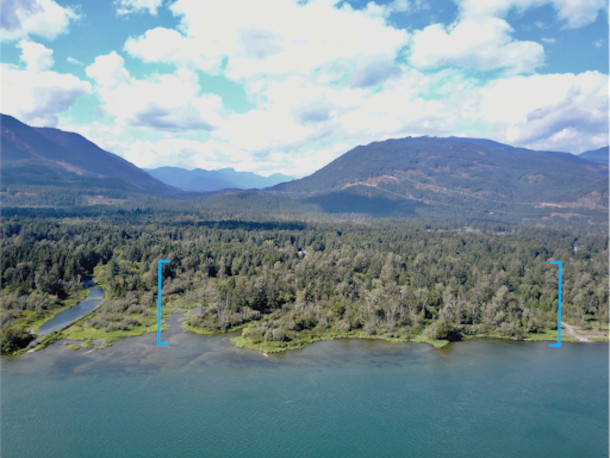
An aerial shot of the Sts’ailes forest garden. These forests demonstrate the way that First Nations people in the Pacific Northwest have actively managed natural ecosystems to increase the accessibility of preferred food near their homes.

Today’s story is about how indigenous people in Canada have created “forest gardens” to be able to harvest the traditional food the tribes value.

From the radio show Living on Earth:

“BOBBY BASCOMB: British Columbia is home to lush forests that cover almost two-thirds of the Canadian province. And for some ten thousand years, First Nations peoples made the forests their home. The trees provided much of what the people needed to survive and thrive. After asking permission of towering cedars, Coast Salish and other peoples would harvest bark for weaving and wood to carve canoes and totem poles. But they also carved out special gardens in the forest to grow food and medicinal plants. And new research shows that these forest gardens are still home to abundant biodiversity. …

“DR. CHELSEY GERALDA ARMSTRONG: We live in the Pacific Northwest where you have very contiguous conifer dominant forests … cedar and spruce and hemlock and firs. [But the forest gardens are] broadleaf forests, which are very rare here … maple and birch and then sub canopies of hazelnut and crabapple, all deciduous species. One of the big things that kind of sticks out when you’re in these places is at the right time of year, it’s just like a fruit paradise. There’s so many fruits going, kind of around late August, early September. It is an edible forest without question, and also a lot of medicinal species as well in that understory, things like wild ginger. …

“BASCOMB: And these were gardens cultivated by the Indigenous people that lived there, how did they create them? It sounds like they must have had to travel quite far to bring these different species together in one spot. …

“ARMSTRONG: We don’t know exactly how they were started, or when, how old they are, although we are getting closer to some dates. … Hazelnut, for example, [is] a native species to British Columbia, but it’s found far outside its range in certain forest gardens. But also, people were managing for succession. These types of forest management practices are basically utilizing and capitalizing on natural ecosystem processes. So things like wild raspberries, black huckleberries, Alaska blueberry, oval-leaf blueberry, all these kinds of plants that grow in forest gardens are locally available. And so it’s just about letting those things come back, keeping the competitors out, and then enhancing them with new species. …

“ARMSTRONG: Comparing forest gardens with the surrounding conifer forests, or what we refer to as peripheral forest, it was very clear that overall, forest gardens [were] a lot more biodiverse. … So you can imagine that, in fact, the edge between these two ecosystems are incredibly productive areas.

“BASCOMB: Well, that totally makes sense. I mean, you would expect more biodiversity in an area with, say, maybe a field, next to a forest, with a river running through it. If you have several different ecosystems all in one spot. ….

“ARMSTRONG: We found that forest gardens have a higher frequency of animal-dispersed and animal-pollinated species. So what this means is that forest gardens are the result of animal movement. And of course, humans are included in that category. But on top of that, what this suggests is that after humans left these gardens and villages, in some cases a couple hundred years ago, forest gardens began providing really unique habitat for animals and pollinators seeking food. So what we see here is an example of human land use that actually provides and increases functions across the landscape, rather than depleting it. …

“BASCOMB: Can you tell me about the First Nations people that lived in this area and created these gardens? …

“ARMSTRONG: I worked with two communities, Kitsumkalum, and Kitselas. And, you know, the archaeological record of people living in this area is very, very rich. People have been here for, you know, 10,000 plus years. And for Kitselas, we know that [families] have been in the same canyon area for at least 7,000 years. [But] people were forcibly removed from their communities. A lot of times they moved to the coast to work in canneries, which were, you know, kind of slave-like conditions for people. But they returned, a lot of them, to their communities in the ’50s and ’60s. …

“There are elders in Kitselas that always say, ‘Old villages are really good places to hunt,’ … But basically, these places have not been maintained for, you know, 200 years. … A huge part of our research is actually employing different management strategies, clearing the forest garden areas and getting them back to a place where they can be producing lots of food for people locally.

“BASCOMB: And what did you learn about these forest gardens from the First Nation elders that you spoke with? …

“ARMSTRONG: The elders had pointed me in [the direction of hazelnuts, which I was studying], saying, well, it’s not just hazelnut. [It’s] Pacific crabapple, it’s Saskatoon berries, it’s soapberries. And so, you know, they’re the ones that were leading a lot of this inquiry. And of course, we know from them all the different ethno-botanical uses of plants. … A lot of our research is kind of being led by them and the questions that they have about these places that we can answer.

“BASCOMB: Chelsey Armstrong directs the Historical and Ethnoecological Research, or HER, Lab at Simon Fraser University.”

More at Living on Earth, here.

Read Full Post »

5472

Photo: Daniel Boud
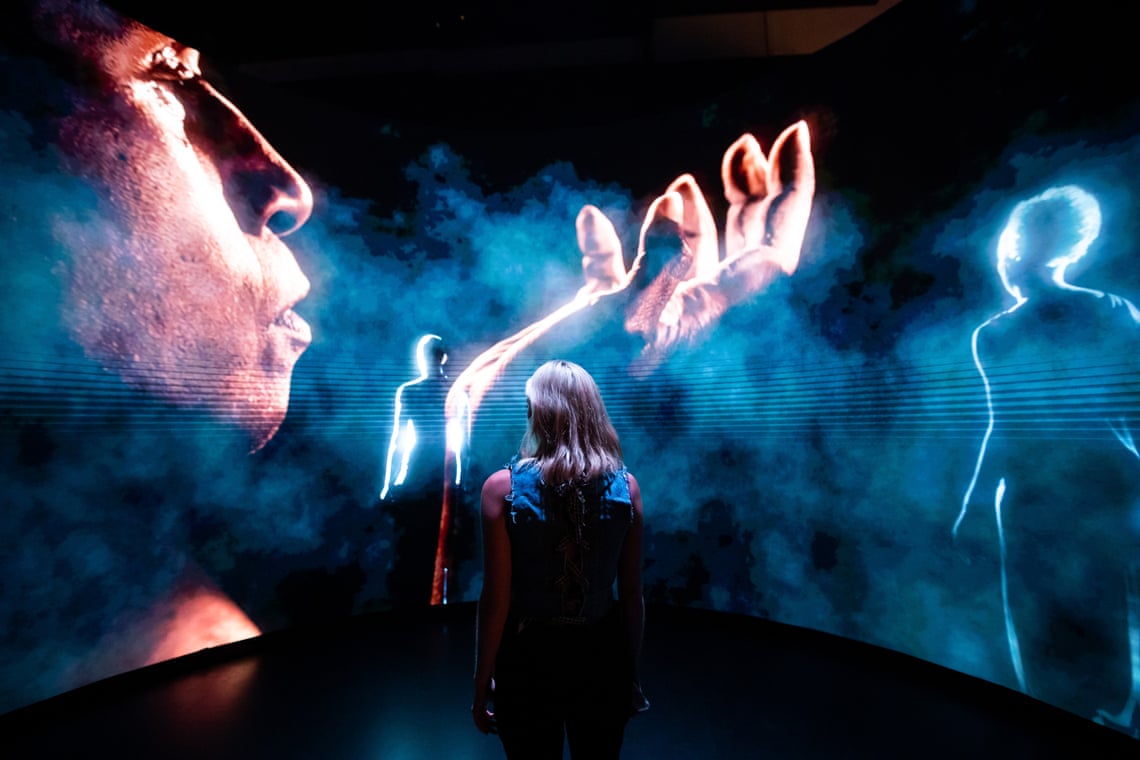
“It’s in our Indigenous DNA to use oral stories … to carry culture,” says Stephen Page of Bangarra, a dance company in Australia.

When the new has practically obliterated the old, it’s not a bad idea to co-opt the new and use it for your own purposes. That’s what some indigenous people in Australia are doing as they test the possibilities of virtual reality for passing along oral traditions.

As Clarissa Sebag-Montefiore writes at the Guardian, “When Brett Leavy recently showcased his digital renditions of pre-colonial landscapes in Australia, one Aboriginal man in the audience started to cry.

“ ‘I get tears [from the Indigenous audience] because they feel a sense of loss. … And then there’s also anger,’ he says. Leavy is a Kooma man and founder of Brisbane-based Virtual Songlines: a First Nations interactive design agency whose output ranges from video games to virtual reality.

‘I’m doing this in a fun way – it’s a bit gamefied – but the question I’m asking is: who are the sovereign custodians of the land?’

“For millennia, Indigenous Australian communities have been passing down histories, knowledge, language and customs, largely through oral storytelling. But in a world of digital addiction, where even the most remote parts of the country are being infiltrated by smartphones, telling stories via screens is the new necessary: a way to both preserve tradition and reach out to the young. …

“ ‘There is massive intellectual capital in our community. There is this whole untapped resource,’ Mikaela Jade, founder of the Indigenous augmented reality app Indigital Storytelling, said at a talk in Sydney in 2017. ‘Don’t wait for it to be built and then be given it to us.’

“Stephen Page, creative director of Indigenous dance company Bangarra, is taking this idea seriously. [To] celebrate its 30th anniversary, Bangarra [opened] a free immersive installation, Knowledge Ground: 30 Years of Sixty-Five Thousand [and launched] the company’s new digital archive site of the same name, which contains interviews, photographs, videos and essays about Bangarra’s productions and processes. …

“Of course simply putting content up online – or placing it on a screen in an art show – does not mean it will automatically make an impact, or find an audience.

“Torres Strait Islander filmmaker John Harvey, 44, sees this harsh truth every day at home on the Sunshine Coast with his two children, aged four and 13. Kids, he sighs, are brutally honest. If online content doesn’t ‘feel authentic to them in a way that they can relate to, they will stop straight away. It doesn’t matter if it’s been made by an Indigenous person or not – they will just stop.’

“Harvey is in the process of creating a work for the new permanent exhibition at ACMI [Austrailian Centre for the Moving Image], which opens in Melbourne in May 2020. Inspiration came from seeing the first-ever footage of Indigenous people in Australia: a four-and-a-half minute sequence shot by British zoologist AC Haddon during a Cambridge University expedition to the Torres Strait in 1898. Locals were portrayed as anthropological subjects.

“In his artwork, Harvey wants to counteract this by filming intimate moments at home. Rather than white rich outsiders holding the camera, he’s using his own phone to capture his own people as he sees them, from the inside. It is, as he says, about ‘democratisation of stories and storytelling.’ …

“Virtual reality was not an obvious tool to tell the story. But many of the senior women observed young people ‘increasingly engaging with screens and technology, and so wanted to capture their attention and interest,’ [Angela Lynch, manager of the Ngangkari program at NPY [Ngaanyatjarra, Pitjantjatjara and Yankunytjatjara] Women’s Council] says. ‘They strongly believe that traditional culture and Anangu law holds the answers to the issues and problems of contemporary life in remote communities.’ ”

More here. PS. Please look at the wonderful photoat the NPY Women’s Council Page. It’s protected, and I can’t copy it for you. Made me smile.

Read Full Post »

1jeremydutcherheader

Photo: Matt Barnes
Jeremy Dutcher is a First Nations tenor and pianist who is getting a lot of attention in Canada and beyond.

Bit by bit we’re all learning more about the people around us, people who may have very different lives and who in the past we knew nothing about. Even those we thought we knew well sometimes have lives that are veiled to us, as I learned this summer when our niece sent me her story, a heartbreaking tale of a childhood that I had only perceived on the surface. You just can’t know what is going on behind someone’s eyes.

Among the kinds of people I am learning more about are indigenous people, both in the United States and elsewhere. This story is about a young tenor who belongs to a Canadian tribe.

Jeff Kaliss writes at San Francisco Classical Voice, “Interviews with Jeremy Dutcher figure among the new demands on a Canadian First Nations (indigenous) singer-pianist who’s risen rapidly to international attention. The 28-year-old Toronto resident needs now and then to take a break from the clamor, to return to something like the pastoral pace of his raising in the Maritime province of New Brunswick, as a member of the Wolastoqiyik [pronounced Wuh-last-o-key-yik] tribe.

“I first witnessed Dutcher a year ago, at the Festival International de Jazz de Montréal, performing on piano and singing in his tribe’s native Wolastoq language (the word denotes ‘the beautiful river’; renamed by the colonizers of New Brunswick as the St. John), in the basement of a church, a beautiful historical landmark. He hadn’t yet won Canada’s prestigious Polaris Prize, nor its Grammy-equivalent Juno Awards. Both of these wins would recognize his debut self-produced album, Wolastoqiyik Lintuwakonawa, translated as Songs of the People of the Beautiful River. …

“Dutcher incorporates in his live and recorded music an unusual and affecting act of legacy, playing transcribed wax recordings from 1911 by an early anthropologist of a tribal elder singing and speaking, and following the melodies with his own heldentenor voice and mellifluous keyboard compositions. The method and quality of his approach derive from his training, including classical voice with Marcia Swanston at Dalhousie University in Halifax, Nova Scotia.

“Two semesters before completing his music degree, Dutcher enrolled in a class in Social Anthropology, and decided to stick around Dalhousie for an additional year, completing a second major and an honors thesis on the subject of Traditional Music in a Contemporary Moment: Musical Pan-Indigeneity as Revitalization in the Wabanaki Region. The region is a confederacy of five indigenous nations including the Wolastoq and extending across the current provinces of New Brunswick, Nova Scotia, Prince Edward Island, and Quebec, and the state of Maine. The thesis title took the form of a mission statement for Dutcher, who was led to the wax recordings by a living tribal elder, sweat lodge keeper, and First Nations ambassador, Maggie Paul.

“ ‘I made my way to Ottawa [the site of the Canadian Museum of History] and went down into the basement archives there and threw on some headphones and started a journey,’ Dutcher recalled for an NPR presentation last year.

“ ‘To not just hear the songs, but also to hear the background noise and to hear them laughing and telling jokes — there was a sense of entering into that space through these voices. And that was something that changed my life.’

“The Dalhousie anthropology faculty have declared in writing their admiration for where their alumnus has taken his education and his life. … ‘Dutcher honors intergenerational connections, his voice singing on with the voices of his elders … It disrupts widespread expectations of indigenous music as a thing of the past, and shows instead how it lives in the present, fully capable of working and remixing in contemporary idioms. This has a decolonizing effect, in that it unsettles public conceptions that all too often primordialize and essentialize indigenous art forms.’ ”

I love the idea of a decolonizing effect. I never thought about that — about not only promoting healthier relations between indigenous people and others going forward but actually starting to undo harm that was done in the past. How great if we could apply that idea to all kinds of wrongs the world has seen!

More at San Francisco Classical Voice, here.

Read Full Post »

The radio show Living on Earth recently reported how negotiations among environmental activists, the timber industry, indigenous people, and the British Columbia government protected 85 percent of a huge Canadian forest.

“Eighty-five percent of the Great Bear Rainforest in British Columbia is now protected … Steve Curwood discusses [the compromise] with reporter Andrew MacLeod of the magazine The Tyee, who explains what’s been protected and what’s open for logging.

MACLEOD: “It’s an area of 6.5 million hectares between the top end of Vancouver Island and the Alaska Panhandle. So it’s an area, about the size of Ireland, and it’s quite remote. There are only about 1,400 people who live there. So much of it has never been logged. This is usually described as the largest intact temperate rainforest in the world, a very lush, mossy, moist year-round ecosystem. … We’re talking trees that five or six people put their arms around. Some of these cedars can be in 20 feet in diameter …

CURWOOD: “Tell me what is the [forest’s] Spirit bear?

MCLEOD: “They are a subspecies of black bear. They are a genetic variant that comes out white, so it’s a white black bear. There are also Grizzly bears there, there are whales, wolves, and just a relatively pristine ecosystem up there.

CURWOOD: “And who calls them Spirit bears? …

MACLEOD: “My understanding is that it goes back through the First Nations, there have always been these genetic variant bears there and they’re seen as special.”

When Curwood asks why the timber industry agreed to the negotiation, MacLeod explains that the campaign to protect the forest helped to avoid extended confrontation.

“Lots of First Nations people will tell you they’ve been on the land for thousands and thousands and thousands of years and it’s been sustainable, it’s been healthy, that it’s really only last 150 years of colonialism where you’ve seen clear-cuts and destruction and species driven to extinction. On the other hand, there are lots of people from First Nations who are working in the logging industry today as well. Over time, First Nations have sort of reestablished their rights. There have been some precedent-setting cases just in the last few years that have recognized aboriginal title does exist.” More here.

Of possible interest: Read how Wabanaki diplomacy smoothed a similar negotiation process in Maine, here.

Photo:  Elsen Poulsen/Animals Asia, Flickr CC BY-NC 2.0
A white Spirit bear fishing

Read Full Post »